Report1 pages
Raport Bieżący Nr 14/2025: Wstrzymanie prac deweloperskich nad projektem Gemini
PCF Group S.A. has officially suspended development work on Project Gemini, a title previously produced under a work-for-hire agreement with Square Enix Limited. This decision, effective June 1, 2025, follows the expiration of the existing content rider and the absence of a subsequent agreement to cover future production milestones. The cessation of operations stems from a lack of communication from the publisher regarding the project's status, creating significant uncertainty surrounding the publisher's intent to finalize the game.
The scope of this development halt covers the European operations of the PCF Group, specifically impacting the contractual relationship established under the original production and publishing agreement. Given the publisher's failure to provide terms for continued development or clear guidance on the project's future, the management board currently views the prospect of ongoing collaboration on Project Gemini as highly doubtful.
This strategic shift marks a definitive pause in the studio's involvement with the project as of mid-2025. The company has indicated that it will provide further updates as the situation evolves and more information regarding the status of the collaboration becomes available. The decision reflects the inherent risks associated with work-for-hire models when contractual renewals and publisher alignment are not secured in a timely manner.
- PCF Group S.A. officially suspended all development work on Project Gemini effective June 1, 2025.
- The suspension follows the expiration of the content rider with Square Enix Limited and the absence of a subsequent agreement for future production milestones.
- PCF Group halted operations due to a lack of communication from Square Enix regarding the project's status and intent to finalize the game.
- The management board of PCF Group currently considers the prospect of continuing collaboration with Square Enix on Project Gemini to be highly doubtful.
- The development halt specifically impacts PCF Group’s European operations and the contractual relationship established under the original production and publishing agreement.
+1
PCF Group
Report1 pages
Raport Bieżący Nr 16/2025: Podjęcie decyzji o zawieszeniu dalszych prac nad projektem Bifrost
PCF Group S.A. has officially suspended all development work on the self-published project Bifrost. This strategic decision follows a series of recent organizational adjustments, including the prior reduction of the project’s development team and the impairment of associated assets. The move marks a significant shift in the company’s operational focus as it navigates current financial constraints and resource allocation challenges.
The primary catalyst for this suspension is the failure to secure a new execution agreement for the Gemini project, which was being developed in Europe under a work-for-hire model for Square Enix Limited. A subsequent internal analysis of the company’s cash flow revealed that the loss of this partnership rendered the continued self-funding and production of Bifrost financially unviable. Consequently, the company lacks the necessary organizational resources and capital to sustain the project’s development and eventual market release.
This decision reflects a broader restructuring effort within the company, occurring in tandem with the concurrent halt of development on the Gemini project. By suspending Bifrost, the organization aims to mitigate further financial risk in light of its updated liquidity projections. Management intends to provide further updates regarding the implications of this decision and the company’s future strategic direction through subsequent regulatory disclosures.
- PCF Group S.A. has officially suspended all development work on its self-published project, Bifrost.
- The suspension of Bifrost follows the collapse of a work-for-hire agreement for the Gemini project with Square Enix Limited.
- Internal analysis determined that the loss of the Gemini partnership made the continued self-funding and production of Bifrost financially unviable.
- The company lacks the necessary capital and organizational resources to sustain Bifrost's development and eventual market release.
- The decision to halt Bifrost is part of a broader restructuring effort intended to mitigate financial risk and address updated liquidity projections.
PCF Group
Report1 pages
Raport Bieżący Nr 15/2025: Podjęcie Decyzji o Redukcji Zespołu Deweloperskiego Projektu Gemini
PCF Group S.A. has initiated a workforce reduction affecting over 60 employees previously assigned to the development of Project Gemini. This decision follows the formal suspension of all development activities related to the title, which was being produced in Europe under a work-for-hire agreement with Square Enix Limited. The restructuring is a direct consequence of the publisher’s failure to provide a subsequent executive agreement, rendering the future of the collaboration and the project’s continuation untenable.
The termination of the development team marks a significant shift in the company’s operational strategy regarding this specific partnership. By failing to secure a follow-up contract, the company faced critical uncertainty regarding the project's viability, necessitating the immediate downsizing of the dedicated staff. This action reflects the inherent risks associated with the work-for-hire business model, where project continuity is heavily dependent on the publisher’s commitment to ongoing executive agreements.
Management maintains that the current status of Project Gemini remains uncertain, and no further development work is scheduled at this time. Future updates regarding the project’s status or potential changes to the company’s relationship with the publisher will be disclosed as they arise. This reduction represents a definitive step in mitigating the financial and operational impact caused by the cessation of work on the project.
- PCF Group S.A. has suspended all development activities for Project Gemini, a title previously produced under a work-for-hire agreement with Square Enix Limited.
- The company has initiated a workforce reduction affecting over 60 employees who were assigned to the Project Gemini development team.
- The project's cancellation stems from Square Enix Limited's failure to provide a necessary subsequent executive agreement, rendering the collaboration untenable.
- Management has confirmed that no further development work on Project Gemini is currently scheduled, leaving the project's future status uncertain.
- This downsizing serves as a strategic move to mitigate the financial and operational impact caused by the sudden cessation of the project.
+1
PCF Group
Report1 pages
Raport Bieżący Nr 18/2025: Podjęcie Decyzji o Redukcji Zespołu Deweloperskiego Projektu Bifrost
PCF Group S.A. has initiated a significant workforce reduction following the recent suspension of development on Project Bifrost. This strategic decision marks a shift in the company’s internal resource allocation, as the project was previously being developed under a self-publishing model funded entirely by the company’s own capital. The move reflects a broader effort to streamline operations and mitigate financial exposure associated with the project’s cessation.
The restructuring impacts over 50 employees who were directly involved in the development of Project Bifrost. To retain institutional knowledge and maintain operational continuity, the company has extended offers to the remaining staff members to transition into roles within other active projects currently under development by the group. This approach aims to preserve human capital while pivoting resources toward more viable production pipelines.
These actions represent a definitive step in the company’s management of its current portfolio. By reassigning personnel and reducing the headcount associated with the halted project, the organization is adjusting its cost structure to align with its updated strategic priorities. Future updates regarding the status of Project Bifrost will be disclosed as they arise, ensuring transparency regarding the company’s ongoing development activities and organizational adjustments.
- PCF Group S.A. has officially suspended development of Project Bifrost, a title previously managed under a self-publishing model funded by the company's own capital.
- The project cancellation has resulted in a workforce reduction impacting over 50 employees.
- To preserve institutional knowledge, PCF Group S.A. is offering remaining staff from the Bifrost team roles within other active projects.
- The restructuring is a strategic move to streamline operations, mitigate financial exposure, and realign the company's cost structure.
- Management is pivoting internal resources toward more viable production pipelines following the cessation of the Bifrost project.
+1
PCF Group
Report1 pages
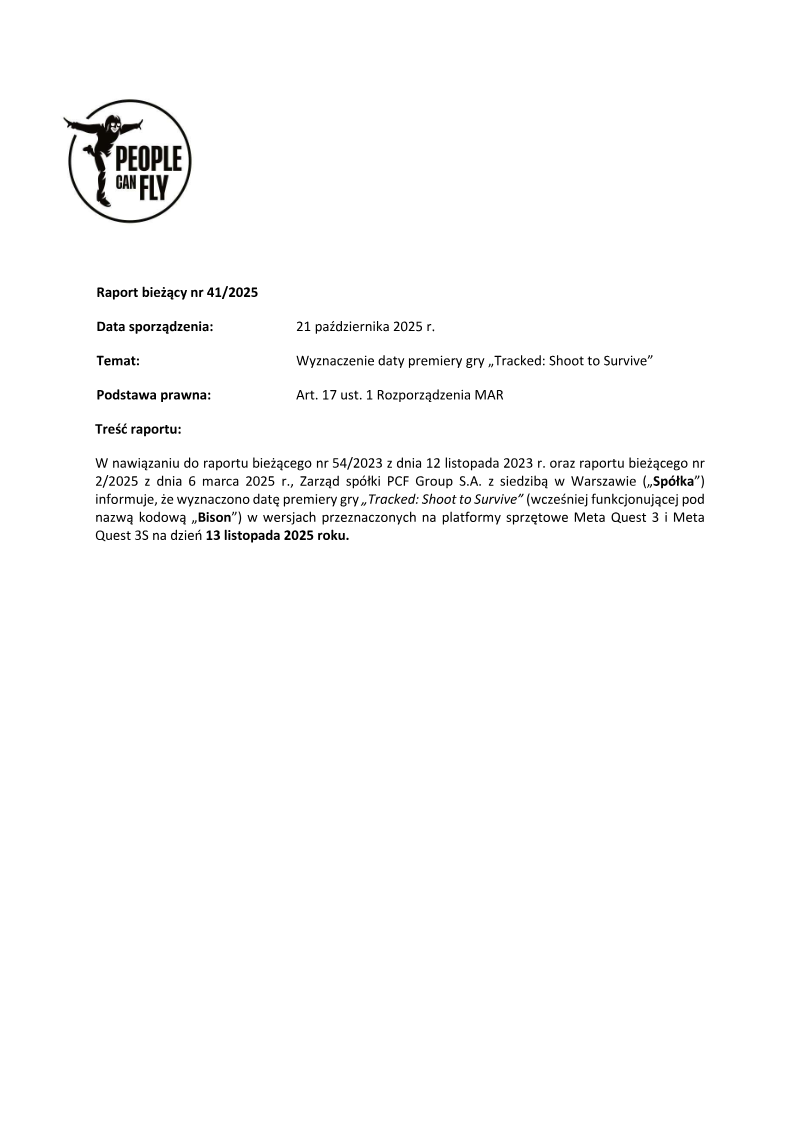
Raport bieżący nr 41/2025: Wyznaczenie daty premiery gry „Tracked: Shoot to Survive”
PCF Group S.A. has officially scheduled the global release of the title Tracked: Shoot to Survive for November 13, 2025. This announcement confirms the commercial launch timeline for the project, which was previously developed under the internal codename Bison. The game is specifically optimized for the Meta Quest 3 and Meta Quest 3S virtual reality hardware platforms.
The decision to finalize the release date follows a multi-year development cycle, with initial project disclosures dating back to late 2023 and further updates provided in early 2025. By targeting the Meta Quest ecosystem, the company is positioning this release within the growing sector of standalone virtual reality gaming. This strategic move reflects the studio's ongoing efforts to expand its portfolio within the immersive technology market.
The announcement serves as a formal regulatory disclosure, ensuring transparency regarding the company’s production pipeline and commercial milestones. As the launch date approaches, the focus shifts toward the final deployment of the software to the specified VR platforms. This release represents a significant step in the company's current development roadmap, marking the transition of the project from the production phase to active market availability.
- PCF Group S.A. will release the game 'Tracked: Shoot to Survive' globally on November 13, 2025.
- The title is developed exclusively for the Meta Quest 3 and Meta Quest 3S virtual reality hardware platforms.
- The project was previously managed under the internal codename 'Bison' and has been in development since at least late 2023.
- This release marks the transition of the project from the production phase to active market availability.
- The launch represents a strategic expansion of PCF Group S.A.'s portfolio into the standalone virtual reality gaming sector.
+1
PCF Group

Report11 pages
Aktualizacja Strategii: Nowe Otwarcie
The updated strategy for People Can Fly (PCF Group) marks a transition toward a self-publishing model while maintaining its core expertise in developing high-end shooter games. Having successfully completed its post-IPO objectives, including the expansion of production capacity and the establishment of multiple creative studios across Europe and North America, the company now aims to scale its operations to support the simultaneous development of several ambitious projects. The primary thesis centers on leveraging internal intellectual property and proprietary technology, specifically the PCF Framework and Unreal Engine 5, to deliver high-quality gaming experiences while capturing a larger share of revenue through self-publishing.
Key operational findings highlight a shift from a single-project focus to a multi-project production model supported by over 600 employees. The company has implemented agile methodologies and Centers of Excellence to improve efficiency and risk management. Financial targets are aggressive, with a goal of reaching 3.0 billion PLN in total revenue between 2023 and 2027. To achieve this, PCF plans to release six games over the next four years, focusing on the Games-as-a-Service (GaaS) model to ensure long-term player engagement and recurring revenue. Projects currently in development include Gemini, Dagger, Bifrost, Victoria, and Thunder, with a mix of work-for-hire and self-published titles.
The scope of this strategy covers global operations across seven studios, including locations in Warsaw, Rzeszów, Kraków, Katowice, Newcastle, Montreal, and New York. To fund this expansion, the company intends to raise between 205 million and 295 million PLN through a new share issuance. This capital will be directed toward scaling development teams and supporting the production of its self-published portfolio, with no dividend payments expected before 2025.
- PCF Group aims to generate 3.0 billion PLN in total revenue between 2023 and 2027 by transitioning to a self-publishing model.
- The company plans to release six games over the next four years, prioritizing the Games-as-a-Service (GaaS) model to secure recurring revenue.
- To fund the expansion of its development teams and self-published portfolio, PCF intends to raise between 205 million and 295 million PLN through a new share issuance.
- Operations have scaled to over 600 employees across seven global studios in Europe and North America, supporting a new multi-project production model.
- Current development projects include Gemini, Dagger, Bifrost, Victoria, and Thunder, which utilize proprietary technology and Unreal Engine 5.
+3
PCF Group
Report1 pages
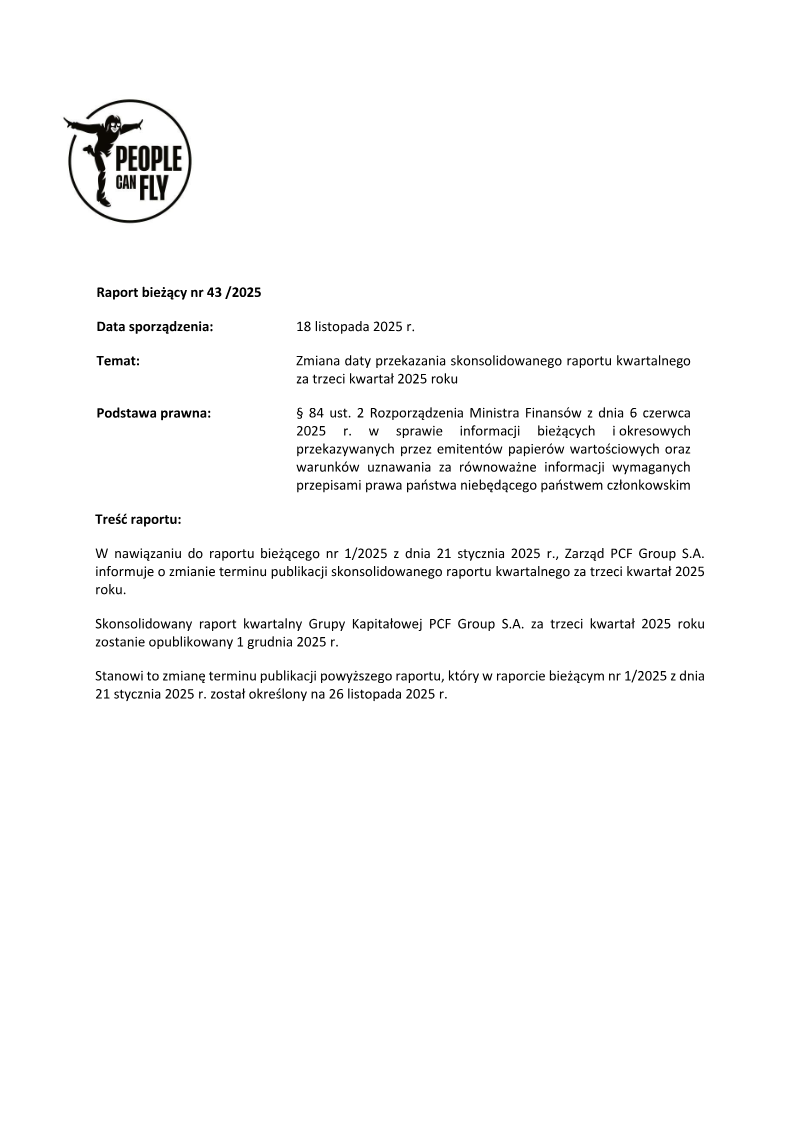
Zmiana daty przekazania skonsolidowanego raportu kwartalnego za trzeci kwartał 2025 roku
PCF Group S.A. has formally announced a revision to its financial reporting schedule for the third quarter of 2025. The primary purpose of this communication is to notify stakeholders and regulatory bodies of a delay in the release of the company’s consolidated quarterly report, which was originally scheduled for publication on November 26, 2025.
The updated timeline establishes December 1, 2025, as the new date for the disclosure of the consolidated financial results for the Group. This adjustment serves to align the company with its ongoing reporting obligations under the relevant financial regulations governing issuers of securities. The change represents a brief postponement of five days from the previously communicated deadline.
This administrative update pertains exclusively to the corporate financial disclosure schedule of PCF Group S.A. for the specified fiscal period. No further details regarding the underlying financial performance or operational status of the company were provided in this notification, as the announcement is strictly limited to the procedural modification of the reporting calendar.
- PCF Group S.A. has postponed the release of its consolidated quarterly report for Q3 2025 by five days.
- The new publication date for the Q3 2025 financial results is December 1, 2025.
- The original deadline for the financial disclosure was scheduled for November 26, 2025.
- This schedule adjustment is a procedural update intended to ensure compliance with financial reporting obligations for securities issuers.
- The announcement contains no information regarding the company's financial performance or operational status for the period.
PCF Group
Report1 pages
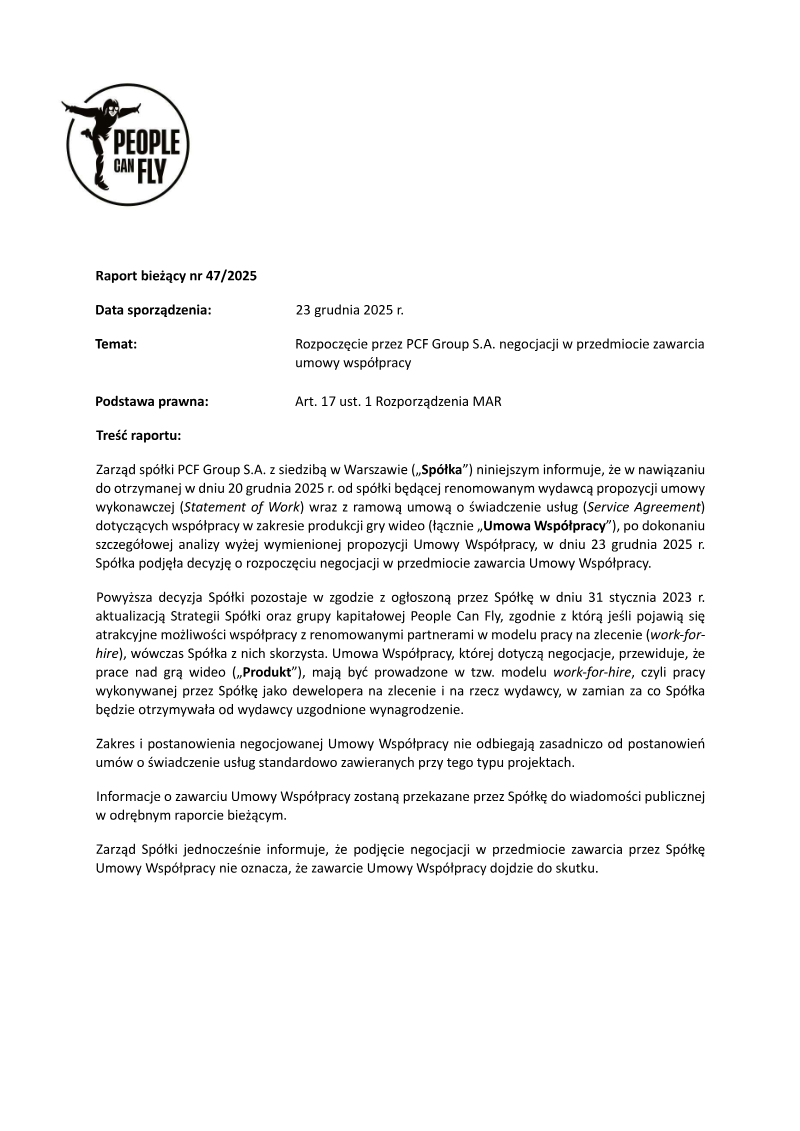
Raport Bieżący Nr 47/2025: Rozpoczęcie przez PCF Group S.A. Negocjacji w Przedmiocie Zawarcia Umowy Współpracy
PCF Group S.A. has officially entered into formal negotiations regarding a new service agreement and statement of work with a prominent, unnamed publisher. This development follows the receipt of a formal proposal on December 20, 2025, which the company analyzed before committing to the negotiation process on December 23, 2025. The potential partnership centers on the development of a new video game title, structured under a work-for-hire model where the company will act as the developer in exchange for agreed-upon compensation.
The decision to pursue this collaboration aligns with the company’s long-term strategic goals, specifically the updated corporate strategy announced in January 2023. This strategy explicitly prioritizes the pursuit of high-quality work-for-hire opportunities with reputable industry partners to diversify revenue streams and leverage internal development capabilities. The terms currently under discussion are consistent with standard service agreements typical for large-scale game development projects within the global interactive entertainment industry.
While the initiation of these talks marks a significant step toward securing a new project, the company emphasizes that the negotiations do not guarantee a final binding agreement. The outcome remains subject to the successful conclusion of discussions between the parties. Further updates regarding the status of the contract will be disclosed to the public once a definitive agreement is reached or if the negotiations are terminated.
- PCF Group S.A. entered formal negotiations on December 23, 2025, to develop a new video game title for an unnamed publisher under a work-for-hire model.
- The potential partnership follows a formal proposal received by PCF Group S.A. on December 20, 2025.
- The project is intended to provide compensation for development services, aligning with the company's January 2023 strategy to diversify revenue through high-quality work-for-hire contracts.
- The terms currently under discussion are consistent with standard service agreements for large-scale, global interactive entertainment projects.
- No binding agreement has been finalized, and the company will only provide further updates upon the conclusion or termination of these negotiations.
+1
PCF Group
Report2 pages
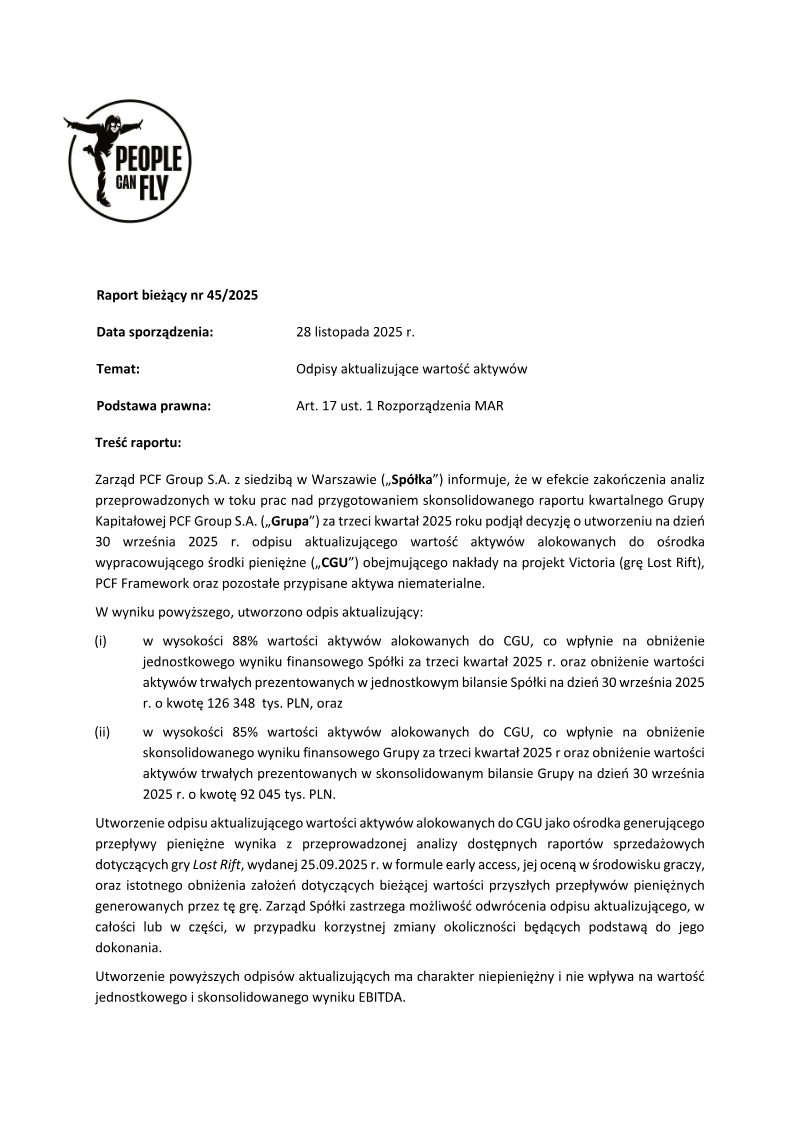
Raport Bieżący Nr 45/2025: Odpisy Aktualizujące Wartość Aktywów
PCF Group S.A. has initiated significant asset impairment charges following a performance review of the project Victoria, specifically the game Lost Rift, alongside the PCF Framework and associated intangible assets. This decision, finalized in November 2025, reflects a strategic reassessment of the carrying value of these assets as of September 30, 2025. The impairment was triggered by disappointing sales data following the early access launch of Lost Rift on September 25, 2025, compounded by unfavorable player reception and a downward revision of projected future cash flows.
The financial impact of these adjustments is substantial, affecting both the company’s standalone and consolidated financial statements. On a standalone basis, the company recognized an impairment of 88% of the relevant asset value, resulting in a reduction of 126,348 thousand PLN. On a consolidated level, the impairment accounts for 85% of the asset value, totaling 92,045 thousand PLN. While these figures significantly lower the value of fixed assets reported on the balance sheet for the third quarter of 2025, the charges are non-cash in nature and do not impact the company’s EBITDA.
Management maintains the possibility of reversing these impairment charges, either in whole or in part, should market conditions or the commercial performance of the affected assets improve. These figures remain estimates and are subject to final audit verification before the publication of the full 2025 financial statements. The scope of this adjustment is limited to the specific cash-generating unit associated with the Lost Rift project and its supporting technological framework within the broader PCF Group portfolio.
- PCF Group S.A. recognized a consolidated asset impairment of 92,045 thousand PLN, representing 85% of the carrying value of the 'Lost Rift' project and its associated PCF Framework.
- On a standalone basis, the company recorded an impairment of 126,348 thousand PLN, which equates to 88% of the relevant asset value.
- The impairment was triggered by poor sales performance and negative player reception following the early access launch of 'Lost Rift' on September 25, 2025.
- The financial adjustments are non-cash in nature and will not impact the company’s EBITDA, though they significantly reduce fixed assets on the Q3 2025 balance sheet.
- Management has indicated that these impairment charges may be reversed in the future if the commercial performance of the affected assets improves.
PCF Group
Report125 pages
Integrated Report 2020
I N T E G R AT E D R E P O R T 2 0 2 0 The BANDAI NAMCO Group develops entertainment-related products and services in a wide range of fields, including toys, network content, home video games, amusement machines, amusement facilities, and visual and music content. “Dreams, Fun and Inspiration” are the Engine of Happiness.
- BANDAI NAMCO Group's Mid-Term Plan (April 2018-March 2021) aims to maximize IP value, expand globally, and develop high-growth regions/businesses, with a consolidated net sales forecast of ¥650,000 million and segment profit of ¥50,000 million for the fiscal year ending March 31, 2021.
- The company is strategically expanding in North America and China, focusing on Japanese IP, enhancing e-commerce, and bolstering sales to mature fans, including a joint venture with Shueisha Inc. established in 2019.
- BANDAI NAMCO's Toys and Hobby unit is celebrating the 40th anniversary of Gundam plastic models with strategic product launches, large-scale promotions, and media collaborations, while also expanding production facilities in Japan to meet overseas demand.
- In 2020, BANDAI CO., LTD. partnered with TOEI COMPANY, LTD. to open KAMEN RIDER STORE TOKYO, the world's first official Kamen Rider flagship store, targeting a wide range of customers from children to adults.
- The company views human resources as its most important asset, implementing performance-linked remuneration, systems for idea proposals across departments, and a group-wide recognition system (BANDAI NAMCO Awards) to foster innovation and employee engagement.
+1
Bandai Namco
Report60 pages
Gamedev Salary Pulse 2026: North America, Western Europe, Nordics, Central and Eastern Europe
The game development industry is currently navigating a period of profound structural instability, characterized by widespread workforce reductions and a pervasive sense of professional anxiety. Despite the rapid integration of artificial intelligence, the primary driver of current career displacement remains studio restructuring rather than technological replacement. While the majority of the workforce remains employed in hybrid or remote roles, a significant portion of professionals are actively reassessing their career trajectories. This climate of cautious realism is reflected in market sentiment, where nearly 40 percent of industry participants anticipate further decline, leading to increased emotional fatigue and a shift in priorities toward time-based benefits, such as the four-day workweek, over traditional office perks.
Geographically, the industry maintains a clear hierarchy in compensation, with North America consistently commanding the highest salary tiers across all seniority levels. In contrast, Central and Eastern Europe continue to function as the most cost-effective hubs for talent acquisition. This regional disparity underscores a broader trend of geographic diversification, as studios balance the need for specialized expertise with the economic realities of global operations. Although the workforce remains mobile, the prevalence of remote work has effectively anchored many professionals, creating a distinct divide where on-site employees demonstrate a significantly higher propensity for international relocation compared to their remote counterparts.
The current landscape is defined by a maturing workforce dominated by mid-to-senior level professionals, accompanied by a concerning decline in new entrants. This demographic shift, coupled with the ongoing volatility in employment, has necessitated more flexible recruitment strategies. Studios are increasingly moving away from traditional hiring models, favoring diverse solutions that range from subscription-based flat-fee packages to comprehensive recruitment process outsourcing. As the industry continues to evolve, these data-driven benchmarks serve as a critical framework for both studios and professionals attempting to navigate the complexities of global compensation and shifting labor market dynamics.
- Nearly 40 percent of game industry professionals anticipate further market decline, driving a shift in worker priorities toward time-based benefits like the four-day workweek over traditional office perks.
- Workforce reductions and studio restructuring remain the primary drivers of career displacement, significantly outpacing job losses attributed to artificial intelligence integration.
- North America maintains the highest global salary tiers for all seniority levels, while Central and Eastern Europe remain the most cost-effective regions for talent acquisition.
- The industry is experiencing a demographic shift characterized by a maturing workforce of mid-to-senior level professionals and a concerning decline in new entrants.
- Remote work has anchored the workforce, resulting in a clear divide where on-site employees are significantly more likely to relocate internationally than their remote counterparts.
+3
8BitMar 2026
Report3 pages
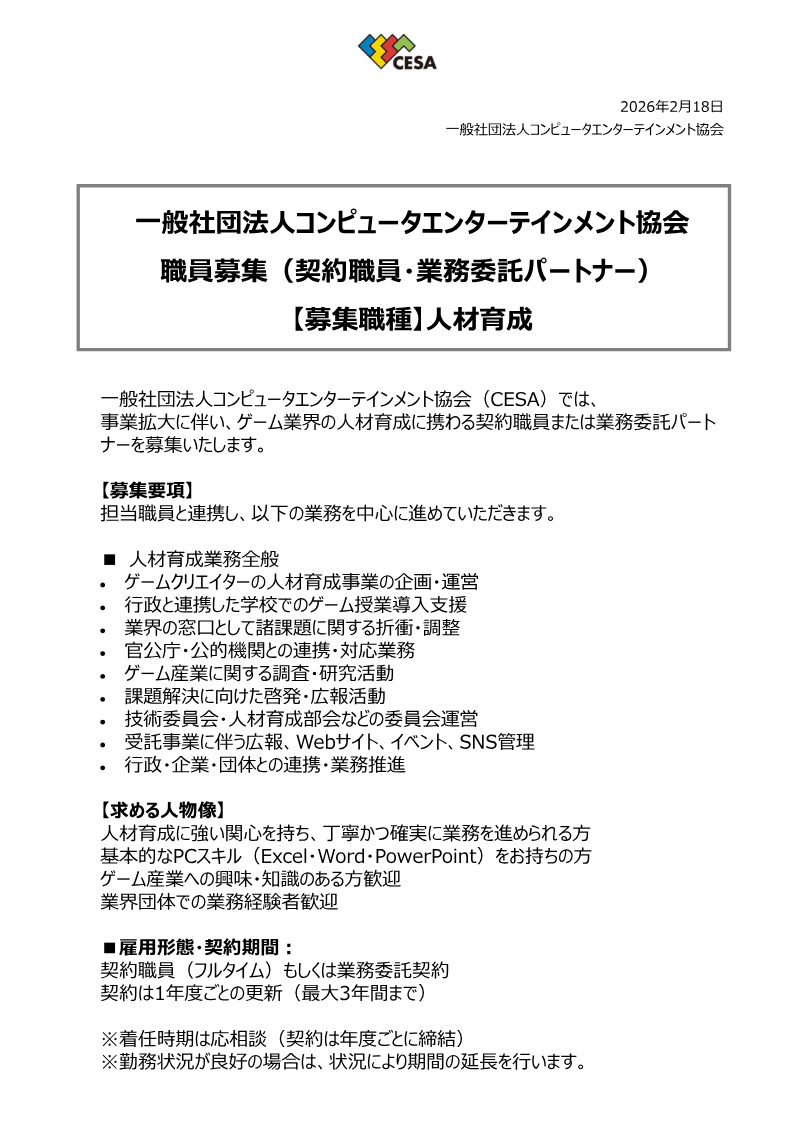
職員募集(契約職員・業務委託パートナー):人材育成
The Computer Entertainment Society (CESA) announces a recruitment drive for contract personnel and outsourced partners to support its expanding human‑resource development initiatives within Japan’s video‑game sector. The role centers on planning and operating creator training programs, facilitating the introduction of game‑based curricula in schools in collaboration with government bodies, and acting as a liaison for industry‑wide issues. Additional responsibilities include coordinating with public agencies, conducting research on the gaming industry, managing outreach and publicity, overseeing committee activities, and handling web, event, and social‑media communications tied to commissioned projects.
Candidates are expected to possess at least five years of professional experience, demonstrable negotiation and coordination skills, and a strong interest in gaming. Preferred backgrounds include prior interaction with governmental entities, experience driving contract‑based projects, and familiarity with educational or certification activities related to games. Basic PC proficiency in spreadsheet, word‑processing, and presentation software is required, while prior employment in game companies or teaching roles is advantageous.
Employment is offered either as a full‑time contract employee with a standard 9:00‑17:30 schedule in Shinjuku, Tokyo, or as an outsourced partnership negotiated according to individual expertise. Contract terms are annual, renewable up to three years, with an hourly wage starting at ¥1,800, subject to experience. Benefits encompass health, pension, unemployment, and workers’ compensation insurance, a complete two‑day weekend, and a smoke‑free office environment. Applications are to be submitted via the CESA inquiry form, followed by a two‑stage interview process conducted online and in person.
- The Computer Entertainment Society (CESA) is hiring contract personnel and outsourced partners to lead human-resource development and creator training programs within the Japanese video-game industry.
- Core responsibilities include facilitating game-based curricula in schools, managing government relations, conducting industry research, and overseeing communications for commissioned projects.
- Candidates must have at least five years of professional experience, with preference given to those with backgrounds in government liaison work, project management, or educational certification.
- Contract employees are based in Shinjuku, Tokyo, with a standard 9:00–17:30 schedule and an hourly wage starting at ¥1,800.
- Employment terms are annual and renewable for up to three years, with full benefits including health, pension, unemployment, and workers' compensation insurance.
+2
CESA – Computer Entertainment Supplier's AssociationFeb 2026
Report7 pages
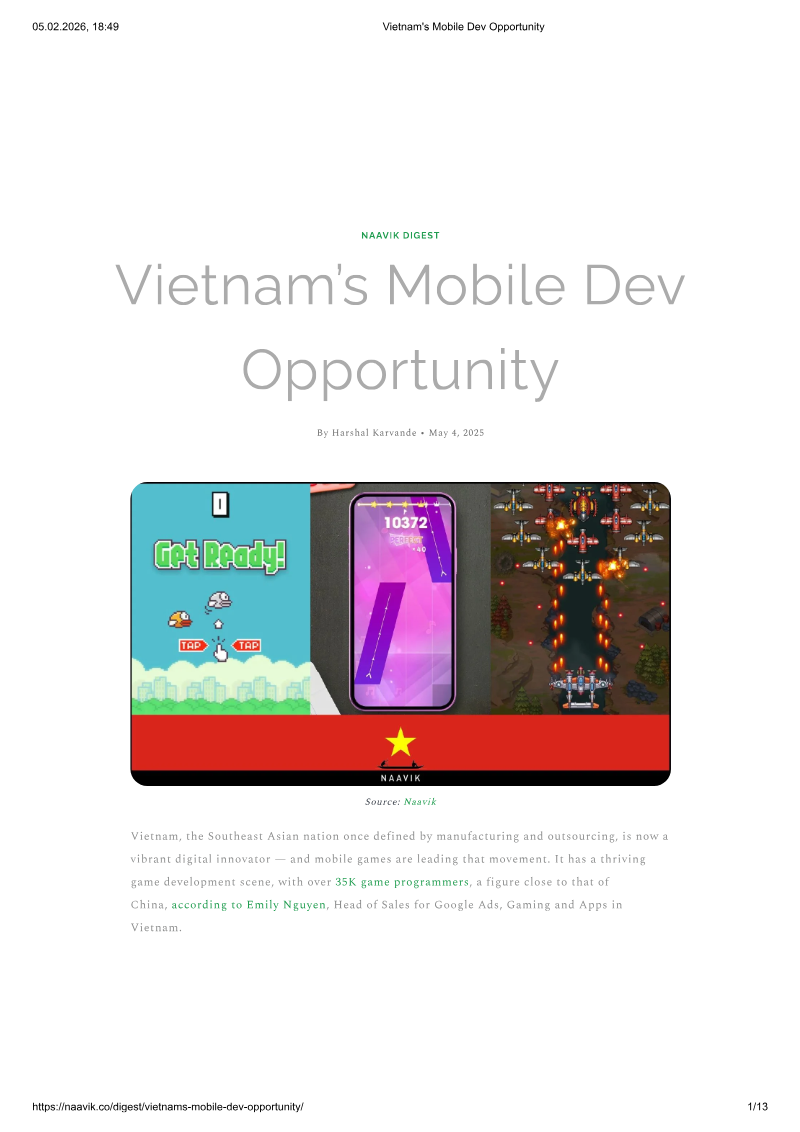
Vietnam's Mobile Dev Opportunity
Vietnam’s mobile game sector has evolved from a consumer‑centric market into a burgeoning production hub, driven by a skilled talent pool forged through outsourcing, stringent regulatory frameworks that forced local publishing entities to emerge, and the explosive rise of mobile gaming. The country now hosts over 35 000 game programmers—comparable to China’s workforce—and more than 300 active mobile publishers headquartered in Vietnam. In 2024, five Vietnamese studios ranked among the world’s top 25 publishers by downloads, contributing nearly 2.4 billion downloads and $133 million in revenue—a 67 % increase in downloads and an 82 % rise in earnings since 2020. Key titles such as Car Race, Wood Nuts & Bolts Puzzle, and Hair Salon: Beauty Salon Game illustrate the domestic IP pipeline, while globally recognized titles like Sky Garden: Farming Paradise, Magic Tiles 3, and Axie Infinity showcase the country’s capacity for high‑impact releases.
The transformation accelerated after 2013 when Vietnamese solo developer Nguyen Ha Dong’s Flappy Bird achieved worldwide chart dominance, proving that local talent could produce globally successful mobile games with limited resources. This success spurred a wave of small studios and startups, many of which transitioned from outsourcing or publishing roles to independent IP creation. Vietnam’s high smartphone penetration (84 %) and a youthful, digitally native demographic further underpin market growth.
Regulatory challenges remain: stricter limits on gaming time for minors, mandatory Ministry of Information and Communications approvals, and content censorship can constrain creative expression and international appeal. Future success will hinge on navigating the shift from hypercasual to more complex casual and social mobile games while adapting to evolving regulatory constraints. Despite these hurdles, Vietnam’s established talent base, rapid growth trajectory, and increasing foreign investment position it as a rising contender for global mobile game leadership over the next decade.
- Vietnam has emerged as a major global mobile development hub with over 35,000 game programmers and more than 300 active local publishers.
- In 2024, five Vietnamese studios ranked among the world’s top 25 publishers, generating 2.4 billion downloads and $133 million in revenue.
- Since 2020, the sector has experienced significant growth, marked by a 67% increase in downloads and an 82% rise in earnings.
- The industry’s transition from outsourcing to independent IP creation was catalyzed by the 2013 global success of Flappy Bird, which proved that local talent could achieve international chart dominance.
- Domestic market strength is supported by a digitally native population and an 84% smartphone penetration rate.
+2
NaavikFeb 2026
Presentation24 pages
Financial Results Briefing FY2025
GungHo Online Entertainment is currently undergoing a fundamental strategic pivot, transitioning from a primary focus on the domestic Japanese mobile market toward a global, multi-platform distribution model. This evolution targets North America and Europe specifically through the development of action-oriented intellectual properties for console and PC. The success of this shift is evidenced by the dramatic rise in the overseas net sales ratio, which is projected to reach 66% in fiscal year 2025, up from just 11.4% in 2016. Key drivers for this international expansion include the upcoming launch of Let It Die: Inferno and the continued global scaling of the Ragnarok and Puzzle & Dragons franchises across more than 150 countries.
Despite this aggressive geographic expansion, the company faces immediate financial headwinds characterized by a contraction in consolidated net sales and operating profit. Quarterly performance data reveals a downward trajectory over a four-year period, with peak values declining from over 16,000 to approximately 7,750 in the most recent quarter. This downturn is largely attributed to softening sales of legacy mobile titles and a reactional decrease in revenue from the subsidiary Gravity. To stabilize these core assets, the company is utilizing high-profile collaborations with major brands such as Sanrio and Digimon to maintain domestic user engagement while simultaneously preparing for the launch of Ragnarok Online 3 in major Asian markets.
The long-term outlook centers on a diversified portfolio that balances established mobile revenue with new, high-scale global releases. While current financial indicators reflect a period of contraction and volatility, the commitment to 100-player raid mechanics in upcoming titles and the expansion of Ragnarok X: Next Generation into EMEA markets signal a move toward more technologically ambitious projects. Ultimately, the transition toward a global-first strategy represents a necessary adaptation to the maturing domestic mobile landscape, aiming to replace declining legacy revenue with sustainable growth from international console and PC audiences.
- GungHo is executing a strategic pivot from the domestic Japanese mobile market to a global, multi-platform model, with overseas net sales projected to reach 66% of total revenue in FY2025, up from 11.4% in 2016.
- Consolidated net sales and operating profit are in a four-year decline, with quarterly performance metrics dropping from a peak of over 16,000 to approximately 7,750.
- The company is addressing the softening sales of legacy mobile titles and decreased revenue from its subsidiary Gravity by leveraging high-profile collaborations with brands like Sanrio and Digimon.
- Future growth is anchored in the expansion of the Ragnarok franchise, including the upcoming launch of Ragnarok Online 3 in Asian markets and the introduction of Ragnarok X: Next Generation to EMEA regions.
- GungHo is shifting its development focus toward action-oriented console and PC intellectual properties, highlighted by the upcoming release of Let It Die: Inferno.
GungHo Online EntertainmentFeb 2026
Report23 pages
The State of Web Gaming Report 2026: A Data-Driven Guide to the Untold Reality of Contemporary Web Gaming
Web gaming is currently undergoing a significant renaissance, driven by a growing consumer preference for frictionless, instant-access experiences that bypass the cumbersome download and update requirements characteristic of traditional PC and console platforms. This shift reflects a broader evolution in gaming habits, where time-poor users increasingly favor rapid, cross-platform engagement. As of 2026, the sector has transitioned from a legacy medium into a high-value discovery layer, serving as a vital top-of-funnel acquisition tool for the wider gaming ecosystem.
Data indicates that web gaming audiences are remarkably engaged, with 37 percent of users playing multiple times daily. This high level of interaction is complemented by a strong conversion pipeline, as 62 percent of players eventually purchase or download titles they initially encountered through a browser. Despite these compelling metrics, a persistent perception gap remains among some developers who view the web as a low-quality channel. However, the industry is actively correcting this bias, with 53 percent of developers planning to port mobile titles to the web within the coming year to mitigate widespread discoverability challenges.
The global market for web gaming is characterized by low barriers to entry and high competition, yet HTML5 development provides a cost-effective strategy for reaching deeply engaged audiences. By leveraging the web as a primary discovery channel, developers can effectively bridge the gap between casual browser play and long-term ecosystem investment. Ultimately, the integration of web-based gaming into broader distribution strategies is no longer optional but a critical growth imperative for developers seeking to maintain relevance in an increasingly fragmented digital landscape.
- Web gaming has evolved into a primary top-of-funnel acquisition tool, with 62 percent of browser-based players eventually purchasing or downloading the titles they first encountered on the web.
- The web gaming audience demonstrates high retention, with 37 percent of users engaging with content multiple times per day.
- To combat mobile discoverability challenges, 53 percent of developers plan to port their mobile titles to the web within the next year.
- The shift toward web gaming is driven by a consumer preference for frictionless, instant-access experiences that eliminate the need for traditional platform downloads and updates.
- HTML5 development serves as a cost-effective strategy for developers to reach highly engaged audiences while navigating a market defined by low barriers to entry and high competition.
+1
PokiJan 2026
Report25 pages
State of African Games 2026
The analysis delivers a data‑driven overview of African‑developed video games, concentrating on performance across global platforms—primarily Steam, with supplemental PlayStation and Xbox data—from 2015 through 2025. Its central thesis is that the continent’s game‑development ecosystem is emerging rapidly yet remains highly concentrated, especially in South Africa, and is transitioning from volume‑driven growth to a focus on higher‑quality, strategically positioned titles.
South Africa accounts for the overwhelming share of both developers and commercial success, supplying all titles in the top‑ten sales list and driving the continent’s 2 % share of Steam unit sales—higher than the Middle East and comparable to Oceania. Releases peaked in 2023 with 23 Steam titles before falling to 11 in 2025, suggesting a shift toward longer development cycles. Genre analysis reveals a mismatch: simulation games achieve the highest median sales (≈372 k units), followed by adventure and RPGs, while action titles dominate the release count. Pricing follows global indie norms, with most games priced between $5.99 and $19.99; premium pricing above $21.99 appears in only a small fraction of titles. Unity is the leading engine (≈18 % of releases), Unreal accounts for about 7 %, and the remaining 73 % use a diverse set of smaller tools, reflecting a decentralized technical landscape.
Methodologically, the study relies on Video Game Insights estimations for games launched after 1 January 2015, employing internal sales‑estimation algorithms that convert review counts and apply the Boxleiter method to infer unit sales and revenue. The scope encompasses all major platforms, covers the entire African continent, and isolates trends in genre, pricing, engine choice, and geographic distribution.
Conclusions point to a transitional phase where success will depend less on release volume and more on distinctive cultural content, genre diversification, and broader support structures beyond South Africa. If these dynamics persist, the African game‑development sector is poised to evolve from an emerging participant to a recognized creative force within the global industry.
- South Africa dominates the African game development sector, accounting for all top-ten selling titles and contributing to a 2% share of global Steam unit sales.
- The industry is shifting from volume-driven growth to longer development cycles, evidenced by a decline in annual Steam releases from a peak of 23 in 2023 to 11 in 2025.
- There is a significant genre mismatch in the market, as action titles dominate release volume while simulation games achieve the highest median sales at approximately 372,000 units.
- The technical landscape is highly decentralized, with Unity powering 18% of releases and Unreal Engine 7%, while 73% of titles rely on a diverse range of smaller development tools.
- Pricing for African-developed titles remains aligned with global indie norms, with the vast majority of games priced between $5.99 and $19.99 and very few exceeding $21.99.
Sensor TowerJan 2026

Report13 pages
Annual Review: 2025
The document outlines Ukie’s first year of its five‑year “Supercharged” strategy, aimed at accelerating the UK video games and interactive entertainment sector. The thesis is that a coordinated policy, industry‑wide campaigns, talent development and trade support can secure the UK’s position as a global leader in games. Key findings show that consumer spending reached £7.6 billion in 2024, a record high, and that Ukie’s advocacy generated three major policy wins: recognition of games as a growth sector, a tailored growth package and £30 million for the UK Games Fund. The organisation also secured £75 million in business wins through global trade activity at GDC and Gamescom, and delivered 19 consultations to government bodies. In talent development, Ukie supported 30 companies via its Growth Programme and ran the largest student game jam with over 200 participants, while Digital Schoolhouse won a national BETT award for best opportunities and experience. The scope covers the UK, with outreach to Scotland, Wales, Northern Ireland and international partners such as Tencent. Methodology includes evidence‑based lobbying, a national pulse survey network, and partnership with academic institutions for skills research. The report concludes that the next year will focus on deepening policy influence, expanding trade missions, and fostering emerging mobile, UGC and external‑engine opportunities to sustain industry growth.
- UK consumer spending on video games and interactive entertainment reached a record high of £7.6 billion in 2024.
- Ukie’s advocacy efforts secured £30 million in funding for the UK Games Fund and official recognition of the sector as a key driver of economic growth.
- Global trade activities at GDC and Gamescom generated £75 million in business wins for the UK games industry.
- The organization delivered 19 formal consultations to government bodies to influence policy and secure a tailored growth package for the sector.
- Talent development initiatives included supporting 30 companies through the Growth Programme and hosting a student game jam with over 200 participants.
+2
UkieDec 2025

Report112 pages
Square Enix Next: That Excitement Once Again
Square Enix’s recent performance review exposes a persistent decline in revenue growth and profitability over the past three years, with operating income falling 32 % and ROE dropping 61 %. The downturn is driven primarily by weak margins in both high‑definition (HD) and small‑dungeon (SD) game segments, excessive portfolio fragmentation, sub‑optimal product design and promotion, and escalating development costs. While the MMO licensing arm remains the sole growth driver (+11 %), overall gaming revenue has slipped, with HD and SD titles declining 4 % and 5 % respectively. Operating margins for these segments hover around 35–40 %, noticeably higher than the industry average of 28 % but still lagging behind competitors, indicating inefficiencies that are not being adequately addressed.
The company’s medium‑term “Reboots” plan offers only high‑level directions without concrete key performance indicators or quantitative targets. Critical gaps include a lack of clear business‑portfolio strategy, insufficient disclosure on non‑core business rationales, and no defined mechanisms for monitoring progress or maximizing shareholder value. Capital allocation disclosures are similarly weak: cost‑of‑capital calculations, ROE and ROIC targets, and hurdle rates are absent, while share‑buyback authorization remains unused despite a sharp price decline. SG&A costs exceed peer norms by 5–6 ppt, driven largely by an oversized sales force, further eroding profit margins.
Geographically, SD game revenue is almost entirely domestic; the Japanese market has contracted 2 % annually since 2020, and overseas growth remains only 3 %. The company’s global SD strategy is inert, with a 7 % overseas expansion rate falling short of projected growth and flagship titles such as FFVII Ever Crisis deriving 70 % of revenue from Japan. Non‑core Amusement and Publishing businesses are undervalued, with a significant conglomerate discount relative to peers and declining sales and margins. Limited cross‑synergy between game and publishing arms further hampers value creation.
In summary, Square Enix faces a multifaceted challenge: declining core game performance, weak strategic direction and KPI setting, high SG&A costs, and an underperforming non‑core portfolio. Addressing these issues through tighter cost control, clearer performance metrics, aggressive overseas expansion, and potential portfolio optimization is essential to restore corporate value and achieve sustainable growth.
- Square Enix has experienced a significant financial decline over the past three years, marked by a 32% drop in operating income and a 61% decrease in return on equity (ROE).
- Core gaming segments are underperforming, with HD and SD game revenues falling 4% and 5% respectively, while MMO licensing remains the only growth driver at +11%.
- Operating margins for HD and SD segments remain inefficient at 35–40%, and SG&A costs exceed industry norms by 5–6 percentage points due to an oversized sales force.
- The company's 'Reboots' medium-term plan lacks concrete KPIs, quantitative targets, and clear capital allocation strategies, such as defined hurdle rates or ROIC goals.
- Square Enix’s SD game revenue is heavily reliant on the contracting Japanese market, with flagship titles like 'FFVII Ever Crisis' generating 70% of their revenue domestically.
+2
InvestGameDec 2025

Report34 pages
Llibre Blanc de la Indústria Catalana del Videojoc 2024
I’m ready to combine the section summaries into a cohesive overview, but I’ll need the remaining sections to capture the full scope, key data points, and conclusions of the 2024 Catalan video‑game industry analysis. Could you please provide the rest of the section summaries?
- The Catalan video game industry generated €756 million in 2023, representing 53% of Spain's total revenue and a 6.6% increase from 2022. It employed 5,174 professionals, accounting for 50% of the national total.
- The industry is projected to reach €893 million by 2027, with an estimated compound annual growth rate (CAGR) of 4.3% for 2023-2027, despite an anticipated stagnation in 2024.
- In 2024, there were 262 video game studios in Catalonia, with 161 formally constituted as companies, a 10% increase from the previous year.
- Catalan studios primarily focus on original intellectual properties (91%), with self-publishing (54%) and third-party development (39%) being other popular activities. Serious games development increased to 22%.
- Digital premium sales are the main revenue source (40%), followed by outsourcing (16%) and service sales (14%). 74% of games developed in Catalonia include a Catalan language version.
+3
Direcció General d’Innovació i Cultura DigitalJul 2025
Presentation17 pages
Financial Results Q1 2025
The financial results for the first quarter of 2025 detail the operational and fiscal performance of PCF Group S.A., a global video game developer. The data reflects a period of strategic transition, characterized by rising quarterly revenues alongside shifting profitability margins. Total revenue for the first quarter of 2025 reached 63.0 million PLN, an increase from 56.9 million PLN in the same period of the previous year. Despite this growth, the group reported a net loss of 3.9 million PLN for the quarter, compared to a narrow loss of 0.9 million PLN in the first quarter of 2024. Adjusted EBITDA also saw a decline from 11.0 million PLN to 1.7 million PLN year-over-year.
The financial performance was influenced by several key operational factors, including the integration of PCF Chicago into PCF US and the inclusion of new projects such as Project Delta and Project Echo. Conversely, profitability was impacted by lower revenues from Project Gemini and the recognition of costs related to Project Bifrost within the cost of goods sold. The group’s workforce remained stable at 675 employees as of March 31, 2025, with a significant concentration of developers in Warsaw and North American studios.
In the virtual reality segment, the subsidiary Incuvo continues to manage Green Hell VR, which saw a successful co-op mode launch in late 2024. The group plans to release Project Bison in the fourth quarter of 2025, which is intended to be the final VR title published by PCF Group. Geographically, the group maintains a strong presence across Europe and North America, with its primary development hubs located in Poland and Canada. The methodology relies on consolidated financial data and internal project tracking as of the end of the first quarter of 2025.
- PCF Group S.A. reported Q1 2025 revenue of 63.0 million PLN, an increase from 56.9 million PLN in Q1 2024.
- The company recorded a net loss of 3.9 million PLN in Q1 2025, widening from a 0.9 million PLN loss in the same period last year.
- Adjusted EBITDA fell significantly year-over-year, dropping from 11.0 million PLN to 1.7 million PLN.
- Profitability was negatively impacted by lower revenues from Project Gemini and the recognition of costs associated with Project Bifrost.
- The group maintains a stable workforce of 675 employees, with primary development operations concentrated in Poland and North America.
+2
PCF GroupJun 2025