Report4 pages
Nordic Game 2026: Participant Profiles and Platforms
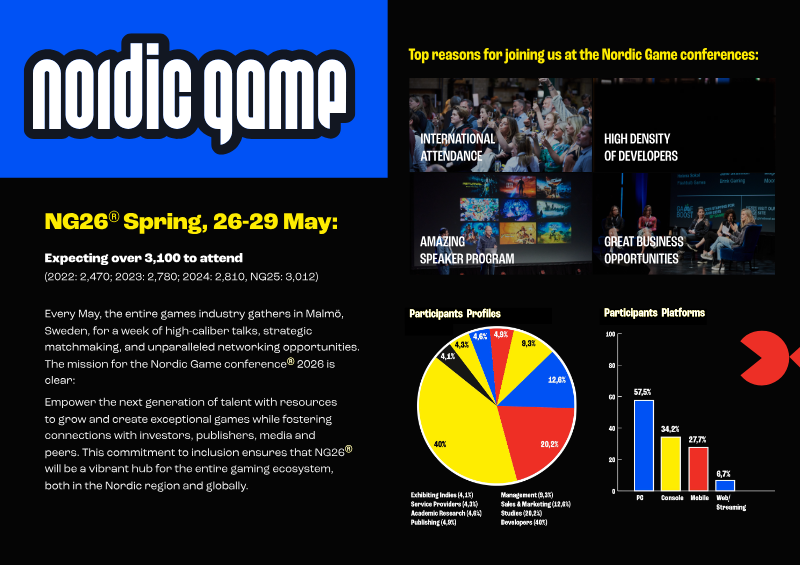
Nordic Game 2026 serves as a primary hub for the Northern European video game industry, emphasizing a high density of developers and international attendance. The event facilitates business development and networking through a comprehensive speaker program, an expansive expo floor, and the annual Nordic Game Awards, which honors excellence among regional studios. The gathering targets a diverse range of industry professionals, including game startups, established studios, and service providers, with a specific focus on fostering connections between growing companies and global partners.
The participant base is heavily weighted toward production and leadership, with developers and artists making up the largest segment at 40% of all attendees. This is followed by professionals in sales and marketing at 12.6%, management at 9.3%, and service providers at 4.3%. Smaller contingents include exhibiting indies and various support roles. In terms of platform focus, PC remains the dominant sector for participants at 57.5%, followed by console development at 34.2% and mobile gaming at 27.7%. Web and other emerging platforms represent a smaller portion of the ecosystem at 6.7%.
The event infrastructure is designed to maximize return on investment through scalable exhibition options, ranging from small four-square-meter booths to large custom pavilions. Private meeting facilities are a core component of the offering, providing flexible spaces for four to fifty people to accommodate different business needs, from formal lectures to casual networking. By integrating sponsored content opportunities and specialized events like the Discovery Contest, the conference aims to support the entire lifecycle of game development within the Nordic region and beyond.
- PC development is the primary focus for 57.5% of Nordic Game 2026 participants, significantly outpacing console development at 34.2% and mobile gaming at 27.7%.
- Developers and artists constitute the largest attendee segment at 40%, followed by sales and marketing professionals at 12.6% and management at 9.3%.
- The event prioritizes business development by providing private meeting facilities that accommodate groups ranging from 4 to 50 people.
- Service providers represent 4.3% of the total participant base, which also includes a mix of startups, established studios, and exhibiting indies.
- Emerging platforms, including web-based gaming, account for 6.7% of the total development focus among conference attendees.
+1
Nordic GameJan 2026
Report13 pages
Annual Review: 2025
The document outlines Ukie’s first year of its five‑year “Supercharged” strategy, aimed at accelerating the UK video games and interactive entertainment sector. The thesis is that a coordinated policy, industry‑wide campaigns, talent development and trade support can secure the UK’s position as a global leader in games. Key findings show that consumer spending reached £7.6 billion in 2024, a record high, and that Ukie’s advocacy generated three major policy wins: recognition of games as a growth sector, a tailored growth package and £30 million for the UK Games Fund. The organisation also secured £75 million in business wins through global trade activity at GDC and Gamescom, and delivered 19 consultations to government bodies. In talent development, Ukie supported 30 companies via its Growth Programme and ran the largest student game jam with over 200 participants, while Digital Schoolhouse won a national BETT award for best opportunities and experience. The scope covers the UK, with outreach to Scotland, Wales, Northern Ireland and international partners such as Tencent. Methodology includes evidence‑based lobbying, a national pulse survey network, and partnership with academic institutions for skills research. The report concludes that the next year will focus on deepening policy influence, expanding trade missions, and fostering emerging mobile, UGC and external‑engine opportunities to sustain industry growth.
- UK consumer spending on video games and interactive entertainment reached a record high of £7.6 billion in 2024.
- Ukie’s advocacy efforts secured £30 million in funding for the UK Games Fund and official recognition of the sector as a key driver of economic growth.
- Global trade activities at GDC and Gamescom generated £75 million in business wins for the UK games industry.
- The organization delivered 19 formal consultations to government bodies to influence policy and secure a tailored growth package for the sector.
- Talent development initiatives included supporting 30 companies through the Growth Programme and hosting a student game jam with over 200 participants.
+2
UkieDec 2025
Presentation19 pages
Wyniki Finansowe 3Q25
This financial analysis details the third-quarter 2025 performance of PCF Group S.A. (People Can Fly), a global game development studio. The primary thesis centers on a strategic pivot toward financial stability following a period of reorganization and disappointing performance from self-published titles. The scope covers the group’s global operations, including studios in Warsaw, Montreal, Newcastle, and Dublin, with a specific focus on the nine-month period ending September 30, 2025.
The financial data reveals a significant net loss of 117 million PLN for the first nine months of 2025, compared to a 33.3 million PLN loss in the same period of 2024. This deficit is largely driven by substantial non-cash write-offs totaling over 100 million PLN. Key impairments include a 92 million PLN write-down for the project Lost Rift (Victoria) following its Early Access launch on September 25, 2025, which failed to meet sales and player reception expectations. Other write-offs include 6 million PLN for PCF Chicago goodwill and 5 million PLN for Unreal Engine licenses. Despite these losses, revenues increased to 152.1 million PLN from 131.9 million PLN year-over-year, bolstered by work-for-hire (WFH) projects such as Delta, Zulu, and Echo.
The group’s methodology emphasizes "adjusted EBITDA" to illustrate underlying operational health, reporting a corrected EBITDA of 6 million PLN for the first nine months of 2025. Following a reorganization that left the workforce at 756 employees, the company is shifting its strategy to prioritize cash flow. Future objectives include securing at least one new WFH contract by the end of 2025, scaling back the Lost Rift team to achieve self-funding by 2026, and halting investment in new self-published projects until the group generates positive cash flow. Current active partnerships include ongoing projects with Microsoft, Krafton, and Sony.
- PCF Group S.A. reported a net loss of 117 million PLN for the first nine months of 2025, a significant increase from the 33.3 million PLN loss recorded in the same period of 2024.
- A 92 million PLN write-down for the project 'Lost Rift' (Victoria) following its September 25, 2025, Early Access launch was the primary driver of the group's financial deficit.
- Despite the net loss, total revenue grew to 152.1 million PLN in the first nine months of 2025, up from 131.9 million PLN in 2024, driven by work-for-hire projects including Delta, Zulu, and Echo.
- The company reported an adjusted EBITDA of 6 million PLN for the first nine months of 2025, which management uses to demonstrate underlying operational health despite total losses.
- PCF Group is halting investment in new self-published titles until the company achieves positive cash flow and is prioritizing securing at least one new work-for-hire contract by the end of 2025.
+1
PCF GroupDec 2025
Presentation17 pages
Wyniki Finansowe 1H25
This financial summary details the performance of PCF Group (People Can Fly) for the first half of 2025, reflecting a period of organizational restructuring and portfolio transition. The group operates across two continents with a total workforce of 756 people as of June 30, 2025, a slight decrease from 2024 levels. This team is distributed primarily across studios in Warsaw, North America, and various European satellite locations, following the merger of PCF Chicago into PCF US.
Financial results for 1H 2025 show a significant recovery in profitability compared to the previous year. Revenue for the first half of 2025 reached 115.3 million PLN, a substantial increase over the 76.3 million PLN reported in 1H 2024. EBITDA improved from a loss of 11.3 million PLN in 1H 2024 to a positive 2.9 million PLN in 1H 2025. Despite these operational improvements, the group recorded a net loss of 21.3 million PLN for the period, though this represents a narrowing of the 33.3 million PLN net loss seen in the prior year. Key drivers for these results include the increased contribution of Project Echo, the inclusion of Project Delta in financial reporting, and accounting write-offs related to goodwill and licenses following the Chicago studio merger.
The group’s product strategy highlights a shift in its VR segment managed by Incuvo. While Green Hell VR continues to receive updates, including a successful co-op mode launch, the upcoming title Tracked: Shoot to Survive (Project Bison) is scheduled for a Q4 2025 release. This title will mark the final VR game published by PCF Group as it refines its long-term development focus. Quarterly revenue trends indicate a stabilization in the 50-60 million PLN range per quarter throughout late 2024 and early 2025, supported by a mix of work-for-hire projects and internal IP development.
- PCF Group revenue grew to 115.3 million PLN in 1H 2025, up from 76.3 million PLN in 1H 2024.
- EBITDA turned positive at 2.9 million PLN in 1H 2025, recovering from an 11.3 million PLN loss in the same period last year.
- The company narrowed its net loss to 21.3 million PLN in 1H 2025, compared to a 33.3 million PLN loss in 1H 2024, despite accounting write-offs from the Chicago studio merger.
- PCF Group is exiting the VR segment, with the Q4 2025 release of 'Tracked: Shoot to Survive' (Project Bison) serving as its final VR title.
- Quarterly revenue has stabilized in the 50-60 million PLN range, supported by a combination of work-for-hire projects and internal IP development.
+1
PCF GroupSept 2025

Report34 pages
Llibre Blanc de la Indústria Catalana del Videojoc 2024
I’m ready to combine the section summaries into a cohesive overview, but I’ll need the remaining sections to capture the full scope, key data points, and conclusions of the 2024 Catalan video‑game industry analysis. Could you please provide the rest of the section summaries?
- The Catalan video game industry generated €756 million in 2023, representing 53% of Spain's total revenue and a 6.6% increase from 2022. It employed 5,174 professionals, accounting for 50% of the national total.
- The industry is projected to reach €893 million by 2027, with an estimated compound annual growth rate (CAGR) of 4.3% for 2023-2027, despite an anticipated stagnation in 2024.
- In 2024, there were 262 video game studios in Catalonia, with 161 formally constituted as companies, a 10% increase from the previous year.
- Catalan studios primarily focus on original intellectual properties (91%), with self-publishing (54%) and third-party development (39%) being other popular activities. Serious games development increased to 22%.
- Digital premium sales are the main revenue source (40%), followed by outsourcing (16%) and service sales (14%). 74% of games developed in Catalonia include a Catalan language version.
+3
Direcció General d’Innovació i Cultura DigitalJul 2025
Presentation17 pages
Financial Results Q1 2025
The financial results for the first quarter of 2025 detail the operational and fiscal performance of PCF Group S.A., a global video game developer. The data reflects a period of strategic transition, characterized by rising quarterly revenues alongside shifting profitability margins. Total revenue for the first quarter of 2025 reached 63.0 million PLN, an increase from 56.9 million PLN in the same period of the previous year. Despite this growth, the group reported a net loss of 3.9 million PLN for the quarter, compared to a narrow loss of 0.9 million PLN in the first quarter of 2024. Adjusted EBITDA also saw a decline from 11.0 million PLN to 1.7 million PLN year-over-year.
The financial performance was influenced by several key operational factors, including the integration of PCF Chicago into PCF US and the inclusion of new projects such as Project Delta and Project Echo. Conversely, profitability was impacted by lower revenues from Project Gemini and the recognition of costs related to Project Bifrost within the cost of goods sold. The group’s workforce remained stable at 675 employees as of March 31, 2025, with a significant concentration of developers in Warsaw and North American studios.
In the virtual reality segment, the subsidiary Incuvo continues to manage Green Hell VR, which saw a successful co-op mode launch in late 2024. The group plans to release Project Bison in the fourth quarter of 2025, which is intended to be the final VR title published by PCF Group. Geographically, the group maintains a strong presence across Europe and North America, with its primary development hubs located in Poland and Canada. The methodology relies on consolidated financial data and internal project tracking as of the end of the first quarter of 2025.
- PCF Group S.A. reported Q1 2025 revenue of 63.0 million PLN, an increase from 56.9 million PLN in Q1 2024.
- The company recorded a net loss of 3.9 million PLN in Q1 2025, widening from a 0.9 million PLN loss in the same period last year.
- Adjusted EBITDA fell significantly year-over-year, dropping from 11.0 million PLN to 1.7 million PLN.
- Profitability was negatively impacted by lower revenues from Project Gemini and the recognition of costs associated with Project Bifrost.
- The group maintains a stable workforce of 675 employees, with primary development operations concentrated in Poland and North America.
+2
PCF GroupJun 2025
Report67 pages
Studie Vlaams Gamebeleid: Eindrapport
The Flemish game industry stands at a critical juncture, requiring a strategic pivot from project-based support toward comprehensive business scaling and economic consolidation. While the sector has seen a rise in the number of studios between 2020 and 2024, growth remains heavily concentrated among a few major players, creating a fragile ecosystem characterized by a lack of mid-sized companies. To ensure long-term viability and competitiveness within the global market—which is currently valued at approximately 187.7 billion dollars—Flemish policy must evolve to address the "missing middle" by facilitating access to private capital and fostering entrepreneurial maturity.
Current support mechanisms, including the VAF/Gamefonds and the Tax Shelter, have been instrumental in initial development but are increasingly viewed as insufficient for the demands of international scaling. Global competition, driven by aggressive fiscal incentives in regions like Canada and France, necessitates a more robust and integrated financial instrumentarium. Stakeholders emphasize that while talent development remains a strength, the sector suffers from a lack of commercial focus, high production costs, and difficulties in retaining intellectual property. Consequently, there is a clear mandate to shift policy priorities toward attracting foreign investment, enhancing international promotion, and streamlining governance through a centralized strategic body.
Ultimately, the objective for the 2026–2030 period is to transition the Flemish games sector into a more stable, economically diverse industry. This requires a dual approach: optimizing existing public funding to better support commercial growth and implementing new, flexible economic tools that bridge the gap between early-stage prototyping and market-ready maturity. By aligning educational outputs with industry needs, fostering cross-sectoral collaboration, and prioritizing business development over isolated project subsidies, the region can mitigate the risks of brain drain and build a resilient, internationally recognized gaming hub.
- The Flemish game industry lacks a 'missing middle' of mid-sized companies, with growth concentrated among a few major players despite an increase in total studio numbers between 2020 and 2024.
- To compete in the $187.7 billion global market, Flemish policy must shift from project-based subsidies toward business scaling and private capital access for the 2026–2030 period.
- Existing support mechanisms like the VAF/Gamefonds and the Tax Shelter are currently insufficient to match the aggressive fiscal incentives offered by international competitors such as Canada and France.
- The sector faces structural challenges including high production costs, difficulties in retaining intellectual property, and a lack of commercial focus despite strong local talent development.
- Strategic priorities for the next five years include attracting foreign investment, enhancing international promotion, and establishing a centralized governance body to oversee industry development.
+1
Departement CultuurMay 2025
Report74 pages
Games Industry Employment Survey: Europe 2025
The European games industry is currently navigating a period of profound instability, characterized by widespread layoffs and a significant exodus of talent. Over the past year, 26% of professionals have faced involuntary unemployment, with junior-level staff suffering a disproportionate 39% exit rate. This volatility is driven by a transition from rapid market expansion to a focus on operational optimization, further complicated by the rapid integration of artificial intelligence. While 63% to 69% of the workforce now utilizes AI for core tasks, this shift has fostered deep-seated skepticism among creative and quality assurance roles regarding long-term job security and the potential devaluation of human expertise.
Financial dissatisfaction has become a defining feature of the current landscape, exacerbated by salary freezes, reduced bonuses, and a persistent gender pay gap. With over a third of companies eliminating financial bonuses entirely, salary has emerged as the primary motivator for 87% of employees. This economic pressure, combined with a lack of structured support—such as the absence of dedicated diversity and inclusion specialists in 67% of firms—has contributed to a sharp decline in employee engagement. Burnout, affecting up to 63% of the workforce, and ineffective management are now the leading drivers for professionals considering career changes or leaving the industry altogether.
Despite these challenges, the workforce remains committed to hybrid work models, though a growing disconnect exists between employee preferences for flexibility and actual workplace mandates. Relocation trends have shifted toward a pragmatic focus on cost-of-living stability rather than traditional geographic mobility. As the industry matures, the data underscores a critical need for improved management practices and better alignment between organizational goals and employee well-being to mitigate the ongoing loss of talent and restore professional morale across the European sector.
- The European games industry is experiencing significant volatility, with 26% of professionals facing involuntary unemployment and a 39% exit rate among junior-level staff.
- Financial dissatisfaction is widespread, as 87% of employees now prioritize salary above all else following salary freezes and the elimination of bonuses at over one-third of firms.
- Burnout affects up to 63% of the workforce, serving as a primary driver for professionals considering leaving the industry alongside ineffective management practices.
- While 63% to 69% of employees now utilize AI for core tasks, the integration has triggered deep skepticism regarding job security and the devaluation of human expertise.
- Organizational support structures are lacking, evidenced by the absence of dedicated diversity and inclusion specialists in 67% of European gaming companies.
+2
InGameJobJan 2025
Report139 pages
The Game Industry of Poland: 2025
Collective work under the direction of dr Jakub Marszałkowski dr Jakub Marszałkowski, Indie Games Poland, Poznan University of Technology (chapters 3, 5, 8, 9) Eryk Rutkowski, Polish Agency for Enterprise Development (chapters 2, 4, 6) Wojciech Trusz, Creative Industries Institute (chapters 1) Piotr Milewski, Sirius Game Studio, Gdynia Maritime University (chapters 7) Game Industry Conference team: Olga Matej, Agnieszka Wołoszyn, Kacper Żubryk, Hanna Marszałkowska, Dominik Latos Extra data minin...
- The provided report content contains only the title and author credits, lacking the body text, statistical data, or specific industry findings required to generate factual insights.
- Due to the absence of substantive data in the provided source, it is impossible to extract growth rates, company performance metrics, or industry trends for the Polish game industry in 2025.
- The source material consists exclusively of administrative metadata regarding the report's contributors and institutional affiliations.
- No concrete takeaways regarding market size, employment figures, or economic impact can be derived from the provided text.
- The input provided is insufficient to fulfill the request for a data-driven summary of the Polish game industry.
+3
Polish Agency for Enterprise DevelopmentJan 2025
Report2 pages
The Romanian Video Games Development Industry
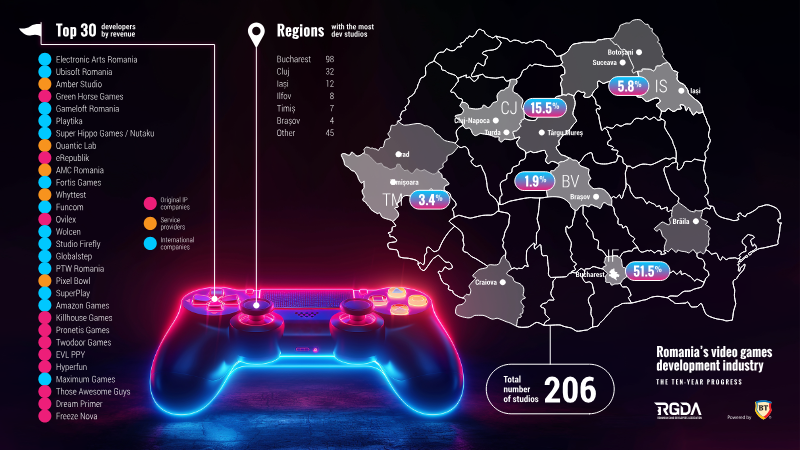
The analysis presents a comprehensive overview of Romania’s video‑game development sector, focusing on revenue performance, geographic concentration, and workforce trends over the past decade. Its central thesis is that the industry has experienced rapid expansion, with total turnover rising from roughly €119 million in 2015 to more than €340 million in 2024, while the number of active studios grew by 70 % within the same period.
Revenue concentration is illustrated by a ranking of the top thirty developers, highlighting that multinational publishers such as Electronic Arts Romania (Bucharest) and Ubisoft Romania (Cluj‑Napoca) dominate the market, together accounting for a substantial share of the €340 million total. Mid‑size studios—including Amber Studio (Iași), Green Horse Games (Ilfov), and Playtika (Brașov)—contribute notable percentages, ranging from 5 % to 15 % of overall earnings. The data also maps studio locations, revealing a strong clustering in Bucharest, Cluj‑Napoca, Iași, and Brașov, with emerging hubs in Timișoara, Turda, and Arad.
Workforce figures show headcount increasing from 279,986 employees in 2015 to a projected 343,160 in 2024, reflecting a 12 % annual growth rate in personnel. Productivity, measured as turnover per employee, rose by 7.4 % over the ten‑year span, indicating that revenue gains are not solely driven by hiring but also by higher efficiency. Service‑oriented companies and international providers together represent 51.5 % of the sector, underscoring the importance of outsourcing and cross‑border collaborations.
The scope encompasses the entire Romanian market, covering all development, publishing, and service activities from 2015 through 2024. Figures appear to be compiled from company‑reported revenues, employee registers, and regional studio counts, suggesting a mixed methodology of financial reporting and industry surveys. Overall, the evidence points to a robust, diversifying ecosystem that is increasingly integrated with the global video‑game supply chain.
- The Romanian video game industry has nearly tripled its turnover in the last decade, growing from approximately €119 million in 2015 to over €340 million in 2024.
- The sector’s workforce has expanded at an annual rate of 12%, with total headcount projected to reach 343,160 employees by 2024.
- Market dominance is held by major multinational publishers like Electronic Arts in Bucharest and Ubisoft in Cluj-Napoca, while mid-size studios such as Amber, Green Horse Games, and Playtika contribute between 5% and 15% of total earnings.
- Industry efficiency has improved alongside growth, with productivity—measured as turnover per employee—increasing by 7.4% over the ten-year period.
- The number of active development studios in Romania has increased by 70% since 2015, with operations clustering in major hubs like Bucharest, Cluj-Napoca, Iași, and Brașov.
+2
RGDA – Romanian Game Developers AssociationJan 2025

Report15 pages
El Seguro en el Ámbito de los Videojuegos
This industry guide, developed by the Spanish Video Game Association (AEVI) in collaboration with legal experts from Pérez-Llorca, serves as a strategic framework for managing risk within the video game development and publishing sectors. The primary thesis emphasizes that insurance is an essential mechanism for ensuring the financial viability of projects, acting as an indirect prevention tool against the inherent complexities of game production, such as tight delivery schedules, technical bugs, and intellectual property disputes.
The analysis identifies several critical risk categories specific to the gaming industry, including breach of delivery deadlines, transmission of computer viruses, and unauthorized data intrusions. Key findings highlight that Professional Civil Liability (RCP) and Errors and Omissions (E&O) insurance are the most vital protections for developers, covering involuntary contractual breaches and negligence. Furthermore, the guide underscores the rising importance of cybersecurity insurance to mitigate operational costs and reputational damage resulting from hacking, ransomware, and data leaks, which can trigger significant sanctions from regulatory bodies like the Spanish Data Protection Agency.
The scope of the guidance focuses on the Spanish market, referencing local legal standards and regulatory bodies, while covering the entire industry lifecycle from independent developers and freelancers to large publishers. It details specific coverage areas such as intellectual property infringement—protecting against claims regarding music, characters, and concept art—and liability for defamation or the unauthorized use of public images. Methodologically, the guide provides a practical checklist for insurance procurement, advising firms to utilize insurance brokerages for periodic contract reviews and to ensure all operational risks are disclosed to maintain policy validity.
- Professional Civil Liability (RCP) and Errors and Omissions (E&O) insurance are the primary mechanisms for protecting developers against involuntary contractual breaches and professional negligence.
- Cybersecurity insurance is essential for mitigating the operational costs and reputational damage associated with ransomware, data leaks, and hacking incidents.
- Insurance policies must specifically cover intellectual property infringement, including claims related to unauthorized use of music, character designs, and concept art.
- The Spanish Video Game Association (AEVI) and Pérez-Llorca identify breach of delivery deadlines, computer virus transmission, and unauthorized data intrusions as the most critical operational risks for game studios.
- Regulatory compliance, particularly regarding data protection standards enforced by the Spanish Data Protection Agency, is a major driver for adopting comprehensive insurance coverage.
+1
AEVIJan 2025
Report14 pages
Employment Issues in Video Game Development: Spain
The guideaims to help video‑game publishers, developers and related staff in Spain navigate employment legislation while fostering safe, productive workplaces. It stresses that compliance with the Workers’ Statute, the 2022 labour reform and the Remote‑Working Law is essential to avoid costly legal sanctions and to protect staff from the health‑risk phenomenon known as “crunch.”
Key findings highlight the danger of false self‑employment, where workers appear independent but are actually subject to employer control. Spanish courts identify dependency, subordination and fixed remuneration as hallmarks; violations can trigger Social‑Security fines of €3,750‑€12,000 per worker, plus surcharges up to 150 % of unpaid contributions. The guide confirms that indefinite contracts are the default; fixed‑term contracts are permissible only for production‑related needs or to replace absent employees, with a maximum six‑month duration for the former and 90 days per calendar year for the latter. Misusing temporary contracts converts the relationship to permanent status and incurs fines of €751‑€7,500 per affected employee.
Remote work must be voluntarily agreed, cover at least 30 % of a worker’s time, and include employer‑funded equipment costing roughly €25‑€35 per month; non‑compliance also attracts fines of €751‑€7,500. Occupational‑risk prevention is mandated under Law 31/1995, with penalties ranging from €45 to €983,736 depending on severity, and requires systematic risk analyses to curb physical and psychosocial harms linked to crunch periods. Additionally, firms must maintain objective daily time‑recording systems, respect the irregular distribution of hours (up to a 10 % pool, notified five days in advance), and implement digital‑disconnection protocols, equality plans for organisations with over 50 employees, and whistle‑blowing channels.
Overall, the guide provides a practical checklist for Spanish video‑game companies: verify contract types, assess self‑employment arrangements, formalise remote‑work agreements, enforce occupational‑risk measures, and ensure accurate time‑keeping and compliance with broader digital‑and‑equality obligations, thereby reducing legal exposure and promoting healthier work environments.
- Misclassifying employees as independent contractors can result in Social Security fines of €3,750–€12,000 per worker, plus potential surcharges of up to 150% of unpaid contributions.
- Indefinite contracts are the legal default in Spain, with fixed-term contracts strictly limited to production needs (six-month maximum) or employee replacement (90 days per year); misuse of these terms triggers fines of €751–€7,500 per employee.
- Occupational risk prevention, specifically regarding 'crunch' and psychosocial health, is mandated under Law 31/1995, with non-compliance penalties ranging from €45 up to €983,736 for severe violations.
- Remote work agreements must be voluntary, cover at least 30% of working hours, and include employer-funded equipment costs of approximately €25–€35 per month to avoid fines of €751–€7,500.
- Companies are legally required to implement objective daily time-recording systems and adhere to digital-disconnection protocols, while organizations with over 50 employees must also maintain formal equality plans and whistle-blowing channels.
+1
AEVIJan 2025
Report12 pages
Financing Video Games: Spain
The guide aims to equip Spanish video‑game developers and publishers with a practical framework for securing external financing beyond traditional bank credit. It argues that investment agreements (IAs) represent a flexible, hybrid model that can bridge the gap between shareholders’ equity and debt, allowing investors to fund projects while retaining political and economic rights comparable to shareholders without immediate capital‑increase obligations.
Key content outlines the typical structure of an IA: investors provide lump‑sum or milestone‑linked capital, receive a defined share of commercial revenues, and obtain voting, dividend and information rights. Comparative analysis shows that, unlike standard debt, IAs do not impose fixed repayment schedules, instead tying returns to project profitability and offering conversion mechanisms that can transform credit into equity if revenues fall short. The guide enumerates standard clauses—profitability timeframes, capitalisation rights, representations and warranties, confidentiality, “bad‑leaver” provisions, and pre‑emptive rights—to protect both parties and manage risk. An illustrative example notes that a €100 investment with a 20 % return target is achieved once the project generates €120 in revenue.
The scope is national, targeting the Spanish video‑game sector and addressing developers of any size who seek alternative funding. Authored by legal counsel from Pérez‑Llorca and the Asociación Española de Videojuegos, the document draws on industry practice rather than empirical surveys, presenting a checklist and glossary to support contract drafting and due‑diligence processes. Its conclusion stresses that, as acquisitions and external investments rise, IA investors will increasingly influence project governance despite not holding formal share capital.
- Investment agreements (IAs) serve as a hybrid financing model for Spanish developers, bridging the gap between equity and debt by granting investors shareholder-like rights without requiring immediate capital increases.
- Unlike traditional bank loans, IAs replace fixed repayment schedules with returns tied directly to project profitability, often including conversion mechanisms that turn credit into equity if revenue targets are missed.
- IAs typically structure capital as lump-sum or milestone-linked payments, with returns defined by a percentage of commercial revenues, such as a €100 investment targeting a €120 return.
- Standard contractual protections in these agreements include profitability timeframes, capitalisation rights, confidentiality clauses, pre-emptive rights, and 'bad-leaver' provisions to mitigate risk for both parties.
- Investors utilizing IAs gain significant influence over project governance, including voting, dividend, and information rights, despite not holding formal share capital.
+1
AEVIJan 2025

Report13 pages
Guide to Consumer Rights, Advertising and Data Protection: Spain
The guide is intended to equip Spanish video‑game publishers, developers and marketers with a practical understanding of the legal framework governing consumer rights, advertising and data protection. It draws on the General Law for the Defence of Consumers and Users, the General Advertising Law, the Unfair Competition Law, the General Data Protection Regulation and the Spanish Organic Law on Data Protection, applying them to digital products released in Spain throughout 2025.
Key consumer‑protection provisions require clear pre‑purchase information, a 14‑day withdrawal right for most digital purchases, and safeguards against unfair terms such as unilateral contract changes. Exceptions apply to virtual currencies, physical copies that have been opened and age‑rated titles once gameplay begins. Developers must maintain and communicate updates, while digital assets—including NFTs—must be presented with transparent licensing terms and explicit notices when the right of withdrawal is lost. Advertising must avoid misleading claims, covert sponsorship, political content outside election periods, and any material that exploits minors, encourages violence, discrimination or unhealthy behaviours; influencer promotions must be marked with visible disclosures such as #Sponsored or #Ad.
Data‑protection obligations centre on distinguishing controller and processor roles, informing users through layered privacy notices, and securing personal data—including special categories—via documented processing activities and contractual safeguards. For users under 14, parental consent must be verified through age checks or electronic signatures. The guide concludes with a checklist summarising rights to information, withdrawal, fair advertising, loot‑box age verification, ongoing game maintenance and GDPR‑compliant data handling.
- Digital purchases in Spain generally require a 14-day right of withdrawal, though this is waived for age-rated titles once gameplay begins and for opened physical copies or virtual currencies.
- Data processing for users under 14 requires verified parental consent, which must be obtained through age-verification mechanisms or electronic signatures.
- Influencer marketing must include clear, visible disclosures such as #Sponsored or #Ad to avoid violating regulations against covert sponsorship.
- Advertising content is strictly prohibited from exploiting minors, promoting violence or discrimination, or featuring political messaging outside of designated election periods.
- Digital assets and NFTs must be sold with transparent licensing terms and explicit notifications informing users exactly when their right of withdrawal is forfeited.
+1
AEVIJan 2025

Report15 pages
Insurance in the Video Game Sector: Spain
The guide explains that insurance is a critical safeguard for video‑game development in Spain, where tight schedules, complex technical workflows and the involvement of multiple parties create a range of legal and financial exposures. Its central thesis is that appropriate coverage not only mitigates the impact of unforeseen events but also functions as an indirect prevention tool, protecting both small studios and independent creators from liabilities that could jeopardise a project’s completion and commercial success.
Key risks identified include failure to meet delivery deadlines, software bugs, transmission of computer viruses, cyber‑attacks, data‑protection breaches, intellectual‑property infringements, defamation, and malicious acts by employees. Each risk is linked to potential legal consequences such as contractual liability, third‑party compensation claims, regulatory penalties from the Spanish Data Protection Agency, and reputational damage. The guide matches these exposures to specific insurance solutions: Professional Liability Insurance (PLI) and Errors & Omissions (E&O) for contractual and professional errors; Cybersecurity Insurance for hacking, ransomware and data‑loss incidents; Multi‑Risk and General Civil Liability policies for broader operational hazards; and specialised coverage for intellectual‑property disputes, defamation and employee misconduct.
The scope is national, focusing on the Spanish video‑game sector and addressing developers of all sizes, from freelancers to larger studios. While the guide does not present original empirical research, it draws on prevailing market offerings and legal frameworks to construct a practical risk‑assessment matrix. Recommendations emphasize engaging insurance brokers to conduct tailored assessments, compare policy terms, and periodically review coverage, with clear procedural steps for application, policy issuance, amendment periods and premium payment.
Overall, the guide provides a comprehensive checklist for selecting and maintaining insurance that aligns with the specific vulnerabilities of video‑game projects, underscoring the importance of proactive risk management in a highly competitive and technically demanding industry.
- Spanish video game developers face critical financial and legal exposures from project delays, software bugs, cyber-attacks, and intellectual property infringements.
- Professional Liability Insurance (PLI) and Errors & Omissions (E&O) policies are essential to mitigate risks related to contractual failures and professional errors.
- Cybersecurity insurance is required to address specific threats including ransomware, data-protection breaches, and the transmission of computer viruses.
- General Civil Liability and Multi-Risk policies provide necessary coverage for broader operational hazards and physical or malicious acts by employees.
- Developers should engage insurance brokers to conduct tailored risk assessments and perform periodic reviews of policy terms to ensure coverage aligns with evolving project vulnerabilities.
+1
AEVIJan 2025
Report17 pages
Taxation in the Video Game Sector: Spain
The guide explains the tax framework that applies to video‑game companies operating in Spain, outlining both mandatory obligations and the range of incentives available to reduce fiscal burdens. It establishes that resident legal entities must pay corporate income tax at 25 % of profit, value‑added tax generally at 21 %, and the Economic Activities Tax, which is exempt for the first two years or for turnover below €1 million. Non‑resident individuals and firms are subject to the non‑resident income tax, with rates of 25 % when a permanent establishment exists and 19‑24 % otherwise, and must file the appropriate IRNR forms within prescribed periods. Personal income tax for self‑employed developers ranges from 19 % to 47 % depending on income level, and withholding obligations apply to employee and contractor payments.
Key fiscal incentives include a research and development and technological innovation deduction that allows a 12 % credit on qualifying expenses, capped at 25‑50 % of the tax liability, and a patent‑box regime that reduces the taxable base on income from patents, utility models, designs, and advanced software. The Start‑ups Law offers a reduced corporate tax rate of 15 % for four periods and defers advance instalments, while small entities with turnover under €10 million benefit from accelerated depreciation, finance‑lease deductions, and an equalisation reserve that can lower the tax base by up to 10 %. Companies located in the Canary Islands can access the REF and ZEC regimes, featuring a 4 % corporate tax rate and exemptions on property‑transfer and IGIC taxes when specific investment and employment criteria are met.
The guide also lists practical tools to support compliance, such as the tax‑agency’s query database, an annual calendar of filing deadlines, virtual assistance services, and a telephone help line. It emphasizes the need for proper registration, reporting of activity start‑up and cessation, and electronic filing using certified certificates, ensuring that video‑game developers can meet statutory requirements while exploiting available tax efficiencies.
- Resident video game companies in Spain are subject to a 25% corporate income tax rate, while qualifying start-ups can access a reduced 15% rate for four tax periods.
- The Canary Islands offer a highly competitive 4% corporate tax rate and exemptions on property-transfer and IGIC taxes for companies meeting specific investment and employment criteria.
- R&D and technological innovation expenses qualify for a 12% tax credit, capped at 25–50% of total tax liability, alongside a patent-box regime that reduces the taxable base for advanced software.
- Small entities with an annual turnover under €10 million are eligible for fiscal benefits including accelerated depreciation, finance-lease deductions, and an equalisation reserve that lowers the tax base by up to 10%.
- Non-resident firms without a permanent establishment face income tax rates between 19% and 24%, while resident entities must generally apply a 21% value-added tax.
+2
AEVIJan 2025

Report15 pages
Aspectos Laborales en el Desarrollo de Videojuegos
The guide aims to equip professionals in the Spanish video‑game sector with a practical framework for complying with national labour legislation while fostering safe, flexible and sustainable work environments. It stresses that employment relationships must be governed primarily by the Estatuto de los Trabajadores and the 2022 labour reform, positioning indefinite contracts as the default model and limiting temporary contracts to production‑related needs or substitution of specific workers.
Key legal risks are highlighted, notably the use of “falso autónomo” arrangements. Indicators such as dependence, lack of entrepreneurial risk, fixed remuneration and provision of equipment can reclassify a contractor as an employee, exposing firms to Social Security back‑payments of up to €50 000, fines ranging from €3 750 to €12 000 per case and additional penalties of 100‑150 % of the owed contributions. Incorrectly formalised temporary contracts trigger automatic conversion to permanent status and fines between €751 and €7 500 per affected worker.
The document outlines the regulatory regime for teleworking, requiring a voluntary agreement, employer‑borne provision costs of roughly €25‑35 per month, and detailed specifications on schedules and monitoring tools. Non‑compliance is penalised as a grave infringement with fines identical to those for improper temporary contracts. Prevention of occupational risks, especially the “crunch” phenomenon, is mandated under the 1995 Prevention of Risks Law; violations can attract fines from €45 up to €983 736, and employers may face civil liability for work‑related injuries or illnesses.
Additional obligations include mandatory daily working‑time records introduced in 2019, the use of irregular‑hour distribution up to 10 % of total hours with five‑day notice and strict rest‑period safeguards, and the implementation of digital‑disconnection protocols, equality plans for firms with more than fifty employees, whistle‑blowing channels and digital‑device usage policies. The guide, authored by legal experts and industry consultants, synthesises statutory provisions and recent reforms to provide a comprehensive compliance checklist for developers, publishers and marketing teams operating within Spain’s
- Misclassifying contractors as 'falso autónomo' carries severe financial risk, including Social Security back-payments of up to €50,000, fines of €3,750 to €12,000 per case, and additional penalties of 100–150% of owed contributions.
- Indefinite contracts are the mandatory default under the 2022 labour reform, with improperly formalised temporary contracts triggering automatic conversion to permanent status and fines ranging from €751 to €7,500 per worker.
- Violations of occupational risk prevention laws, particularly regarding 'crunch' culture, can result in fines reaching up to €983,736 and potential civil liability for work-related health issues.
- Teleworking requires a formal voluntary agreement and employer-covered costs of approximately €25–35 per month, with non-compliance classified as a grave infringement subject to fines of €751 to €7,500.
- Employers must maintain mandatory daily working-time records and adhere to strict rest-period safeguards, while also implementing digital-disconnection protocols and whistle-blowing channels.
+1
AEVIJan 2025
Report17 pages
La Fiscalidad en el Sector de los Videojuegos: España
The guide aims to clarify the tax framework that applies to video‑game developers, publishers and related service providers operating in Spain, outlining both mandatory obligations and available fiscal incentives. It serves as a practical reference for resident legal entities, self‑employed professionals and non‑resident firms that generate income in the Spanish market, helping them meet compliance deadlines while exploiting deductions that can significantly lower the effective tax burden.
Key obligations are mapped to the principal Spanish taxes: corporate income tax (IS) at a standard 25 % rate, personal income tax (IRPF) ranging from 19 % to 47 % for individuals, value‑added tax (IVA) generally set at 21 %, the economic activities tax (IAE) with fixed tariffs and exemptions for the first two years or turnover below €1 million, and withholding obligations on salaries and payments to non‑resident contractors. Filing deadlines are detailed for each model form (e.g., Model 200/210 for IS, Model 303/390 for IVA, Model 111/190 for IRPF withholdings) and the guide notes the possibility of fiscal consolidation for groups of related companies.
The most valuable incentives for the sector include a 12 % deduction on qualifying research, development and innovation (R&D +i) expenses, which can rise to 45 % for projects carried out in the Canary Islands, and a patent‑box regime that reduces taxable income from intangible assets such as patents and advanced software. The 2022 Spanish Video‑Game Development White Paper underpins the emphasis on genuine technological advancement. Start‑up companies meeting ENISA criteria benefit from a reduced corporate rate of 15 % for four years, exemption from advance payments, and deferred tax liabilities. Small and medium‑sized entities with turnover under €10 million can also apply accelerated depreciation, enhanced lease deductibility and loss‑carry‑forward mechanisms.
Operational guidance covers the procedural steps required to register for a tax identification number, declare activity commencement or cessation, and submit electronic filings via the Agencia Tributaria’s portal using a digital certificate. Complementary tools include a searchable tax‑question database, an annually updated taxpayer calendar, virtual assistance services for the main tax types, and a dedicated helpline. Together, these resources aim to streamline compliance, reduce administrative risk and enable video‑game firms to maximize the fiscal advantages embedded in Spanish law.
- Video game companies in Spain can access a 12% tax deduction for qualifying R&D+i expenses, which increases to 45% for projects developed in the Canary Islands.
- Start-ups meeting ENISA criteria qualify for a reduced 15% corporate tax rate for four years, along with exemptions from advance payments and deferred tax liabilities.
- The standard corporate income tax (IS) rate in Spain is 25%, while personal income tax (IRPF) for self-employed professionals ranges from 19% to 47%.
- A patent-box regime is available to reduce taxable income derived from intangible assets, including patents and advanced software.
- Small and medium-sized enterprises with an annual turnover under €10 million are eligible for accelerated depreciation, enhanced lease deductibility, and loss-carry-forward mechanisms.
+2
AEVIJan 2025

Report43 pages
Videojuegos en el Aula: ¿Qué se está haciendo en España? Manual para docentes 2025
Video games have become a central cultural and educational tool in Spain, where more than 22 million people—over half of them women—play an average of 8.2 hours each week. This widespread engagement is leveraged to motivate learning, prompting the development of a coordinated ecosystem that supplies teachers with curated resources, professional training, and ready‑to‑use platforms such as Dok Student, Cokitos, Mundo Primaria, Eutopía and Escapeweb. Publicly funded titles like ABC Dinos, BookyPets and Quijote: Quest for Glory employ RPG, tower‑defense and card mechanics to reinforce early literacy, while historically grounded games such as Dîrok, Plus Ultra Legado and El Enigma de Toledo integrate rigorous research into curricula, supporting both STEM competencies and language development.
A parallel surge in health‑oriented games addresses the mental‑health concerns of Spanish adolescents, with 41 % reporting problems and one‑third never having discussed them. These applications aim to provide preventive support and therapeutic engagement within school settings. Meanwhile, esports and gamified learning are gaining institutional traction; a national competition rewards winning schools with €20 000 in technology, and industry partnerships like GGTech’s site visits illustrate viable career pathways. Complementary initiatives, such as Cruz Roja’s 150‑hour Unity programming course for unemployed youth and the Andalusian “Desafía & Aprende” program, further embed game design skills into broader employment strategies.
Overall, the Spanish educational landscape demonstrates a rapid, multi‑sectoral integration of video games that spans literacy, history, health, and vocational training, reflecting a strategic response to the medium’s pervasive cultural presence and its potential to enhance learning outcomes across the country.
- Spain’s gaming ecosystem is supported by over 22 million players, with women accounting for more than half of the user base and an average weekly playtime of 8.2 hours.
- Educational integration is facilitated by a standardized infrastructure of platforms including Dok Student, Cokitos, Mundo Primaria, Eutopía, and Escapeweb.
- Publicly funded titles like ABC Dinos, BookyPets, and Quijote: Quest for Glory utilize RPG and tower-defense mechanics to improve early literacy, while games like Dîrok and El Enigma de Toledo support STEM and history curricula.
- To address the 41% of Spanish adolescents reporting mental health concerns, schools are increasingly adopting therapeutic and preventive video game applications.
- Institutional support for esports and gamification includes a national competition offering €20,000 in technology prizes and industry-led career exposure through partners like GGTech.
+3
AEVIJan 2025
Report74 pages
Big Games Industry Employment Survey 2025: Salaries, Compensation Trends and State of the Games Sector in Europe
The European games industry entered 2025 in a state of significant distress, characterized by widespread layoffs, stagnant wages, and a sharp decline in employee well-being. Approximately 26% of professionals across the continent experienced layoffs, with junior-level talent bearing the brunt of the instability as 39% exited the sector entirely. This contraction has shifted the labor market from a growth-oriented environment to one focused on cost optimization. Consequently, employee engagement scores have plummeted, and over half of the workforce reports suffering from professional burnout. Financial stability has replaced company mission as the primary motivator for 87% of workers, many of whom are now accepting inferior contract terms or pay cuts to remain employed.
Compensation trends reveal a deepening divide based on geography, seniority, and specialization. While median salaries remain highest in the Fighting and MMO genres, reaching up to €90,000 in the EU and UK, a persistent gender pay gap continues to affect technical and C-level roles. Programmers have seen a downward trend in compensation due to increased competition and the rapid integration of artificial intelligence. AI adoption has surged, with over 60% of professionals now using these tools regularly, particularly in analytics and management. However, creative fields like art and quality assurance remain more resistant to AI integration, even as these specific roles face the highest risks of unemployment and long-term job searches.
Workplace culture is currently defined by a regression in structured support and a rise in management inefficiency. The number of companies lacking dedicated diversity and inclusion specialists has increased to 67%, while nearly one-third of developers report stagnant professional growth. Although remote flexibility remains a high priority, the shift toward pragmatic relocation suggests that workers are increasingly making career decisions based on cost-of-living calculations rather than traditional ambition. This environment of instability has doubled the rate of long-term unemployment, leaving the European games industry with a workforce that is increasingly disillusioned and prioritized toward survival over innovation.
- The European games industry is in a state of contraction, with 26% of professionals experiencing layoffs and 39% of junior-level talent exiting the sector entirely.
- Financial stability has become the primary motivator for 87% of the workforce, leading many to accept pay cuts or inferior contract terms to maintain employment.
- Over 50% of the workforce reports suffering from professional burnout, while 67% of companies now lack dedicated diversity and inclusion specialists.
- AI adoption has reached 60% among professionals, contributing to a downward trend in compensation for programmers, while art and quality assurance roles face the highest risks of unemployment.
- Median salaries for top-tier genres like Fighting and MMOs reach up to €90,000 in the EU and UK, though a persistent gender pay gap remains in technical and C-level positions.
+1
InGameJob & Values ValueJan 2025