Wolfenstein: The New Order
Game
Documents about Wolfenstein: The New Order
Article
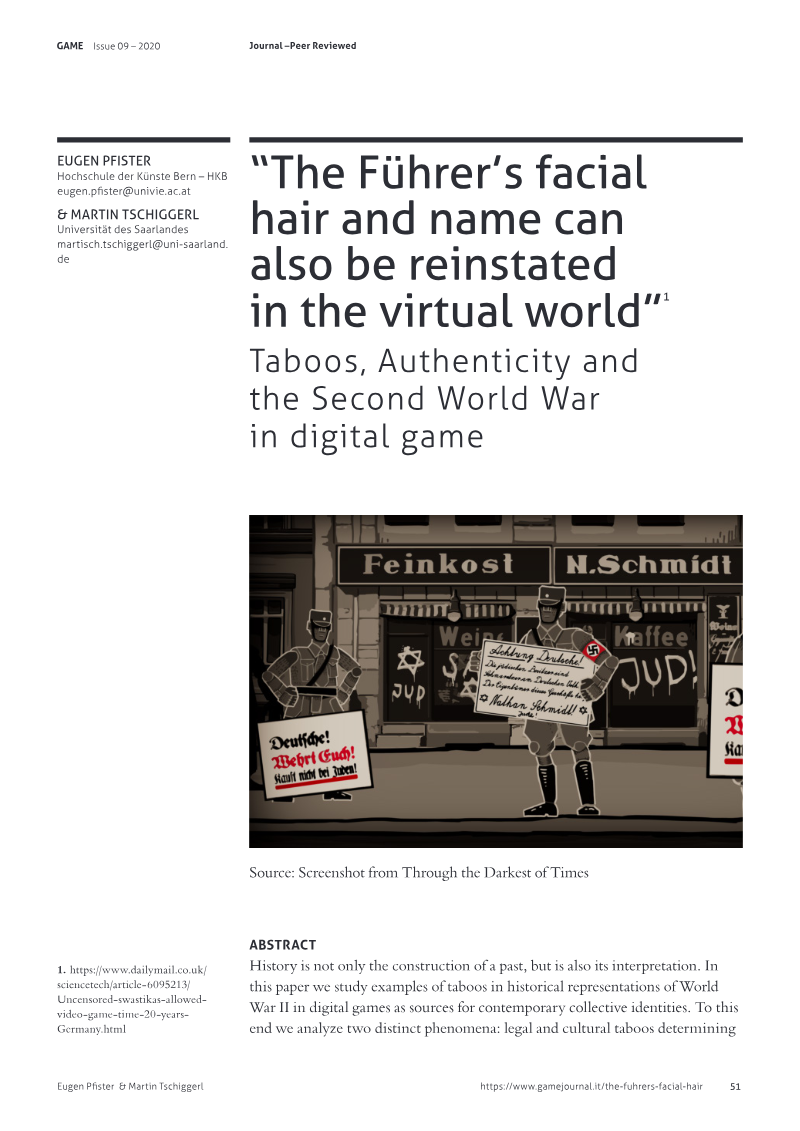
The Führer's Facial Hair and Name Can Also Be Reinstated in the Virtual World: Taboos, Authenticity and the Second World War in Digital Games
This study examines how legal taboos, cultural norms, and player-enforced standards of "authenticity" shape the depiction of Nazi symbols, the Holocaust, and the Second World War in digital games.
- German and Austrian bans on Nazi symbols, extended to games by a 1998 court ruling, led publishers to pre-emptively censor content through cosmetic changes such as covered swastikas and renamed characters, which the authors argue can depoliticize Nazi material rather than prompt critical engagement.
- Earlier controversies such as the 1980s KZ-Manager and the 2010 Sonderkommando Revolt mod drew sharp backlash and withdrawal, while a clear paradigm shift became visible in the late 2010s, partly attributed to the pulp, fantasy, or explicitly historical framing of titles like Wolfenstein: The New Order and Through the Darkest of Times.
- Players have internalized official taboos and generate additional taboos of their own around 'authentic' historical representation, so enforcement of standards comes substantially from the player community rather than only from regulators or publishers.
G|A|M|E – The Italian Journal of Game StudiesJan 2021
Article
To Dream a Game: Dreams as Interactive-Narrative Devices in Digital Games
Frank G. Bosman's article "To Dream a Game" examines dreams and dreamlike phenomena as interactive-narrative devices in digital games, arguing that these sequences occupy a distinctive place where ludological and narratological functions converge.
- Dream sequences in digital games are almost always lucid because the medium's mandatory interactivity gives players control over dreamlike segments, with the exception of non-interactive cutscenes.
- Citing Gackenbach's research, the article reports that gamers, particularly hard-core players, tend to have more lucid and control dreams, more bizarre dreams, and more violent or nightmarish dreams, which they experience with less distress.
- Bosman proposes a working definition of dreams as a temporarily diminished-consciousness state experienced involuntarily, and applies it through close reading and game-immanent analysis of playable texts.
gamevironmentsJul 2020
Article
Heute Gehört Uns die Galaxie: Music and Historical Credibility in Wolfenstein: The New Order's Nazi Dystopia
The article examines how the soundtrack of Wolfenstein: The New Order (2014) constructs an alternate-history setting in which the Nazis won the Second World War.
- The soundtrack of Wolfenstein: The New Order (2014) builds an alternate-history Nazi-victory setting through 'Nazi rock 'n' roll': German-language parodies of 1950s–60s American hits released under the fictional label Neumond Records.
- The author argues that the music's departure from historical fact paradoxically strengthens the game's verisimilitude, using Planells' semantic-pragmatic model and concepts of authenticity and historical resonance/dissonance.
- The game leans on cultural shorthand, especially the association of German language with the Third Reich, while keeping lyrics ideologically 'aseptic' and largely avoiding explicit Aryan supremacist content, as in the lunar song 'Mond, Mond, Ja, Ja.'
G|A|M|E – The Italian Journal of Game StudiesDec 2017