Multi-User Dungeon
Game
4 documents in the library are about Multi-User Dungeon, from writers such as BITKRAFT Ventures, DiGRA and Extra Credits. Each has a summary and key insights with the page they come from.
Connections
Each row is a game or company named alongside Multi-User Dungeon, each column a document, oldest first. A mark means that document names it. Select a row to see those documents.
Documents about Multi-User Dungeon
Autonomous Worlds | BITKRAFT Summit 2024
Autonomous worlds represent a paradigm shift in digital environments, functioning as fully on-chain gaming ecosystems where blockchain technology serves as an immutable, permissionless foundation.
- Autonomous worlds are defined as fully on-chain, permissionless environments where digital physics and rules are decentralized, allowing for unlimited, composable experiences beyond the original creator's intent.
- Cartridge is developing the open-source toolchain 'Dojo' and 'Slot,' a rollup-as-a-service platform, to provide the infrastructure necessary for developers to build fully on-chain games.
- Unlike centralized platforms like Roblox, autonomous worlds eliminate platform take-rates and permission requirements, enabling developers to commercialize and iterate on game assets and mechanics freely.
Silent In-game Concerts: Text-Based Musical Performances in MUDs
The document argues that in-game concerts, often perceived as a recent phenomenon exemplified by events like Travis Scott's Fortnite concert, have a much longer history rooted in Multi-User Dungeons (MUDs).
- The paper argues that in-game concerts, such as Travis Scott's 2020 Fortnite performance, descend from spontaneous musical self-expression in text-based multi-user dungeons (MUDs) rather than originating with recent spectacles.
- Its evidence base is qualitative: semi-structured Discord interviews with a former MUD player and a BatMUD developer, email correspondence with MUD1 co-creator Richard Bartle, and BatMUD gameplay records from 2001, gathered in 2023–2024.
- Players conveyed musical performance through written descriptions of emotional qualities, such as a "plaintive chord," rather than technically specified notes or audio, with the author treating described sound as a form of sound.
MUD: Messrs Bartle and Trubshaw's Astonishing Contrivance
The original Multi-User Dungeon, developed in 1978 by Richard Bartle and Roy Trubshaw, serves as a foundational case study for the importance of simulation-based design in virtual environments.
- The 1978 Multi-User Dungeon (MUD) by Richard Bartle and Roy Trubshaw demonstrates that immersive virtual worlds are best built on robust, logical mechanical systems rather than imitation of existing game tropes.
- Prioritizing consistent internal physics and environmental causality minimizes cognitive dissonance, allowing players to engage in emergent gameplay through environmental manipulation instead of scripted paths.
- The MUD's ten-level progression system was designed as a meritocratic structure to subvert rigid social hierarchies, illustrating that mechanics should function as a purposeful expression of the creator's vision.
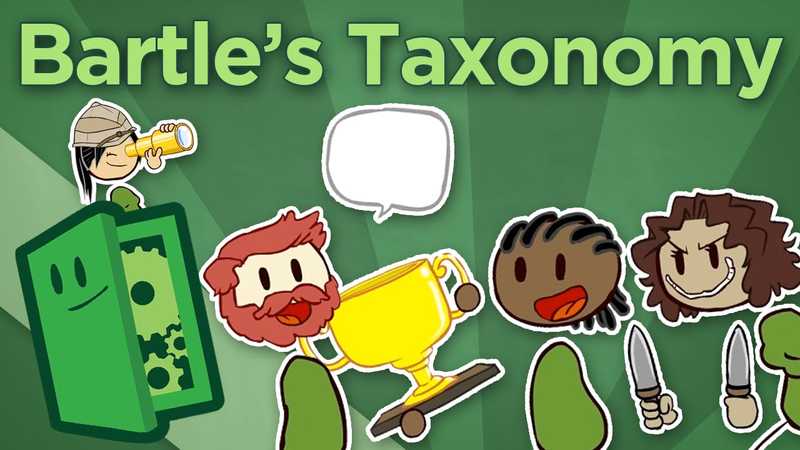
Bartle's Taxonomy - What Type of Player are You? - Extra Credits
Bartle’s Taxonomy serves as a foundational framework for understanding player psychology within multiplayer environments.
- Bartle’s Taxonomy categorizes player motivations into four archetypes—Achievers, Explorers, Socializers, and Killers—based on Richard Bartle’s sixteen years of observation of Multi-User Dungeon (MUD) players.
- The taxonomy utilizes a two-axis coordinate system—acting versus interacting and players versus the world—to map how specific game mechanics influence user behavior.
- Achievers are driven by mastery and status, while Explorers prioritize the discovery of hidden mechanics, lore, and secret areas.