Depression Quest
Game
Documents about Depression Quest
Whitepaper23 pages
Playing to Care: Games as Empathy Development Tools in Healthcare Education
Digital games serve as a transformative pedagogical tool for cultivating clinical empathy within healthcare education, bridging the gap between traditional narrative medicine and interactive digital experiences.
- Digital games offer a viable pedagogical tool for developing clinical empathy in healthcare students, functioning similarly to narrative medicine by fostering cognitive empathy and the intention to help patients.
- A literature review of 604 publications identified 36 relevant studies, revealing that while commercial games like 'Depression Quest' and 'Spiritfarer' show potential for empathy development, only one game has been experimentally proven to achieve this outcome.
- Clinical empathy is best served by cognitive empathy—a detached understanding of a patient's state—rather than affective empathy, which involves mirroring a patient's emotional distress.
Press StartAug 2026
Whitepaper14 pages
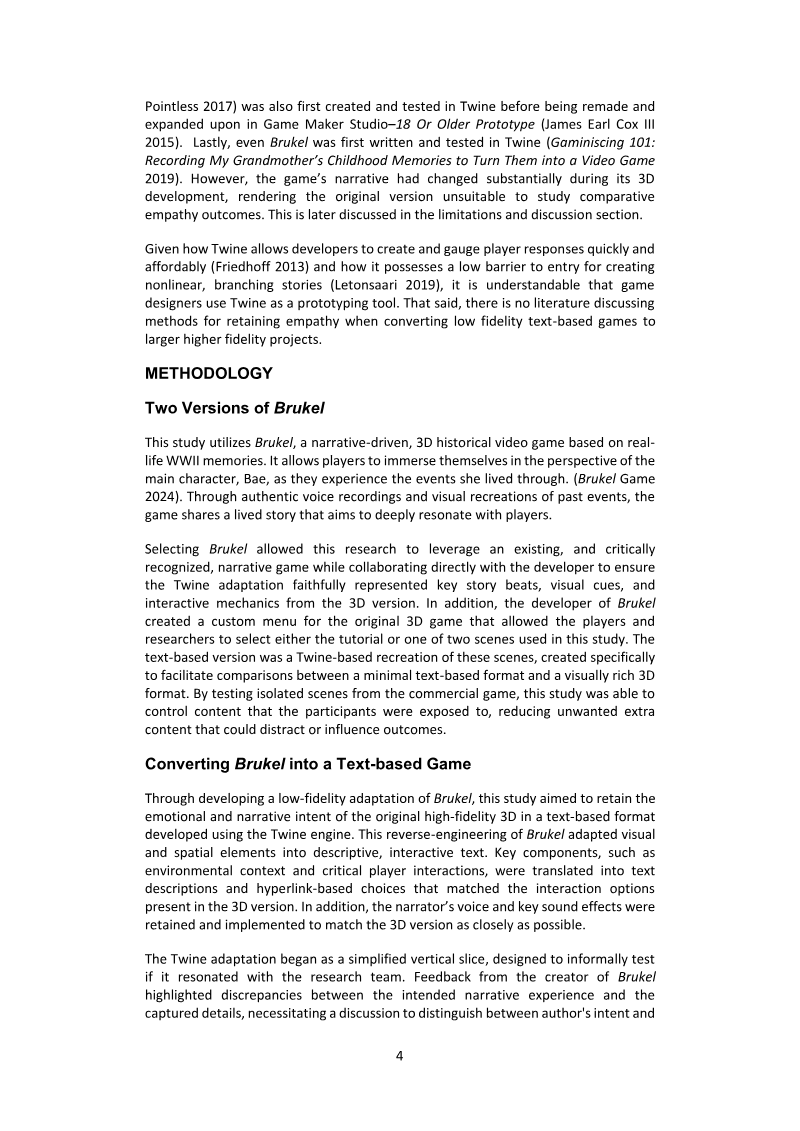
Assessing Empathy Across Game Fidelity Levels: A Case Study of 3D and Text-Based Versions of Brukel
This study aimed to determine if game fidelity influences player empathy, specifically comparing a high-fidelity 3D version of the game "Brukel" with a low-fidelity text-based adaptation.
- A 2025 DiGRA study randomly assigned 42 participants to either a low-fidelity Twine text adaptation or the high-fidelity 3D original of the narrative game Brukel and measured empathy with Shen's State Empathy Scale.
- Frequentist tests found no significant differences between the versions on any empathy dimension, but the equivalence tests (TOST) were also non-significant, so equivalence could not be confirmed under that approach.
- Bayesian analysis showed moderate evidence of equivalence for cognitive empathy but only anecdotal evidence for affective and associative empathy, suggesting the text version may be strongest at fostering understanding of characters' perspectives.
DiGRAJun 2025