ArticleGame Discovery Now
Will Fewer People Buy Your Steam Game Due to Player Reviews?
24 Jul 20261 pages~10 min full read
Key insights
5 slides
The rising bill
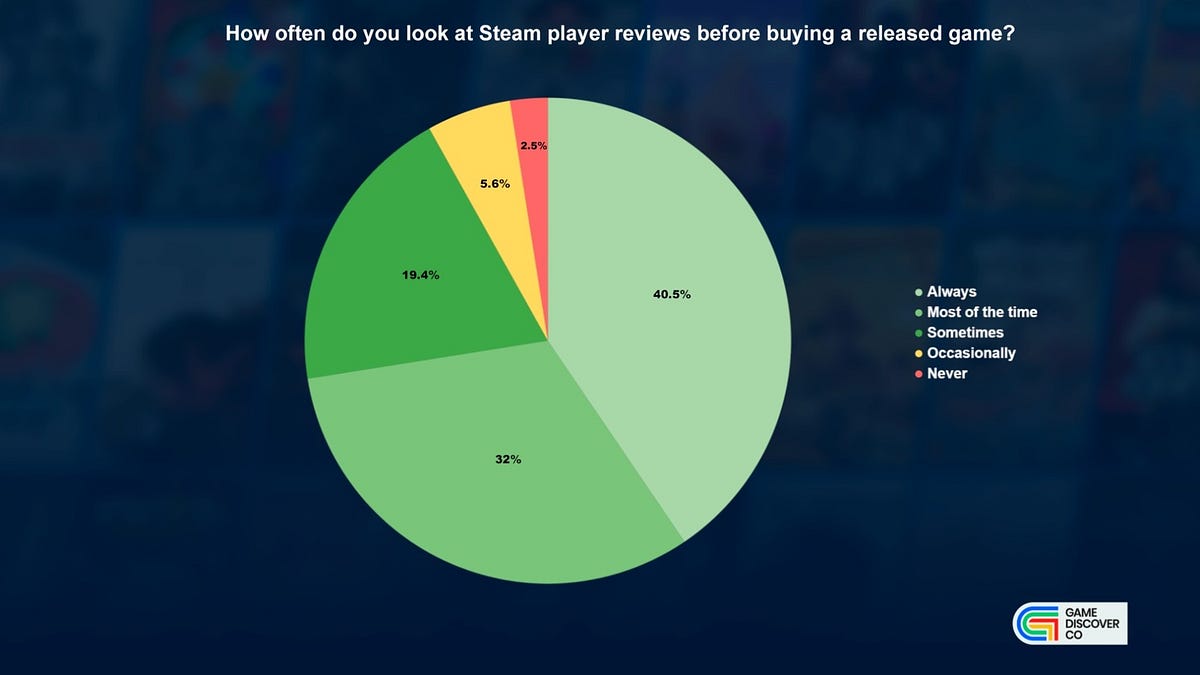
Most players check reviews before making a purchase.
A significant majority of respondents check reviews either always or most of the time before buying. Only 9.7% stated that review ratings have no significant impact.
72.5%
of respondents check reviews always or most of the time
- said ratings have no significant impact
- 9.7%
Key number
Lower review scores make players less likely to buy.
30.8% of participants are less likely to buy a game with Mixed or lower reviews. 20.3% are less likely to buy a game with Mostly Positive or lower reviews.
Score impact. 30.8% of participants indicated that a rating of Mixed or lower would make them less likely to buy a game.
Trend signal
Recent reviews worse than all-time ratings trigger close scrutiny.
38.1% of players will look very carefully at recent reviews if they are worse than all-time reviews. An additional 47.4% will check them while understanding potential short-term complaints.
What players value
Players value reviews for identifying bugs and technical issues.
The most helpful aspects are identifying bugs, performance, and technical issues, cited by 14% of respondents. Providing an overall aggregate player consensus was cited by 8% of respondents.
Platform response
Steam added wishlist organization changes to help players sort reviews.
Steam implemented changes to wishlist organization, allowing players to sort by categories like 'Next Fest' or 'Wait For Reviews'. Games featuring demos are highlighted.
- 01Sort by categoriesPlayers can sort by categories like 'Next Fest' or 'Wait For Reviews'
- 02Customize notificationsPlayers can customize notifications
- 03Highlight demosGames featuring demos are highlighted
1 / 5
Ask AI about this report