ArticleGame Discovery Now
Why Hobbyists Are a Bigger Discovery Disruptor for Games Than AI
2 Jun 20261 pages~13 min full read
Key insights
8 slides
Core claim
Hobbyist developers are a bigger disruptor than AI.
AI accelerates development, but democratized tools drive the market shift.
Disruptor. Hobbyist and semi-professional game developers represent a more significant disruptive force than AI.
Enablers
Accessible engines, asset stores, and Steam fuel the rise.
High-end engine technology, affordable asset stores, and global distribution platforms allow small teams to reach audiences directly. These factors make it difficult to distinguish professional from independent outputs.
- 01Accessible enginesUnreal and Unity provide high-end technology.
- 02Asset storesFab.com offers readily available assets.
- 03Global distributionSteam offers equal reach for small teams.
Scale
Dinkum reached $23 million in lifetime Steam revenue.
The solo-developed game secured a publishing deal with Krafton.
AI's role
AI equips programmers with faster tools.
AI's impact is about equipping programmers with faster tools and enabling non-programmers to create games. It does not directly produce games itself.
Strategy
Developers must focus on genre-specific expertise and communities.
To remain competitive, developers must focus on genre-specific expertise, identify clear scale differentiators, and cultivate dedicated communities. Failure to adapt risks irrelevance as high-quality hobbyist content saturates the market.
- 01Genre expertiseFocus on genre-specific expertise.
- 02Scale differentiatorsIdentify clear scale differentiators.
- 03CommunitiesCultivate dedicated communities.
Platform
Steam's lack of search ads benefits organic discovery.
Paid app store ads on platforms like iOS can lead to acquiring users who would have been found organically. Steam's lack of on-platform search ads is beneficial in this context.
Hardware
Nvidia's RTX Spark runs intensive games at 100fps.
Nvidia announced RTX Spark, Arm-based chips for Windows PCs, capable of running graphically intensive games like Indiana Jones and the Great Circle at 100fps at 1440p. The chips include anti-cheat support for Windows on Arm.
Viewership
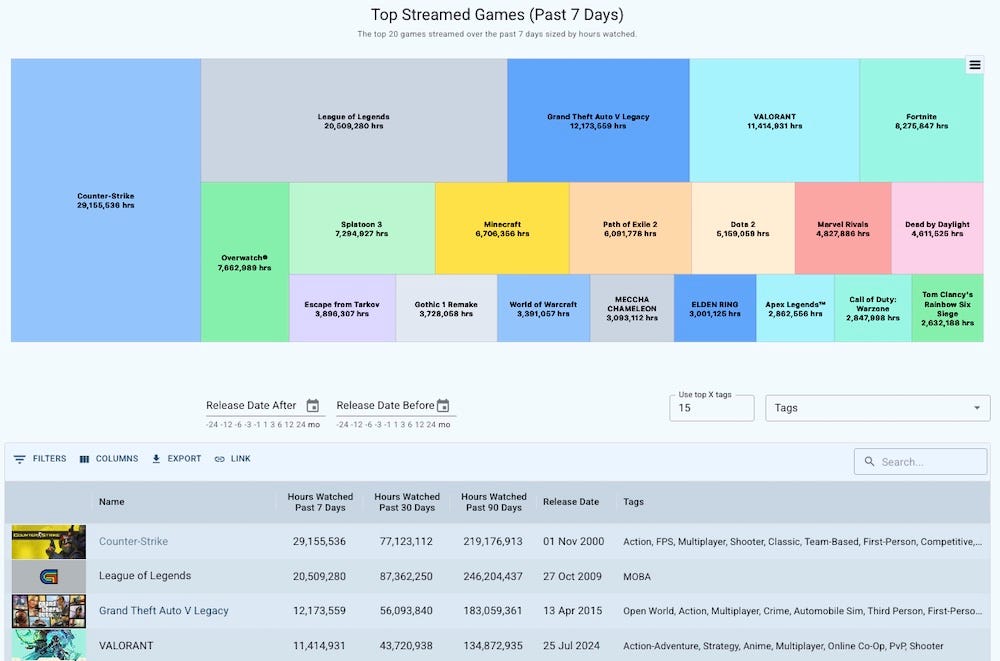
League of Legends viewership rose 27.9% in May 2026.
The game reached 185 million hours watched in May 2026. This increase was partly due to LCK Cup 2026 coverage and the rising popularity of platforms like Chzzk in Korea.
1 / 8
Ask AI about this report