1 free read left. Create a free account for unlimited reading + AI research.
Create free account
Why/How Does Web3/Blockchain add Value to the Players & to the Game Studios - Adoni Ioannou
Key insights
5 takeaways- 01The shift toward Web3 gaming is driven by significant capital investment and the entry of top-tier talent, signaling a transition toward long-term industry adoption as user experience barriers are resolved.
- 02Blockchain technology enables true digital asset ownership, granting players legal status over in-game items and creating a portable record of play that exists independently of specific gaming platforms.
- 03Web3 infrastructure facilitates 'modding for markets,' allowing players to build third-party tools and economies that add value to the core game experience beyond the developer's original scope.
- 04Studios can leverage existing APIs and SDKs to transition from traditional monetization toward two-way economies that reward active player participation.
- 05The integration of decentralized infrastructure allows studios to move away from 'walled garden' models, reducing reliance on major technology firms and fostering deeper player retention through aligned incentives.
Ask AI about this video
Transcript
foreign [Music] [Applause] we are now on to our last talk so the talk that was in the schedule isn't now happening the one office one but uh the next uh final talk for the for the South this afternoon is uh adoni from immutable oh Andy's brand as well um can be talking about how does web 3 blockchain add value to players and game studios so that's pretty much everything isn't it okay off you go thank you hi everybody my name is adoni I'm from immutable and
I'm also the last thing standing between you and drink so appreciate you sticking around immutable X is a platform to help game companies on board to web 3 and be successful but we're also a game Studio I am not here though to talk about us I'm here to talk about why web3 matters for the player and why it matters for the developer out of our conversations with tons of Studios we try to distill it in a few I'm not sure why this is going forward without me clicking try to distill it in a simple argument that you can hopefully take it back to explain to your colleagues to your to your partner to your friends right and in in summary as a gamer I care about web 3 because I've already been promised asset ownership and I also care because I want to be able to create on top of my favorite games and experiences I want deeper play and I want new types of social
experiences and and communities and for the developer now I get to add more value to the player I get to align my incentives further with my customer and web 3 just like social and mobile becomes this brand new distribution method that has the potential to disrupt the power that big Tech has over the Internet so that was the summary um and let's let's jump into it but first when I say web 3 games I mean actual game experiences that people play for the sake of playing I don't mean any of the projects that are uh promising to get you really rich overnight so there's three arguments on the player side and the first is that it just delivers on an existing promise right the game industry has been selling assets online forever all the way from Bethesda to you know the horse armor to why this is moving on its own to World of Warcraft to Fortnight it's a massive
business because there's real appetite for digital assets both conscious and unconscious and I say I say unconscious because the gamer doesn't always have visibility into what they're going to want in the future the same thing happened with game game streaming right they didn't know people didn't know they're going to want it but then they were given it they figured out cool ways to use it and the industry was moved forward in exciting ways the same thing will happen with ownership but up until now ownership has not been there yet it is often denied or it's a thermal lasting as long as the game's budget lasts or as long as that player is given access to the game really getting the user excited about the asset but not fully delivering on it and that's not because the industry is evil or it has bad intentions it has just lacked the framework to deliver on
that and that is what that it's all broken that is that is what uh web3 really does it it delivers on that through a multi-layered openstack that delivers real ownership and I say real ownership because it has real legal status right the same status as a Bitcoin or as a physical item a good status that can be passed down to your children or that it can be represented at court and generally what I would have been showing you here in this beautiful button uh is at the bottom you have the blockchain that just proves who has what then on top you have a scaling solution that scales you to the billions you have forever hosting that allows to host digital assets for more than 200 years and then a platform like immutable that brings it all together as a as a platform with great ux and if you think
about all those layers you couldn't have asked any game company to build that on their own it had to happen at the protocol level just like the internet and so for the game developer think of the merchandise that they sell right like the physical the hats and the bags that they might be selling but now they're digital and they need a digital asset Factory to deliver things on time even when the demand spikes a digital asset Factory that's not going to get broken into or collapse and will ship high quality products and of course not everything has to be a real asset on the blockchain the devs can still have it's just it's just moving around on its own yeah maybe we kill it and I just talk
yeah but I was as I was saying you don't need everything to be on the blockchain you can still have pretend assets on your database as a developer but increasingly so as the you know as the user base gets educated on all of this they're going to start asking questions right like okay you're selling this 20 item to me what does it mean what access do I have for how long now that the the cat is out of the bag it's very hard to walk backwards and so that was Point number one real ownership with real status delivered by this new stock Point number two is equally as exciting it is the fact that web3 will open up Innovation and user generated content and creativity for the player base it's going to open up the game similar to how modding opened up games before but now it's going to be modding for markets and for assets if you recall
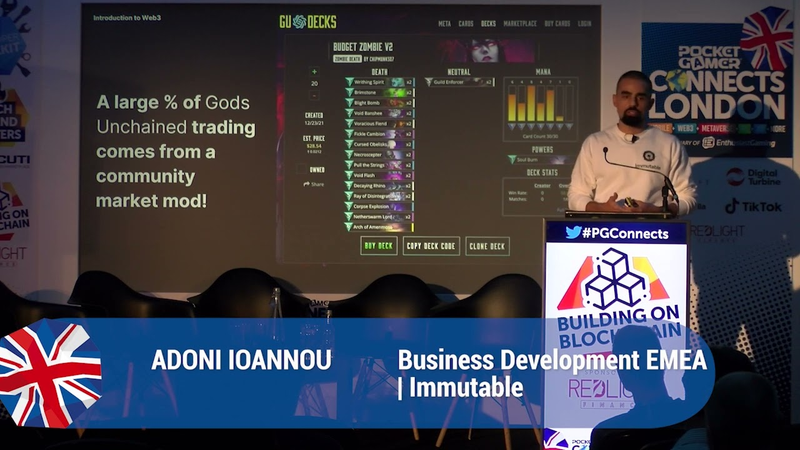
with modding in the beginning the industry was very suspicious of it didn't really know what the point is right like what are my users going to do are they going to build naked mods how am I going to make money what's going to happen and then a few companies relax the grip and beautiful things came out like Counter-Strike and DOTA in Minecraft all of those things are products of modern and now it's considered best practice that is what web3 is asking of Studios relax the grip over assets and over markets and see what the players are going to do you don't have to relax it completely you can start small you can you can fully relax it but try it out and see what the players are going to do player-led Innovation cannot be exaggerated that's perfect yeah cannot be exaggerated nice uh this is one of our games actually this is not a game we have a game called Gods on chain it's a trading card game like
Hearthstone it has an evolving meta it's a web free game and what the community did is that they built this Market mod it's called gu Dex and what I can do as a player I can connect my wallet it sees what assets I have and what history that I have and can suggest different cards I should be buying based on the latest meta of the game and then with one click that green button down there I can potentially do 32 peer-to-peer transactions with other players to buy their cards and build my deck right and that's only possible because of web 3 and because of the blockchain we as immutable as God's Unchained Unchained had nothing to do with this site and now a really big part of the game's trading comes from that green button down there that's pretty amazing if you take that as an example as inspiration we think that in the future you're going to have the nfts the the assets having inherent
utility that's created by the studio but then increasingly you're going to have libraries of utility created by by the community or by vendors allowing people to do things like auction the asset or package it or crafted in a completely different type of asset you can't really predict what they're going to do but they're going to figure it out and that's what this is about so that's Point number two motive for markets and creativity Point number three for the player is the metaverse and we believe that it's the definition is simple the players are the metaverse and to begin with the player needs to own and control the record of play and achievement like imagine that right the whole identity their entire history in one place today that history is fragmented across hundreds of games and platforms like Xbox and PlayStation and epic can't really do anything with it
and that fragmentation to be fair is totally normal because in the game industry you don't have a massive winner like Google that's going to step in and say Here's your record of play and that's great because we don't want that but also it puts the industry at a stalemate and stalemates like that can only be broken through technology changes at the protocol level where power is given back to the user no one company is controlling it and then you can do interesting things on top that's what web3 does it breaks the stalemate it can create this record of play and achievement this identity and then we can build to the interesting parts of the metaverse where you have assets living in between games and between different types of platforms but if you don't have a foundation you can't build up to that so those are the three points on the player side it's real ownership it's the motive for markets and creativity and it's this record of play
now on the developer side to us at least it's pretty obvious that now the developer can add more value to the player and new types of experiences and taking a step back can respond to this phase that the game industry has entered a phase of hyper consolidation and Hyper competition you already have half of the world's population playing games marketing costs and production costs are skyrocketing you have user acquisition getting harder and harder because of the Privacy changes so it's totally normal to be in that environment and you have the big tech companies coming in to acquire game companies and their audiences to keep them in their world Gardens but we believe it's game companies and gaming Tech with the blockchain that have the ability to provide this Innovative experiences build the future and disrupt this power that big Tech has
over audiences but again we believe that the level up that is needed is ownership because when you can own it collect it Trade It it massively improves the player experience you have a two-way economy that creates deeper play new types of communities social experiences business models and it is two-way it means it aligns the incentives between the player and the developer because the player now has a stake participates in the selling participates in the marketplace they care more they stick around for longer retention goes up and overall they spend more money and web 3 opens up this new distribution method error that is going to create new category winners if you look back over the last decades you have these societal shifts this massive changes in our lives that change everything across the board and for games if you think about it you know
social mobile PC console all of those things open up a new distribution method error and the companies that embrace them first got to be category winners of the next phase think of Zynga think of you know supercell think of think of politica that's what web3 will do create category winners as a new distribution method as a societal shift and everybody adapts to it in one way or another so the question is how long do we wait do we wait until we have all the data we need and it's obvious to everybody that the shift is happening or is that too late because every time before the era really took off you could have observed signals in the market for console games it was hey are there enough homes with TVs for PC games somewhat similar but maybe also is it affordable enough for a lot of folks to have a PC for mobile games
you know smartphones existed for a while but it wasn't until the speed of the connection and the reliability of the connection was high enough to support the user experience for web 3 the question is can I scalably mint digital assets for under a cent or for free without hurting the user experience and the answer to that today is actually yes you can which we believe makes the transition inevitable another factor of course that supports the inevitability is the capital and the talent usually when you point those two things at an interesting problem they tend to to solve it it's what happened with the internet it is what happening with what's happening with web3 over the last years we've had billions of VC money poured into the space funding web 3 infrastructure companies web free game companies and talent quitting their high-paying jobs or coming in from University to to take a crack at this
but it's not just the the startups it's also the world's largest companies that are stepping into this into the fire line with you know with an evolving narrative and they're figuring out how to iterate how to test and build and be part of it rather than waiting until they can acquire someone much later at a premium cool so where are we with all of this we're not a hundred percent there yet mainly well it's a good thing gives us more time but uh mainly because of two reasons one the user experience is still pretty clunky especially for the mass market player the whole industry realizes this and we're all racing to solve it including immutable and the second one is that there's just not enough high quality games out there to date like real real games but there are tons of successful game makers that will be shipping product this year and for the next few years so it's not really a matter of if it happens it's a matter of when it
happens so the the takeaway if you can bring that back to your company or to your friends the takeaways here is as a gamer I care because I care about true ownership with real legal status I care about new Creator economies I care about creating on top of my favorite games and I care about having my entire play history and achievement in one place and for the industry that better aligns incentives it creates deeper play Community social experiences and for the developer web3 becomes this brand new distribution method that can disrupt the power that big Tech has over all of us over over audiences so we believe that now it's the time for devs to be building and learning now that the iron is hot rather than waiting until it's all mature and it's obvious to everybody that this is the way things are that's been our experience building games and supporting tons of other developers with our services and our
platform we are 350 people globally where company value at 2.5 billion we are already under the top protocols in actual gaming nft Trading tons of developers you might have heard some like eluvium an ember sword Undead blocks our own games like Guild of Guardians and gods Unchained tokens and of course tons of investors supporting our our ecosystem so without appreciate you guys I hope that you enjoyed our point of view happy to chat after this find me on LinkedIn email me or just go on our site and and build on us it's very easy it's all behind apis and sdks anyone can build thank you very good good way to end the day I don't think I have anything yeah any questions uh would that be the best way to end date are there any questions out there or is everyone everyone it was so clear everybody just got it everyone's
just going to go yeah yeah got that I think we've all done then lovely well thank you very much thank you thank you [Music] [Applause]
Summary
Web3 and blockchain technology offer a transformative shift for the gaming industry by providing a framework for true digital asset ownership, enhanced user-generated content, and decentralized identity. The primary thesis posits that these technologies move beyond current industry limitations by granting players legal status over their in-game assets, enabling community-led innovation, and establishing a portable record of play that transcends individual platforms. For developers, this shift represents a new distribution method that aligns incentives between creators and players, fostering deeper engagement and retention while offering a strategic alternative to the consolidation and control exerted by major technology firms.
Key findings emphasize that the current gaming landscape is characterized by fragmented player data and "walled gardens" that limit user agency. Blockchain technology addresses these issues by providing a multi-layered, scalable infrastructure that allows for the secure, permanent hosting of digital assets. By relaxing control over these assets, studios can encourage "modding for markets," where players build tools and economies—such as third-party trading platforms—that add value to the core game experience. This transition is supported by significant capital investment and the entry of top-tier talent into the sector, signaling a shift toward inevitable adoption as user experience hurdles are overcome.
The scope of this analysis covers the global gaming industry, focusing on the intersection of game development and decentralized infrastructure. While acknowledging that the sector is still maturing, the findings suggest that the current phase of development is critical for studios to gain a competitive advantage. By leveraging existing APIs and SDKs to integrate blockchain, developers can move beyond traditional monetization models toward a two-way economy that rewards player participation. Ultimately, the integration of Web3 is framed not as a speculative financial endeavor, but as a necessary evolution in game design and distribution that empowers players and disrupts existing power structures within the digital ecosystem.