1 free read left. Create a free account for unlimited reading + AI research.
Create free account
A Deep Dive into Liquidity Pools (ft. Crypto Unicorns) - The Metacast by Naavik
Key insights
6 takeaways- 01The success of a liquidity pool launch relies primarily on robust community education and the establishment of genuine pre-launch demand rather than technical configuration.
- 02Integrating decentralized finance liquidity pools and automated market makers allows Web3 games to replace centralized order books with self-balancing, real-time internal economies.
- 03Maintaining stable trading environments requires developers to actively manage slippage risks and ensure sufficient liquidity levels are consistently available.
- 04Liquidity Bootstrapping Pools enable fair price discovery and trustless liquidity, helping developers avoid the mispricing risks associated with fixed-price token launches.
- 05Protocol-owned liquidity and staking models incentivize long-term token locking by offering governance weight and yield, which aligns community interests with project longevity.
- 06To mitigate the risks of volatility and speculative trading, developers must ensure that tokenized economies are backed by immediate, tangible in-game utility.
Ask AI about this video
Transcript
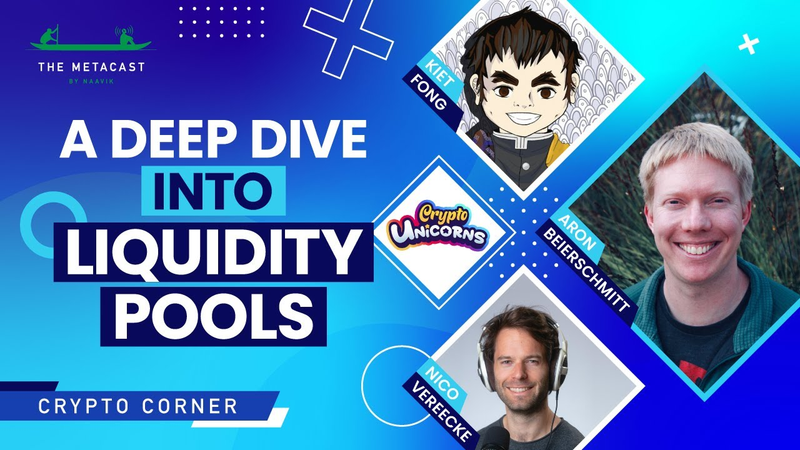
[Music] GM friends and welcome to the medicost cryptocorner brought to you by navic I'm your host Nico Greek or Nico for shorts and today I'm joined by Aaron byersmith who's the co-founder and CEO of crypto unicorns and we also have get Fung who's a researcher and angel investor in gaming the idea for this episode was to take a deep dive into liquidity and what liquidity means for games if you're building a web free game with an open open economy more specifically we're going to talk about liquidity pools what are they why are they needed why do game devs need to think about them and what can we learn from the implementations we've seen over the past years and we're also doing a bit of a double whammy in this episode because we haven't had Aaron on yet but Aaron is building one of the coolest games out there um crypto unicorns live on polygon
um so yeah let's let's get going let's start with some intros um Aaron you want to give us like a two minute background on you certainly Miko um I appreciate you guys having me on um I am one of the co-founders at Laguna games and we are the creators of crypto unicorns a top game on uh the polygon uh side chain I'm excited to be here and deep dive into all things liquidity and corns love it um one quick question what did you do before founding Laguna games yes I said another gaming startup called Beyond games we were building Forex strategy uh mobile MMOs um we built launched and live operated battle Strike Force which had Sylvester Stallone as the face fit um we live operated that game for about 18 months um ultimately almost got acquired by a machine Zone um that fell through in late 2019 and uh over the course of December myself and
Stephen Garcia my co-founder uh worked to kind of put together a seed round and rehire a chunk of the uh X Beyond games team and that kind of became the seed for uh Laguna and yeah we kicked things off in January of 2020 right as covid was taking over so uh startups are a pain startups are a painful process yes otherwise everyone would do them you know so exactly yeah all right good how about you so I'm kit and thank you Aaron for being here today I am really excited to have you on because I wrote this paper and I was like man I wish I got to speak with these Founders and actually ask them what kind of what they were thinking about so I'm very glad to have you on today a big background on me I was in crypto since 2017 but more on the D5 side but uh prior to that I was actually in gaming I built and ship games on Roblox specifically and then you know fast forward to 2022 where web3 gaming
is a thing and I get to mix crypto and gaming together so it was a Perfect Blend and now I run a basically a news aggregator and daily content for web 2 and web 3 gaming news called The Core Loop and I also am a contributor to navic um as a research SAS fantastic and so the background of this episode is a piece that get Rhodes for navic pro um which like where we provide some some very deep pieces on different topics within blockchain gaming but also free to play Etc um and that was about liquidity pools and so he wrote a what was it like 27 page piece um and so today we're gonna make your life your life easy you're gonna don't have to read it because we're gonna provide everything you need um in your ears so um yeah kick it off uh what like you know curious to have you let to have you you walk us through and then have Aaron's input as well yeah absolutely yeah so Aaron as a web 2
founder who kind of just Dove head first into web three like clearly you you weren't afraid to experiment with all of the different D5 Primitives from the liquidity bootstrapping pool all the way to like the staking mechanic could you walk me through a little bit about your very first foray into this like liquidity pool what was your research process who did you talk to and things of that nature yeah absolutely honestly a big part of it was my own experience in the space so I had been um I like to say I kind of became a crypto d-gen over the course of 2017 that was really my entrance into the space um I cobbled together about fifteen thousand dollars it was about every dollar I had in the world at the time um to make my first like major investment in the space January 3rd of 2018. which basically timed the market top pretty much exactly
um so I joke because that was my entrance into the space was like crashing out 85 um over the next two quarters in 2018 right and it was really 2018 2019 that I started to kind of just um you know really begin to I guess drink the Kool-Aid like I am uh I became very comfortable with kind of self-custody and um uh you know familiar with just connecting my wallet to all these apps and beginning to experiment and use things like uni Swap and um other dexes and things of that nature and then you had the covet crash in 2020 and at that point I go all right I've seen the story before you know Now's the Time right so I was able to make um a pretty sizable investment in ethereum um at 212 and then obviously D5 summer happened so I'd been doing a lot of yield farming um uh liquidity Mining and things of that nature
um and so it was really a lot of that experience that I took into um uh the pivot of us from kind of web 2 and into web 3. um so looking at places to deploy um uh are or do our I guess our public sale of the rbw token the copper launch platform came up pretty quickly right because I've been following the balancer team a ton and I'm a huge fan of um a lot of the innovations that they've kind of brought to the space particularly like non 50 50 waiting of pools and things of that nature as well as pools of you know uh varying assets um uh uh and so anyway when when they launched this kind of liquidity bootstrapping mechanism um and I saw other projects kind of taking uh and leveraging that with success it became kind of a natural place for us to um kick off our public token offering got it and as you know actually I want
to take a step back and really quick for the listeners at home could you share what is crypto unicorns yeah so we're a blockchain based game on the polygon Network it's all about two primary nft assets one is land um uh which you can piece together into these kind of little mini land Empires and then you take your unicorn nfts and you put them to work on your land and so you can plant and harvest uh berries which unicorns love those berries as well as other materials feed into a very deep crafting system in which you can take your unicorns deploy them into the workshop to craft various Commodities and items all of those are used to either upgrade buildings or create evolutionary or hatching boosters that allow you to boost the potential chance of getting higher Stat or better part uh unicorns as you're doing breeding and
evolution and things of that nature so we started with this MVP launch of our kind of Farm Sim and then over the course of the next year we're based releasing a series of battle loops on top of the Farm Sim and the idea is that you take your high stat unicorns off the farm to go and do and participate and compete in these in these various battle Loops right so the first is joustain because they're unicorns they have horns it's hilarious um or she was so close to releasing some teaser footage of the unity build of that game Loop and it really does look incredible it's kind of moved in a very like kind of Pokemon Arena Street Fighter direction that I think is just going to be a lot of fun to kind of watch and compete and so the overall system is you tie everything to this core uh Farm Sim that represents kind of the engine of the overall game economy so all the Commodities that are being produced for
example like potions and jousting which buff or debuff you or your opponent those are coming out of the crafting and workshop system right and so with everything we release um uh we're driving value back into that kind of core Farm Sim for players that want to participate in that um system got it and how does the rbw token kind of weave into this whole economy yeah so one of the major decisions we made early on was to very deeply integrate rbw into the game economy and make it kind of the focal point where a lot of games keep their government's token really outside of their game economy we made it the center of ours and to do so we created the rainbow token Marketplace which is actually an off-chain amm so we actually use the same equation that uh uni swap V2 and many other dexes use um to this day to determine the uh price
of all of our soft currencies so the vast majority of soft currencies in the game exists within the rmp and are effectively in their own little two-sided liquidity pool so not only are we doing all the kind of on-chain liquidity stuff that you would expect we actually have this real-time 24 7 365 amm inside of the game where you know for for example you can go in and buy plain berries and the cool thing is as the prices go up we naturally see players who've been producing those Commodities sell them back into the marketplace and there's this entire economy Sim at the center of the farm gameplay that's very deep and and a lot of fun if you're into that style of game well that's super cool I love how you took something that is natively on chain and Incorporated so deeply into your games economy but that's very clear that you have a core with three ethos and
values right there big time um yeah I I wanted to talk a bit more about the rainbow token launch there like you said you went with copper and was there a reason why you set the weight a certain way or is there any advice or anything you would do differently if you could have gone back and changed the LBP I mean I think in our case uh you know we were very very lucky in the timing of our copper launch in kind of late uh February of this year so prior to kind of the market collapse that we've all experienced um and I mean we've had the largest and most successful copper launch on polygon today I think were um you know we raised more Capital than anyone else on uh polygon and even competed with some of the ethereum mainnet uh copper launches um advice for people is I I do think it's a smart decision to keep it at three days I've seen some people do four or five I think you want to keep a amount of constraint on the overall time
that you're running the Ideo given the um I think if you extend the length of time too much there's not enough pressure to kind of come in right as far as the weights I don't think we did anything special relative to other projects that have launched on that platform I think a big part of it was just making sure there was enough excitement and demand in the lead up to that round I do think me closing the kind of private token cell in the lead up to that round helped the public sell because we had many investors that I talked to that elected to invest in the public round because it did not have the same lockup conditions investing conditions of the private token cell so it was an effort to set it up in the right way but I think it was really external to the variables within the copper launch platform got it and and speaking of that external
factors you know how important did the whole marketing and corralling the community do uh for the success of your LBP at any best practices there for the listeners at home education I think is really very important um you know we have a lot of people within our community who are very new to crypto many people who've created their first wallet crypto wallet to come and play crypto unicorns and so educating people on the mechanism itself because it's a little strange in that you start with an imbalanced AMA and you're trying to balance it over the course of the auction and it attempts to balance it by constantly putting downward uh price pressure um or downward pressure on price um unless there is demand and so you know in in most of the I guess one part around the strategy that I think is really important that is probably the the the difference between success and
failure on copper launch is what you set the starting price at I think some projects set it like astronomically high and what happens is it falls for a long time before getting picked back up right because it will eventually fall to a price where somebody's willing to purchase it um I think it's much you want to be much more reasonable in that starting price such that it's again it's reasonable to start with based on your expectation of demand um and and um you know the amount of buying uh pressure that you expect relative to the size of your community and these kind of things like we knew how many people we had in Discord we knew how many people um had held nft assets and things so we had this like Target set of wallets that were likely to participate in the public cell and we attempted to set a starting price that felt again very reasonable and so you would see you know if you go back and look at our copper launch graph because you can see all the ones historically and I think that's a very
good thing to research for anyone looking at this as a mechanism is to see how other auctions performed and I feel ours was pretty ideal because you saw a price kind of dip and then there was just an inflection point at which people were willing to purchase rbw that spiked it up and then it you know it's it's remained relatively stable around that price where I think fail cases are where it just Falls and falls and falls and falls and never kind of picks up and that to me is an indicator that you likely set the initial price far too high um for the launch um for the launch because that's another piece and this was a part of the education is it's really important to understand that early on when it's so imbalanced the price moves a lot quicker and up and down right that's a part of the mechanism and then as the pool gets closer and closer to being balanced the price is not going to be as volatile right which is intentional again because towards the end of the auction you don't want people moving the price crazy up and down right and you want larger buys and sells to
have to obviously move the price the same amount as they would have say on day one and again this is a very complicated design to explain especially to people who in some cases had never used an amm before um and so again uh the the best practices there is to make sure the community really understands the mechanism that this is an auction trying to um discover the price of an asset like what you said it at the beginning is not you know necessarily at all where it will and right um and so pricing that is is very very very important at the uh at the onset and then to your question or Point earlier around the uh the initial weight of say usdc um or wrapped teeth or whatever the counter pair is uh to your native governance token the only thing you can really do there is if you're putting more usdc at the front and it's less imbalanced because
it just means the price will be slightly less volatile at the start and I I don't know exactly personally where I fall on that um I think you want price to be a bit volatile at the beginning so that it can find the appropriate um uh price and like stabilize uh if that makes sense there's tons to dig in there but for the benefit of me and some of the listeners I feel like I'd like to take a step back because I heard a lot of terms there I heard uni swap I heard amm I heard LBP I heard copper I heard initial balances and space the space we might you know be to to going too hard to djend too fast right now so maybe yeah all right we'll pull the rep cord you'll have to kind of go through them real quick so I'd like you um to explain to me what problem is a liquidity pool solving for you and how
is it doing that yeah I think in the broader Market not just with game projects but just generally in D5 like an automated Market maker is a different mechanism for trading one asset with another um versus the more traditional order book style that a centralized exchange would have where normally there's just this order book with a bunch of buy and sell orders and the exchange is in there matching the bids with the um offers and you know trying to obviously make money on the spread and so an automated Market maker which is usually in this space encapsulated in a smart contract so it is simply a trustless mechanism by which I can take one token and go and grab another token eliminates the need for an order book and it means that there is on-demand effectively on-demand liquidity for the token that you're looking to purchase so say I have usdc and I want wrapped eth and automated Market maker like uni swap which is
pretty much the most popular one uh in the world outside of maybe curve um I go to UNI Swap and I say hey I have usdc and I won't wrap teeth and it will quote me a price based on the liquidity that exists in that pool and if I submit that transaction on chain I will receive that wrapped ease the question is do we start talking about slippage or do we just ignore that fact because that is probably the disadvantage of an amm relative to an order book it's you're likely going to incur some form of slippage which it just means you know if you really think about it I always think about it as like two columns of tokens in a pool right and again they're trying to match each other in value it at all times not necessarily quantity but value and if I go in and make a very large trade relative to the amount of liquidity that is in the pool so say there is a million dollars of liquidity in this automated
Market maker pool for wrapped teeth in usdc um and I come in to make a hundred thousand dollar trade right I'm going to incur some slippage on that because I'm handing the pool a hundred thousand in usdc and it is going to try and give me back roughly a hundred thousand in each but it will ultimately end up being a little less because of the slippage that occurs when you make that trade so the benefit ultimately is finding the pool or that goal is always to find the pool with the highest amount of possible liquidity because that will lower your slippage um in doing a trade with an automated Market maker so I think the advantages of an automated Market maker is it's automated you don't have a centralized order book um you can immediately fill an order or complete a buy or a cell in this case um and the disadvantage is going to be um slippage as a as a buyer if you are
looking to buy a certain token the disadvantage is that there's a potential for slippage correct why did you decide to like what were the other options why did you did you have to go for liquidity pool um and and or or what were the like what was your thinking then or is this just the the web free purest in you deciding no we're doing this online chain I mean there were a lot of options um you we could have set a fixed price for the token and said you know we're trying to sell 10 million tokens we'll sell them at 50 cents a token just throwing out numbers and let's see if we can sell 20 million tokens at 50 cents a token right um there are strategies like aurori uh did on Solana where there's like a fixed supply of tokens but you're not just selling them at a fixed price you're kind of letting people come in and basically put in um usdc and again they raise like a
hundred million dollars that way um not setting kind of a fixed price per token in our case we it's really hard to know what the price of your asset should be like how do I predict what the demand is going to be and I don't think there's any mechanism to do that because you're trying to kind of predict what human behavior is going to be right and so the advantage that I saw in Copper launch and liquidity bootstrap mechanism is the idea that we could effectively run this auction that would allow people over the course of the three-day period to it just naturally determine what the price of our token is versus me coming in and saying oh I want to sell it at this fixed amount um and you know Rory again didn't sell it at a fixed price they kind of did an auction as well the advantage of the
liquidity kind of bootstrap mechanism is at the end of it we just removed that liquidity and then we put a portion of that a brand new liquidity pool within 10 minutes and suddenly we had a live open market for the token out uh once the copper launch had kind of concluded and so that was kind of an advantage given you're already on balancer um and it made it very easy for us to have liquidity available for anyone looking to buy or sell the token after the auctions kind of conclusion um so there's a ton of options available you could use an iGo or an Ido platform and kind of go that route um but again this is a pretty web 3 native approach to it and and there are certainly some some desire to stay as web 3 forward as possible you said iGo and ideal what do those stand for Ido stands for initial decks offering so there are many decentralized exchanges that are offering platforms Sushi swaps
miso is a is an example of that where IGG launched um iGo is like initial game offering they're all kind of kind of the same thing but like binance has a platform that pitching now which is their igl platform there's lots of options available for entrepreneurs we certainly chose a path that again was pretty web3 native that we were fully in control of um and a huge shout out to the Copper launch Team it's a pretty complex thing that you're setting up and it's a very um well documented and um easy to kind of Step through experience got it so I'm going to try and explain what I understood back to you and then you can correct me when I'm wrong right not if it went so a liquidity pool is essentially um I can imagine two different pools with certain two different assets um where there's liquidity put in and when I put in liquidity so let's say we have used dollars and maybe the rainbow
token to make it easy right rainbow token is a token that you use within crypto unicorns and then US dollars is usdc is like a token that is supposedly picked to the US dollars easy to think in value-wise and so you have these two pools that have a certain balance and so they have they have an initial balance and so every time someone wants to either you know buy the Rainbow token or sell the rainbow token for usdc they can interact and use the liquidity of that pool and so depending on the amount that people buy and sell the balance will change and that will shift the relative price of rainbow token compared to US dollars that is correct at this time we are not listed on a centralized exchange when that happens um at that point it gets interesting because the automated Market maker is not using an external pricing Oracle it is simply shifting price based on
Demand right and the amount of buys and sells in that pool and as the ratio or the quantity of the assets shift based on you know if more people are coming in and giving the poll usdc and pulling rpw out the value of rbw is going up the quantity of rvw is going down in the pool the quantity of usdc is going up in the poll and so it kind of ratios around based on that level of activity when we have a centralized exchange with an order book there becomes an Arbitrage opportunity where if the automated Market maker the Dex is moving you know up or down relative to the centralized exchange There's an opportunity to kind of Arbitrage that pool back to the uh market price or the external market price of the assets in the pool okay and so just to complete my train of thought here because we also started talking about liquidity bootstrapping pools and I think this is also important so you know we've just talked about the cons concept of a liquidity pool it is a way for people you know I see someone with a
crypto unicorn profile picture and I'm like holy I want to play that game um hey I need this rbw token where do I get this okay there's this liquidity pool where I can you know put in some UCC or some rep perhaps and I get some rbw and then I can start playing the game using it to play the game now you know how does this all get started right that's I guess the next question and you know what is like how do you find that initial balance um and price that's what we talked about earlier where you know you as a Founder have to decide you know okay we're gonna start a liquid and we have to decide on how much rbw we put in there and then how much USD C uh or whatever other token you put in there and and so you know could you again now that we have more a little bit more context walk us through like how you approach that like how what price did you have in mind and how did it for example relate to some of the token sales you've done before if you did any so I guess let's just kind of walk through the mechanism and then the
sequence so when you're setting up a copper launch which again is built on top of balancers liquidity bootstrap pools idea right and the idea from balancer originally was again you don't know what the price of an asset is going to be because it is based on demand so rather than set a fixed price for the token in which you'll either not sell out because you set it too high or you'll potentially leave capital on the table because you sold it too low and it sells out why not bootstrap the liquidity over time um and so you start by setting the weight in the pool to be imbalanced so usually it's 50 50 between the two assets in the pool and for example we started with five percent usdc and 95 rbw and we had a target of roughly I think
20 million rbw tokens that we wanted to sell over the course of the auction and so we ended up putting 40 million in the pool um so 40 million set over here and we put I think just under a million usdc for that five percent and that gave us this starting price of roughly 60 cents a token and to your question around you know how we set that starting price it's it's just kind of a result of the the ratios and the the weights itself we didn't set that price and again in all our education we were like this is not us saying we think the price is going to be 60 cents you know it could be a dollar twenty it could be 250 it could be 15 cents it could be 10 cents like it's really your decision um and the idea of putting a million usdc next to 40 million rbw it gave us uh you know an idea of how quickly or how volatile the price would be how quickly the price would move up or down in the first uh day of trading
um and you know again a little bit of this is like sticking a thumb in the wind you really don't know what's going to happen um but again the mechanism is every single I think it's every minute or whatever it's going to slowly tick the price down in the over the course of the auction and you can kind of see in the projections you know if I think had no one bought eventually it would have gone down to two cents or something over three days right that's just the mechanism and then if there's people buying the price is going to move upward right and in in if any tick occurs and once there's not a buy it's just going to slowly tick down the price because it's trying to find like okay no one wants to buy at this price let's try it at this price let's try it at this price let's try it at this price um again ultimately getting to 50 50. and so at the end of the auction we had 20 million in rbw roughly on one side of the pool and we had uh just over 14
million in usdc and that was kind of the end result of that auction and then we turned it off we removed that liquidity and we took a portion of it um I think 10 million in total liquidity and we created a new pool on balancer um to set up that liquidity because now we had established a market price for the token I believe it was at roughly 75 cents at the end of the copper launch and then I went in and created a new 50 50 wrapped these rbw pool on balancer um with a portion of the liquidity that uh we had in the copper launch platform got it so to to conclude this you your initial liquidity boot trapping pool was a way to get the rbw token out there it's like a certain sort of initial offering and based on
the mechanics of how these work you you know based on demand find a like a price balance uh after I guess the number of days it is right correct it's three it's three days that is a variable that you can set most people thus far that have launched use three days and and we did okay and so after three days you have a prize where you know it stabilizes and then you can you use that price as your like starting price you create a new liquidity pool that people can use to trade rbw on um and then you know everyone can start playing your game and buying rbw token because it's it's on chain yep because the ultimate goal to your point is to create a liquid and open market for people to buy and sell your token ideally for people buying the token to come in and play the game and for some people selling the token who are either exiting the game or uh more beneficially sticking around and just using um and harvesting some yield
fantastic got it wow thank you Aaron for giving us a really comprehensive overview there you explained it very very cogently um much better than I could have I tend to rant and I'm always like I don't know this stuff is in the weeds it's uh it's a very it's difficult to initially grasp but I think once you figure it out there's a real light bulb moment around it yeah and the worst thing is the lpp is just the start right after that now the token is in the wild and you have to worry about token emission schedules staking yes yeah the hard part yeah yeah so it starts so before we dive into all that hard stuff I would love for you to kind of share with audience what is a token admission schedule and what does it mean to have a staking mechanic what does it mean to have a protocol owned liquidity yeah so um token emissions are a core part of the
token economics of just about every governance token uh that's ever been listed and usually it includes some fixed um time based inflation schedule in which you know you start with a certain amount of tokens like for us at the end of the copper launch we had roughly uh four percent of the circulating supply of rbw out and in the wild um and then we did a 10 uh Community uh airdrop one percent Community airdrop to bring us to five percent circulating Supply and I think we're now at roughly seven and a half percent of this uh circulating Supply and so usually you see a graph right it has different bands in it which represent the unlocks of the various um pools uh if you want to call them that so like in our case the team and the investors we are locked up all the way through March of next year and then we start a two-year linear unlock which
means 1 24th of our tokens will begin to unlock every month which uh when they unlock I consider them to be circulating where right now they are locked Supply that does not and cannot touch the open market and then in addition to that we have our ecosystem fund uh which has a certain amount of tokens that unlock into it which um again is in the hands of our Dao and so the Dow can choose to vote on how to distribute those tokens over time and so you again this is all kind of encapsulated in our white paper and should be in anyone's white paper that's kind of launched in the space of the last couple years um and then to your point staking and in our case plan earn are the uh final two pools and so uh with staking I mean this is actually a key point I glossed over in the copper launch that I do think was uh advantageous for us is we actually launched staking the moment the copper
launch went live so if you wanted to you could begin to stake the rbw that you had purchased um to begin to earn yield on that staked rbw and we had a whole kind of fun leaderboard competition for that earns you points based on when you staked over the course of the copper launch and I do think that was helpful somewhat in um helping us have a solid auction on that front so that's something that I think entrepreneurs should evaluate as they look at options um for copper launch but our staking mechanism rewards our stakers Pro rata um a little more complicated than that but I don't think we need to get in those weeds but it rewards our stakers Pro rata based on their srbw Holdings which is the representative token uh when you take your rbw and stake it into our staking contract and then on the play and earned side we have rewards that you earn in game right and um right now that's predominantly by
buying and uh or by selling profitably into the rainbow token Marketplace that amm inside of the game which allows you to earn and of course you can get rbw Gathering and things of that nature when the battle Loops come online that's going to be when the plan earn rewards really begin to kick off because we want to reward rvw based on uh skill over just being able to spend time and kind of grind and to a certain extent like mash buttons right we want to ensure that rbw is being rewarded from a planner perspective to players who are the most strategic and skillful um in our overall ecosystem got it and when you say players can earn yield and earn rewards these rewards are paid in rbw correct that is correct okay and then I saw that you on your
staking mechanism I do want to double click here because I saw you could lock your rbw or your rbw LP token which stands for liquidity provider token which is like a receipt that you receive when you provide liquidity into say like a balanced rule for example and I know on crypto unicorns you could lock it up from one to 12 months is that correct that is correct yeah yeah so that's a key feature I'm glad you double clicked on it uh when looking at staking systems and you know we were putting all this together kind of last year um I didn't think any game company um and I I kind of believe this to this day had really has really solved this problem like what is the appropriate staking system for uh a game company so I chose to actually look at defy um for ideas um and I think the most I will say the most successful D5 project is curve
um it's the largest AMA in the world for stable or sort of stable assets or at least assets that are designed to be roughly the same price like stake teeth and Eve doesn't always work um but curve has a very unique mechanism by which you can time lock your curve to earn ve curve which entitles you to rewards and the really unique thing uh I think that curve has a unique feature is that the longer you are willing to lock it up the more weight in governance you have and the more ability you have to influence the protocol which I think makes sense you want to align with the people who are willing to look and think long term over those who are thinking more short term so our mechanism is not identical to curve to ve curve but it does have the
same um it is the same in the sense that if you are willing to lock your rbw for a year I'm going to give you four srbw for that one rbw and if you're only willing to lock for a month you're getting far less srbw right thus the incentive to maximally kind of stake and lock up your rbw again helps you maximize your influence over the the game over the protocol and the ecosystem what is the um sorry to interrupt okay what is the purpose of staking um and I'm assuming they're staking and there's liquidity pool tokens taking so I'm assuming these are two different things what is the the first like the purpose of the first type of staking for you Aaron yeah so single side or just pure rbw staking the primary purpose of that is governance so in a lot of cases governance is just a meme with these
projects we chose to really dive deep on it um and I I think the response um you know really shows that we've gone above and beyond many other projects in the space and what I mean by response is we have over 60 percent of the circulating supply of rbw has been staked in governance um on average nine months or longer um with 12 months being 75 of the um you know entirety which is really phenomenal and then we have over our roughly 50 of srbw holders voting on our snapshot proposals so if you want to influence the direction of the game and the protocol and how we spend the ecosystem fund and all of that stuff you need to maximize your srbw your staked rbw so the primary function of staking is to get your seat at the table in our
governance system and so the reason why there is a system where the longer you lock something up the more voting power you have is to avoid that people buy a ton of rbw vote and then sell it again and play yeah incredibly important to align interests um to shift voting weight to people who are willing to take the risk of locking up over the long term because I think they are going to be much more long-term in their mindset and I think that alignment is very very very important because you're sitting here with team and investors who um you know we're looking at four to five years down the road right and we want participants within the ecosystem that you know are like I love this IP I want to see this expand and grow and evolve over time and I want to participate in that process and again to do so I think um you know we really focused on making sure there was long-term alignment between
um us the developer and our player base yeah makes sense could you also talk about so we just discussed a single-sided staking where you're staking rbw token um before this we discussed liquidity pool you know in the liquidity pool there's a pool of two assets or it could be three as well but in in your case it's rbw and then another token who who provides this liquidity could you elaborate a bit on that yeah so initially we did when we kind of removed liquidity from the copper launch platform we took a portion we didn't take all of it we took a portion we we seeded the initial um balancer pool of wrapped teeth and rbw and then we offered to anyone within our community who was willing to take rbw and rap deep and put it into that pool when you enter a pool in an automated Market maker you give it the two erc20 tokens and it hands you back what we call an LP token it's another
erc20 token but it represents your effectively your pro rata stake of the pool so if I have you know 10 of the liquidity in a pool I'm going to have 10 of those LP tokens anyone holding the lp token which represents a stake of wrapped teeth and rbw could give us the token or effectively stake that token in this case it is not uh it does not give you srbw it it simply gives you um staking yield and rewards and part of that is an acknowledgment that liquidity providers do take on it and we haven't even talked about in permanent loss but you take on a lot of risk when you enter these pools and the rbw yield on top of that is meant to help mitigate that risk um and so you know I haven't checked the numbers in a while but I think we're at least 90 percent of the liquidity that
that currently exists for rbw and raft teeth in the balancer pool so we are the largest LP we do not stake our token so we are not claiming our BW rewards back into the treasury via that we let uh the players do so um and that's kind of how we set it up um For Better or For Worse it's pretty typical to set up things in that fashion where you both reward single side rbw staking as well as the the liquidity providers because again you're providing a service by creating a more liquid market for the game token and uh there needs to be reward for that um service that you're providing as well as the risk that you take as an LP provider and I'm assuming it's a pretty good thing that you own 90 of your liquidity pool because that means that it's relatively safe where if if if all of that is external and people start you know getting out of the market then one the value of rbw
could go to the zero and there couldn't be no liquidity for people to trade against yeah I think um protocol on liquidity liquidity is critical so it needs to be the Crux of I think any strategy uh in the space today um you know we are very likely going to begin to bootstrap more and more protocol owned liquidity I was kind of purposeful in not seeding the pool with as much liquidity as possible early on I will say that that um hurt in a bear Market because less liquidity means more price volatility so you know some people taking a really bare look at the space may look at our tokens and say why is this token down relative to some other game projects it's usually just because of the amount of liquidity that we had in the pool but the flip side is we now sit on a very very large Treasury and we have the opportunity to begin to bootstrap more and more protocol on liquidity and Nico you hit the nail on the head with the idea that when we own the liquidity and
commit to not removing that liquidity as we have there is more security from the perspective of players and that they kind of know that liquidity is there to stay um and again I think we're very focused on growing protocol owned liquidity over the next three to six months in tandem with us spinning up our uh growth plans makes a lot of sense um could you so could we talk a bit about impermanent loss because I think it's important and uh okay you did a pretty pretty great job describing it in a few sentences in your piece so could you go ahead and try and give us a good definition sure um it's much better written so I'm gonna plug my essay here you just go and jump and read that one paragraph but essentially the impermanent loss is the difference between the value in U.S dollar terms of your two assets if you had held them separately versus putting
them together like Aaron had mentioned every single time a trade occurs in the pool the quantity changes between asset a and asset B in this case rbw and wrapped beef so if you know you held a hundred dollars worth of rbw and a hundred dollars were worth of the wrapped each separately and and the price they do what they do at least your combined value would still be arguably the same versus if you had put them into the pool you may end up with more rbw or more rap Eve as the price changes and that would affect the total USD value of your Holdings and so Aaron when you mentioned staking rewards for liquidity providing tokens that is essentially because when I let's say that I have a few rbw tokens and I have
too many and I have a bit of rap eth and I'm like I might as well try and generate a return on this I hear all these defy degents doing yield farming I want me a piece of that so I'm going to do it myself as well I'm gonna put my liquidity into the lp pool but then I run the risk of these you know this impermanent loss where you know if there are high fluctuations in the value of of the the assets or the the relative value between the assets it could be that at the end I have like a ton of rbw tokens almost no wrapped ether left um and you know the dollar value of both of my assets together combined at that point is way less than what I initially put in and so for that reason Aaron you as a developer and as a as a network owner or decision maker for now um you have some of your token Supply that you use to reward the people that are actually providing liquidity to make up for that impermanent loss and that
risk correct so we do provide a portion of the staking reward allocation towards the lp providers and yeah you guys are both right like the risk is that the price of the two assets relative to each other moves right and and it's interesting it actually plays into why we chose wrapped eth instead of usdc as the pair with rbw because we figured like many assets um in the space erc20 tokens often track the ups and downs of uh ethereum now they're going to usually move down a lot harder than ethereum and and sometimes move up a lot quicker than ethereum um but yeah you would absolutely potentially end up in a situation in which you had uh lower dollar value um for your LP tokens than what you started with but you can enter situations where and this was a lot of the strategies
that I used to I guess still do run is trying to also get and permanent loss can also be in a permanent gain I hate that word because it's really just impermanent until you pull out of the pool right um but you can create situations where the dollar value went up or I have always really enjoyed strategies where if I'm a long eth and I just want a higher quantity of eth from when I entered the pool before and I exit the poll from when I entered like that to me it becomes an accumulation game right because I'm like East to 10K in the next three to five years like that's the you know that's division so I want to start with 50 East and grow that to 150 each I care less about the dollar value of you know impermanent loss um a lot of people would say well why aren't you just stage trading in and out and in and out and that's never been my style I've always preferred the more passive strategy of let me provide liquidity and earn fees that's one thing we haven't talked about is when you provide liquidity you do earn a pro rat
a share of the fees in a pool and so what you really care about is an LP at least what I really care about an LP and all of our positions we do a lot of yield farming on polygon trying to kind of I don't have the whale money to really go to East and generate a return there but on polygon on Arboretum on many of the l2s and l3s that are coming out the the liquidity is low enough that you can be kind of a significant portion of the pool and if it's an asset that's being traded back and forth a lot you know you can generate um uh decent kind of fee revenue and so the question around impermanent loss is always well what did I generate in fees and how did that make up for um or potentially offset the impermanent loss that I occurred uh over the period of time that I was in the pool yeah I did and to kind of put a bow on this liquidity pool discussion because I know it's so riveting for the listeners at home um if you could go back in time and tell
yourself an advice or some guidance and tips about launching your own token what would that be we structured the launch such that I I really wanted the token to be playable useful in game as soon as possible after the launch um but I very much came into this year uh it's the one downturn that I do believe I called so um I was just getting 2018 uh 2017 like just PTSD and Vibes and like this isn't looking great and so we did our copper launch when we did it because we wanted to get the token out in the current uh environment and then the plan was to launch the game 30 days after well it took us an extra 30 days so 60 total to launch uh the game itself um and having a token that is purely
being speculated on because there is no utility I think is a very dangerous place to be and so going back I would not launch a token without immediate use in utility for it um and if you look back I mean the prices were going up I mean it was great right but again it's unbounded it's it's just not grounded in anything that uh was close to um uh reality I think because there was just no um immediate use in utility so it was not really Our intention to have that Gap it just happened because Game Dev is not easy um but again going back I would only be launching a token that had immediate utility within the game it feels walking or listening to this that you know in order to navigate the Waters of web free gaming you almost need a PhD in finance to understand all of the intricacies to you know go from a balancer pool to you
know a liquidity bootstrapping pool and only these different mechanisms um but this was a fantastic conversation there and um it's exciting what you're doing and I'm I really like that you represent a hybrid between people that actually know how to build games and someone that is DJ enough to go liquidity farming on on polycom because that's where there's less liquidity you can actually make make some gains there so um really appreciate you coming on here um uh yeah where where can people find you if they have any more questions or they want to you know try out um your liquidity pool and that stuff yeah I'm um on Twitter at a bear Schmidt so feel free to give me a follow um I'm usually pretty quiet but you'll see me like and we retweet all kinds of d-gen Articles and so you can very quickly get a sense for what I'm looking at and what I'm uh fascinated by um come to our Discord we have a phenomenal community that hangs out and has a lot of fun every day
um and if you can prove your worth and get into one of the the founders of the star corn Channel um I'm more than happy to uh to kind of chat with people there so those would be the two places to I think find me fantastic I found that um I've spoken to a few people that own unicorns and they are absolutely absolutely in love with them it's um it's pretty crazy um so you've done a great job in in building beautiful nfts and a great experience around them um get thank you as well for joining um and for writing the piece and inspiring this conversation this was amazing um I would highly recommend anyone that's interested in this um go read the piece it's you know everything we talked about now probably a bit more succinct succinct and um some extra details and some extra graphs because I think you know graphs and visuals are useful when talking about liquidity um yeah anyway why are we doing a podcast anyway um this was fantastic so Aaron and get
thank you very much for joining me and and you know sharing your thoughts and insights and then listener um I hope you enjoyed this as well hope you learned something um I hope you realize that it's not too late uh this is still in a very emerging field and you know in two years we might not be using automated market makers anymore there might be a new flavor of the month and maybe we we have order books on on chain order books who knows um so this this space is evolving um but if you want to stay up to date then uh be sure to keep following us keep listening um and uh yeah we hope that you enjoyed and we look forward to speaking to you in the next episode ciao [Music]
Summary
The integration of decentralized finance liquidity pools into Web3 gaming represents a significant shift in how digital economies are managed and sustained. By utilizing automated market makers, developers can move away from centralized order books toward self-balancing ecosystems where player-produced commodities and soft currencies are traded in real-time. This approach allows for the creation of internal economies that react dynamically to player behavior, ensuring that value remains captured within the game environment rather than leaking to external speculative markets.
Liquidity Bootstrapping Pools serve as a critical mechanism for this transition, enabling fair price discovery through market-driven demand rather than fixed-price launches. When executed correctly, these pools allow projects to avoid the pitfalls of mispricing and provide immediate, trustless liquidity. Success in these launches depends less on technical pool configurations and more on robust community education and the establishment of genuine pre-launch demand. However, developers must remain vigilant regarding slippage risks and the necessity of maintaining sufficient liquidity to support stable trading environments.
Long-term economic stability is further reinforced through protocol-owned liquidity and sophisticated staking models. By drawing inspiration from established DeFi protocols, games can incentivize users to lock tokens in exchange for governance weight and yield, effectively aligning community interests with the project’s longevity. High staking participation rates demonstrate the efficacy of these models in fostering engagement. Ultimately, the sustainability of these tokenized economies hinges on the delivery of immediate, tangible in-game utility, which serves as a vital hedge against the volatility of pure speculation and shifting development timelines.