Unity Software is currently undergoing a significant strategic pivot aimed at streamlining operations and refocusing on its core Create and Grow solutions. By sunsetting the ironSource Ads Network and divesting the Supersonic game publishing business, the company is actively shedding non-core assets to improve long-term operational efficiency. These restructuring efforts, while necessary for long-term alignment, have introduced short-term volatility, including revenue attrition and operational uncertainty that pose ongoing risks to the company’s path toward sustained profitability.
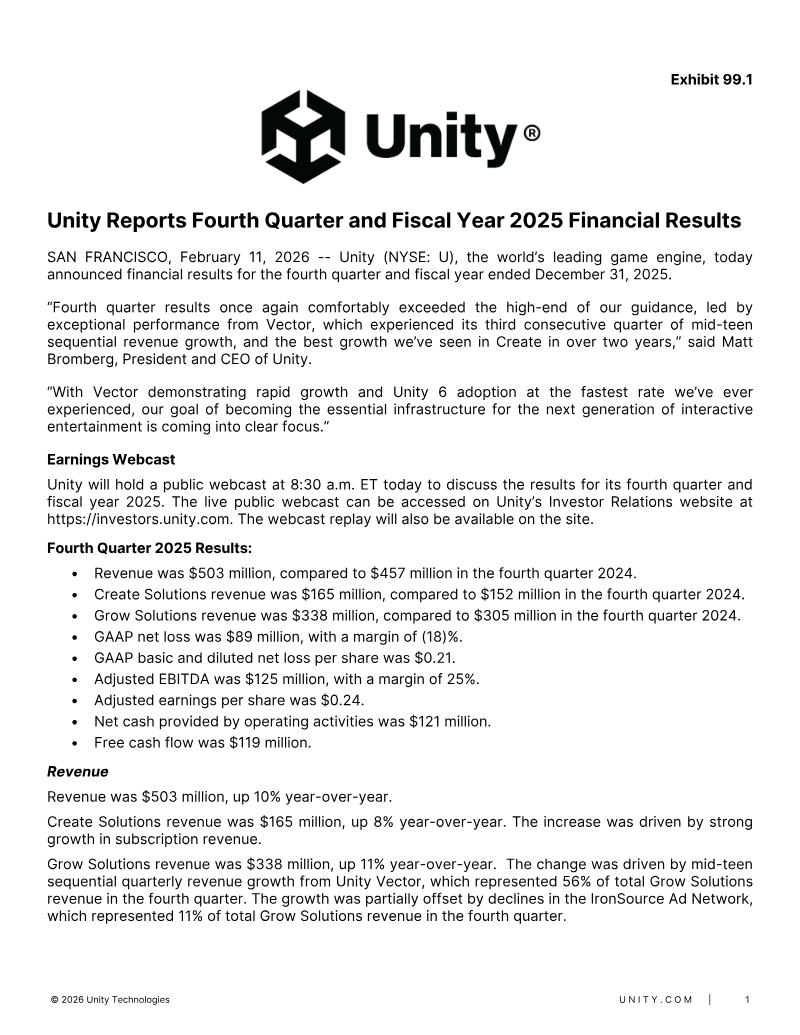
Financial performance for the first half of 2026 reflects this transition, characterized by a total revenue increase to $1.05 billion compared to $876 million in the prior-year period. Despite this growth, the company recorded a net loss of $371.2 million for the six-month period, heavily impacted by $270.5 million in impairment charges related to the aforementioned divestitures. However, the second quarter showed signs of stabilization, with a net loss narrowing to $23.6 million and adjusted EBITDA climbing to $160.2 million, up from $90.5 million in the second quarter of 2025.
The company maintains a stable liquidity position, with sufficient capital to meet working capital requirements and debt obligations over the next 12 months. Capital structure remains defined by $2.2 billion in outstanding unsecured convertible notes, while internal cost-control measures have included the suspension of the Employee Stock Purchase Plan. As the company moves past the August 2026 finalization of the Supersonic sale, management continues to navigate a complex transition period, marked by both executive leadership changes and a disciplined effort to optimize its core business segments for future growth.