1 free read left. Create a free account for unlimited reading + AI research.
Create free accountArticleHomo Ludens
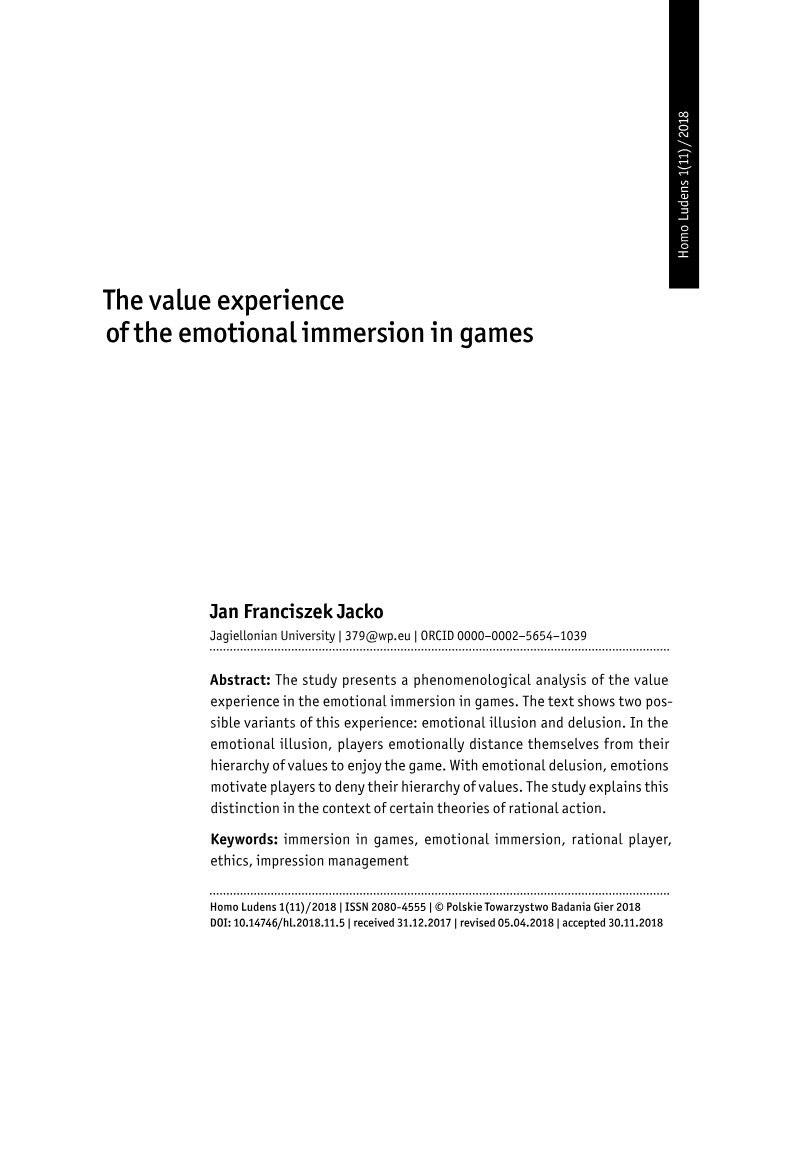
This paper offers a phenomenological and conceptual analysis of emotional immersion in games, grounded in Max Scheler's account of emotions as experiences of values. Its central thesis is that players' emotional engagement with games involves value experiences that can take two forms: an "emotional illusion," in which players aesthetically set aside their everyday value hierarchy to enjoy a game without losing sight of reality, and a more problematic "emotional delusion" or "emotional lying," in which emotions pull players toward choices that contradict their own values. The author works descriptively and analytically rather than empirically, using a subjective understanding of value, and does not offer quantitative data.
A key finding concerns the delusions that immersion can produce, including powergaming, aesthetic delusion, and ethical or pragmatic economism. In these cases, players sacrifice more important values for less significant in-game outcomes. Drawing on Weber's distinction between instrumental and value-rational action, together with game-theoretic reasoning, the paper concludes that such choices are instrumentally rational within the bounds of a single game but value-irrational when viewed across a player's overall value system.
The analysis is deliberately non-normative. It identifies and classifies these experiences without prescribing how players ought to behave, leaving the development of a moral theory of game immersion to future work. The paper's conceptual scope is the individual player's experience of games generally, and it frames its explanatory aims in terms of rational action theory, with immersion, the rational player, ethics, and impression management as its guiding concepts.
Homo Ludens · 2019
Homo Ludens · 2019

Homo Ludens · 2019
Homo Ludens · 2019
Homo Ludens · 2019
Homo Ludens · 2019

Homo Ludens · 2019

Homo Ludens · 2019
Homo Ludens · 2019
Homo Ludens · 2019
Homo Ludens · 2019
Homo Ludens · 2019
The Game Business · 2026















Comments