1 free read left. Create a free account for unlimited reading + AI research.
Create free accountArticle DiGRA
1 free read left. Create a free account for unlimited reading + AI research.
Create free accountArticleDiGRA
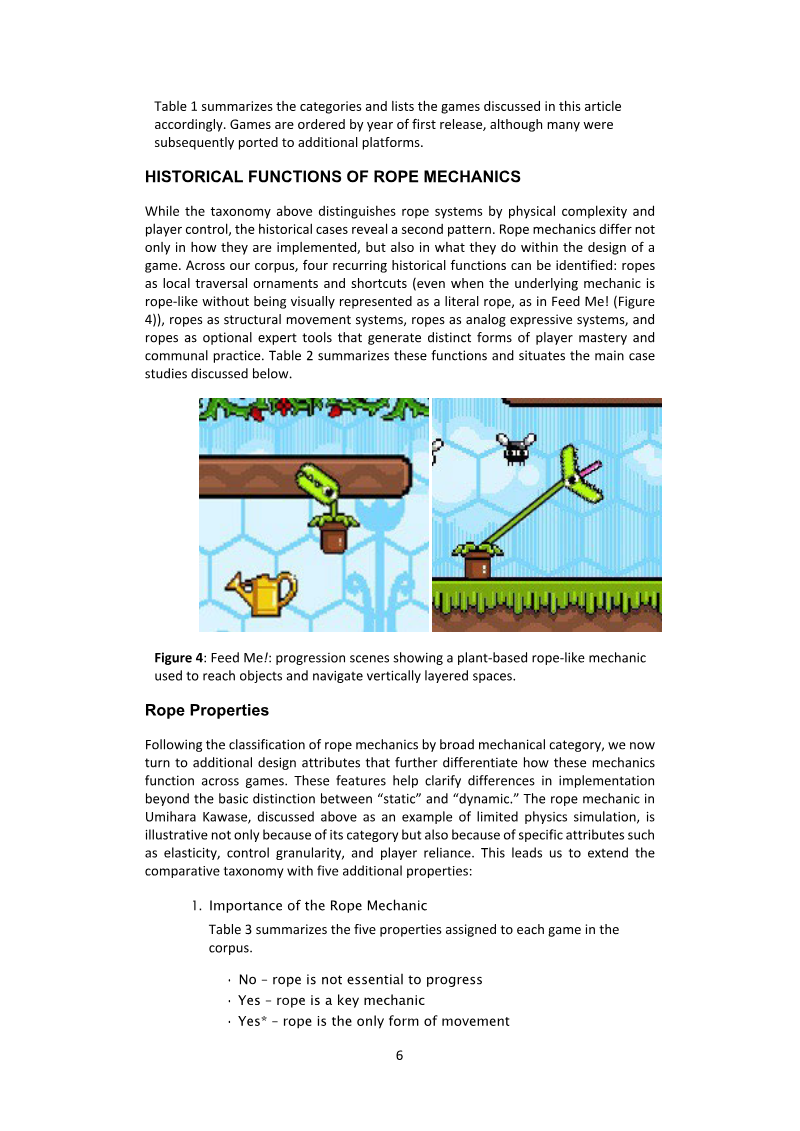
The analysis argues that rope mechanics shape how players move, learn, and master a game. It classifies them into three categories.
This analysis traces the evolution of rope mechanics in two-dimensional games, arguing that ropes are best understood not as simple traversal gadgets but as a family of expressive movement systems that shape how players move, learn, and master a game. Drawing on a qualitative, inductive review of roughly 25 to 30 titles released between the 1970s and 2023, the study classifies rope systems into three categories: static, player-deployed static, and dynamic systems with limited physics simulation. Its central claim is that the value of a rope mechanic depends on how well its fiction, physics, and controls align with the game's goals and its intended player skill level.
The historical narrative moves from fixed, scripted vines in early platformers such as Pitfall! (1982) and Super Mario Bros. to player-deployed grappling systems in titles like Roc'n Rope and Bionic Commando, where the rope became structural to movement itself. A subsequent shift toward expressive, physics-driven ropes is illustrated by Umihara Kawase, whose elastic mechanics produce emergent techniques, and by Worms Armageddon, whose optional Ninja Rope fostered community metagames through player appropriation. The analysis finds no universally superior rope configuration; the appropriate design varies with game objectives and target audience.
A key design contrast separates discrete "wire-action" ropes, which are readable, easy to gate, and approachable but expressively limited, from elastic or segment-based ropes, which offer high skill ceilings at the cost of harder onboarding and balancing. The authors recommend providing both safe and expert routes, along with graded failure states that support a "mastery ramp" for learning. The accompanying ludography catalogs rope and grappling games across arcade, NES, Super NES, PC, and browser platforms, from major publishers including Nintendo, Konami, Capcom, and Team17 to independent releases such as Floating Point (2014) and Damn Ropes (2023).
 Super Mario Bros.Game · Nintendo R&D4 · 1985 · 76 documents
 NintendoCompany · Japan · founded 1889 · 1,634 documents
 CapcomCompany · Japan · founded 1979 · 244 documents
 KonamiCompany · Japan · founded 1969 · 101 documents
 Team17Company · United Kingdom · founded 1990 · 29 documents
 ActivisionCompany · United States · founded 1979 · 588 documents
 WormsGame · Team17 · 1995 · 9 documents
Each row is a game or company this document names, each column a document, oldest first. A mark means that document names it. Select a row to see those documents.
DiGRA · 2026