Loading the document
1 free read left. Create a free account for unlimited reading + AI research.
Create free account
Superstar Session: Three Steps to Generate Unimaginable Scale for Cloud Gaming
Key insights
5 takeaways- 01The cloud gaming industry's current reliance on pixel streaming creates a scalability bottleneck, as it requires expensive, dedicated GPUs for every individual user.
- 02Transitioning to command streaming allows application logic to run in the cloud while rendering graphics locally, eliminating video compression degradation and reliance on scarce GPU hardware.
- 03Command streaming utilizes elastic, general-purpose CPUs instead of GPUs, a shift that has already been proven to support up to 40,000 concurrent users in testing.
- 04By balancing cloud-based logic with local rendering, developers can move away from inefficient brute-force infrastructure to support millions of concurrent users across diverse hardware.
- 05Future scalability relies on composable compute, which orchestrates resources across hyper-scale data centers, 5G networks, and local end-user devices.
Ask AI about this video
Transcript
[Music] thank you so yes I'm Bruce Grove mentioned jet engines in my bio it's actually where I started so many people may know the Wright brothers Wright brothers were famous for heavier than air flights they were the first people at Kitty Hawk to actually have a self powered aircraft take off and fly a distance and it led to what we know today as the aircraft industry that incredible ability to travel great long distances but it came about through a series of people really sort of building the pieces the fundamentals of the technology to make that 20 years before
they flew at Kitty Hawk a Russian named Alexander majeski almost nobody would have heard of and yet he flew an aircraft heavier than air for a hundred meters the reason it wasn't considered to be the first powered flight it was an assisted takeoff he went down a ski jump and he actually took off but they subsequently proven that had the other pieces of technology been there specifically the engine the plane could have actually sustained powered flight by itself so one of the things we have to think about is when we're building platforms when we're building solutions we need lots of pieces to come together to actually turn it into something viable from a technology perspective so the three steps piece of this this is also why no one talks about massive scale why do people not talk about the number of concurrent users in things like cloud gaming so a decade ago a lot
of companies were involved in the cloud gaming race those companies have all pretty much come and gone now one of those companies on life back in 2007 in Silicon Valley I was the first head of engineering for I have a lot of experience in cloud gaming I designed the servers I work on their clients I worked across the engineering team to build something that really sets a stage for can we deliver games at scale a lot of people said it can't be done we can't stream games from the cloud they'd say latency see bandwidth they say any kind of number of excuses why it couldn't be done but it worked and it worked very well if people were close enough to the data centers if people had a decent internet connection if they could connect to the servers so all of those companies went away and then here we are a decade later and it all feels very familiar all of these companies that we have suddenly seen coming up talking about cloud
gaming are talking about all of these great things they've overcome but if they really actually done anything differently are they really doing something that has moved the technology forward or are they still going down the ski jump and are they still doing their power assisted takeoff so how do you do cloud gaming well the problem is how you build it you have to take all of these pieces of infrastructure all of these pieces of architecture you have to take all of these game machines and put them in the cloud and then you have to take lots of users and get them all to connect together and all of those moving parts need to a problem of how does it work at scale although you can stream games we're still doing the same thing we were doing a decade ago we're moving our machines around and we're just changing where we actually get that resource from we're not actually
changing the way we do it so this is still a power-assisted problem we do this for everything we talk about virtual desktops we want to make our virtual desktops more powerful how do we run huge CAD applications how do we actually design our games in the cloud why do I need a big workstation under my desk to do that why do I want to build a bridge when I want to use the power of the cloud to build ever bigger models automotive Corvette launched a car configure a rate recently it's a beautiful thing it uses 3d unreal engine technology to give you the most photorealistic version of a car you've ever seen but it is in expensive to operate and when they launched it they ran out of Amazon servers to have people use it and that's a car configurator that's not ten million people playing for tonight that
was actually about six thousand people trying to build their car Corvette at the same time and then we have training simulation any number of uses for 3d now all chasing this resource that we keep putting into the cloud that's really expensive the graphics processor itself so the elephant in the room continues to be that we're still using a ski-jump to actually build this technology well so what do I mean by that well before the cloud we have a CPU we have a graphics processor we render our image on our screen and we get a lovely representation we get beautiful games we get beautiful graphics now this is the same if I use a phone it's the same if I use a game console and they keep getting more and more powerful with pixels streaming what we see today from stadia is the same thing we saw ten years ago from on live I put the CPU and the GPU in the cloud I then encoded into video and then I
deliver that video down to your screen now in doing that I actually compress it that's the nature of video compression so the image I put on the screen is not the same image I started with at my graphics processor the very nature of it means it's a compromised solution but it also means that every player needs the same equivalent resource that they used to have before the cloud if I wanted ten million people to play for tonight I would need ten million of those equivalent consoles in the cloud close enough to the users all with good enough network connections all to connect just so that I can run that single game with that number of concurrent users League of Legends just broke three and a half million concurrence a couple of weeks ago pub G broke a million several years ago the number of concurrent users in these games now is massive so if we're really to fulfill cloud gaming we need a
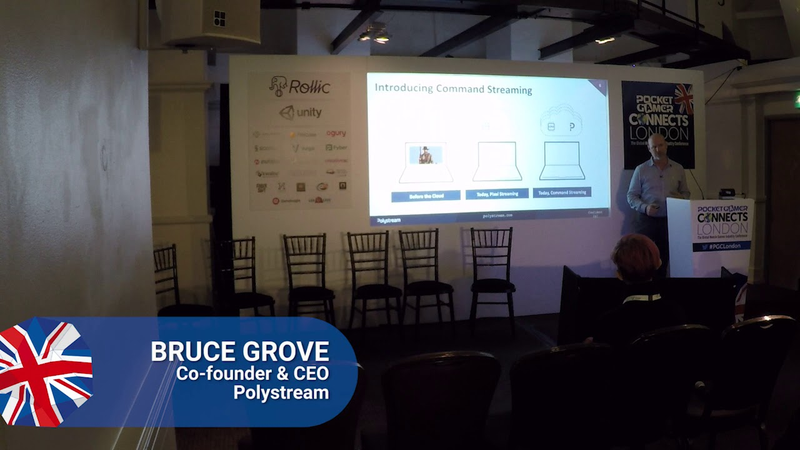
solution actually going to scale for that so poly stream created something called command streaming we thought about the problem differently we looked at the fact that our compute resources should be distributed our compute resources should be on-demand where we need them when we need them we shouldn't just be moving all the compute from one place to another we've all got phones in our pockets with graphics processors on them we all have laptops we have tablets we have pcs or Macs so rather than just push everything from one place to another poly stream orchestrates the resources it looks at what you need when you need it and so what we do is we run the game in the cloud the application we run that on the CPUs and we then take the commands the graphical commands and we stream them to your graphics processor one of the
benefits of that is your drawing locally it's pixel perfect it is by its very nature no longer compressed video it is actually locally rendered graphics it also means what we're using in the cloud is CPU CPU is a very very easy to to get resource it's very elastic there's a lot of it there are literally billions of CPUs in the cloud so suddenly the idea that we could run 10 million 20 million 50 million isn't so far-fetched and in fact to prove that just in December we ran 40,000 concurrent users now we know that none of those other platforms I previously mentioned have even come close to that yet not even the largest names on that list have come close to running 40,000 concurrent users 40,000 is still a relatively small number compared to fortnight we're still in development so we stopped there just because it was a test it was a trial but if we can do
40,000 there's no reason we can't do 400,000 or 4 million so that's command streaming today so three steps really are we've had pixel streaming there's our ski jump persisted take off command streaming demonstrates there's a better way to deliver 3d applications from the cloud there's a way that scales there's a way that uses elastic general-purpose resources but where the Internet is going where the network is going is something called composable compute composable compute is using all of the resources it's thinking about where each piece is that we need when we need it no longer just running a game from a GPU in a cloud and then just trying to get it over there using a brute force approach but it's actually looking at all of the resources 5g is about low latency networks it's also about massive numbers of users connecting to those networks at the same time and that's very important it's not
really about faster pipes it's about connectivity it's about low latency CD ends are a place where we can put assets they're a place where we can cache parts of it edge compute is where we talk about today is where we just kind of route packets for the last mile it's the last piece of Internet it's not particularly clever it's not pertinent resting but actually edge compute could be a lot smarter there are pieces we could offload there and then at the bottom we have your machines we have whatever we're connecting to we have no reason not to use that compute the old saying throw the baby out with the bathwater that's what cloud gaming has been it has been take that machine and just push it all to one side and expect everyone to jump onto it but instead what we're actually doing is ignoring all of the compute and the resources that are available elsewhere and we want to use
those resources because that's how we make more efficient compute that's how we make more scalable compute and that's ultimately how we stop Corvette from falling over at 6000 concurrent users or fortnight falling over at 15 million concurrent users we want them all to be able to access resources when they need them and where they need them so it means we can scale here we are poly streams already there poly stream now has no reason to not keep scaling around the world there's more than 550 hyper scale data centers the important thing about those data centers is they have ubiquitous computing them they have the kind of compute that can run a game we could run a game out of any data center in the world today using poly streams technology and if you take the locations of those 550 data centers as they are today it means you're also
close to users which means that I can always overcome latency just simply by being closer to the end users being where I need them when I need them and it's those recurring themes that are about putting the compute where you need it when you need it that's how you make it scale that's how you make it operationally effective that's how you make businesses that can operate a cloud gaming service so 3d interactive content and apps ready world doesn't matter whether it's car configurator 3d retail doesn't matter whether it's games it is about bringing all of these devices together orchestrating the needs for them and making them all work seamlessly so that those resources can give every user the best possible experience regardless of their device and regardless of where they are in the world we just don't believe it we'll be
using video and GPUs in the cloud not like that thank you diverse dividend questions but if your computing the game in the cloud but then you're rendering the graphics locally yep what what what kind of games are go are going to work well and look good and what games aren't if my local GPU has fairly limited then surely then you've got a lot of variation in what different users will see yes so today we sort of we've taken this approach to compute that the local machine is there to run the game so if you have a GPU and a CPU the CPU is there to power the graphics processor and in doing that our assumption is always that I'm going to have a low
powered graphics processor if I have a low powered machine whereas if we start to look forward and we think about what does it mean to build those next infrastructures what does our architecture look like there's no reason for me not to have a streamer box with a better graphics processor in it it's still a cheap box but it could render 4k and it can render it beautifully and today I'm stuck with this problem that if I put a big GPU in it I must put a big CPU in it and it's about rethinking not just sort of how do I get the application but what is the the end users needs if I want a next generation console do I really need to put a 10 terabyte disk in it do I really need to put 16 or 32 gigabytes of RAM in it if all I actually need is enough storage enough compute and a nice graphics processor and suddenly I can give a great experience and that's as true of a point-of-sale terminal or a laptop or
any other device my phone has a 4k graphics processor in it but actually doing 4k on my phone is kind of over the top sometimes so it it's about rethinking the balance of their entire infrastructure such that they're all appropriate for their needs if I want to gaming gene if I want a streaming gaming box maybe it doesn't need to have as much compute in it because what I really wanted to do is be able to say I always want to draw a great image but in the cloud I might want to build an open world with a million players in it and I'm not going to be able to do that with the amount of net code I would have to move backwards and forwards today so it's about rethinking that and then building the applications that fit in that world
[Music]
Summary
The current cloud gaming industry faces a significant scalability bottleneck, struggling to support massive concurrent user bases comparable to popular titles like Fortnite. While cloud gaming has evolved over the last decade, the prevailing architecture remains reliant on pixel streaming—a method that mirrors the limitations of early cloud gaming services. This approach requires high-end graphics processing units (GPUs) in the cloud for every individual user, resulting in expensive, inefficient infrastructure that struggles to handle high concurrency, as evidenced by recent failures in non-gaming applications like automotive configurators.
To overcome these limitations, the industry must transition from pixel streaming to command streaming and, eventually, composable compute. Command streaming shifts the rendering process by running the application logic in the cloud while streaming graphical commands to the user’s local device. This allows for locally rendered, pixel-perfect graphics that are not subject to the quality degradation inherent in video compression. Furthermore, because this method relies on elastic, general-purpose central processing units (CPUs) rather than scarce, expensive GPUs, it offers a more viable path to massive scale. Testing has already demonstrated the feasibility of this approach, with successful trials supporting 40,000 concurrent users.
The future of the sector lies in composable compute, which leverages 5G networks, edge computing, and existing local hardware to create a more efficient distribution of resources. By orchestrating compute power across hyper-scale data centers and end-user devices, developers can bypass the brute-force approach of current cloud gaming models. This strategy allows for a more flexible, cost-effective infrastructure that can support millions of concurrent users while maintaining high-quality, interactive experiences across diverse devices, from mobile phones to high-end consoles. By rethinking the balance between cloud-based logic and local rendering, the industry can move beyond current technological constraints to achieve truly global, scalable interactive environments.
















Comments