VideoBITKRAFT Ventures
BITKRAFT Summit LA 2020 | Fireside Chat with Raph Koster hosted by General Partner Scott Rupp
27 Mar 202042 min video
Transcript
all right so I know it's been a long day for everybody we've we've got a great grand finale for the day with mr. Roffe coaster up on the stage whoo we had bit crafter very honored to be his lead investor in his current company Raph is kind of a legend game designer as most of you probably know he's kind of the father of the sandbox MMO he's made some of the biggest mmo's out there particularly in that category he was the lead designer for Ultima Online which is still still going 20 years later also Star Wars Galaxies when he was chief creative officer at Sony and a lot of the mechanics from those games that Raph really pioneered went on to inspire games like Minecraft and roblox and really have built our
industry from from those great starting points and Raph is uh not just not just a game designer he's also an entrepreneur and he founded early I guess you call it a virtual world startup in 2006 called meta place which was acquired by Disney and he recently founded playable worlds where we had the craft or investors and we can't say too much about playable world other than he's gonna bring you living breathing game roars like you've never seen before so stay tuned more to come on that and Raph is also an author and a very frequent speaker so you know as a result of that he's kind of a thought leader in games and he's kind of a you know intellectual light in games but he's not just a conceptual guy he's a get his hands dirty guy and we're gonna use today to go in that direction to try to dive into some of the trenches
where Raph has been for the past 25 years or so so Raph thank you for being here and my pleasure it's been a great day by the way thank you yeah just some great talks so I mean I you know hit some of the bullets of your background but would love for you to kind of fill in some of the texture and color of your journey in the games industry first video game series pong console when I was five or six sold my first game in a ziplock baggie on an Atari 8-bit to a classmate sold one copy didn't sell another game until I was in my early 20s that was when I was about 14 got into online games in 92 93 so I've been doing games as a service before anybody used that term for a really long time that was on text-based
free internet based games muds that kind of thing ended up lead designer on Ultima Online it was the original lead designer on that then next title you'd think you'd have something like UO next title cancelled next title after that cancelled next title after that cancelled right like that's often the reality of the games business next title after that was creative director on Star Wars Galaxies then was promoted to chief creative officer at Sony Online worked on EverQuest EverQuest to planetside the untold legends franchise more that I can't remember then went off to go do my own thing that was meta place meta place was actually kind of Manticore plus koji actually it was UGC virtual worlds with a flash client that anybody could set up and put on a
webpage and we had to pivot to Facebook games so there's plenty of stories there and it ended up acquired by Disney became the back end for Club Penguin that's how Club Penguin ended up on mobile then I was a VP at Disney for a few years worked on a bunch of stuff random stuff and then got tired of just not getting to make things of my home so I actually went freelance if you've played barge at a Buffalo Wild Wings or a sports bar you played my trivia game worked for a couple of years with Google on multiplayer AR found out that batteries aren't anywhere near good enough yet yeah just a bunch of stuff and now I'm making another making worlds again back for more that's right so you've had a chance to work with a lot of huge brands right and yeah they don't get much bigger than in
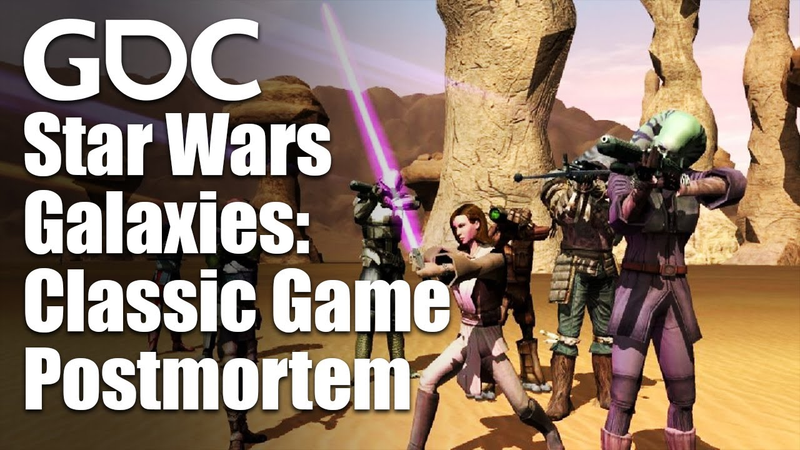
Star Wars I don't know if you worked with Chris Carvalho I don't and any of you ever heard of Star Wars yeah yeah but for most people that would be a dream I think for those in the industry have worked with licenses no it's a double-edged sword and so wonder if you have any tales being on the dark side of license yeah yeah you know I think one of the things that people don't necessarily realize about licenses is the overhead it can be really really dramatic right we're talking not just financial overhead on a cut that goes to the license or but also just the approvals overhead or whatever fundamentally a license is marketing money right you're banking on fans of the license coming in because of the license and then it means that you acquire more users just because of its presence but on the flip side you're handing over a cut to the license all right so I would guess that the overhead
cost of something like Star Wars on an MMO you know when we tally up the number of users we actually had surveys on this half the users came in because of Star Wars which is huge great we doubled the user base but I would also say that the margins on the title were half what they would have been if we hadn't had the license so potentially it was a wash right we could have had a game of half the size that made twice the money you know it's it's hard to describe what the overhead can be and in the case of something like Star Wars probably the there's two key stories probably the the weirdest one the funny one has to do with the approvals process we had access to the materials from the films that weren't out yet those things were like hyper secret they had to be hand couriered on a disk all of the files were encrypted
they were all given randomized names with all of the file extensions changed so that you wouldn't even know when you double clicked it just wouldn't open for you and then there was one single hard copy print out that was a key so that you know that will be there dot txt was actually a movie right one copy of that was allowed to float around the office there came a point where we had worked on lightsabers right lightsabers lightsabers are cool we all like lightsabers in the expanded universe cannon at the time it said Oh different gemstones give you different color lightsabers great we designed this whole really cool lightsaber system around that players could go find different color crystals make lightsabers of different sorts awesome and then one day we get a memo an official memo from LucasArts and the memo says George was editing the new
movie which was a Attack of the Clones the second one and there was a big battle scene at the end you might remember it big yeah you all saw that movie right okay big battle scene at the end and somebody asked him about the colors for the lightsabers and he said well that's easy the bad guys all have red and the good guys all have blue a memo went out to everybody and I mean the people who make the lunchboxes the people who colored the comic books the people who write the novels saying so sorry from now on lightsabers are all red and blue because George says so anything George says is canon and trumps expanded universe floor so we had to throw away the system junk I don't know it was like six weeks of work they've gone into it at that point throw it all away then samuel l.jackson went to George and said George can I have a purple one and Jorge said yeah
great so then there was a follow-up memo that said purple is okay well why is purple okay so people asked George and he said well because he's one of the stars and I want an audience and a big tracking shot to tell where the stars are in a crowd and all of the fodder you know I want them to be red and blue nobody cares but that way you can tell the sides apart and you know whoever the licensing guy who writes memos is goes wait you mean you weren't changing Cannon and George says I'm making a movie so a new memo went out that said never mind put the lunch boxes back re-edit the comics and so we were able to ship our original lightsaber system okay I don't know how many millions of dollars that cost right because it must have cost them ton that is the you know and obviously that's sort of a weird one but when you're working with major
brands you have to be aware there's layers of approvals there's you know backs and forth there we had to generate hundreds of pages of design doc you know we spent a lot of time talking about MVPs up here if you're working with a license or they want to know what you're gonna do in advance you don't get to iterate on some of it you have to send them like this Bible so yeah there's definitely trade offs and the biggest trade off in our case ended up being Jedi if you are making a multiplayer game of any sort it's usually ill-advised for there to be like one class or one position or role on the team that is a hundred times better than everybody else and can kill everybody with like a blink right like usually it doesn't make for a fun fair game but we were mandated you had to have Jedi in the game and they had to be as powerful as they were in the movies and I said
can we change the time period because we were set in the time period when Jedi were two of them right all we knew about was Darth Vader and Luke and Ben was dead right like that was all there were in the Aleksey we're told no it's been negotiated can't change the time period so we had to try to come up with a Jedi system that was uber powerful alpha class incredibly rare but that every player could dream of getting this was not a good recipe right like a pillar needed to give and we ended up coming up with a system where you got selected to be a Jedi for choosing a whole bunch of random criteria random different ways to play in the game it was individual skills there were 700 skills in the game every player at a different list okay players were happy not knowing how to become a Jedi everybody's list is different the list was secret even we
couldn't tell you which things you needed to do and the fact that it was even skills was hidden right players were happy they all thought oh they're like using advanced AI to monitor who role plays is the best Jedi or whatever so all these people just basically ignored Jedi and assumed it would come right and they had fun the people who like dancing went dancing and the people who liked killing critters killed critters and the people who wanted to pretend to be stormtroopers did that and everybody played and just enjoyed themselves and then marketing said we need a Jedi by Christmas drop hints so we start dropping hints players open the first hint and it says you need to go learn this particular skill they open the second box and it said you need to go learn this particular skill they open the third box and it said you need to go learn a skill word spread the algorithm
for getting Jedi is to learn every skill in the game and everybody who enjoyed raising pet banthas from childhood had to learn how to murder them gut them and cook them into pies and everybody who enjoyed being a stormtrooper had to learn how to dance in taverns for tips and everybody started going wait a minute the game is making me play in ways I don't like satisfaction fell off a cliff growth immediately turned in a negative churn and from that point forward in the game's lifespan every subsequent patch was about a panicked reaction to one fateful decision we need a Jedi by Christmas right right choice I just advise don't have Jedi in your game you can get away with it so yeah that's a great story thank you so Star Wars moved to Disney and and met place move to Disney you had an exit
which is something investors and founders get excited about and let's talk about the reality of that and if you don't mind maybe we'll kind of take it a little bit in sequence like how did you how did that process begin was it intentional was it inbound and then we'll talk a little about what the process was like and then a bit about the post honeymoon phase once it was done yeah so so every startup has ups and downs and we had plenty of them right so we were building this UGC virtual word platform we had to make choices do we focus on UGC do we we had lots of work for higher offers which at the time we saw as a trap maybe we shouldn't have frankly that meant we didn't always have the focus that so many panelists who've talked about today right it made for some very very tough strategic decisions at times so we had found a deeply passionate audience that
we were nurturing and I still actually I'm positive that over the long haul it would have worked out and the reason I say that is because our one of our principal competitors at the time that had exactly the same thesis and an extremely similar feature set was roblox so you know it turned out they were right I think we were right to but I don't know whether they were better capitalized or what they were able to stick it out we weren't particularly after the o8 crash right the o8 crash really kind of reconfigured not only the funding landscape but reconfigure well reconfigured our team by about 50% the day after the crash we had to make the very difficult decision just extend runway at by any means possible had to lay off half the team so we started putting together contingency plans at that point a lot of fundraising sources
had dried up and in particular appetite for what we were doing that long burn right that we needed to do that roblox successfully did appetite for that dried up so it became really clear we needed to pivot we had to pivot we had built a really powerful platform and we had gotten some inquiries about acquisition right I can't name which giant mega Corp was interested but it got really really far until it got you know went all the way through multiple months and at the last second didn't happen right so we had contingency plans for the pivot they were buying the original version the pre pivot version and the day after they said no we executed the pivot and we switched over to making Facebook games with basically an elephant gun of technology compared to what the typical Facebook game needed so that meant that
we decided to pivot about three days before Christmas we shipped our first Facebook game about three and a half weeks later we shipped our second Facebook game about six weeks after that we shipped our third Facebook game right into the teeth of a Zynga game that was identical so nobody ever saw that one but it didn't matter because at that point there was a three-way bidding war tobias so it goes to show that i mean at the moment that we decided to execute the pivot we were 48 hours from insolvency that's how tight it came we'd arranged a bridge we'd arranged all of it right but if the sale happens then we're great we have this wonderful exit and if not then we immediately do this take dilution pivot and do what it takes
in order to make this work it worked out that we pivoted exit wasn't as great for all of us individually the company went on to survive and that was the tough choice that we had to make and you know three-way bidding war isn't too bad and it turned out same mega Corp ended up in the bidding war all over again but they lost out to Disney so not exactly the you know stressful time not exactly the smoothest path that things could have taken but committing to the pivot we had to commit to it extremely forcefully meant shutting down what was a thriving community and an active service and we had to tell them it's just not working please follow us to the next thing and many of them did actually because we'd built up that trust with them and how did how did you handle that personally brutal stress and oh well it was hard I mean there's just
no way to I was really really hard you know one of one of the things I know you wanted to talk about was generic advice I think one of my big pieces of generic advice to founders is make sure that you can get kind of critical distance right from from yourself from the things you're going through from from stress you know there's some degree to which you need to be able to set aside your your passion and your commitment and look at the problem dispassionately right and that can be really really hard to do because you spend all of the rest of your time believing as passionately as you can and what you're doing and then you go through something like that and you realize wow sometimes I need to turn into a Vulcan and like really be able to do this and that means stepping away like that can mean turn off all devices and go to the woods for you know
a few days because that you know you're this close all the time right oh yeah and part of that is keeping an eye on your health it's a it's a really really key thing certainly I gained a lot of weight and a lot of blood pressure during those not so similar messages what bo Daly was saying about you know having some self-criticism and dispassionate distance from what you're doing yeah it's crucial so how about you know the Disney deal is done and you you show up for day one as a Disney employee what what was that like and you know how did it how did your post transaction story unfold yeah so you go from a company of 30 and I mean I'd worked at Sony I'd worked a TA you know and even as at an exact level at Sony right but Disney there's another order of magnitude right like you open the company directory and you're
scrolling past 250,000 people it's it's really really different I came in as a vice president of the Disney Corporation I don't think I even appreciated what that meant till I was gone like wow VP of Disney means a lot it it was an astonishing learning experience and at the same time for somebody who had come from you know just we ran in an entrepreneurial framework for almost five years right in four and a half years going from that to a very very large org that is was actually attempting to pivot its entire interactive division right was really an interesting like cultural shift I did quite a lot of internal creative consulting and a lot of what I did was moving the org that I had built
and giving it away right like that was the point I had at one point I had a six to nine month assignment to give away all of my reports and all of the team and structure that I had built and handed over to other people and you know try to make sure they understand it and don't break it since they paid a bunch of money for it learning to let go is also you know a challenging thing right learning that sometimes the things you make kind of have to be set free they have to be given the chance to go grow in their own directions and sometimes they won't make it right sometimes cool entrepreneurial ideas don't survive inside the belly of a beast as large as Disney the fact that what we built did in fact launch I forget the number but it ended up someone like seventeen titles and the
biggest of which you know we had 10 million active users on Club Penguin mobile that came along after I was even gone from Disney right I still count it as a win even though at that point it wasn't mine anymore it was more like the kid that grew up and it's successful once you're gone so I mean there's probably quite a few people in this room who if we fast-forward five years you know they're gonna have exits in their companies and they're gonna maybe be under or announce and they're gonna have to sign or they'll choose to sign employment agreements designed to keep them around you know for their new home how how would you sort of counsel an entrepreneur to sort of step into a post deal commitment like that and then totally different setting an environment to sort of make that go as well as it can go I think a lot does depend on the nature of the acquiring Lord right so
something like Disney has kind of regimented boxes that they expect to put people in because they're so big right they have a lot of process a lot of structure I ended up working inside of Disney play dome which was the Facebook gaming group and they basically I basically worked as an internal creative consultant but played um very much like Zynga and other Facebook game companies of the time you know first meeting I had with the data analyst group you know one of the analysts said to me Oh game design well we have metrics now we solved game design we don't need that anymore which you know playtime isn't around anymore but game design is but yeah there were culture clashes so I would say one of the pieces of advice is really when you think about what your
role will be a lot of it I think is about not being don't be shy about stating things like look I can be effective in these ways I won't be effective in these others and see if you can arrive at an agreement right that reflects actually contributing value it's pretty easy for you to end up in a position as a leader of an acquired org where the metrics for value are not things that you can contribute to right things that don't suit your skill set anymore so I think you need to have that conversation pretty open right if you're in a sense you know you you have to obviously you want to take the money you want to have your exit all the rest but you also need to think in terms of when an org is acquiring you they are hoping
for increased value from it and having a frank conversation about it is is something that should happen that needs to happen because if if it's a mismatch you're gonna have a few miserable years frankly so will they right and it won't work out yep okay so let's let's shift gears one one final topic and then we'll open it up so you have been in kind of the games as a service space longer than most quite some time starting with subscription businesses and obviously beyond we have a lot of companies here that are in soft launch right now they're about to have live vibrant demanding communities they want to innovate around how they serve them and support them and different ways to to touch them how would you kind of talk about the realities of sort of living with a community and serving it well and and things to avoid things to do gosh okay so I think the first thing is in a lot
of cases we see people orgs companies that are coming to service and don't have the background in it yet and I think the first thing I would tell everybody is it's about a three to five year learning curve it's not a straightforward shift and I routinely see companies underestimate that happens all the time even if you know I think earlier somebody said Oh everybody knows LTV everybody does know LTV from a medium article it doesn't mean they know it in here right like there's instincts that you know every every person who works in a business calibrates their instincts and you can't unlearn instincts immediately it takes a while [Music] when Haney talks about what is the next platform I mean I agree with them that hyper IOT connected smart world is
coming but I actually suspect that that there is an intermediate stage there which is where that service mentality becomes ubiquitous games as a service to right now is still only like 10% of the titles in the industry right like this transition has just barely started and there's a long way yet to go in terms of all of the infrastructure all of the learnings really getting out there and disseminating everywhere and we are seeing well everybody it's not just games right we're seeing you know even Apple is saying oh we're gonna be services company now right like it's ubiquitous so I think services swallowing everything is is a thing and that is a new platform it's a new way of thinking it's important to think in terms of relationships right one of the things that happened as
a lot of packaged good companies moved over to running services is that they still tried to keep their distance right keep their distance from the consumer and inevitably they up at some point and because they kept their distance the consumer hasn't built up a relationship of trust with them yet service is about trust fundamentally the key thing that you were working towards is your customer having trust in you I don't even like the term community manager okay because and and by the way I was there when we coined it okay and it was wrong you are not in the business of managing the people who pay your bills I prefer the the community relations term because that is what's going on you're actually building relationships you don't get to manage
that crowd as you know lots and lots and lots of various services have learned through various ma beings and all of the rest right it gets pretty unmanageable so it's crucial to understand that it's crucial to understand things like update cadence and you know you you can't just treat things as oh yeah we made something and now it's a service and then you just let it float out there that's not gonna work right and I think most people have figured that out but they haven't necessarily always figured out the trade-offs that implies right so one key lesson for those of you are working on games as a service is watch out for making things that are about content content is expensive content is consumed incredibly quickly how do you build things that are evergreen as best
you can whether that be via other players whether it be the user generated content procedural content sports style content all of those sorts of more dynamic approaches are crucial and if you've come out of a world where you think of yourself as a storyteller or you know an an entertainer that produces content to be consumed then you know I hope you came out of at least soap operas Yeah right rather than you know single movies because you really do have to think for the long haul when you build an architect things so Raph I'm gonna surprise you a little bit yeah we we prepped some of these questions but I'm gonna drop to surprise question okay well tap dance so the first one subject to whatever NDA is you have how do you feel about all of the tech giant's getting into gaming and what do you what
do you think that's gonna gonna mean and what do you think of whether those organizations are equipped to be successful either because of what you saw about their cultures or what they have resource-wise or technology wise yeah so you mean like the fang yeah all companies so yeah so the reason he says subject to NDA is because during that freelance period I actually consulted for both Facebook and Google so yeah there's some things I can't talk about I think I mean fundamentally culturally they have challenges right none of them are entertainment companies and none of them are content companies one of the things I'll actually pick on a phrase that we have heard lots today which is Minimum Viable Product Entertainment doesn't run on viable products it runs on lovable products right like you need to be targeting minimum lovable
for your initial release because if you launch something that isn't lovable then the users all leave and they don't come back and then it's over right you know and there's obviously there's industry shifts where the level of love ability can fluctuate because a sector isn't entirely mature so you can have something that is lovable and sticks out relative to the market when you're on a fresh new platform where the tropes haven't been settled yet right we saw that with mobile gaming we saw that with Facebook gaming we saw we've seen that right lovable I can't you know like Google doesn't do loveable man like they don't get that it's just alien to their nature right like they don't think that way I'm not sure if Facebook understands what love is like Facebook for a company that is allegedly about connecting people I'm perpetually
astonished by how robotic Facebook is culturally right like they don't get people even though they've aggregated a lot of them so I think I think there's very real challenges there you can't discount the fact that they have enormous giant piles of money right you can't discount the fact that they have enormous giant piles of data but my advice to any and all of them right whether it be Amazon game studios or Facebook games or you know games within Google stadia whatever would be gosh set those set up the games people in a different building give them their money and then leave them the heck alone in order to prevent sort of a dominant culture from kind of taking over and preventing that new
initiative from doing what games can do best right because there's there's just a very real risk of that dominant culture sort of strangling things in the crib if you know what I mean yeah I think there's there's real challenges there yeah so I hope if craft social media will tweet out a minimum lovable products like MLP that's a great one so another topic we talked about a lot within our organization is first-time founders versus second time founders and and what some of those differences are and what means four companies and I'm curious as you kind of think back on your sort of earlier founder journeys what are the kind of one or two big mistakes you think they made then they thought you would never make now and that would be helpful for our audience you know just hear clear of I got to tell you that I think about this a lot
and the more you think about it the more you realize that some days it feels like every single major decision you made last time was a mistake you know what I mean like you can't help but look back and go oh my gosh it could have been more successful it could have done this right we took this wrong turn you know and it's actually really easy to get caught up in all of the missed opportunities but cuz hindsight is hindsight right like today I look back and I go well it worked out for roblox why didn't it work out for us or why didn't we pivot to Facebook sooner there's a good example because at a time when the state of the art on Facebook was the zombies game we had full isometric 3d flash game engine right like we could have been launching city but level stuff literally several years
earlier we could have been single man no like right like there's always things like that and I think all you can do really is just try to take it forward and and add it to your kind of your mental checklist as you make decisions right it just gives you more sort of things to notice right like a lot of stuff is happening and there's patterns that you can start to identify right as you've run a company start identifying patterns like oh that's gonna lead to a morale problem or oh we need to make sure that we you know actually we've gotten tons of good ones in so many of the sessions today oh you really need to think about your total addressable market right like those are things that you start just internalizing and going through it a second time you just have a wonderful library of mistakes do not repeat and I
think you know you have to be careful not to be hypersensitive about them right like not don't overcorrect right I think is a big thing I think you probably do gain more of that critical distance the second time around I think it's easier to contemplate pivots it's easier to think about oh gosh I have to lay off half my company because you've been there and you know what it feels like and you know what the trade-offs are and you and you you know you've you've been there I think those things all help what you really can't do is let it turn you cynical or you know let it rob you of any of that passion that led you do this crazy thing in the first place so in the end when I look back at that experience I end up proudest of of
our initial core set of UGC alpha testers on meta place I think 80% of them work professionally in the game industry today that's a win we wanted to change the world in a particular way we kind of did not for the size of the audience we wanted but we did I look at the careers that the people we hired who helped us build the company I look at the trajectory of those folks who went through that experience with us including a lot of people that we hired fresh out of school and now they're founding their own companies that's a win right and I think of you know I still get fan mail for like the Facebook games you wouldn't you know fan mail for a wine farm game you know or whatever they're still running the wiki and there's still an active Facebook page and it has been shut down
now for like a not quite a decade seven years or something I still get fan mail for it that is a win because ultimately you're in this to touch lives you're in this to make changes right I mean sure I mean money's nice but but in the end if you can't derive the satisfaction from the changes that you have pushed then the money isn't going to be worth a damn right you got to have that that core hope because fundamentally entrepreneurship is is about hope it's about going up against the odds and making a dream render some form of reality and you know enjoying that journey it's more important in the end to you as a founder as consequential
as an exit might be to your life it's more important that that journey leave you with with those lessons with those hopes intact you know and the friends you made along the way that sounds like the perfect place to stop I think I'm gonna I was gonna leave open it up but I think let's let's let that note settle I think to close out the day and would encourage folks to grab raffle with any questions afterwards so thank you all thank you Raph that was wonderful my pleasure [Applause]
Auto-generated captions from YouTube — names and numbers may be misheard.
Key insights
Distilling the key insights…
Ask AI about this video
Cite this video
Citation
Generating citation…



Comments