1 free read left. Create a free account for unlimited reading + AI research.
Create free account
Superstar Session: The Secret Sauce of Multiplayer Games
Key insights
7 takeaways- 01Multiplayer networking must be integrated into the initial production phase, as retrofitting network architecture into completed single-player titles is technically inefficient and prohibitively expensive.
- 02Sustainable multiplayer ecosystems depend on treating community retention as a core design pillar, integrating live operations with robust social and technical infrastructure.
- 03Bots should be utilized as a dual-purpose tool to facilitate rigorous development testing and to maintain active player counts that improve matchmaking efficiency in live environments.
- 04Matchmaking systems must prioritize a balance between player skill, network latency, and queue speed to maintain engagement and minimize user frustration.
- 05Developers should implement server-authoritative architectures to mitigate cheating and ensure competitive integrity, which is a foundational requirement for long-term player retention.
- 06Long-term community health requires the integration of social hubs and reporting tools that empower players to self-moderate and mitigate toxic behavior.
- 07Deterministic engines and predictive simulation are essential technical strategies for ensuring performance consistency, particularly in mobile environments where connectivity is variable.
Ask AI about this video
Transcript
we are now going to be moving on to our our next well the second half of this track which is all about multiplayer we're calling it mastering multiplayer and it's sponsored by photon so before i do any of the introductions uh we've got a little showreel from our sponsors photon to share with you so enjoy and i will be back in just a minute [Music] [Music] [Music] you
[Music] [Music] [Music] uh a huge massive thank you to photon who are our sponsors of mastering multiplayer and speaking of photon we've got mark here so hi mark how are you hi sophia very good good to see you you too good to have you here you're going to be uh taking on the role of our superstar session and talking all about the secret source of multiplayer games there we go we can see it right there but uh before that check out where are you coming at us from where are you based at the moment yeah yeah sure um i'm currently in montreal uh so we just finished summer
like everyone and um yeah yeah definitely and normally i would be in helsinki right now and um but it's a pleasure to be with you all today definitely and uh thank you for the pocket gamer organization for you know organizing uh this wonderful event that everyone can share and and learn and um it's all about networking so um it's a pleasure to be here today frances well it's a pleasure to have you here and before i let you get on with the uh talk uh i just want to remind everyone please continue the conversation in the chat and throw your questions mark into the q a i'll pop back at the end and we'll go through the questions and uh get some answers fantastic fantasy well i'm here in the background if you need me but uh over to you mark thank you so much sophia so uh yes um so this talk today is about the secret sauce of multiplayer game uh first for those who don't know photons we've been in the multiplayer industry for more than 15 years
providing services for thousands of gaming developers we have more than 600 million monthly active users across many games there's hundreds of good games are coming up with us as well in the next month and a year and but i'm not here to talk about fulton really much but more about what is or industry all about in the multiplayer games so let's get started um so first how successful multiplayer games are they are extremely successful so they are on top of almost every chart except for pc uh so all the arts that you're seeing is games that are actually real time and those are half hearts is either you have um in-game chats or you can have leaderboards and share items with your friends there's some aspects of multiplayer in it but in short like if you want to be successful and have a grossing game that is bringing back revenue to your business then multiplayer is the way to go so it's definitely something you have to
consider um in your game design and um regarding the internet as well well uh during covid there was a huge pressure on the overall bandwidth worldwide and uh that made the operators to up their games to provide better online services uh so a user that used to take 10 gigabits a month now is taking 20 to 25 gigabits a month um so um uh so then the the download speed went up the latency went down but for us that make multiplayer games that's actually absolutely no change at all so just be aware uh games takes about three to four percent of their overall uh bandwidth transfer worldwide so it's not very important for isps or internet service providers so in short internet doesn't like real-time games and a good example is obviously riot that build their own private network uh to provide the best services for uh
their user so the whole reason is there's multiple isps level they're reselling bandwidth and obviously games you try to take as less bandwidth as possible so that the packets are very small so you can have more players in real time and it's not as attractive for isps so maybe with time this gonna get corrected but still today we have issues on the overall internet regarding latency and so in that case well you need very good developers obviously to build a good networking solution so the next question is when do you implement multiplayer so something that you can build a single player game and make it multiplayer later well that's absolutely not the case obviously you have to consider multiplayer from day one from the game engine perspective from how you're gonna make your own community play with your game and how they're going to interact between each other but obviously it's all about building the game itself how are you going to
network your objects as part of the developer side of you and then for game design obviously it's much easier to have the mindset right away from the start and try to put it later so the later you wait the more costly it's going to be for you to integrate multiplayer aspect inside of your game and that next part which is a bit more um that's nice technical we're going to go back to game design aspect of it but still game design isn't there which is the game design leads the topology decisions so what is network topologies how all of your servers in the back are going to get connected and how the players are going to find each other so um each of the different topology which is either having a dedicated server going in p2p which you might have heard about with time or having distributed simulations they all have pros and cons but one that is number one which is where is the authority so what is authority in the multiplayer world is uh if what is right and what is wrong
once forward so for example it can a player move more than one meter per second in the first percent shooter game so if you put authority on the server that your player cannot then obviously all the players cannot go as fast as that but if the authority is a peer-to-peer in a client hosted on a phone or someone on a piece of someone you lose all authority so then the various topologies also put in place different cost that is associated and cost going to be something you have to look at it both in definite development time and both in actually your operating expenses so how much it's going to cost you to run this game for x amount of players to each x amount of regen around the world and where you're gonna go with uh your overall flow of building up the game so yes the game design needs a topology decision if you're making a two to four player game it could be that peer-to-peer is good
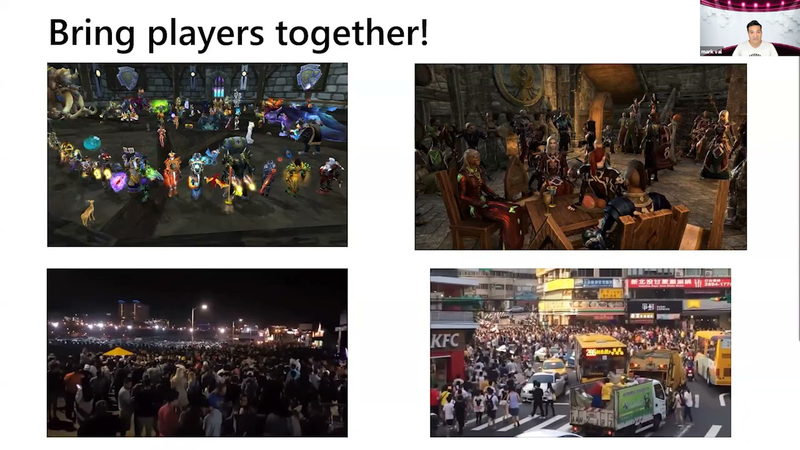
for you but if you fear that it's going to be hackers if you have leaderboards like global leaderboards of course then you might want to have a dedicated server and have authority on top of it so obviously this part can be all presentation on its own but let's continue so the whole point of making games to bring players together the biggest games in the world are only as successful as their communities so both in the real world the virtual world so the two videos that you see at the bottom is pokemon go so we all heard about those stampedes of people when there was a snorlax spawning somewhere and um so it creates a bit of a mayhem but old point is that it's the operation of agglomeration is that once people see each other they are attracted to it they wonder what's going on they want to know more about it and that's entirely human
and that's uh really what you have to keep in mind so as part of the operation of agglomeration there's the 80 20 rule which is that 80 of your players will go on 20 of the space but then we don't we're not all the same we don't have the same psychology traits some likes to be number one some wants to be seen as the best some wants to manage a community we all have different aspects in our life that makes us happy as players but as individuals as well so you have to provide multiple area or hubs for players to meet each other and be together so groups that have similarities with you psychologically you will be attracted to them so you have to provide those areas for them to be able to mingle and chat and form affinities and create values between each other so that way you're going to be able to re have a better retention in short because those players will have fine
friends new friends they're going to find people that they like and they're gonna want to be together so um uh one good mathematic uh formula you can look is the zip floss so that is z ipf lock um and that's really the attraction of people to more people and so if you find friends you want more friends you want to gather people are similar than you so that's what you have to keep in mind but how do you do that so obviously you have to provide ways to communicate you have to provide services for the players to be able to actually manage who are their groups and their affinities on them so when you create lobbies you should be also giving the possibility to create private lobbies where friends can invite friends in our privately together you can also provide some password so that it's productive maybe you want to invite people or maybe you want to make it public but keep some
of the slots private so that way you're going to be able to really have your teammates and clan mates with you and um and obviously when you're speaking into a chat that is global versus a chat that is with your teammates you don't have to provide the same rules because in a chat is global you want to be able to filter what is being either written or said you want to blip words so you can use voice detection in many ways to be able to squelch players as well you should be able to vote up or down depending on how you structure your social system but having a white listing in a global chat is usually the best or when you're having someone that you're playing against that you don't know so that way at least you can communicate in a way that is respectful and that is very important so let's continue um but so bots what is bots
bots can be in many flavors what's going to make your game design go faster both in development but also improving that your game is fun so it's good at the start of your iterations so for example if you're making making pretty much any kind of multiplayer game so if you want to play against someone you need to ask a physical player to play that the opponent but when you have bots all of a sudden you can play against them and obviously you're going to train those bots to be better so you can have all different skills of thoughts and then if you're playing in a game where for example it's a first person shooter game or a moba or actually any kind one of your teammates leave you can have a butt replacing that player for the meantime until maybe there's there was a connection issue or something like that maybe his phone ran out of battery needs to hook it back up and coming back and then when the player comes back the butts is out and the player continue to play and um obviously you're going to be able to test out your game design or even
your meta game if you have an end game to be able to be as much as successful as you uh as you can be so um don't be scared obviously of bots there's multiple there's thousands of games that are faking multiplayer so we're all seeing the io generation of games where it fakes to be multiplayers and those are all bots obviously those bots when we're talking about fake multiplayer games are in the client but when you want to make a real multiplayer games then those bots should be on the server authoritative back to where i was talking earlier regarding topologies if those bots are on the client then it's easier to cheat and hack obviously so don't be afraid of bots find the libraries uh that will make you uh comfortable and with your various moments in your game development either
for pet finding or for actually if it's casual game with words then obviously you're gonna be able to create opponents very fast and be able to find the fun in your game and uh another ingredient to a good recipe for um for a good multiplayer game is about sbmm so skill based matchmaking so you can go skill based or you can do also a segment match uh so what is the difference so for um you maybe you have heard about elo scoring or true skills or other formats which are based really about your rank and then the matchmaking will be based on that there's the other approach which is well you know i want all my new players to play together i want all the players of a certain region to play together as well and then with time maybe this player is
more in line to talk a lot in his game so you can have so you have to implement analytic over your matchmaking service to understand first if the players are actually having a fun game usually when players have a fun game they play another one but a good way to really make sure that they have a good game is that the game is actually a bit hard you should make the game too easy for them well you know after four or five games of winning all the time yeah well there's not that much of a challenge it's a bit boring so i will just you know play another game but that's not what you want obviously so um uh you need in matchmaker to be fast so that means that when you search for a game as a player you shouldn't wait for a minute or two minutes except you have no players but still you can still create a game with bots as i said earlier another way to do it is to expand the search so let's say you have some rules put in in place either by region or by latency or by
skill and then you're going to expand the search based on those criteria and make the range of those criteria much bigger so that we're going to be able to match mate with other players a good example is about time zone so if you are in australia versus if you are in at america or europe or in asia there's all different apologies uh regarding isps and latency speed uh but also there's sometimes just no players at all you want you still want to play and then you're gonna be matchmaker with someone that is a few thousand kilometers away um and then obviously uh you're gonna be affected by latency um so but still you gotta have a game which is the important part that the player wants it tries to deliver the best server either on the edge or elsewhere so that the player can find a nice place to play and have fun between each other another aspect is the in-game balancing so when you play
obviously there's a chance that the other team is a lot better than yours or your team is better than the other one and um as i was saying earlier when a game is too easy or when the game is way too hard uh then the players are going to start leading so then you're going to have imbalance in the numbers of players so earlier that was overwatch we're seeing regarding the matchmaking they also provide in overwatch as you saw at the bottom uh really good ways to spend your time as you're waiting but when you're playing a game and just there's no way to change the balancing you cannot switch off teams uh then obviously it's all about waiting so you're just waiting there and waiting that the game ends in short uh so the screenshot here is for battlefield uh battlefield five and but it happens in many other games as well uh so it's very important that you offer the possibilities for the players to change of teams as they're playing
um either based on rule sets such as what you're seeing now we see there's after team that is gone maybe it's time to propose to the other players to change of teams or just you know uh pretty much uh make it automatically just take a group of players if they are teams a team of four team of six doesn't matter you take the whole team and change it to another side and that way the game is gonna be a bit more fun but you need to communicate with your players about what's going on so that they know exactly where things are going and obviously uh when you are playing with others it's good when there's bonuses when you're playing with the with friends of yours um so that they feel like you know it's not only that we're better as a team but we're also more rewards so it's a good way to uh make those plans for them to play every night at night 99 pm and move forward so another aspect of the ingredients is taking care of the cheaters and the hackers
um as i said earlier if you have a peer-to-peer game it's um it's easier to hack so a good example here is ritual dane that you can find on youtube he has many videos where he goes in games especially the one with the call of duty like what we're seeing now and in call of duty when you're in the lobby the lobby is hosted on the computer of someone like a player uh so then you can find the ip and in this case you find the ip with a few phishing questions while playing he was able to find his facebook profile and his phone number and as he plays you actually call the person uh but um these these kind of cheats or hacks can be at various level it can be also to be better in the game there's multiple games where you can buy acts to be better and we've seen many esports tournament where even people were coming with their mouse and in the mouse there was a chip for autoimm or things like that you can
just activate it and as they're playing they're gonna start to win so hacking has been always there it would be they will not change especially for end bots and other kind of cheats but if you put authority on the server one more time then you're gonna be you have less hacking obviously so lots of analytics you have to look at the chat logs uh and the clients will never be trusted ever so as you play you're going to be able to distinguish also the connectivity when it's hosted on a player the latency is not as good or as when it is hosted on the server and that's something to take care of and um in terms of engines there is also going to the determinism so determinism is when all of the simulations so either server or clients actually have a common uh most of the time physics systems so they all agree that based on physic this is how
things will happen and and then you send inputs and those inputs are being passed to the server and then there's rules that are put together and then then there's an upload from the server to the various clients out there that will make the overall gain uh run smoothly everywhere but also they're gonna be less hack because uh most of the game is based on inputs and then those inputs are based into your physics system so that way you're going to be very much able to give the best should i say simulation built on the server in the cloud but also prevent cheating so it's a good it's a good uh way to do that working so definitely you have to look at that so we've talked about many ingredients in the stock so i've put them all into um a bunch of points so obviously all of those as i said earlier can be expanded much more
you don't become a cook with just ingredients so you have to cook it as well and be better at it but definitely you have to ask yourself well first uh how i'm gonna make my multiplayer game how i'm gonna extend the game after it's launched because really when you make a multiplayer game it's it's it it's building it making sure it's fun doing a lot of qa using those multiple testers that they test one time and then they don't play the game again so you need a lot of new testers a lot of humans that needs to try it out and get and have that first impression that the game is good and then eventually you're gonna launch the game and once you launch a game that's where really everything starts where the community the support the various services on the scale in various regions you want to localize you want to culturalize your content you want to bring the various happy new years of their various calendars out there
but also the holidays and countries and have proper live ups on top of your community so that everyone sees something in the very near future that you can participate and have fun but still when we go back to the lower level of making multiplayer game uh it's more about where do you want to start so there's obviously multiple books about multiplayer networking engineers that are good is super rare they're all taken everywhere um but you can if you're a developer and you're interested by that there's some open source libraries that will get you started that will move you forward and and then regarding live operation uh there's again multiple books about it more most about the gaming services and game design but what i suggest very much if you want to go in live ups and is to go into psychology because that's when you're really going to find out about how to do
price match and other scenarios that's going to improve both your retention your conversion rate and obviously to have more players and if you want to go a little bit faster obviously there's us photons we do provide all types of topologies with fusion and we have a deterministic engine that we call quantum um so fusion is a new service it's about to be launched in a couple of weeks very soon to support up to 200 players at 60 yards so that's actually better than many games are offered up there we do guarantee very good latency as well so that we don't have to think about how we're going to work with all those isps i was talking about earlier and obviously all kind of games are possible to be built with us um so so yeah so i was saying you support all these topologies and that way you're gonna be able to find which one that fits with your business with your game design and then move forward uh from that
so that was the sum of the secret sauce of multiplayer games uh obviously we have all track today uh we're going to talk more about this there's this month that's following me and then we have a fireside chat with paul bettner that should be very very interesting as well so don't miss it a lot of expertise that needs to be shared and that way we're all going to be a bit more avant-garde regarding multiplayer games yeah and uh yeah and thank you mark for such a fascinating talk and i know you're going to be leading us through this track before i rejoin at the end just to remind everyone of what they can expect tomorrow but save you asking yourself your own questions i thought i would thank you and go through the questions with you and then i couldn't leave it over to you but um we've got a little bit of time so i'm gonna dive into some questions um first one from your guest is what kind what are the trends uh that you're seeing in multiplayer games at the
moment what kind of games the players attract yeah definitely so um very good question so obviously we do see uh hundreds of games every month and new games and people that propose okay uh game designs and they want to choose their technology so we see a lot of them uh what is extremely popular right now is co-op games so it's play it's games that you're playing with others uh against uh bosses and pc so that is very much the trend regarding developers right now and uh otherwise it's a big battle game so think battle royale but bigger more complex so we all know the war zone that tax legions scavengers recently and obviously pubg and all the others so that which is very much shooter and that's it but now you have battle games are coming where the battle doesn't last 30 minutes but last you know two three days where um where players have actually to a bit
like rust where they have to either build a camp or something like that and then get a resources and move forward uh there's a bit of valium and those ideology that we're seeing um and then obviously casual super popular um uh casual games that that gives real money prices getting more and more popular um what happened with kovit is that obviously all of the lands and whatnot closed down um so so most of the current events are online and those are cash prize driven anyway but then it's not physical so uh so there's a bunch of new services like skills and others that came up um and then and then for us well they they picked up the deterministic engines so that they are no cheating everyone is at the very low latency and they are able to compete um so that is what is the most popular these days obviously vr lots of vr and that will continue to grow
and um yeah so a lot of unique new things that's what i will say nothing you have seen so far that's what it is fantastic and you actually touched on cheating there but one of the other questions is about like how prevalent cheating is is it a big problem in multiplayer gaming at the moment yeah yeah well it's it's always been there so as soon as there are other players there's gonna be cheaters uh because uh at the moment you have a leaderboard and there's gonna be cheaters because people wants to be at the top but one thing to keep in mind is that cheaters per se obviously as through development you have to take care of it but taking care of cheaters won't make your game necessarily better so you should spend more time making good design making sure the game is fun and then later tackle cheaters because seriously cheaters if you have a successful game you're going to spend the ltd of your game right your lifetime value of your gain at fixing bugs of cheaters and those are usually the one
to two percent of the players uh some aaa studios doesn't do anything for cheaters because they're like well why should i spend you know hundreds of thousands of dollars every month and in fixing something that i can just let it go on the side so it's also a business decision um but um the more you go to the east the more there's teachers regarding leaderboards the more you are going to the western the more cheats you're gonna have for arming others somehow um so there's patterns over there so depending what is you know cultural around your game there's also a set of cheats that comes with it uh also hackers that comes with it as well yeah and uh another question we've got from um dan is taking into account issues with systems that can be abused have you ever considered a system where the player can feedback to the matchmaking whether they are being paired with opponents that are too easy too hard all that yeah it seems like yeah that's right
yeah definitely so the more control you give to the players the better especially when they i want to up them into something such as hey you know these group of players i don't want to play with them or um or as you're saying like i've seen some players uh behaving bad in the game i want to report them so yeah you have to give those tools and that's the whole point of community and support like i always say that once you have a successful game if you have bad support if you have bad community people are going to leave period yeah so you have to give those services in hand so that they are able to themselves as players being able to report and act and have you know fun more fun in the game so i highly encourage that and yes there's multiple games is doing that today i think it's not enough um there is there's need to have more responsibility for the players especially when there's big communities uh but we see the change slowly um i mean like even if we go outside of gaming if we
look at facebook and whatnot it's still not regulated and things like that so there's a lot of work to be done but us as a community of game developers we should take responsibility and give it to our players right away yeah and then another question we've got here is are the multiplayer challenges of mobile different from the multiplayer challenges of traditional for example pc games yeah that's a hundred percent so um mobile in movement is a thing so as you as let's say you're on a bus and a train you're gonna have latency change uh so uh what we suggest there if you go on a mobile game is either cool to go through a deterministic engine or have a game that doesn't doesn't need a lot of twitchiness like a car game for example that needs to go very fast but if you go anyway then you have to do a lot of predictions so predictions toward where all the players are going right now so that you're going to be able to simulate before the data comes in so even if there is latency even if there's moments where there's no connection at all
things are still running smoothly so most of the time when you are in a dirt demonistic engine if you're in a team let's say a team of 12 you're playing against other players and you as a player start to have difficulty with your mobile connection your you know you're not on 5g yet or whatever well then you um uh you still want to to play so what will happen most of the time is that you as a player your view is going to start lagging but the other is when they look at you everything looks fine so so there's various strategy there to attack um but yeah but first if you want to be successful in 2021 2022 and beyond you have to target uh mobile phones so landlines phone are not existing anymore kids needs to talk to each other so they're gonna get a phone at one point and that's gonna be their first platform their first devices uh it's very hard to find xbox series x today it's hard to find a ps5 um and
that will continue to be like this uh microsoft made the decisions to put all of their chip for the xbox series x in the cloud so they can do cloud gaming uh on your phone so this is gonna be more and more relevant uh for industry as well uh but definitely when you have a mobile game uh that is in real time connection challenge rise up and so you have to attack those by engineering fantastic yeah we'll um
Summary
Multiplayer game development requires a fundamental shift in strategy, prioritizing network architecture and social infrastructure from the earliest stages of production. Retrofitting networking into a completed single-player title is prohibitively expensive and technically inefficient, necessitating an integrated approach where developers select appropriate network topologies—such as dedicated servers for high-stakes, authoritative gameplay—at the outset. By utilizing deterministic engines and predictive simulation, developers can ensure consistency and performance, particularly within the mobile sector, where managing latency and connectivity is critical for the next generation of gaming.
Success in the multiplayer landscape hinges on a delicate balance between technical integrity and player psychology. Implementing server-authoritative architectures is essential to mitigate cheating and maintain a fair competitive environment, which serves as a foundational element for long-term retention. Complementing these technical safeguards with sophisticated matchmaking systems that weigh skill, latency, and speed ensures that players remain engaged without succumbing to frustration. Furthermore, the integration of bots serves a dual purpose: facilitating rigorous testing during development and maintaining active player counts to improve matchmaking efficiency in live environments.
Beyond technical performance, the longevity of a multiplayer title depends on fostering a healthy community through robust social design. Developers must prioritize the creation of social hubs and communication tools that empower players to self-moderate and report toxic behavior, thereby protecting the user experience. By combining these community management tools with dynamic team balancing and a focus on live operations, studios can cultivate a sustainable ecosystem. Ultimately, the most successful multiplayer games are those that treat community retention as a core design pillar, ensuring that technical robustness and social engagement work in tandem to drive player satisfaction.
















Comments