1 free read left. Create a free account for unlimited reading + AI research.
Create free account
Superstar Session: Bringing New Life to Your Game; A Case Study
Key insights
6 takeaways- 01Underperforming mobile games can be revitalized by treating store presence as a dynamic asset and using data-driven App Store Optimization (ASO) and conversion rate optimization (CRO).
- 02Continuous A/B testing and competitor research are essential to validate that visual assets and keyword choices effectively convert traffic into downloads.
- 03Pivoting the art style and call-to-action language of 'Love and Dating Story' to match its actual demographic resulted in a 314% increase in Google Play installs and a 49% increase on iOS.
- 04Bridging the gap between a game’s initial performance and its market potential is achieved through iterative updates to store metadata and visual assets.
- 05Long-term success requires aligning a game’s visual identity and metadata with the preferences of the actual player base rather than the assumed target audience.
- 06Search-based acquisition is the most reliable driver of long-term retention and lifetime value, outperforming social recommendations for sustainable growth.
Ask AI about this video
Transcript
cool so uh we're now going to move over and start talking uh to anna this is um uh obviously lab cave are our sponsors uh for the track uh we've got uh anna uh from lab cave talking about bringing new life to your game uh hopefully anna will be uh joining us uh on screen shortly uh i think this is yeah really interesting talking to matthew about the way the id uh idfa is going to affect things but also how the history have been passed this already uh we've had similar changes in the past we've adapted and of course we'll adapt to this and it does mean that we're gonna have a change of mindset change of the ways that we've optimized and have to optimize again but again
thinking about how we can use that to our effect and actually how we can integrate that with the game design as well is really interesting uh so i'm not too sure where anna is at the moment uh oh yeah so i think we've been uh and has been having some technical issues so i'm gonna keep talking for a little bit longer one of the things that really struck me though in matthew's talk i know that one of the lessons from hyper casual has been to be able to use small amounts of particularly facebook uh ad basis to test and try to engage and estimate what the cost of install is likely to be for a new game and it's actually a technique that we're starting to look at for longer term or um casual or or kind of uh retention focused games to basically try and see what the impact of of individual changes are and particularly around the awareness and value of the initial experience of the game and so it's going to be interesting to
see how the sort of the change of the way the information is provided maybe how much more work we have to do as game designers to integrate effectiveness of of growing our game um but again i also think that there's a wider question around this which is about thinking about the other forms of marketing traditionally um we haven't found as much impact from doing pr and branding and social media and all that kind of stuff because it's harder to get the direct measures uh perhaps now there'll be a little bit more of a rebalance on that side we know how important social media has become we know how important community is uh but in terms of user acquisition direct user acquisition uh they've obviously been the most important factor so i think this are we still that's how i think i think we're still waiting for anna so yeah i'm just checking up with on the notes here so uh yeah she's that again
there's the internet issues i think so i think it's a it's a vastly interesting and evolving space and uh when when you look at the context of that as matthew said with the um the changing uh economic circumstances combined with the changing data circumstances we're going to have to be much more crafty in the way that we think about the makeup and testing of our of our ads and to make sure that we're as effective as possible i think the efficiency of the um of the ua team is again going to be critical to this process and i think learning different skill sets realizing the importance of creative realizing the importance of placement within the game as much as the importance of um targeting the right games i think it's going to be interesting to see how the design side is going to affect the user acquisition side normally when we're talking about growth we're not particularly worried about the game
but one of the lessons i learned back in the old days when i was unity doing in the ads was how important placement inside the game was uh for the effective monetization of the game and i'm increasingly of the opinion that the getting the player at the right point of decision where they actually do care about what ad they're seeing and they actually get value from doing that that i think is going to have a knock-on effect on the effectiveness of the games that we target as well now do i have any proof of that of course not it's hard to measure those kind of things but i do think it's an interesting space to try and explore so um if anyone else has any sort of questions or thoughts um we're happy to kind of try and answer them uh and uh there was a question that was um uh what do we think about uh can we do targeting of display ads uh unfortunately there's not an area i know about so i can't i can't fill that one in but i do think that we have had a lot of
dependence on uh you know the specific mechanisms that we have provided for us by facebook by apple uh by google um and uh you know we have had to work around that maybe we have to start thinking about new mechanisms new alternative approaches uh and like i say i i kind of hate to use the term but there used to be a phrase synergistic marketing i know it's horrible phrase but thinking more about the role of the community you have playing a game and how you can feed that through uh one of the things we're experimenting with is can you take live events and live operations and use that to feed expectation of what's going on in the game so you can actually build you know an audience awareness that there's a narrative of how your game is progressing and seeing what effect that has because we do know that more people see ads the more they become familiar with your game that that makes them likely more likely
to proceed if they are interested in that game and my hypothesis by thinking is what how far could we go how far could that happen so that we can start telling stories about what's happening in our game world and creating a kind of desire to play so um i'm told reliably that you can uh hopefully not have to listen to me for the rest of the talk and uh we have anna who's just been restarting her pc fingers crossed that's all working and yes here we go so uh anna's now rejoining us so anna um hey anna that's great great so it's all working now i'm so sorry oh it happens it happens to the best of us so um yeah so i'm gonna get i can take up no more time uh so anna from lab cave our sponsors for the track over to you all right great thank you and uh sorry for the the delay i was i don't know what happened i'm not technically savvy so um hopefully i can get you the information y'all here to
hear um as soon as possible really quickly let me just stop my video share my screen with you guys and can you all see my screen hopefully you can alright fantastic so thank you oscar for the introduction and thank you everyone for coming out to see the presentation today i'm very very sorry for the delay but um as oscar mentioned my name is anna flangoyani and the name of my presentation is bring new life to your game a case study if we were in in person i would ask all the developers and the publishers to raise their hands but since we're not in person unfortunately i'm just going to go ahead and assume that the majority of you here are developers and publishers so you all probably know how difficult it is to launch an app let alone bring new life and revive an app that launched um but it didn't go as planned
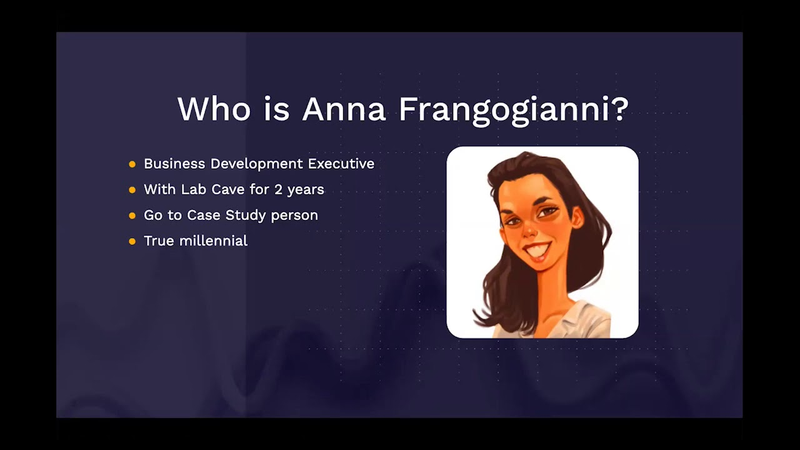
upon launch labcape was in a similar situation where we lost we launched a game that we had a lot of faith in and we really believed in but the results upon launch were not favorable so what we did is we took a step back we analyzed the data we did a lot of research and then we applied our asl expertise in order to bring new life to that game and hopefully after i walk you through the process that we went through you'll be able to take some useful snippets of information with you so first and foremost who am i uh my name is anna flangoyani i'm not italian i'm greek i am a business development executive and i've been with labcave for about two years now you may recognize me as the person that sends out updates about lab case services but beyond that i'm also the go to case study person at lab cave this means that on a regular basis i will approach the leads of our
different departments and if they're working on something absolutely noteworthy and something that is definitely worth sharing with the world i will take that information wrap it up in a nice package which will then become a case study and then i will go ahead and send you more emails with that case study additionally i've characterized myself a little bit as a true millennial because about eighty percent of the time i'm tinkering on my phone on apps uh or i'm playing games so working at lab cave is an absolute natural fit for me without further ado who is labcape hopefully you can see everything labcate is a mobile growth service provider we've been around since 2013 and we're part of the sun media group our main expertise is an aso but over the years we also started offering additional services such as monetization publishing and ad mediation and since our origin in 2013 we've launched over 700 apps
multiple of which have reached number one upon release we've also achieved over 200 million organic installs and we have we are backed by a beautiful aso team of 50 people who are obsessed with data so whoops so um how am i going to structure this presentation i am going to focus a little bit on aso to give you a recap and tell you a little bit more about why aso is as important as it is um and i'm going to give you this recap because our approach to our game and our ability to bring new life to our game was done through an aso lens so you need to be able to have this little foundation in aso to be able to understand what we did in the case study that i'm going to present to you so first and foremost why is asl so important aso is very very important although it might not be a digital marketer's first choice um
because it is what is going to at the end of the day bring the longevity and the new found consistent organic user baseline to your game aso is not your was probably not the first choice because it's tedious it requires a lot of research it requires a lot of testing um and then what is going to be put out in the store you won't necessarily get the results immediately you're going to have to wait a couple of months before the aso iterations kick in and you start seeing fantastic results so it is a bit of a long-term process but at the end of the day it's definitely worth it so what is aso aso stands for app store optimization and aso in a nutshell is the process of bringing visibility to your app in the respective stores aso can be broken down into metadata and cro metadata deals with the keywords and keywords on in aso and on your app stores are very very important because at the end of the day the keywords
are what bring visibility and the exposure to your app and not just any visibility and exposure but the visibility and exposure of your of the right audience of the audience you're looking for so once you have that visibility and exposure through your keywords you really want to be sure that you have a solid cro strategy so you want to have a serial stands for conversion rate optimization so you definitely want to be sure that your assets are aligned with the keywords that you're using and they appeal to your user base because that way that visitor who's browsing around your store will get a good idea of the game that they're about to download and will go ahead and download that game and turn into an install those two put together form aso and a strong and solid aso strategy will also in the long term help you with running external campaigns as solid aso overall makes your average cost per install cheaper
so now what we've all been waiting for our case study our case study is focused on a game that we published it's a narrative driven game called love and dating story and as briefly mentioned the game upon launch did not perform the way we were hoping it would perform um so the team had to take a step back analyze the data do a heck of a lot of research and then after applying the results that they found through the research through our iso expertise we were able to achieve a 314 percent increase in installs just on google play alone so what brought on the revamp i'm just gonna oh i'm gonna move this a little bit um upon release whoops i'm sorry um ios had a large number of pre-orders and many many good reviews we had about 500 000 pre-orders when we went live on ios however google play did not follow the
same pattern it hardly had any installs and in the first couple of weeks that it was live in the story was at most getting about 30 installs a day so especially on google play those are not numbers that you're happy with so clearly some adjustments were neat something went wrong and some further adjustments were needed so the first thing we did was research research research research we started with doing a thorough competitor analysis where we looked at what type of icons our competitors were using what type of screenshots the call to actions they were using their long descriptions their short descriptions and their titles then we did a thorough user research and it's actually quite interesting because initially um our game was targeted at teenage girls and high schoolers but um after doing our competitor analysis and additional research we realized that our true audience on average was 40 year old women so it was back to the drawing board
figuratively and literally where we had to research a whole new bunch of metadata we had to identify new keywords for our long description our short description and our title and then we also had to do research on our creative assets so we had to figure out a way to tastefully age up the assets that we already had in order for them to coincide with our new user base and all the research we had done of course you can't just apply the your hypotheses you have to test so we started our testing through split metrics and split metrics is an external testing tool and what we did there was we tested the different art styles after we had tested a various number of art styles and we came out with one that we liked we started testing directly on the google play console
where we started running a b tests and gradually we moved on to testing the metadata here you're going to get a bit of a snippet of our icon progression so this is the icon that was available when the game was launched in march 2019 on ios as you can see the girl is very young very sweet very innocent looking she's holding a maths book and the background is locker so it's really it's truly an icon that's oriented for a younger audience for high schoolers then a little bit of an element of romance is introduced additional characters are introduced but it's still very young the characters still look very innocent they have these really really big eyes this is when we started testing a truly different art style and you can see there's still that element of a sweet romance in a high school setting again or a school setting but this time the eyes get smaller so you can tell the innocence is not quite there anymore
in september 2019 which is when we also started testing regular rigorously on google play the sweet romance is gone it's all about passion and jealousy as you can see by the gentleman in the background who's looking on jealously but also something very important that we did was that we removed the school background because we felt that the school background was limiting the scope of the game as some of you know narrative games have a variety of scenarios that you can join and be a part of so that's why it was important to not have a specific background then in november the icon is very similar this is because fortunately or unfortunately it depends on how you want to look at it our september icon was so strong that we couldn't actually um develop any new icons new renders to beat the existing icons so what we did was we started changing
small elements in the existing icon and we applied what resonated the most with our user base so split metrics this is a little bit what we did on split metrics as mentioned split metrics is an external testing tool it works very similarly to google play where you test you can test variants against your existing store page what we did here is that this is when we started testing our different art styles i hope you can see it it's quite small but the art styles are quite different as are the the screenshots with a call to actions but our metadata has remained the same so this these tests were purely in order to identify what the new art style was that would resonate with our user base here you get a little bit more of an insight on what our split metrics results and information were so this was the existing
screenshots lineup and this was a new screen screenshot lineup so just by changing the icon and changing the first three screenshots completely as well as switching the order of the fourth and the fifth screenshots we were able to see a 14 almost increase in conversion rate engagement rate increased by almost 10 percent as well as the average time that a user spent on the page that also increased by a good second and a half so overall these small improvements led to a overall 30 improvement in the performance of the store page we did a couple of tests like that and until we settled on the new art style and then once we had settled on the new art style then that's when we started testing directly on google play i'm sorry the my little um panel is blocking my titles but this is
google play now um and here we tested the icons this is an example of the icon tests we ran as i mentioned this was the very strong icon that we created and it was difficult to beat it so as like i mentioned we were just testing out and changing a couple of aspects here we added holly which as you can see did not resonate with our user base but here we went to a completely new style of icon and it really did not resonate with our new user base with the the 40 year old women as you can tell by the numbers which are quite negative however here the same love icon did resonate with our user base and this is a winning variant and this is what we ended up applying toward to our um our app here you can see a little bit more of our screenshot progression the screenshots were tested in the same
way as the icon was tested and similar as what you saw in the icon page the art also ages up so you have innocent very sweet for oriented at high schoolers um a little bit less innocent more realistic and then you essentially our artwork turned into what you would see on the cover of a romance novel a little bit but what i wanted to focus on here was also the call to actions because the call to actions are also very important because they're what prompts the user to download the game is if you wait if you may it's what might get them excited about your game so here it's very innocent nothing solid where the the young girl here with the blue hair is freaking out because the boy is looking at her so this was more what or what resonated with high schoolers but then here
we start giving the users a bit of a better idea of what they can expect from downloading this style of game this narrative um driven game where they are given the option to choose their comedy or their fate or choose drama but still it didn't feel quite right and it wasn't resonating as much as we wanted so after additional testing and you know also relying on the research that we had done on our competitors we um had we moved away from the simple choose your fate choose your comedy and we we focused on on the emotion so we focused on desire and like verbs to to couple with that emotion so here we have enjoy desire find romance confront betrayal and then our art team took it a step further and through a little bit of color psychology i believe they also applied colors to those emotions so they have desire as hot red and they have romance and pink and fantasy and purple and
betrayal and blue so you really were resonating with the new user base of the 40 year old women and this responded with them and it was actually very successful testing here um after we were done testing with all our assets we were done testing our icons and our screenshots we focused on the metadata the metadata was also tested on google play but the last thing to test and to be implemented was the title the title changes were essentially structured and based on what we learned from our competition research however what the team really decided to to keep and insisted on keeping was to keep the keyword story in our title because the keyword story brings high traffic volumes and it also carries a large potential for combinations to make
long-term keywords which also brought high volumes of traffic additionally after testing we saw fantastic results and a lot of new visitors and installs coming through this title change so that was also a success on the team's part what were the overall results well throughout the redesign and the testing period we managed to achieve 300 and 314 increase in our installs on google play this translated roughly to about 450 000 new users um so this google play managed to almost reach the heights of ios upon its release as you can see it was a long term process it took four to five months for all the testing and all the research to be done and for the new variants assets and metadata to kick in and finally take effect additionally though a little additional bonus for us was that
because we were applying the new assets and the the new user uh research on ios as well we managed to achieve an additional 49 increase in our ios installs so that was uh additional bonus overall um we're very very happy about how this project turned out we're incredibly proud of our team for the amazing work that they did and how they were flexible enough to take step back analyze the data and take such drastic changes because more often than not you think no okay my preliminary research is the correct one i have to push to this audience i can't be flexible but no that's not the case you need to do your research you need to follow the data and then in our case through our aso expertise we were able to create a whole new bunch of assets as you saw we were also able to create a whole new batch of metadata which led to some fantastic results so thank you very much for your time
hopefully i didn't go to over i sped it up a little bit um and if you have any questions i'd be more than happy to answer them oh that was great perfect timing it couldn't be better well it's tough it's tough when you kind of have technical issues you don't try and you know you don't want to sort of not have too much of a knock on effect but i totally get it you did a great job as well because what's key to me is just you you go across just how much work there is in the whole research test process and i think it's kind of fitting we've got split metrics following you that you end up talking about hopefully hopefully that's all good um uh so in in terms of questions um there was a question here from um uh chitchin um did you change the game art style too or is it just the app store icon on the metadata first we started changing the app store but gradually the art inside the game also started evolving to match what the users were seeing in the store
and i think that's actually really interesting because i know we've seen a lot of ads that are basically nothing to do with the game and there's all sorts of controversy around that but i am of the opinion that the closer the narrative the closer the experience sorry personality plus the experience of the um player to what they get the more likely you're going to have a resonance exactly rather than a dissonance and i i feel like that's an important factor i mean there are reasons for doing both i mean there's lots of history around people doing crazy things with uh you know life real-time ad um you know like live video type stuff which has nothing to do with the gameplay and somehow that works um but it feels to me that it's more honest or more likely to deliver long-term retention have you seen anything around that well um yeah i mean eventually especially since we started targeting um the correct audience we also saw the session length increase
we also saw the lifetime values of our user increase because the people that started playing our game after all our changes and all our adaptations were the people that were actually looking for this game and they didn't feel like they were misled so we also saw an increase in our game economy from that as well and and just based on a question from science did you also see an increase in organic uplift from that did it did it make any impact on organics or is it just as in i know you're getting absorbed optimization but were you seeing more people coming in after they saw other aspects of the game you know were you seeing um and it's really hard to tell where the sources are but yeah from the attribution data were you getting a sense of a more social led uplift as well well these changes were primarily um primarily resulted in an organic uplift because labca were all about the organic we rarely run i was using the wrong
language i'm just trying to get oh sorry people who go to the app store versus you know if you can find find any kind of um sometimes you can find attribution to social media through previews no but that's what i'm saying like this growth what we saw was was through the organic channels it wasn't we weren't running external paid campaigns we weren't running for example campaigns on facebook or um instagram or on other apps um this was through you uh this was through our organic channel so through search and browse and search and explore yeah there wasn't just the fact you were converting more people who came to the page you're actually getting more people to come to the page exactly that's where the keyword was very the keywords in the metadata was very important like that's why it was so important for us to identify the new audience and find the keywords that resonated with the new audience because it's through those keywords that we were able to attract into the storefront and once they were at the storefront browsing around that's when the assets come in and it's very important to have the correct assets for example the
correct icon feature graphic and screenshots on google play because that's what they see and that's how they more or less get the first idea of what they're going to be getting from the game and that's when they decide if they're going to actually download the app yeah no exactly uh the reason why the thing back in my mind though is i think there's a there's a series of pathways of getting people obviously yeah so the keywords is a key part of it i think the page user acquisition where that's done can be very valuable but i think uh there's also that other aspect which i'm particularly fond of which is to find ways to get people to socially recommend and then the trouble is with social recommendation it's very difficult to differentiate between keyword versus people who've just happened to have gone find the site because their mate told them it was a great game uh we did some work a long time ago we found out about a third of installs were coming from um organic but not just organic but so once they were organic and once they were coming through social links and so and also in person you know
sharing was part of that social part but again it's so hard to track and uh we only could do that by doing a survey of people who had installed which is of course not imperfect so anna thank you so much for that that was really fascinating thank you for being sponsors of this great track thank you it was uh it was great hopefully this uh was useful and because i'm not the most technically savvy person am i going to the green room now it's up to you if you go to the green room or okay let's stay listen and we we've got olga now in fact what we'll do is we'll um katie will uh bring all you know we'll bring olga back into the panel side and um okay great so uh thank you very much anna
Summary
Revitalizing underperforming mobile games requires a rigorous, data-driven approach to App Store Optimization (ASO) and conversion rate optimization (CRO). By treating store presence as a dynamic asset rather than a static requirement, developers can significantly lower acquisition costs and foster sustainable growth. The core thesis posits that long-term success hinges on aligning a game’s visual identity and metadata with the expectations of its actual, rather than assumed, player base.
A case study of the narrative-driven title Love and Dating Story illustrates the efficacy of this strategy. Initial market analysis revealed a critical demographic misalignment, as the game was attracting women aged 40 rather than the intended teenage audience. By pivoting the art style to reflect a more mature aesthetic and refining call-to-action language to emphasize emotional resonance, the development team achieved a 314% increase in Google Play installs and a 49% increase on iOS. These adjustments were validated through extensive A/B testing and competitor research, which ensured that every visual element and keyword choice served the specific preferences of the core demographic.
Ultimately, organic growth is best sustained by optimizing storefront visibility and ensuring that high-quality visual assets effectively convert traffic into downloads. While social recommendations play an auxiliary role in discovery, search-based acquisition remains the most measurable and reliable driver of long-term retention and lifetime value. By continuously iterating on metadata and store assets, developers can successfully bridge the gap between a game’s initial performance and its true market potential, transforming underperforming titles into stable, profitable products.














Comments