VideoPocketGamer.biz
Session: Beat The Uninstall Button: How AI-Native Engagement Rewrites The Player Retention Playbook.
10 Feb 202617 min video
Transcript
Uh retention is um a massive issue. Um how AI can help us with retention. Um yeah, so round of applause for Resh, please. [applause]
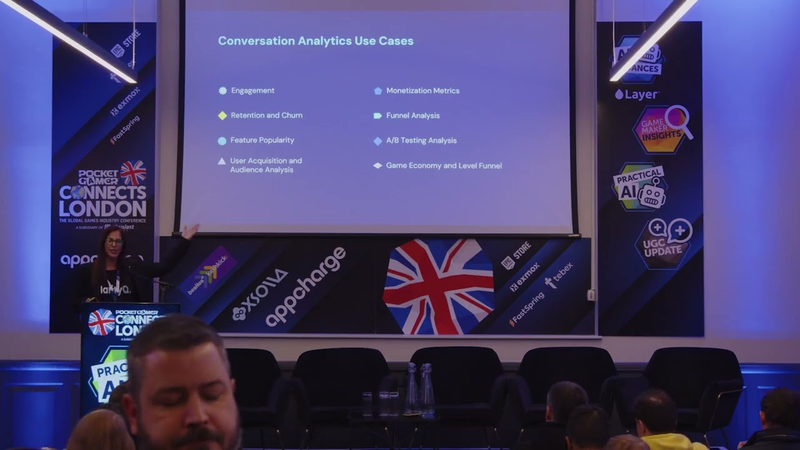
All right, good morning everyone. Um super excited to be here today. Uh I'm Rakkesh Mystery, head of product at Helpshift. Uh we deliver AI native player engagement. Um I'm going to be talking to you today about player engagement and specifically in the context of player support. uh how we can use AI data and insights to drive an
increase in player engagement. We'll also be sharing lots of recent player survey data at the end. So let's get going. All righty. So I want to start in a similar vein to the previous conversation really uh recognizing that the pace of change the rate of change in technology particularly in AI uh was kind of unthinkable a few years ago. uh and rather than simply feel that we should just all embrace that technology on mass and move at that same pace, I really want to shift gears in the context of player support and consider how AI and insights that we can use can actually improve the overall player experience first. Uh and at Helpshift, we're all about improving conversations in player support and in player engagement. The three critical parts of what make up Helpshift are our technology, our AI, and human services. our technology that's really driving the in-game player support experience. Our AI, we've made some exciting advancements in AI agents that are designed for all parts of the
player support and engagement journey. Uh I'm going to show you some of this later as well. And our expert human services that go to drive value uh and drive that human touch uh that's absolutely critical when it comes to player support and player engagement. And we know this space super well. uh help shift have a ton of experience across huge gaming companies where we've helped to deliver meaningful outcomes for our customers whether that's driving high deflection rates automation rates in player support driving savings for our customers um but particularly and above all else driving high seesat that drives player engagement. So, we're now evolving towards a player engagement platform and that means increasing our focus on player centricity in our solutions in 2026. So, I want to pause on this for a second and uh bridge the gap between player support and what player engagement means. And that means understanding how player support can be more than just issues and tickets, but it's actually about
handling conversations across the entire player experience. It also uh thinks about how AI is simply more than just bots and automation, but it's actually about understanding how to act better and how to act quickly to drive better player engagement as well. And fundamentally, it's more than just driving a reactive experience, which is typically what player support is, and actually starting to think about being more proactive in that space. So, I want to start then with a thought. Um, what if in your player support data and in your cues and in your forums, you're leaving valuable insight and opportunity to engage players in a different way? Have you considered how your support teams and the data becomes a valuable source to drive further engagement or how your community actually might react or your wider player base might react knowing that your player support and your player engagement tools u were actually driving really high satisfaction and high quality. So to understand this in a little bit more detail, we actually surveyed players on why they disengage
from their games. And what we learned was super interesting. Now, it's no surprise that one of the number one causes of disengagement was ads and monetization. But fundamentally, when it comes to player support and engagement, poor player support, particularly player support that results in long wait times, can create player churn. in fact for over 60% of the survey audience and almost half of that audience would churn if those responses were not helpful. Interesting also that the vast majority of players that we surveyed around 75% said that they would recommend a game or spend more time or money in a game if that player support experience was of high quality. It's also interesting to see that players are not allergic to knowing that AI is part of that player support journey as well. So I think there's a degree of hesitancy when it comes to adopting AI and today's been all really about AI adoption and the fast pace of AI. We're actually seeing that we're starting to see uh player survey data actually helped to buck that
trend. To understand this a little bit better uh I wanted to share a typical journey of a player. And this player um for hypothetical reasons we call Jacob. Uh, and Jacob's playing a a mobile game called Galactic War Alliance, and he experiences an issue in his game when he's trying to redeem his weekly challenge reward. Uh, this issue comes up with an error code. He doesn't quite know what to do. So, he does what we all do, which is jump straight onto Google, uh, Google the error code and see what Google has to say about it. And maybe three or four articles pop up. Uh, doesn't quite resolve the inquiry. So, he spends the next few days doing a little bit more research and a little bit more um, investigation. uh he finds a Reddit thread from like 2023 which doesn't really have a clear resolution in it. It's kind of outdated. Uh so he goes to raise this problem with player support. Um and when he raises this problem with player support, um he sees that the response that comes through a few days later maybe um is a very rich, very deep FAQ response that he has to go
navigate. But by the time he's got through that, he hasn't found a clear answer. Life kind of takes over. he effectively churns uh and hasn't really resolved his issue. So we see this kind of journey and I know that was a hypothetical journey but I think it's fair to say particularly in our research that's fairly common. Uh and where what we're concentrating on is really in each node of that journey from where the error was identified how quickly he actually got that resolution to the point in which how quickly the helpful answer actually got to him. Uh we see this as a threat to good player experience. So we think about solving this problem in two key ways. One of them is our AI agents. They're playercentric and purpose-built for player support. I'm really excited to be showing you some of that today. And number two, it's uh proactive engagement. So let's start there. So firstly on proactive, we're super excited to be having this in beta right now with a GA release very soon. And this is different to simply just sending
marketing engagements out to your player base. Uh the key thing here is that we can also drive conversations with our players. Whether you're segmenting your user base to concentrate on VIPs or any monetization activities that you want to drive with your players, the key thing is that capturing that moment in time and having a conversation with your player is a way to drive engagement. So, we're super excited to be launching this soon. Uh and it's a great way for gaming studios to start to be a lot more proactive with their player base through uh proactive engagement. Secondly, help shift AI agents. And we're super excited to be sharing this with you today. We took a playercentric approach when it comes to designing AI agents. And we're developing four of them that play a key role in the player experience. So, I'm super excited to be sharing a video of this shortly. Hopefully, it works. Fingers crossed. Uh, and you'll see a lot of this um over the coming um weeks and months from Help Shift. uh and and hopefully if we're back here next year, we'd love to see uh how this is actually activating across a bunch of our player base as well. Um I'm
going to start with care AI. Care AI is designed for end-to-end uh player support. It's ready to go. It's trained with the years of experience that we have at Help Shift in player support and we're currently actually in closed beta with a bunch of our customers testing this today. Um the other AI agents quickly uh we have engage AI that we're developing which will be our first proactive AI agent designed for VIP engagement but also um aiming at reducing or predicting player churn. Um thirdly community AI agent where we're taking um insights community insights from Reddit, Twitch, Discord uh particularly the sentiment around your communities and we're turning that into an AI agent that can be used within a player support queue. So we think player support is not transactional. We don't think that players actually are coming in just to ask for something to be solved, get that solved quickly uh and then off they go. Whilst that will drive the right resolution rate, we also think that's a moment in time to drive uh a deeper engagement with your player base, particularly when it comes to fandom. Uh
and then lastly, Guard AI. It's a non-con conversational AI agent. It's designed to house all of your guard rails and your monitoring rules and your policies. uh particularly when it comes to a lot of the topics that were covered today around making sure that uh we protect the overall player experience and make sure that AI agents um don't go arry. So for today we asked ourselves a very straightforward question. What if we could use AI agents to enhance the overall player engagement through player support? And what you're seeing up here on the screen now is our care AI agent handling a player support question from Jacob that we saw earlier today. And for the interest of time, we've kind of sped this video up. Um, but what you're seeing is Jacob asking that same question around his missing rewards. What it'll receive from Care AI is an instantri reply coming from our AI agent which will troubleshoot. They'll provide multicontext answers powered through generative AI. But more importantly,
those answers are personalized using all of the player telemetry data that we have with our in-game SDK at helpshift. It provides a deeper context and we're connecting to backend services. So, we're able to say to Jacob, "Hey, we found your missing rewards and we've got that sorted for you. Do you want a tip from the community?" From Jacob's perspective, no, not quite now. I actually have another question. So, our AI agents are able to navigate multicontext turns within that conversation whilst, you know, holding on to a tip from the community. Jacob actually wants to know about an issue uh with war rooms. Why is he not seeing it? The AI agent's able to answer that question using a lot of player data. So, a personalized answer saying, well, hey, the feature is only available at level 20, but you're only at level 18, so keep going. And if Jacob comes back and changes context, yeah, what about that tip that you showed me? Well, our community AI agent is able to answer that and say, "Yep, absolutely. You're missing out on a 30% damage buff that the community is talking about right now." So, what you saw there was a
conversation between Jacob and two AI agents, one trained on player support and the other trained on community insight, able to answer that question quickly. And if we go back to that original side where we were talking about the disengagement journey, how important it is to engage your player within the player support journey. It's absolutely key that you answer that question quickly, which is why we're designing our AI agents in the first place. But actually, uh, the disengagement survey showed us that the vast majority of players disengage from their games because the answers are unhelpful. So, it's absolutely key that AI agents are able to navigate the complex questions that are asked in player support and answer those questions effectively. We're excited to alo also be sharing some of the results that we've been seeing uh as we've been testing this with customers uh around three months and since running the beta with select customers we're seeing super strong results in seat and automation rates. We've designed care to encourage player engagement and as we saw from the disengagement survey poor seesat and
quality actually drives um disengagement down. We're actually seeing engagement go up as a result of an average of 4.2 two on seesat which is super strong from an AIdriven experience but also an increase rate in automation and you see a few quotes there from customers um who can actually see that the AI uh AI agent engagement that they're seeing from their player base um they see as the way forward and not wanting to go back to that sort of traditional transactional route of bots and automation. So to finish, let's take a look at what I think is an optimal player journey, at least in concept. Instead of waiting for players to reactively escalate to player support, having the knowledge and the data allows us to be proactive and preempt any support inquiry. Um, and and and that allows us to have a moment in time with our players to open up a conversation. Remember, from our perspective, proactive is more than just a push notification that goes to the player, but actually a moment in time that's personalized, enabling you to open up a conversation to engage that
player further. We saw earlier how uh taking time in answering the player's question, particularly providing them long and unhelpful answers, um isn't particularly a way to engage them. So, we're designing AI agents that can get to those answers super quickly and keep that player um well engaged. And then lastly, making sure that your player support is in game also helps to minimize that level of disengagement. Sending that player off to different wiks or different forums adds to the engagement. And whilst that might be table stakes from a from your perspective as you're designing your game, uh, as close and whatever proximity you can have to your experience in player support is a way to help to minimize that level of disengagement and increase the level of personalization that you can actually apply to your player support and player engagement. And once we have the basics, those top three levels of uh addressing the level of disengagement that we're seeing from from players within the survey, um we also think you could do a little bit more. So that might be an opportunity for you to think about
promoting upsells and upgrades within the player experience. Maybe it's also a way to drive a deeper level of VIP engagement with your player base as you segment that player base out between VIP and nonVIP. It also gives you license uh particularly to think about how you might want to um substitute any um uh ad and monetization opportunities being the number one level of disengagement that we see with a more meaningful way of having a conversation with your players. All righty. So, I want to finish on um an interesting point. Um I'm obviously not going to be the only one today talking about AI at Pocket Gamers. Um but we did want to share some recent insight on the state of AI in gaming support. So please take a scan of this QR code um and provide us some feedback on the session uh and also scan to get your copy of the state of AI. Um we surveyed leaders uh in the gaming industry and it shows us two very clear themes. One, the overwhelming majority 75% of all respondents of of leaders in
the gaming industry are positive about AI, positive about the momentum of AI. Um and then the ones that aren't uh they cite a lack of gaming specific solutions that stand in their way or data quality that stands in their way. So that's quite an interesting point that within the industry um we're seeing um uh it being swarmed with AI tools that aren't particularly gamingcentric and that's really why we've started to think about this from a gamingcentric perspective but the state of AI report will show you a little bit more in terms of how the audience thinks about it. We've also split the audience in in three uh areas as well and we see that in the survey data. Um those people that are pioneers um who are out there with AI tools facing players and actually testing the models out there and and those that are observers, those that are standing by the sidelines uh waiting to see how the big behemoths actually solve for this and then they can step in with those models as well. And you'll you'll be able to read and and see some of their thoughts in the state of AI report as well. So if you scan the QR code, you get an instant copy to that as well. If you have any questions about helpshift, I'm conscious of time and I've tried to
save a little bit today. Um, come and find me or our excellent team that are here today. So, you got Sarah, you got Kent, I think I see Sam and Ollie as well. Um, so, uh, we're all here to answer any questions that you have. Um, otherwise, thanks for your time today. [applause] [music]
Auto-generated captions from YouTube — names and numbers may be misheard.
Key insights
7 takeaways · ~3 min read- 01Poor player support is a primary driver of churn, with over 60% of surveyed players stating they would abandon a game due to long wait times or unhelpful responses.
- 02High-quality support significantly impacts retention and monetization, as 75% of players report they would spend more time or money in a game if they received a high-quality support experience.
- 03Player survey data indicates that users are not inherently resistant to AI in support, provided the technology delivers effective, personalized resolutions rather than generic, transactional automation.
- 04Helpshift's beta testing of AI-native support agents resulted in an average CSAT score of 4.2, demonstrating that specialized AI can improve player satisfaction while increasing automation rates.
- 05Industry research shows that 75% of gaming leaders are positive about AI adoption, though many cite a lack of gaming-specific solutions and poor data quality as the primary barriers to implementation.
- 06Modern player support strategies are shifting from reactive ticket handling to proactive engagement, using in-game telemetry to anticipate issues and initiate personalized conversations before a player churns.
- 07Effective AI-native support requires multi-contextual capabilities, such as the ability to troubleshoot technical errors, provide community-driven tips, and offer personalized game-state advice within a single conversation.
Ask AI about this video
Cite this video
Citation
Generating citation…




















Comments