1 free read left. Create a free account for unlimited reading + AI research.
Create free accountReport European Conference on Games Based Learning (ECGBL)
1 free read left. Create a free account for unlimited reading + AI research.
Create free accountReportEuropean Conference on Games Based Learning (ECGBL)
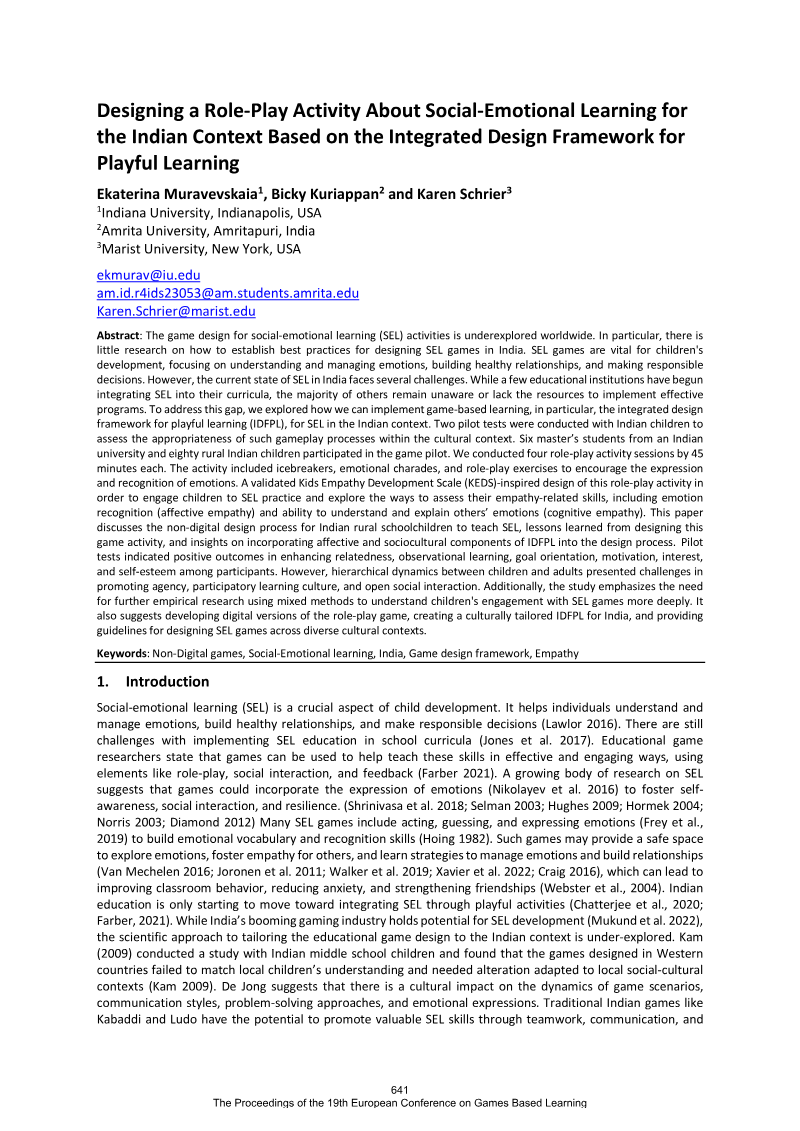
This study examines how Grade 7 students in northern Thailand experienced a digital games-based learning (GBL) module designed for comprehensive sex education (CSE), with a focus on preventing sexual harassment and sexual abuse. Drawing on pre- and post-test data from 1,152 Year 7 students across six secondary schools, the research finds that the gamified module produced significantly higher post-test scores than traditional instruction, with gains observed across all six levels of Bloom's Taxonomy. Engagement and critical thinking appear to have been supported, though not uniformly.
Gains were strongest in remembering and analysing, while understanding, applying, and evaluating improved least. This unevenness is a central finding: the game reliably strengthened recall and analytical reasoning but was less effective at developing skills that require transferring knowledge to real-life situations or making reasoned judgments. The authors attribute these patterns to the nature of the intervention rather than to any single failure of the game itself.
The authors also caution that the pre/post design, in which the same students were taught under different conditions across semesters, limits the ability to attribute gains solely to the game. Results should therefore be read as suggestive rather than conclusive regarding GBL's independent effect.
The conclusions point toward a blended approach. GBL is not sufficient on its own and should be combined with enquiry-based and situated learning, with explicit real-life and hands-on application. The authors further emphasize broader stakeholder involvement, including parents, educators, policymakers, and religious leaders, and identify teacher competence as a key determinant of success in delivering CSE effectively.



European Conference on Games Based Learning (ECGBL) · 2026



European Conference on Games Based Learning (ECGBL) · 2026



European Conference on Games Based Learning (ECGBL) · 2026



European Conference on Games Based Learning (ECGBL) · 2026



European Conference on Games Based Learning (ECGBL) · 2026



European Conference on Games Based Learning (ECGBL) · 2026



European Conference on Games Based Learning (ECGBL) · 2026



European Conference on Games Based Learning (ECGBL) · 2026



European Conference on Games Based Learning (ECGBL) · 2026



European Conference on Games Based Learning (ECGBL) · 2026



European Conference on Games Based Learning (ECGBL) · 2026



European Conference on Games Based Learning (ECGBL) · 2026
European Conference on Games Based Learning (ECGBL) · 2025
European Conference on Games Based Learning (ECGBL) · 2026
European Conference on Games Based Learning (ECGBL) · 2026