1 free read left. Create a free account for unlimited reading + AI research.
Create free account
Sports for the Win! Why Licensed Sports Games are Positioned to Win Big in Mobile - PGC Digital #2
Key insights
6 takeaways- 01Licensed sports IP, such as NFL and NBA, acts as a primary user acquisition tool that reduces reliance on organic growth and optimizes customer acquisition costs.
- 02Long-term retention and monetization in mobile sports games are driven by data-led live operations that mirror the seasonality and real-world narratives of professional leagues.
- 03The mobile sports genre is shifting from complex console-style simulations to mobile-first, short-session experiences lasting 4 to 5 minutes.
- 04Investors, including those with direct ties to professional sports ownership, are increasingly prioritizing studios that combine authentic branding with accessible, 'clash-style' gameplay.
- 05Developers are moving away from treating mobile as an ancillary distribution channel, instead building games specifically designed for the mobile user's lifestyle.
- 06High barriers to entry caused by the difficulty of securing major sports licenses create a competitive moat for studios that successfully integrate high-fidelity IP with mobile-native mechanics.
Ask AI about this video
Transcript
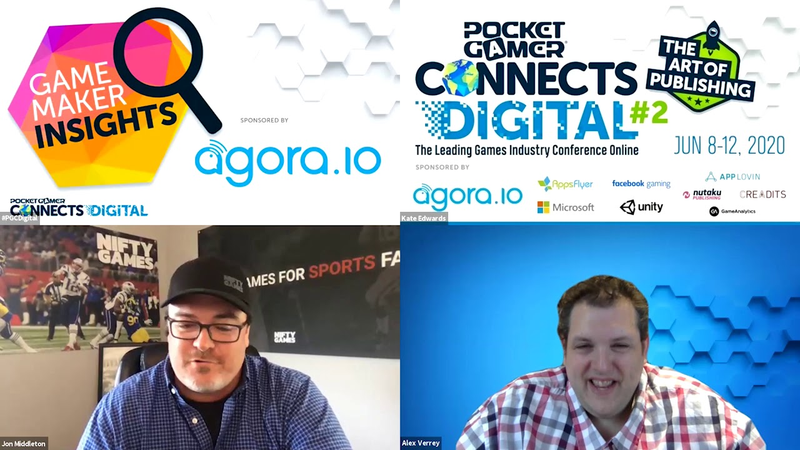
Why licensed sports games are positioned to win big in mobile. And so I would love to introduce John Middleton and Alex Verney of Nifty Games to talk about this subject. All right. There you are. All right, take it away. We've done it. Alex isn't quite here yet, but that's all right. There he is. Oh, there he is. There he is. There we go. Hello, Kate. How are you doing? Good. By the way, Alex, there was like a fantastic the last presentation a really interesting segue into kind of what some of the aspects of what we're going to talk about. So that was that was pretty good. Yeah, it was good, wasn't it, huh? Really good. Thanks, Alex. But Alex and his take on on the uh Alexander's take on the kind of the availability of realism and and and
you know, IP in gaming is you know, it's it's not all that different than what we're talking about. So Well, indeed. So so so let us segue in. I'm a lowly PR guy. You don't want to hear too much from me. So my name is Alex. I'm the global PR director of a company called Heaven Media. I work at a gaming marketing agency. Nifty Games is one of our clients. The reason I wanted to introduce John is simply but that we go back a long way. So John is more than a client. He's a friend. And I worked with John Middleton back in the days of Mad Catz where John was instrumental within the board as our business development director. John, I hope I don't embarrass you when I say I think you're one of the most ubiquitous and best known business development guys in the business. And I know you've been doing that for for a long time. Oh, well, yeah, it's it's it's a painful amount of mingling, but yeah, no, it's all good.
Well, for about a decade when I knew you were working together at Mad Catz, I know that that Nifty Games is the culmination of a dream that you've had for a very, very long time. I know that sports and sports gaming is is is a subject very close to your heart. So, if it's okay with you, John, why don't we spin a little video that we that we could show everybody going to give the flavor of where we're at with sports nowadays. Yeah. So, if if the guys from Pocket Gamer could could kindly spin that video, that'd be great. I wonder if they're listening to us. I hope so. I don't know. Well, I I am here. I don't have the ability to do that, but um Nah. So, I sent the link to Sally. I could I could do a screen share, but I think my my frame rate's going to be brutal. But, I could try. We sent the link over to Sally, and I think she sent that over to to your team. Okay. I just pinged them.
No problem at all. I tell you what, while we get that ready Yeah, yeah. Keep We'll we'll keep going while I'll I'll work on that. You guys keep on that. I don't I don't want to hold things up. So, I tell you what, John, why don't give everybody watching the elevator pitch on on Nifty. As I say, we've we've worked together for a very, very long time now over at Mad Catz. Sure. And and I know that when you left Mad Catz, you set about with this with this grand dream of joining the industry elite, getting everybody together, and launching a new company focused laser focused on on introducing short session mobile titles, and fusing that with the with the greatest sports licenses. So, do you do you think that's a fair analogy? Why did you want to start Nifty Games? Yeah, I I mean, we started Nifty Games now about 2 years ago. We raised some seed funding, and then uh uh more recently, we closed a series A funding in uh late last year. So, we've raised a total of about $15
million so far. Um the reasoning for that is frankly that the opportunity for for sports games, particularly licensed sports games, has never been better as far as um you know, audience addressability and and and the ability to go find these fan bases that are passionate about about each individual sport, and um and and the mobile platform particularly has been available for different types of of sports games for quite a while. And sports games uh you know, is showing massive growth on mobile as mobile gaming becomes more ubiquitous. Uh sports is basically kind of uh I think about it as part of human life. It's you know, athleticism, competition, uh everything you think about when when you think about uh how people uh behave with one another in a community aspect, and then as it evolves into gaming, uh likewise, you know, uh for mobile, we know how our engagement's
going to work. We know where our our influences are. You know, when we license the NFL or when we you know, the NFL Players Association is a a partner of ours and actually at this point an investor of ours as well. Um same thing with the National Basketball Association and and the NBA Players Association, uh they've got fantastic reach and and evergreen uh connection to their fans. And it's an ongoing passion. This is not something that is uh you know, uh even compared to the major entertainment licenses, whether you say a you know, a a Star Wars or Star Trek or you know, some of the greatest entertainment properties of all time have have, you know, kind of lulls and dips. Uh uh sports is is totally different. It's a it's a foundational license partnership where there is, you know, they rejuvenate and they renew on a seasonality basis. Uh well, pretty much up until now, obviously, with the the current situation uh
around the globe with with pandemic, it's interesting that it's you know, a pause of sports has really been um you know, really been affecting a lot of people. And I think the lack of having that availability of of professional sports leagues and the competition and even from a fandom basis um has been difficult. But uh sports games themselves have never been none better. Everybody's flourishing. Um you know, obviously, a lot of that's due to uh you know, a lot of uh to say that due to due to the lockdown more people have been playing sports games than ever before, uh not only to keep themselves occupied. We know how how, you know, the general use of of gaming in general, hours spent gaming at home has shot up in in recent months. But I guess that for sports fans as well, if they can't get their fix on TV, uh they're going to want to play online even more, right? So And uh speaking of getting a fix, we do have a video for you if you'd like to watch it. Sure. Yeah, this is This is
This is kind of a video without It's actually It's actually I'll give credit to Nike cuz it is a Nike video, but it's it does do a great great uh job at capturing the essence of sports and and where it stands now. No one's ever come back from 3-1. An agonizing defeat. Down 5-1. She's got to give it all. We've all been underestimated and counted out. In those moments, we felt like it was over. It's not looking good for Rafa. But it's when we're given no chance know what could Osaka be thinking right now. that we somehow found that last bit of strength to keep fighting. running down to see if he's okay. And then we did what no one thought we could. Not even ourselves. We came back from the impossible. From being broken.
We found a way when it seemed hopeless. Came back when we should have been long forgotten. And we did it time and time again. Right now, we're fighting for something much bigger than a win or championship. But if we learned anything from sports, is that no matter how far down we may be, we are never too far down to come back. Uh, you see I love that video. There you go. I get goosebumps. It sets it sets the scene, but you know I I I I think I feel that everybody's kind of chomping at the bit to get sports started again. And to get into that,
right? And so, you know, John, I want to get kind of into the weeds of things. Um, sports games been you know, a perennial hit and an evergreen hit for so many years. Uh, we all got we've already got big behemoths out there. You've got the likes EA and 2K. They're doing fantastic console sports games. You've got the Madden series, you've got the 2K sports series. Um, you know, why do we need Nifty? Surely those guys have have got mobile versions as well. Sports games to mobile isn't isn't a new concept. No, they do. They do. And I mean for for really for EA and 2K thus far, it's really been much more of kind of an ancillary distribution platform. You know, there there's it's it's it's I mean, they're making some of the greatest games of all time, you know, with FIFA, with 2K Hoops, with Madden Football. I mean, uh the the fidelity, the real you know, the realism, uh even bringing kind of the the
structural complexity of the sports, particularly when you get into football, and when you get into the the basketball, and the way that the games are played, and the actual sport. Um they've never been better. I mean, it's some of it's it's fantastic. But, uh you know, on on mobile, there's different types of gameplay. There's different types of ways to address mobile gamers have a different um consumption of gaming. You know, it's it's it's a bit more uh you know, for for our standpoint, it's it's more short session, it's more granular. It's more community-based. It's more, you know, we're going down the realm our first game has been announced. We're going to do, you know, it's NFL Clash. You know, we've got the the the league, we've got the players, we've got uh an infrastructure that is built around, you know, a proven genre at this point when you look at Clash gaming. I'm certainly Golf Clash has done incredibly well in sports genre. Tennis Clash is doing great right now. Uh those guys have done a really nice job, and then and even Fishing Clash, frankly, has done well. Well, a lot of
things these things have proven, you know, that that genre of gaming, even beyond Clash Royale, uh is something that people understand, they want. Um it it it's it's engaging, the retention is is excellent, uh monetization is there. Um all of the kind of the the the the basics, the meat potatoes of mobile gaming, fit lock and key with what sports is, and what sports means to people, you know, and and the community aspect, and being able to constantly uh refresh the content to give people that are already predisposed towards the types of uh interactions with players and and teams and leagues and and the sport itself uh it's incredible. So, for what we're after is just uh effectually looking at uh sports less from the
you know, what was essentially uh you know, box product into DLC model that uh a lot of the larger sports games have have migrated. And for us, it's much more we're looking at sports from a purely mobile aspect. Uh you know, data-driven how does that differ? Can you Can you explain a little more about short session versus uh a console experience? Yeah, well, I mean, it's not just that. I mean, it's also the way it's built from the ground up. We're We're definitely looking at at at the games we build uh from an analytical standpoint using information, a lot of testing going on, a lot of uh uh you know, tweaking and tuning. And that certainly as we get to soft launch in a couple of weeks, we'll we'll definitely be uh getting even more uh tweaking and tuning. We get some tech feedback, we get some player feedback. We start to look at our KPIs and and our our monetization loops and our larger metal loops as we go along. And so, you know,
going free-to-play in and of itself in a true aspect with gameplay that is engaging and authentic to the sport but then containing that to, you know, a 4-or-5 minute uh experience is something that really hasn't been done in a long time. Um you could say that maybe some of the sports games, you know, when we were kids had that aspect where you could play pretty quickly um and they were far less complex, um but they didn't have the you know, they weren't the masterpieces of of sports gaming that today's console games are. Why is that why is that authenticity important to a mobile audience do you think? Why why is licensing so important? It's uh takes a lot of time, a lot of energy, a lot of money to secure those licenses. Um does it make sense to make licensed sporting product? What does it what does it add to a mobile game do you think? Well, it does. You know, we've done a lot of study and and we gathered a lot of information. I mean, on the mobile
aspect uh certainly with our first two partners and we you know, haven't announced the others yet, but you know, with the NFL and the NBA the you know, the crossover of gaming to to fan base to you know, kind of their passionate crew out there that are are tuning in you know, to every game in every in every territory. Um you know, mobile outweighs every other platform. Mobile outweighs console. Mobile far outweighs PC. And um you know, for us again, it it is there's common sensical stuff where mobile's obviously the the largest platform in gaming from a revenue standpoint. It's the largest platform growing from a you know, uh total margin percentage as far as gaming overall goes. Um and accessibility, you know, obviously I think every pocket camera crease, but uh you know, the product in your in in in your in your in your
pocket is where you want to play your games. And um even myself as as you know, I was a passionate Madden gamer and uh played all kinds of different uh licensed basketball games as a kid in the game or growing up. But nowadays it it gets a little bit more difficult. I don't have the you know, it's it's it's a combination of you know, I don't have the time that I used to have. I don't have the ability to sit down and and have a a longer term you know, 40-minute kind of gameplay session and that you know, that 12-foot experience. And I also don't have you know, my gaming tastes have changed. I'm I'm uh you know, I always joke that I I have the attention span of a very small bird, you know. I'm bouncing around from from you know, I love the I I love you know, Clash Royale is one of my favorite games of all time. And and you know, we were already thinking in this direction as far as looking at how do we maintain authenticity of
the sport and the game and and have some fun but simultaneously find a way to do it in a quick session that allows people to engage more often but on a on a more you know, granular basis. I always joke, you know, we're trying to be the uh you know, the Altoid of gaming, the powerful yet small. And I think it's resonated great with you know, obviously we've uh we've secured these licenses that are not particularly easy to uh to get or to partner with and you know, that's we've done that because we've been able to actually work with the partners that understands what we're doing and how it's complimentary to what they're doing in gaming and how it's complimentary what they're doing overall in their sport cuz you know, sports in the same way that it's constantly regenerating itself on a player level and on a team level and in a competition
level, it's also regenerating itself on a fandom basis, you know. I've got now, you know, I don't know, six or seven hundred kids and um and you know, every one of them is going to be a Red Sox fan. Everyone is every they they they have to be. They have no choice. You know, I'm I'm a Boston guy originally, born and bred. Uh and Nifty Games is in California, so that makes it a bit more difficult to to fend off the There's going to be a lot of folks raging at that, I think. Yeah, it's fine. It's fine. It's uh you know, I I allow them to uh you know, embrace the Golden State Warriors and they you know, that you know, the San Francisco teams are benign to me, so it's it's all good. So, I mean, authenticity a big deal, which is which is why we've got the license, but how many other folks out there have the license for instance for for for NFL when it comes to when it comes to obviously been incredibly exclusive now for many years um in the sense that they have not partnered with many people. Um it's not I mean, not just a contractual exclusivity. It's it's a partnership
exclusivity where you know, they work with Madden uh and EA to really build that game and that community into their overall yearly schedule. So, it's been an incredible uh win for the NFL and the NFLPA. For I mean, EA's put forward an effort to build a a sports game that you know, their games run parallel. I mean, between 2K and EA uh you could put them up against even if you leave the genre, you could put those games up against any game that's ever been made. They're so unbelievably good. Um so, you know, for for a gamer that is a a fan of sports games, having the the players or the real players involved and having the real teams involved and having the real leagues involved and and uh even the way we can synchronize, you know, in-game aspects and uh you know, retention and
engagement tools with what's going on, you know, on the court or in you know, on the field or in the ring or you know, on the pitch, as they would say. I mean, it's a huge advantage. You a lot of mobile games when you're in a fictional realm, you know, if it if we were making games about, you know, unicorns and leprechauns, there's no uh there's no preset community. There's no We We've got a constellation. We've got, you know, player influencers. We've got, you know, press influencers. We've got the teams that uh uh have massive campaigns themselves. The leagues, obviously, are are hugely uh uh you know, competent in in working with their fan base and and and continue to grow. So, you know, and beyond that, even sponsors, you know, networks, broadcasters. There's all kinds of different ways that we can look at uh you know, how do we find the right players that like sports games and like
what we do? And I think uh it's a huge advantage. So, the uh you know, the the console system, uh you know, is well-worn and has been for for many years now. They will used to update every year. Gamers buy the game and and they move on. So, how do you work with the likes of the NFL when it comes to monetization and deciding how that's going to work with short session gameplay? Well, I mean, it's it's um frankly, it's as it's as as simplistic as it can be. You know, it's it's a pure play licensing deal, whether it's console or PC or mobile. Very similar. Um you know, for us it was more about gathering the right team together, the right talent, uh allowing the the PA, the Players' Association, and the league to understand where we're going, being very specific about what we want to do. And Nifty Games is only about sports, and frankly, we're only about sports in a in
a mobile and a clash style. That's what we want to do. That's what we're after. We enjoy that. Um our team our team is built around it. Um, we've kept the team small, but everybody's made sports games before. Everybody's delivered, uh, massive titles and serviced them on in a live ops for a you know, Well, just just very quickly, and I'm conscious that of our time, John, but is it worth talking a little bit about the team or perhaps some of the folks that are that are backing Nifty and and what you're able to bring to the table? Uh, sure. I mean, you know, we've got I mean, our investors are are incredible. I mean, it's Yeah, I'd like to brag about that all the time. Uh, but yeah, we've got, uh, you know, we've got great gaming style investors, you know, in March Capital and Transcend Fund. Uh, Century Game in China has an investment in us. Uh, we have great investors from the tech world like, uh, Defy Ventures, which is a a real, uh, high-class boutique VC, uh,
in Silicon Valley here in the Bay Area where I am. But, uh, we've also got incredible investors that have background in in sports as well as tech. So, you know, our our seed funding came from Axiomatic, which, you know, they own Team Liquid as a a major function, but their background from a the individuals that formed that company, they own the Dodgers and the Warriors and the Wizards and, uh, you know, the Capitals, uh, Tampa Bay Lightning. These are guys that as individuals own sports teams. So, it's we've got a lot of owners involved. We've got I think we have at this point maybe eight or so NBA owners, uh, four or five NFL owners, uh, we've got owners from MLS, we've got owners from NHL, we've got owners from MLB. And we've got, you know, even Premier League owners involved. And I think that's really important because, uh, they get what we're trying to do. They they they're they're cheering us on and our ability to go and deliver mobile
games to an audience that is a bit more casual. You know, we're not we're not like uh you know, we're the we're the some of the biggest Madden fans out there. And uh I think the only time we we I do get to play Madden is when I'm when I'm, you know, sneaking it in at the office. Other than when I go home. Cuz when I go home it's it's it's uh I don't have the time. But it's it's uh you know, we're we're complimentary is what we're going after. We want to try to uh use our game to build audiences and and find, you know, give people what they want. It's it's it's in their pocket. They love the game the sports. They love the game with the sports. Uh right now is a very peculiar instance. And we saw the video, you know, I love that idea of like, you know, Nike hits the nail on the head like every time. But the idea, you know, sports never dies. Sports comes back. Sports wins. And it's a it's a passion. It's something that people get into on a daily basis, uh weekly basis, monthly basis, you you know, all the time. And it's not going anywhere. And people
are always How How in your How in your opinion has have sports games evolved or adapted to fit the mobile platform do you do you think and and where do you see that going in the future? What is What exactly is special about short session gaming? Yeah, you know, it's it's been interesting. I think that uh at the current time, I think a lot of the the sports games that have done well have actually not been licensed. They've cuz they they've I think they've done well because they've found great mobile mechanics and great gameplay on mobile that is more uh you know, basically designed from the bottom up to be uh played on your uh you know, phone or tablet. Uh however, I mean, if you look at the game, you know, the titles that have come over that are licensed, whether it's NFL or NBA or FIFA or WWE or uh you said you know, the list goes on. All those games have been successful as well. You know, the money is is being made because the audience is there. Uh in my opinion, I think there's an
area obviously we're we're fully bought into the idea that there's an area between the two where the licensed products combined with the the right type of mobile game play that, you know, is built specifically for the sport and for the players uh should generate massive community support. And what's And when we have that, you know, uh we'll we'll be able to monetize and and onwards we go. And we're just going to, you know, we're not going to be a two-horse show. We want to build a slate and build a you know, a good little tactical team focused on sports. Kate is back. Yeah, I know. Which We're probably running out of time, right, Kate? Sorry, I babbled a lot. We're getting We're getting We're getting close. So, we And we do have one question we should address. And And again, if people have other questions, feel free to shoot them in the Q&A section down there. Sure. Um but I figured let's um So, the first question we have it's are officially licensed sports games the only only the domain of larger developers? Does the lack of license really hamstring smaller
sports games? Uh no. That's the short answer is no. I mean, we're we're a small, you know, live ops publisher developer. We're not We're very small. Um you know, startup aspect. It's just a matter of whether or not you can kind of navigate through the complexity of the licensing, which is not is not easy. Um but I wouldn't say that smaller developers should shy away from it. I think it's one of the better categories moving forward um as far as it just a genre of content. You know, if you compare it to, you know, any other major areas within mobile. Um you know, it's interesting in and of itself based really upon that idea that there is a a predisposed audience that wants to have your content. And it's it's rare in gaming. You know, it's it's the found If
you look at companies like EA, it is literally the foundation of their entire business for years, and it's worked. It's it just continues to work, and they continue to to go with that that build. Uh and they you know, they add on things here and there. Star Wars, you know, Titanfall, Apex, you know, nowadays actually, you know, obviously are doing really well. And and 2K is very similar. They have Rockstar building phenomenal games in other genres, but then they have the NBA, and that that's been their their cornerstone. So, um I think for those are the big guys, but for the smaller developers, um yeah, I wouldn't shy away. I I would look at things that were more digestible on that level, and and and look at, you know, the fact that even what some people might think are are niche categories actually are are really interesting possibilities for, you know, to build a cool game that's a lot of fun, and also have an audience that's addressable in the sense that, you know,
you can you can make money, cuz obviously at the end of the day, as much as we all want to make really fun games and have everybody have a blast, we need to make money to make sure we can keep doing it. Yeah, exactly. We have one one other question, I guess, that kind of your comments sort of lead into that is how much does the the IP affect the user acquisition? Like a specific specific for sports franchise versus another. Sure. Um you know, uh the short answer to that is it it it's definitely has a a major effect as far as organics go. Um but from a Nifty Games standpoint, and I think, you know, we've got a lot of guys that have a lot of experience in in mobile and and in live ops, we're not uh relying upon that, you know, we're not going to be shy with our UA and with uh treating the games Yeah, we want to be A to Z. We're a mobile company. We want to practice mobile mobile techniques. We want to We want to work on our games in the same way as if they weren't
uh branded and geared towards a certain audience. We We just happen to know where to drill for oil. You know, so um it's it's a really good advantage, but I would say that it doesn't change our aggressiveness from a uh user acquisition standpoint. I think hopefully, obviously, like everybody hopes that it has a effect on uh you know, lower CPIs and and higher LTVs and you know just like every other every other game maker out there, we want to find the right people who love to play the game and feel feel good paying for it. Um So, yeah, the the short answer is I think it has a really big effect, but it doesn't necessarily affect the way we approach publishing the game. Mhm. Well, excellent. Well, with that um yeah, that uh that's a great answer. So, with that, I think we're going to wrap up this particular session. So, thank you guys very much. Thank you. That was fantastic.
thank you for everybody tuning in.
Summary
The mobile gaming industry is experiencing a significant shift in the sports genre, moving away from traditional console-style simulations toward short-session, mobile-first experiences. The core thesis is that licensed sports games are uniquely positioned to dominate the mobile market by leveraging the evergreen, global appeal of professional leagues and athletes. By combining authentic branding with accessible, "clash-style" gameplay mechanics, developers can capture highly engaged audiences that are increasingly shifting their attention from console and PC platforms to mobile devices.
Key findings indicate that while major publishers like EA and 2K have historically treated mobile as an ancillary distribution channel for complex simulations, there is a substantial opportunity for developers to build games specifically for the mobile user’s lifestyle. This involves prioritizing short, 4-to-5-minute gameplay sessions that maintain the authenticity of the sport while utilizing data-driven live operations to ensure long-term retention and monetization. The use of official licenses—such as those from the NFL and NBA—serves as a powerful tool for user acquisition, providing a pre-existing, passionate fan base that reduces reliance on purely organic growth and helps optimize customer acquisition costs.
The industry landscape is characterized by high barriers to entry due to the complexity of securing major sports licenses, yet these partnerships provide a foundational advantage that fictional or non-branded titles lack. Investors, including those with direct ties to professional sports ownership, are increasingly backing studios that focus on this intersection of mobile-native mechanics and high-fidelity sports IP. Ultimately, the success of this model relies on treating mobile sports games as a service, where content is continuously refreshed to mirror the seasonality and ongoing narratives of professional sports, ensuring that the games remain relevant and engaging for a global, mobile-first audience.


















Comments