1 free read left. Create a free account for unlimited reading + AI research.
Create free account
Speaking 'investor': How to communicate and interact with money managers
Key insights
6 takeaways- 01The evaluation of a studio’s sustainability relies on three core pillars: the strength of the game portfolio, the efficacy of monetization and user acquisition strategies, and the studio's long-term growth trajectory.
- 02Analysts assess a studio’s long-term viability by evaluating its track record, the depth of its intellectual property, and its ability to maintain player engagement through live operations and expansions.
- 03Equity analysts bridge the gap between gaming studios and institutional investors by translating complex performance data into actionable financial models.
- 04Transparency regarding key performance indicators—specifically monthly active users (MAU), average revenue per paying user (ARPPU), and UA spending efficiency—is essential to manage investor expectations and reduce stock price volatility.
- 05When seeking capital, studios must present a well-defined growth plan that explicitly details how financing will be deployed to reach specific, measurable milestones.
- 06Studios should initiate dialogues with financial institutions early in their lifecycle, well before an initial public offering, to establish credibility and visibility.
Ask AI about this video
Transcript
[Music] hello everyone my name is well I have a long complicated name as as he already alluded to you can call me valet and I work for se be here in in in Helsinki and first and foremost I'm a gaming nerd and and secondarily I'm also an equity analyst my favorite game is world of warcraft it's in case someone wants to know also doom and command & Conquer are really good so they evergreens what I'm here today or why I'm here today is to elaborate a little bit on what we as investors or people representing the investors are
looking for and how you name companies can can help us to do it even better in my role as as an equity equity analyst I research finish mainly finish small cap games and IT companies in my previous employer I I also did some work on the larger global players Activision Blizzard EA and and the others but but also also I did a lot of work on the Nordic listed game companies paradox g5 entertainment and and so on so let's see if it were there it is just few mandatory corporate slides so ACB is well really old Bank
and we've based in in Italia splenetic here in the inter center this is a sort of a broad organizational picture of us I work in the markets where we me and the team we focus on analyzing mainly listed companies across different sectors I'll shortly show a picture of the team we also have large corporates coverage so corporate banking aside which is obviously very important to us and with whom I work rather closely together this is the the the sort of picture of the equity analyst team I'm there in the middle I'll be taking over Rovio analysis but my role there is to broaden the scope to include other
Finnish listed game companies but I'll be also working a lot on let's say non list at once so privately held companies who perhaps one day could be listed companies and I'll spend considerable time also on the sort of global bigger peers [Applause] that's a very small small picture but it the point is that SE se B is a global player so we are headquartered in in Stockholm but we also have presence in North America London and also in in Asia where we represent the cases to our our clients and this is just a picture of a CBS activity in the IPO market still only a few game companies there but who knows hopefully there will be other ones
now let's get to the real interesting part so as I said we analyze companies we try to understand what the game companies actually do we try to understand them so that we are able to discuss with pension funds municipalities foundations family offices and also asset managers portfolio managers who manage the money we pitch them with ideas we have a dialogue with them and try to help them understand what the game company is is all about all our clients are institutional clients so the AUM assets under management ranges from few hundred thousand euros to hundreds of millions of euros and and even even to tens of billions of euros I divided my
presentation to three parts one is about the game portfolio so the games itself the other one is about UA and and monetization and the third part is about growth I'll shortly tell you a little bit about the process how we approach and and slice and dice the game companies so essentially we want to understand what what does the company do so what is the game portfolio like what what are their sort of key titles and how what is their track record so how long these games have been in the market how well has the company been able to leverage them and and make the games grow the other other big aspect for us is also to
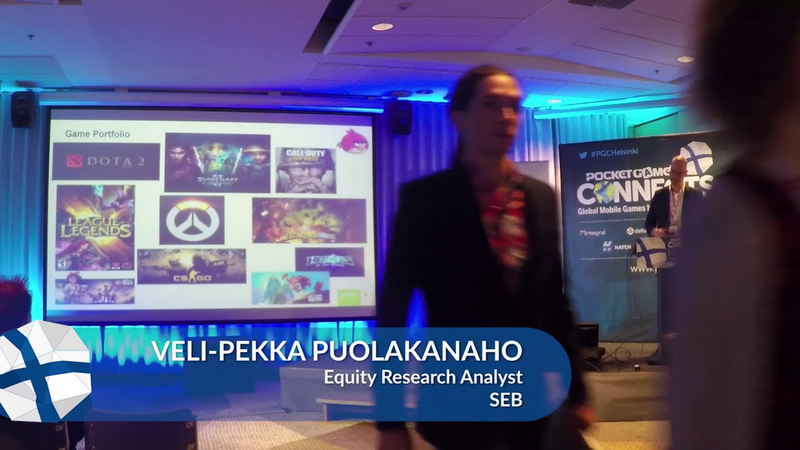
assess whether I mean not not all games make gazillion euros a month but we are a we want to be able to assess properly what is the growth sort of trajectory for the different games and what is the company's plan of leveraging these titles for instance here we have some finish and some foreign examples of great games some of which have been in existence for a long long time for instance Starcraft but but but other ones there as well it's interesting to see how some some companies are able to keep their titles alive and either having external IPS or creating their own IPs and essentially we want to understand what makes your game company unique and is this something that you
can hold on to over over a longer period of time so essentially how sustainable is it the competitive advantage I mean [Applause] we typically have a lot of irritating questions for the new game companies we ask ask a lot of questions to fully understand what's what's going on and how does the company work who's the management how they are incentivized and and what is the sort of strategic outlook for for the company and and how you actually aim to achieve that I don't op of this sort of qualitative profile we obviously do a lot of spreadsheets as the previous speaker just showed I didn't bring much my spreadsheets with me they're too boring to look at but nevertheless we do a lot of quantitative modeling we slice and dice your balance
sheets and and income statements and and so on and so on we model the company and make evaluation assessment and all this the qualitative profile as well as the quantitative bit results in a recommendation it results in a price target stock price target and protections of how we see company evolving going forward so that's I guess in a nutshell our process and as I said about the games we want to understand fully the drivers of growth and return now versus what they are in the future so we want to have a good dialogue with the company okay so you have these wonderful franchises IPS games on the market we want to understand how you see them going forward and we want to also
understand what proportion of the future growth comes from the new titles so the new product launches and what can we sort of expect from that ideally we want to see proof that you guys have been able to do it so if you have if you have one good game that's great so there's some evidence some proof of concept that you guys obviously have a good team and you've been able to develop the game but even even better if you have a game portfolio because the way we think of investing to game companies is that usually the visibility tends to be well not perfect at least but the more games you have and the wider portfolio you have for instance if we think of something like Activision Blizzard which obviously is a mature company they have their Starcraft's
Warcraft's then they have the hearts toned and they have the Call of Duty's and so on the broader the game portfolio the better better the visibility and better that we are able to sort of model it out and see how it works but this is not to say that we wouldn't be interested in in in single game companies they are also very interesting as as long as we we see that the company has a good plan to grow the the issue many times is which I alluded to earlier is that we are always look at game companies from outside so we we have very limited visibility and this is something that I've been discussing with a lot of game companies is that it would be great I mean the more we as on the sell side but also on the buy side the more we are able to
understand your metrics your KPIs assess the game somehow the better we are able to do that the better we are able to communicate that to the end investors ideally what we want to see is for instance how many users you have monthly active users you have how many of those actually pay for the content what is the average revenue per paying user and so on and so on so that we are able to get a bit little bit flavor and as I said the better we are able to understand the dynamics of your game portfolio the more realistic picture we are able to paint to the institutional investors pension funds municipalities you name it and the more the better dialogue we're able to have with them so that you know your if you are a listed company or even if you are
not your you don't get unnecessary volatility to your stock price and as I said it's about managing expectations so you guys as game companies you manage our expectations and we then try our best to manage the end clients the end end investors expectations to a realistic level where you guys as game companies you can meet those expectations and hopefully even surpass those then just a few words on monetization and and user acquisition this UA is you guys obviously know the term very well and and how it's done for us it's sometimes a bit blurry so we want to carefully understand your go-to-market
strategy and essentially how do you plan to get new players and on the other hand keep those players so when you have a great game we want to understand how you plan to keep bringing those players back if it's by DLCs if it's by expansions if it's by live operations this is something that again relates to the earnings dynamic I alluded to earlier we also want to understand your marketing strategy essentially the UA how do you plan to drive the you a budget it's as the previous speaker just said that you a is becoming more and more expensive we want to understand how that drives the returns and on the other hand how your UA spending effects the bottom line ie earnings of the company and yeah that's
I guess the important thing and then just a few words it's the I'm running out of time I took some nice photos here Merc lling evolving to captain cookie and Anna well playing evolving through two or Newseum so basically growth we want to it's very important for us that we have what we also obviously understand that it's really difficult to predict growth especially if you're a young game company if your game takes off it can it can have amazing growth rates but for a small company we feel that it's important that you guys have a good growth path that that you are striving to you may have the best game
in the world but it's it's very important that you guys are able to communicate to us and we are able to understand how you actually plan to achieve those targets that you've imposed to yourselves sometimes game companies as well as other companies tend to be a bit shy on on the data we feel that the more open you guys can be towards us ie revealing some of the KPIs that that you look at so that we are also able to assess are you achieving that growth are you surpassing that growth how are how are your games actually doing and then when it comes to financing it's good also to think it so that we for instance at ACB we have the corporate banking side and that I know those guys have a lot of
dialogue with young game companies it's good that you guys have or enter a dialogue with likes of us very early on so I mean there's there's no need to have a high threshold to contact for instance our corporate guys and and discuss about potential need for financing we all know that it is it is it is not necessary it's it's not necessarily that cheap to develop a game let alone get to publish that and get users to your games so we we always think it's good if you come to us at an early stage and if you need stern or financing it's good to elaborate carefully what this financing is needed for this is this sounds like an obvious comment but it's it's it's it's important that that you have a carefully thought well thought plan how
you are going to execute that growth plan and as I said I'm actually running out of time but please have a have a low threshold to come and chat with us have a I always value a good dialogue and if even if you guys are not all planning to become a stock market company there are many steps before actually getting your company listed on stock exchange and it's get better best if you take them bit by bit okay do you have any questions for VP we have one or two good this is this so it can be difficult making difficult questions technical ones no doubt that strategic vs VC investment why should we go with VC versus a strategic investor maybe with more industry knowledge what would will
be the benefits of working with somebody like Aslam well I think well I'm I have to underline that I'm more more focused on the listed companies myself but I think that that this is something that you guys should think carefully and and also have a dialogue with the different types of parties there are there are many many different there are many different types of external financing and you should have a dialogue with different partners to see what suits you the best we have some good solutions there are others who also have good solutions but I think it's important that you choose a partner that is there in the long run and and who wants to evolve and develop the relationship on the longer scope okay whoo-hoo you mentioned you look at differentiating factors when you evaluate a company and whether it's
something that a company can sustain what are some of those differentiating factors well one one obviously obvious thing that I try to assess is the the strength of the game portfolio if if the company has we the previous speaker also told us about IPS for instance if they have for instance proprietary IPS or franchises that they've been able to develop that's usually I mean for instance I play hearthstone all the time well not all the time but but a lot whenever there's an expansion I go to app app store and buy boosters 50 bucks 200 boosters something like that on the stage and so everybody I'm hooked so so if you have an IP a good franchise that's also obviously obvious one distinguishing factor and but but there
are others which are not as clear-cut for one is the team who's made the game the the sort of brain capacity of the company that's obviously one one important factor as well you
Summary
Equity analysts serve as critical intermediaries between game companies and institutional investors, such as pension funds and asset managers. The primary objective of this analysis is to translate the complex, often volatile performance of gaming studios into clear, actionable financial models. By evaluating both qualitative factors—such as management strategy and intellectual property strength—and quantitative data, analysts provide the necessary visibility for investors to make informed capital allocation decisions.
The evaluation process focuses on three core pillars: the game portfolio, monetization and user acquisition (UA) strategies, and long-term growth trajectories. Analysts assess the sustainability of a studio by examining its track record, the depth of its IP, and its ability to maintain player engagement through live operations and expansions. Because gaming companies often operate with limited external visibility, the quality of communication regarding key performance indicators—such as monthly active users, average revenue per paying user, and the efficiency of UA spending—is paramount. Transparency in these metrics helps manage investor expectations and reduces unnecessary stock price volatility.
While large, mature companies with diversified portfolios offer more predictable modeling, analysts also engage with smaller, privately held studios. The industry is encouraged to initiate dialogues with financial institutions early, even before considering an initial public offering. Whether seeking venture capital or corporate banking support, studios must present a well-defined growth plan that clearly articulates how financing will be deployed to achieve specific milestones. Ultimately, the goal is to establish a sustainable, long-term relationship where studios provide the data necessary for analysts to paint a realistic, credible picture of the company’s potential to institutional stakeholders.















Comments