1 free read left. Create a free account for unlimited reading + AI research.
Create free account
RSTLSS: Digital Identity in Web3 - The Metacast by Naavik
Key insights
7 takeaways- 01Digital fashion shifts consumer behavior toward avatar-centric self-expression, reducing physical production waste while granting users greater agency over their virtual identities.
- 02Blockchain technology provides the necessary infrastructure for digital fashion by enabling verifiable ownership, intellectual property protection, and automated royalty structures.
- 03Successful digital fashion integration requires a shift from top-down marketing to community-centric, grassroots collaboration with digital-native creators.
- 04Digital fashion platforms must prioritize inclusivity by offering diverse avatar systems that reflect a wide range of body shapes and identities.
- 05Interoperability is a critical requirement for digital goods, allowing assets to function seamlessly across diverse gaming environments and virtual worlds.
- 06Technical adoption barriers are being lowered by tools that allow users to customize and export 3D assets, enabling brands to monetize IP without managing complex blockchain infrastructure.
- 07The future of digital identity is a hybrid model where established luxury houses and Web3-native entities collaborate to define the market.
Ask AI about this video
Transcript
[Music] gm uh dear listener and welcome to the medical scripted corner brought to you by navic i'm your host nico and today i'm joined by faye maiden and charlie cohen and today um we're talking about the thing that i'm excited about which is digital expression in web3 and we also have two people on the pod that i'm also very excited to have on um so if a and charlie um yeah let's kick this off quick intros and then we can dive straight in um my name is nico i'm an investor on the crypto side at bitcraft and um next to that i also talk about blockchain and gaming and that's what i'm doing today um but i'm super excited to host faye and charlie so uh faye you wanna you know kick this off with an intro about yourself yes thank you so much nico really excited to be here um so hi everyone i'm faye i'm an investor at bitcraft i've been here almost almost a year now which is crazy um i've
got a strong interest in all things sort of digital fashion virtual worlds digital expression previously i was a cmo at an avatar company before joining venture and then before that actually worked momentarily in the fashion industry um in a luxury show so it's good to know did you not i was sorry yes um and so imagine my excitement when we were introduced to charlie um it felt like the merging of two worlds and we were able to lead the restless round which we'll we'll definitely cover in this pod and that was joined by rogue vr fun and starting line and angel investors including paris hilton uh so we're very excited to have her today um to chat to her and and hear her take on all things digital fashion and why web 3 is coming for the fashion industry so we'll pause here and pass over to charlie to share a little bit more about her background thanks so much faye and nico great sir great to be here um so i started i guess
what would now be described as a metaverse fashion brand 10 years ago so i've been in the space for a while got into immersive tech ar and vr pretty early on looking at how to create virtual experiences around physical fashion um from that or segwayed into the gaming industry started focusing more on virtual assets so in-game skins that had physical fashion counterparts and as i became somewhat obsessed with tackling the interoperability issue around skins and in-game items i fell down the nft rabbit hole obviously i'm still there launched restless from within that rabbit hole specifically to tackle issues around interoperability offering the ability to customize wearables and have a real level of control over your virtual identity no amazing and i think something that you didn't mention there that i think we
have to start with is that you actually founded your own fashion brand at 15. so i think we need to i think we need to start there also um to tell us a little bit more about that journey because to be quite honest with you don't really hear about that unless we're talking so sort of more like the roblox fashion groups which is definitely where that where they're starting early but 15 for us and our gen is is quite young how did that happen um so i had just arrived in new zealand by boat from the uk um so sort of two years sailing to new zealand i had quite a lot of time to think about what i wanted to do with my life um upon arrival so i was drawing a lot writing a lot planning a lot um and i'd always been very interested in fashion i think sort of inherited from my dad who's quite a fashionista um and by the time i got to new zealand we were in quite a remote um
area um school was extremely easy compared to the uk i was really bored um and i decided that okay with all the spare time it would be great to figure out what it actually means to run a fashion brand i already had a bit of an inkling by then that design was probably a small part of it um so i thought okay the best way to get my head around the rest of it like supply chain wholesale marketing how to fill out a tax return all that fun stuff um it would be good to get the experience uh then when there was just less pressure around it just one question why did you take a boat from the uk to new zealand oh i would i mean why why wouldn't you i would highly recommend it to everyone like it was it was an amazing formative experience um from having a very adventurous mom and stepdad um so yeah it was uh it was their dream i was along for the ride um and yeah fantastic informative experience okay
yeah school of life i love it exactly um no that's that's awesome and sort of then taking fashion from like let's say the physical to the digital where did that all start i'm assuming that wasn't also on the boat that wasn't that wasn't also on the boat um and and just from my experience also in the fashion industry which was quite short i'll tell you and you're you know far more advanced in that sense um but obviously right now it feels like yes we've made great headway but before um fashion was very much stuck in its traditional ways and i'm curious as to why you felt like this was the route you wanted to take your career in fashion i think because by the time so i'd had this um sort of experience of running this brand before uni and then went into my fashion degree um during which time i was still um kind of experimenting with my
um my own assorted businesses one of which was sort of accidentally falling into social media marketing my friends were mostly in your sort of typical unpaid fashion internships and just this kind of exposure to the traditional industry like just by the time i'd finished my degree i absolutely hated the fashion industry so i was quite determined to do something that was different from what we've been seeing um so firm believer like if you want to be able to change something you need to do it from the inside and it's really important for industries to have people and founders in them who are you know really uncomfortable with the current status quo otherwise nothing progresses um so one of the things that i was very interested in at that time and i hadn't sort of quite gone into the the actual virtual fashion
side but being able to create immersive virtual experiences that were an alternative to traditional fashion weeks and that was something that everybody could participate in and you know get close to the brand get to really understand the um the inspirations behind the collection um a way for me to interact with the community and for them to interact with each other um so that was my initial focus um and then as through video games i started to understand the potential for virtual fashion um one piece that i was really excited about was uh the identity and self-expression piece because we spend you know arguably more time socializing interacting in digital than in physical um so our visual identity should you know have the same level of importance you should have the same level of power
over it in digital as you do in physical so that was very interesting to me and then the other piece was sustainability so even though i'd set up charlie cohen as a sustainable brand um you know it's still not sustainable putting new product out into the world and that was something that i was very uncomfortable with so this idea of being able to shift a significant portion of the brand's revenue into pure digital uh was really appealing because you know i could reduce like significantly reduce the amount of physical production i was doing and also even for pieces that we would physically produce i could test appetite take pre-orders via virtual fashion and then literally just produce to demand amazing and that just leads perfectly onto my next question which is how has that changed since the pandemic like there has been this rise of interest in virtual fashion um obviously
we're not going to the bricks and mortar stores that was obviously then when we were all locked down um and then we were sort of moving inward and playing our our games um not really seeing anyone else so as you mentioned right like the clothes that we're wearing that were probably in pjs but um our characters look insane because we're leveling up and playing so much so yeah i'm i'm still curious about about that yeah the i mean the pandemic really accelerated things for us um you know we were in an amazing position of having um you know we've now had experience at the beginning of 2020 in building virtual worlds and virtual retail environments um and also creating purely digital fashion and at the same time we also had um a kind of small batch supply chain set up so we could still do some physical production um even with all of the restrictions um so
suddenly a lot of people wanted to collaborate with us because we had the solution to their you know their problem through 2020 and they had a whole marketing budget that needed redirecting um so we did collaborations with with reebok with assassin's creed with sanrio um i think you know there was the level of consumer understanding around virtual identity was already there because there was already like a prolific market for gaming skins but for wider industry outside of the gaming industry to really understand it um that yeah that was a really significant shift during the pandemic yeah i know super interesting and um danny loftus who you know you and i both know um a member of red dow the the digital fashion dial she wrote this amazing white paper and she makes this
like a really interesting distinction between like orl so on real life so digital fashion worn by humans and then url on real life so digital fashion worn by avatars um i'm curious like as there's been this innovation in the fashion space especially around digital fashion have brands been more excited by the orl or the url avatars or humans i think orl was an easier proof of concept um so we've seen a lot more um you know a lot more uh innovation around ar fashion versus avatar based fashion um but i mean personally um i think that it's you know it's quite a limited market for um orl besides you know as a sales tool for physical fashion it makes sense um i
really like using ar to interact with physical garments rather than replace them um so you know you can scan a marker on that garment and then it creates a digital layer um to the garment rather than just being an ar dress um i think it's it's more of a um it's more of a fun additional experience rather than something that's really commercial um whereas creating fashion for avatars is extremely commercial um and very scalable hmm amazing no i i completely agree um and just thinking about how like the spark ar creators those lenses as well lens studio like they're still not very easily monetized too no it's it's a very strange concept to be selling selling an ar filter and you know to be fair the for fashion
especially the the tracking is still not there to have the type of experience that you'd want to pay for yeah and even that even brands might want to add on to their let's say the you irl purchase or yeah orl purchase let's say um super interesting actually this whole point obviously i was working with avatars before um but it was more of an overlay and we you know i definitely saw a lot of gaps there around sort of the monetization but the creativity was was super strong um so i'm i'm really excited about what you're building at risk this and we'll get to that um but wanted to sort of now so gradually think more about sort of your web three strategy so um you sort of mentioned that you've done a couple of collabs um obviously uh actually high-rise one of uh big cross portfolio companies and then also fairly recently um with established ip like uh pokemon which was really exciting um collaborating with selfridges obviously being brits that's
just awesome um that brand is stellar uh can you share a little bit more of your learnings of these from these activations and how it has informed your web three strategy with resus yeah so i think um actually the collaboration we did with highrise was a very sort of key turning point for how i was thinking about this so we it was a collaboration with the sanrio character gudetama and we had a physical collection we had a vr based experience in the museum of other realities with a vr based collection and then we also had the uh collection within high rise and it was the first time that we were really looking at this idea of um interoperability but it was a very convoluted experience for the actual consumer because they had to have three
different um i guess kind of purchase flows and experiences they weren't able to kind of go into one space and access everything from there um so it was it was cool but it still had this limitation and from a licensing perspective um and you know we do most of what we're doing is around collaboration and licensing it was a nightmare because we had to have sort of separate contracts and stipulations for each of these different um activations and types of garment um so that was really when i started kind of diving into like how can we set it up so a customer can come into just one space and be able to um you know access all of these different ways of like wearing and experiencing the collection um one space where they can easily portal into these different worlds as well and then come back to where their
kind of wardrobe is is living um so that that really was the um ended up being the premise for restless as through that i was trying to figure out how within the charlie cohen brand we could streamline um and by the time i'd figured that out it just made much more sense to build it out as a completely separate product because it was addressing an issue that a lot of us are like facing um in this industry no 100 and and you also touched on something a little bit there around um ownership which i think is super important in web3 like we see it a lot on roblox there are copycats now i mean the the creator um market is just so saturated now and those glasses i don't know whether you've seen them like the shades i think maybe i think up to like 100 creators have have made them and are now selling them and obviously they're just outbidding each other on the starting price and uh obviously the the original
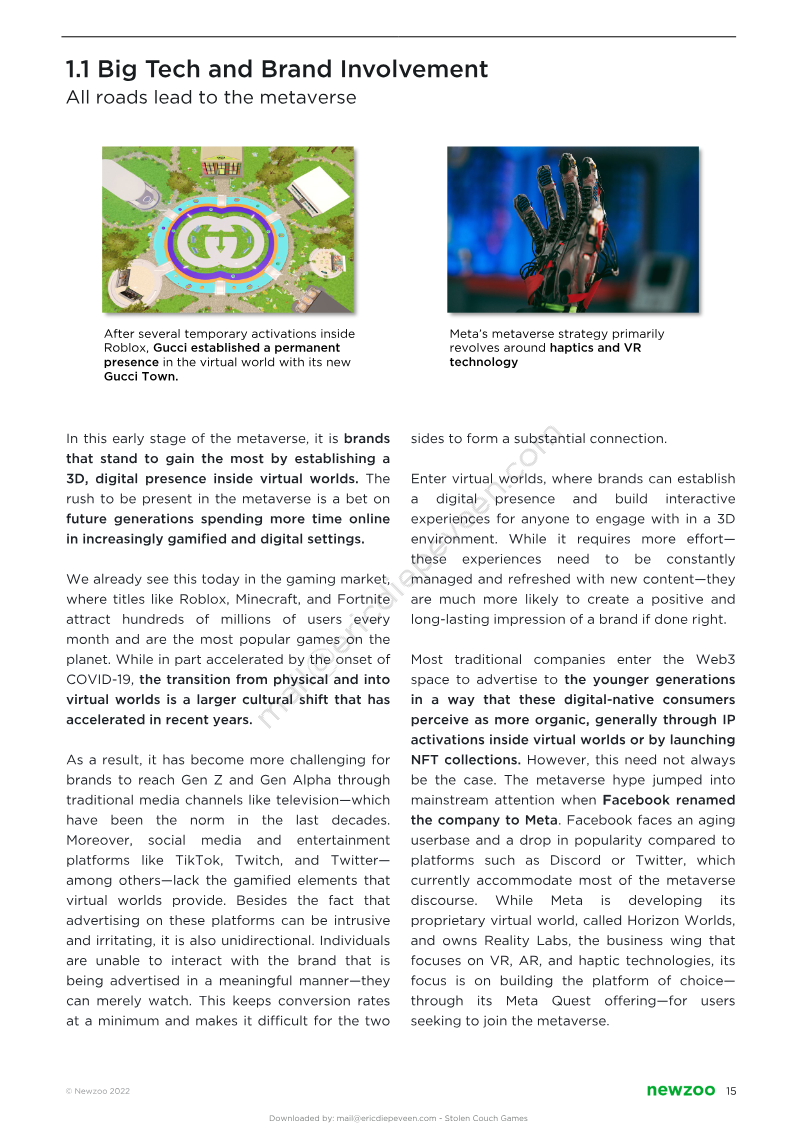
designer you you don't know of right there it's it's it's super interesting and there was um a great actually one of our venture partners seb put me on to this great story of anna relu who runs kestrel um the uh the the fashion group on roblox and what had happened is when gucci came onto the platform they realized that they'd actually copied some of their shading and i'm just thinking with web 3 it would have been a maybe an easier route to sort of show that you know over time show that ownership through the metadata but here she had to go through the pixels and she had to do it side by side and she had to then share it with her lawyers and it was super a super interesting one and especially just with how fashion is going right now i'm curious as to how you think about especially ownership and obviously copycats is just it's just common in the industry right yeah so like as as you touched on um i mean within
virtual there are so many issues around copycats um also obviously historically within physical um so yeah and you know nfts and blockchain they're you know proof of first um you can you know you can literally check the history you can also um you know you can you can see who has owned stuff over time um which you know something that is quite common in the uh physical fashion industry is that people will buy stuff and then copy it if you have unlockables within digital that are backed by nfgs you could literally track to see if somebody had done that um so there there are you know there are lots of ways that it's protecting ip the fact that you can build in royalties as well for like reuse and resale of what you've created is incredible because there's obviously
no way to be able to benefit from a secondary market as an artist or a designer within the physical world um or within um sort of traditional gaming industry um so that's another significant benefit as well no i love that and also another point because we're you know right now it feels like there's a new pfp project every day um and there it is and or yeah not just not just one either so it's hard to keep track of all of those but what i am seeing a lot of is or just hearing um is that you know there's stories of those not fulfilling their road maps so becoming really just a pure collectible over including you know any of the utility as promised now the fun thing with digital fashion is that utility is just baked in at the core right like it's yes you can collect but you you don't necessarily wear fashion
just to stare at it in your wardrobe um well i certainly don't anyway um so or in your wallet or in the wallet yes exactly how odd is that how odd is that such a strange look at my wealth quite often just admire all my text-based nfts you know you see yeah the thing is if i was the owner of one of those dng crowns i mean i would want to be wearing that everywhere you know it's so annoying to me that that it's not correct me if i'm wrong but i don't think you can wear those anywhere right no i don't think you can i think that i feel like there is like a physical link to some of those cng pieces i think yeah now that you've said that i really need to have a crown custom made for you so you can you can wear it everywhere and i will expect to see you everywhere wearing it thank you no that would be really helpful but do you see what i'm saying though with digital fashion it's it's different and i think you know obviously we're just getting started really on
this obviously pfp's um it's it's also baked into the the character as a whole but um i think fashion on its own i think there's real utility baked in and i think that's what makes it so exciting also for web web3 yeah absolutely i think and also you know when it comes to pfps like they're baked in utility is that you use it as your twitter profile picture or your social media profile picture and it's doing the same thing as fashion does it's it's signaling something about your identity um it's connecting you with the community who are buying into that same project um and with fashion that's you know that's exactly what you're doing just dressing your body um and there are you know there are so many more applications within web3 and the virtual world to use digital fashion as a way to express your identity um but um you could argue that like pfps are fashion in there in their own way
because they are kind of doing that same thing if you're on youtube i'm just showing off my fashion pfp look at this oh gosh so i have is it on the is it on the press pocket that's that's not too bad i didn't know that was uh much right yeah very subtle yeah put it on exactly specifically for this podcast sorry if you're listening to this we appreciate that podcast um and on that actually oh nico perfect segue so when you're thinking about working with crypto native brands so like the punks let's say as you've given us a great example here um versus sort of established legacy luxury or you know even streetwear brands is there a difference in your approach how do you go like also around creativity around accessibility around the flexibility around the ip i'm sure that you're i mean i'm sure that both have a
completely different perspective and maybe before we answer that could you like when you you say approach what are you doing exactly i think maybe lay that as a foundation and then go into how you approach well how you do that exactly with different types of brands so i think um sort of streetwear and web3native have the most similarities um it's very much this you know based around building up this grassroots community that you launch into very much based around graphics and artwork whereas luxury fashion the i mean that is the approach they need to be taking in web3 but the approach they've been taking traditionally is very top-down so they're used to being able to pay for advertising pay for influences um and they're now experiencing in like with the web3 native customer that that doesn't fly
um so the actual the actual approach i think should be very similar but it's much easier for a streetwear brand or a sportswear brand like like say adidas who did a pretty good job of coming into the space to get their head around because it's reflecting how they've approached things in the physical world or even in web 2 based social media luxury fashion i think it's even more important for them to be collaborating with um you know with artists who are already in the space because they have yet another set of steps they need to take to kind of prove that they're authentically thinking about how do they bring value to the community um they have a lot more to prove but they're coming from a place where they've been kind of able to sit on their laurels and they're used to people coming to them and they're used to having the power um so it's it's quite a head for
them oh i'm sure this is really interesting and you mentioned adidas like could you share a little bit for those that may not have known about some of those drops yeah so adidas like i honestly like i'm throwing them out so much as an example that they should be paying me at this point um yeah i'll be be sliding into the dms asking about my real ideas um but they um they took a whole year of um engaging with community in the space before they even thought about well before they even spoke about monetizing and dropping a uh product um and that's something that i mean i have a lot of respect for i think the community at large has a lot of respect for um so they were very active and then when they did drop their first um product they did it in collaboration with two really like well-loved well-respected ips in the space um board eighth year club and punk's comics um
and also did it together with uh g-money as a consultant who is again like a very well-known and well-respected collector in the space so they had so many touch points along the way just showing how much they'd thought about and researched what the community actually wants and what would you know how can they bring value to the space rather than how can the space bring value to them no that's really interesting and i love that you brought up the power shift because i think it's really palpable um right now i love it yeah yeah it's never been this way right so it's like it's super interesting just to view and then just on the flip side if we're moving away from brands and we're thinking more about platforms um specifically in the web3 space what do you think they should be considering when they're thinking about building out their avatar systems especially around expression so you know thinking form factors skins etc what are some of your must-haves just
from someone also building a platform within the space so i guess from the avatar perspective especially um we have a kind of clean slate here to address some of the issues that have been prolific in the physical fashion industry around like representation body shape skin color like all of these things that have been you know a a major major issue and you know still you know relatively little improvement um in the last couple of decades so i think there needs to be a real effort for platforms building out especially creating avatars first of all to make sure that within their actual teams they have um real representation um so that you know that can be fed back into how the actual product and avatars
are being designed and then yeah making sure that that then um informs how these avatars are created if you're um if you're creating something that is supposed to you know if you're creating animals then fine um but if you're creating something that is supposed to be reflecting kind of human race then i think there's a massive responsibility there to repair some of the damage that's been done yeah no amazing and and also in terms of interoperability do you think that there is some strength in having an avatar that can cross a you know a few of these web 3 worlds or do you think that being able to express yourself not doesn't just apply to dress but also different form factors like i'm just thinking to myself now like maybe i kind of like that i'm blocky in in roblox and then in fortnight i'm more streamlined and i you
know it's obviously more high fidelity i'm curious about whether you think that also it's just occurred to me not just around fashion but also the form factor go on yeah i was going to say are you using fortnite as an example for high fidelity yes i don't know i would probably i know a few games who do a better job at high fidelity i'm used to the blocky so in your comparison relative to it's true yeah yeah okay fair point fair point but yes i'm curious about your thoughts off the back of that off the back of that brutal burn yeah um i think i think it's good to have the the option um so you know i think you're gonna have sort of two sets of people um with avatars and with
fashion as well like the ones who really do want to have a sort of very consistent identity um across all of the platforms that they're engaging in um and those who will want to explore different facets of their identity and different alter egos in each of these spaces but it's certainly nice to be able to have like your avatar set up especially when you just want to kind of investigate an environment so you can go in as you figure out you know the lay of the land there um and then maybe that evolves into you creating your own like specific avatar that is kind of fits more into the aesthetic of that space um but you know interoperability should be just about having these options uh however you want to be exploring identity you should be able to do that yeah no i think that's i think that's totally fair um
and then i had one other question just around how you view nfts and the idea of luxury and how luxury might be changing in the web3 context so luxury is is typically related to high quality but in this sense it's also with web3 it's around accessibility and exclusivity and i'm curious about how you're thinking about building sort of a quote-unquote luxury brand and what that means in this context so you know in in the nft space like luxury is purely about scarcity yeah um and you know the the flex that's associated with scarcity like it means that you know if you've got onto that first mint like you have to have been in the know maybe you're some you know maybe you got white listed because and you know that that is a flex um because this is such an exclusive product so it doesn't necessarily even
have to relate to price point in the same way um but obviously when you have something that's scarce the likelihood is um that the resale price is going to go up and up and up um so that's that's really that's really how it's determined i think in the nfc space yeah i know totally agree um and then just sort of leading on from that thinking more about accessibility and it not be and it being sorry as you say based on scarcity right now i think that also comes from the lack of of 3d design tools also um i'm curious like in digital fashion and 3d asset creation it feels like the the bottlenecks are around so the tools available we've got maya we've got blender obviously on roblox it's a lot easier but when you need to make something other than let's say t-shirt and pant combo um you really have to leave that to the the
ugc experts right in the in the creator program so i'm curious as to do you see a world in which everyone is able to create and customize their own virtual garments what needs to change um are you seeing any any cool innovations in this space what gets you excited really curious on on that part so i agree like right now there is a huge barrier to 3d 3d design and especially um 3d apparel where you're having to you're having to rig like there are so many different considerations um and just i guess like you know experience and technical know-how that's required um so i think like yes it makes complete sense in the digital world that the actual consumer should be able to customize and personalize um and you know have a lot of you know power over the looks that they create
for themselves but we you know we need far more tools to support that like you said like you know roblox is a good example of being you know you have your your building blocks but being able to take some of those tools into something that's much more kind of high fidelity um that's you know that's a big challenge i guess you know that's why we're you know starting to tackle that with restless um so you know initially we're looking around customizing with um like graphics and texture application um and you know over time there will be more tools to be actually kind of playing around with the silhouettes and you know again like what we're doing there is making sure that once you've done that you're it's automatically creating a version for each of the worlds that you need it for so you don't need to worry about building from scratch in each space and
maybe we can double down on that and just sort of understand exactly how restless works for a creator and also a consumer both of those personas i think that would be really helpful for uh listeners also yeah for sure um so as so initially i mean initially we're starting off with these curated drops but as we start opening it up to user generated content um an artist is able to come in um and drop their limited edition graphics and textures to be applied to garments and then their fan base is able to come in choose from a selection of silhouettes um customize it with these limited edition textures so they could be you know they could be one of ones they could be editions i'm just approaching it the same way as nftr you mint that and then put together a bundle of different environments you
want to be able to export it into so for each of those environments there's a version of that garment that's been created for that specific um that specific engine or that specific aesthetic and as restless kind of continues to support more environments across web3 but also traditional gaming industry you can continually come back in and add a version for that environment cool no that's really helpful and then where brands come in is they allow their ip um to be used as sort of the customized template let's say for creators cool so what that enables is that brands have some level of control um it's it's almost like it's the best of both worlds right they they allow the community to come in and experiment while also having the the management tooling to you know essentially still hold on and still get full visibility yeah so that is being used they can build their own boundaries around
exactly how the iep can be used you know if there are commercial rights in which case that user can you know create additions using the ip and um and go on to sell those something that um will work particularly well with uh pfp projects as so many of those have commercial rights so it kind of allows a holder to monetize their pfp without having to sell it um oh super nice that's uh yeah from from the from the ip perspective um they have they have a lot of control they can um they can veto environments if that's a conflict especially when we're bringing in gaming ip there's you know that's possibilities of conflict of you know competitor gamer environments but yeah they and they're also able to see us see how the ip is being used collect all of the secondary market royalties and so on no amazing
and then my question on this part would be which brand would you be most excited to work with which brand is on your wish list either to do a an nft drop collab or just to have them um you know as a partner and restless so i think from the like from the pfp side like it would be great to work with ugo labs of course um on the music side and that's going to be a a real focus for us um you know really would love to work with artists who have you know already shown their commitment to web 3 like grimes and snoop yeah um and then on the pop culture side i think bringing in some of this um you know really iconic um anime ip like akira would be amazing
ugh no i i completely agree with you um and we're also very excited about that space we can't say too much right now but um yes we're also looking into it um quite intently and then sort of finally really want to talk to you a little bit about your decentraland activation and fashion week obviously the metaverse fashion week was big um spoke to a lot of people after who absolutely loved it and lots of brands came and obviously were representative there sorry represented there um so curious as to whether you can share a little bit with listeners about what what you did in the space and uh some of the assets that you made i love them yeah thank you thank you as yeah as as i know um so we um our decentralized experience was based around um a a meteors like a piece of the um restless planets that crashed into
decentraland um so you could go into this kind of massive crystal um and though it was a kind of gamified experience where if you solve the um the mystery of the crystal um you'd uh you'd get a poe so we were um we launched our disc discord at the same time so we had like a big meet up in there and everyone was kind of working together to solve this riddle which was really fun um and then we had a rooftop after party as well where we worked with this awesome dj dj dave who live codes uh music so we had um we had her in avatar form wearing the like restless times charlie cohen collection um which was kind of teasing a lot around the restless law so we had um we had these kind of very specific headphones that are part of the um
like the restless avatar or the wrestling um that you'll be experiencing once you start kind of creating in the in the platform um we had like crystal wings um and then um garments that were yeah uh covered in kind of code and and symbols um so there's a big alchemy theme through how the restless law was being built out um so we had lots of easter eggs hidden in each of the designs and then in space itself i think it was just it was really important for us to um create something that wasn't just a kind of replica of what we could do as a like physical fashion show um or a physical fashion installation um you know when you're um you know when you're like navigating around a digital space you're not expecting as the consumer to ha
you're not going in there just to look at stuff you want to be able to do stuff um and you know engage with stuff and work things out so that's what we were kind of focusing very heavily on you know amazing and um our assets looked stunning and especially loved like the wings um but uh no i know we had a little dm back and forth on that but it was really great and uh finally want to give you the opportunity now to just share a little bit more on what's next um actually for those that were listening very intently charlie did give away the answer to the riddle on the discord so you may have to go back and listen again um but charlie tell us a little bit more of what's next um where they can find you what we can expect from restless um in the future yeah for sure um so we are ramping up to
our launch um prior to that there will be a a month of beta um there'll be some further ciphers to access the beta and in there there will be a mint that is exclusive to the beta and then for public launch our first collaboration will be with a a much loved web3 native project um that to yeah to kind of clear you in has a lot of has a lot of vibes famously a lot of vibes that's really exciting um and we we have a pretty awesome lineup of um of projects web through native artists um and sort of traditional ip especially music industry that's going to be coming through with these curated drops so it's really um you know we're really focusing on pulling from both
web through native but also um traditional pop culture and music ip that really speaks to the web 3 um web 3 audience um so yeah so that's that's kind of the the line up without giving too much away um the best place for alpha is our discord um we um we're also pretty active on twitter at restless xyz and you can get the uh the discord invite link from there um and i'm gonna be fairly regularly doing amas on the discord as well so if you want to try and like hit me up for any more alpha and seeing why let's live then that's the place to do it that's that's what we're here for the alpha um so one thing i like to do is to throw out things that i have in my head and then get a reaction from people that is usually like what the hell are you talking about and sometimes oh that makes sense and so
you know hearing you speak should i think um or should i imagine you know within five years me wearing my restless ex you know my my favorite brand swag and using that within all of the the virtual worlds that i like to hang out in yes absolutely not not in five years much sooner than that much better than that all right and and then as a next step because i mean okay virtual worlds that there it makes sense right now i'm thinking you know multiplayer games um you know like fortnite do you think we'll be in in a place where you'll be able to have your customizable characters within a game like that yes yeah um we're already having those conversations and it's it's a different way of working um compared to web three native um and you know it will take longer obviously there is huge resistance from the um the gaming audience right now so all
of the triple a's are pretty pretty scared um but one of the things that we're kind of focused on with restless is creating a a middle ground that allows um the traditional gaming industry to kind of dabble without having to be like okay we're creating an nft um so so yeah that's something that's a big focus for us and one last question that i had when i i heard you speak i heard you speak about brands um whenever we've seen a major platform shift in the past uh whether it was in you know going from physical to to digital or um you know with the rise of mobile and free-to-play gaming within the gaming industry more specific we've often seen a very big shift in who the main players are and so my question is how do you see the current fashion titans of fashion exists um within web3 do you think they
have the correct mindset to um fully partake in this um or do you think we'll see you know more web three native brands actually like become you know the new uh louis vuitton etc i think some of the traditional brands they get it very you know a very small minority of them um but i think now is an amazing opportunity um for there to be you know new new legacies beginning in web 3. um i think you know it's been sort of long enough um working with the sort of hierarchies and old guard of the traditional fashion industry um so personally i would love to see um you know web3 native kind of taking over and really taking the power that they have right now um i think in reality we'll see kind of a combination of you know some some traditional brands who really get their head around it but also um new brands emerging from the web3 space
great cool well um this was extremely enlightening i i learned a lot this is a space that i i don't think about enough um because i'm in my pjs at home and you know my avatars in virtual worlds they wear you know magic clothes because i'm a mage in elden ring so i don't i that that's all i do yeah i i like to suffer uh anyway so this this was amazing um charlie and faye uh thank you so much for being here both of you are great i'm very jealous of that very clear british accent um yeah it's just it's just amazing i love listening to this good like yeah i might put this on i didn't say too much so i might put this on you know just calm down before i go to bed amazing well listen yeah there you go um listener yeah yeah i i forced faye to get a mic and um i'm trying to get him her on more so if i should really push let me know and then i might have some you know i can tell the listeners want this do it for the listeners anyway if
you made it till here thank you so much we really hope you enjoyed and if you can smash that like button i love saying that and you know spotify also allows you to rate your podcast so give us five stars if you think we did a good job uh especially faye and charlie um and yeah with that uh faye charlie thank you so much listener thank you for listening this was the metacast by navik and we look forward to speaking to you in the next episode cheers [Music] you
Summary
Digital fashion represents a transformative shift in consumer behavior, moving away from traditional physical production toward sustainable, avatar-centric self-expression. By prioritizing virtual assets over physical garments, the industry can significantly reduce environmental waste while providing users with greater agency over their digital identities. This evolution is driven by the necessity for interoperability, allowing digital goods to function seamlessly across diverse gaming environments and virtual worlds.
Blockchain technology serves as the foundational infrastructure for this transition, offering verifiable proof of ownership, intellectual property protection, and automated royalty structures that are absent in conventional retail and gaming models. Unlike static profile picture projects, digital fashion provides inherent utility and functional application. However, successful integration requires a departure from traditional top-down marketing. Legacy luxury brands often struggle to navigate the community-centric, grassroots nature of Web3, whereas brands that prioritize long-term engagement and authentic collaboration with digital-native creators see significantly higher success rates.
To facilitate widespread adoption, technical barriers must be lowered through tools that enable users to customize and export 3D assets across various platforms. By acting as a bridge between traditional gaming companies and Web3, these systems allow brands to monetize intellectual property and manage commercial rights without the friction of direct, complex blockchain implementation. As the landscape matures, the focus is shifting toward a hybrid future where both established fashion houses and Web3-native entities define the digital identity space. Central to this development is a commitment to inclusivity, ensuring that avatar systems provide diverse representation in body shape and identity, thereby reflecting the global nature of the digital economy.