1 free read left. Create a free account for unlimited reading + AI research.
Create free account
Reimagining Games Advertising
Key insights
6 takeaways- 01The gaming industry must pivot away from third-party data reliance due to stricter privacy regulations, such as Apple's tracking permissions and the phasing out of browser cookies.
- 02Success in the evolving advertising landscape requires organizational agility and cross-departmental collaboration to prioritize long-term player lifetime value over passive data collection.
- 03Meta is mitigating attribution and reporting challenges by deploying the Conversions API, which establishes a direct, secure link between first-party marketing data and its systems.
- 04To maintain performance optimization, Meta is investing in privacy-enhancing technologies including secure multi-party computation, on-device learning, and data de-identification.
- 05Gaming businesses should implement value exchanges, such as in-game rewards or simplified logins, to incentivize voluntary data sharing and build first-party data ownership.
- 06Marketers should adopt a diversified measurement approach by combining attribution data with incrementality testing and marketing mix modeling to address current data gaps.
Ask AI about this video
Transcript
[Music] [Music] we've got our next speaker from facebook gaming at meta which is cheryl savage i don't know if cheryl if you're around a.m cheryl's joining us on zoom hi cheryl hi there see you um and i'm just gonna hand over to you right now but just remember everybody please do keep tweeting with hashtag pgconnects and at pgconnect over to you cheryl um we will tell you online whether uh when you've got five minutes to go cheers okay sounds good uh hello everyone my name is cheryl savage i'm the director of gaming for emea region here at meta i'm delighted to speak to you especially during such a
pivotal time for your business and the industry as a whole i want to walk you through what's happening in the industry with regards to privacy and data its impact on the ads ecosystem what meta is building for performance and what gaming businesses need to consider for the future for marketing so a confluence of important changes are redefining performance marketing and there's a growing more diverse global gaming audience greater demand for privacy as you heard for in the last panel and throughout the day and a changed advertising ecosystem that is impacting the gaming world so first let's first briefly ground ourselves in the global gaming audience as you know it's made up of nearly 3 billion players with millions of those players having entered the market only in 2020. it's become apparent how much the audience has grown how diverse they are and how their needs have changed the diversity of the gaming audience is reflected in different ways from who's
playing their motivations to play and how they engage with gaming content one such example is the extent that gen z and millennials both play in watch gaming content we also see greater diversity in who plays often people across age groups younger and older are playing games daily just take a look at the uk mobile gamers by age group who've reported playing at least some time per day so now that we've rounded ourselves in the audience let's talk about some macro events that go beyond gaming but certainly affect our industry people's questions about how their data is being used has pushed the industry to change first regulators are implementing data privacy laws in just three years we have seen significant regulations put in place across the world to encourage privacy secondly for all app that for all apps that apple believes track people apple will require those apps to get permission their ios 14.5 update
required app developers to ask for permission to track their consumer's activity across the web and apps finally as early as 2023 google is expected to phase out the use of cookies that monitor personalize and save information about people's online activity and to be clear meta supports these changes because we want to give people more choice and more transparency before i move into what we'll be covering today i'll state what we know and what we see with respect to the advertiser ecosystem advertiser ecosystem changes mean that marketers have less data at their disposal and this is leading to some real challenges of which i know you're acutely aware especially when you hear that that last in the last q a the last question regarding first party and third party data people still download apps they still click on ads and they still browse and buy however performance online is declining and costs are rising
further to this attribution is also challenging it's harder to measure whether an ad led to a business outcome in some cases this is due to under reporting we hear your frustrations challenges and uncertainties for what's ahead this is a huge amount of change and it's hard to manage we've heard from many of you that the impact on your advertising investment has been greater than you expected we've been taking actions to address reporting gaps and campaign performance which i'll talk about in a few more minutes so what do we see well we see ourselves at the beginning of the next level of performance marketing the aforementioned changes mean that the future will be less reliant on individual third-party data and this is where we welcome innovation businesses will have to think differently about everything marketing strategy creative privacy and approach them in new ways this new approach will define the future of performance marketing this is what we
mean when we say next level and that means we're at an inflection point this mammoth change can be daunting but it can also be the catalyst to providing greater gaming experiences to deepen relationships with players and to better establish your games in the long run it's going to involve short-term solutions and long-term foundational changes in strategy in order to thrive we'll delve into these but now but know that we're on this journey with you i want to spend the rest of our time sharing what's to come and how the industry can prepare i'll share what we're building now for performance improvements and foundational solutions to maximize performance in the future then i'll discuss actions that you can take to power performance in the future and immediate actions to help performance now so many of you expressed concern over the impact that changes have had on your advertising investment we're listening and taking action to
improve ad performance and measurement on our platform what we'll cover today is only the top level we will work with you and your teams to explain updates and improvements in more details as we progress we are addressing issues across a spectrum of areas from back end ongoing campaign management reporting improvements and new solutions so here are some examples of the improvements that that we have included reporting improvements so we're enabling view through conversion attribution reporting for ios 14 plus mobile app install campaigns via the sk ad network with this you may see improvements in attribution reporting through the sk ad network on the backend performance improvements we're reducing the app install threshold to support your ability to scale scan spend with improved results and greater efficiency as you may be aware we've already reduced conversion thresholds from 128 down to 88. and on campaign management we're increasing the ad account limitation for
scan campaigns so apps can run app campaigns across multiple ad accounts these actions all are in progress or are already underway next let's discuss the most important foundational technology and solutions that we are building to maximize performance and respect people's privacy choices first is the conversions api it's a meta business tool that creates a direct connection between your marketing data and meta systems this helps you use your own marketing data to help optimize ad targeting decrease cost per action more accurately measure campaign outcomes all while respecting people's choices on how their data is used how you source and use your own first party marketing data needs to happen now not later the conversions api is the foundational tool for how businesses can drive best-in-class data-driven marketing in 2022 our goal is to help further the direct connection of marketing data such
as online events like app visits and app installs through the conversion api we expect that the conversions api will help you benefit from new privacy enhancing technologies which i'll cover next we are heavily investing in privacy enhancing technologies to help minimize the amount of personal information that meta processes in instances where we receive people's personal data it will be aggregated and anonymized so that it can't be connected to individual people we believe strongly that no single technology will solve all use cases so we're investing in a spectrum of solutions the first is secure multi-party computation which enables two or more businesses for example meta and an advertiser to learn together by only sharing encrypted or unintelligible data data is encrypted throughout the entire process while in transit in storage and in use ensuring neither party can see
the other's data the next is on device learning a solution that trains an algorithm to find useful patterns in historical data in order to make predictions all while ensuring people's individual data remains on their devices this could help us find new ways to show people relevant ads without needing to learn about specific actions individuals take on other apps and websites similar to a feature like autocorrect or text prediction on-device learning improves over time on-device learning and secure multi-party computation data can be further protected by combining it with techniques to de-identify data de-identified data adds a further layer of privacy protection by reducing the risk that any individual person can be identified this is done by adding randomized data to a large set or aggregates to a certain threshold for example if 118 people bought a product after clicking on an ad the technology would add or subtract a random amount from that number
so instead of 118 someone using that system would see a number like 120 or 114 additionally we can find thresholds so there's a minimum amount of people that have to be included in the data set before it's shared privacy enhancing technologies are not a quick fix they are a long-term investment in the future of the ads ecosystem these changes will play out over multiple years and will give us the foundation to innovate into the future in the meantime we're building testing and learning to provide proven solutions recommendations and guidance to help drive performance for your campaigns some areas we're focused on include campaign levers to drive incremental performance proven creative strategies measuring performance in a privacy for first ads ecosystem and actionable insights and consumer behavior trends now i want to take a moment to zoom in on what this means for facebook gaming
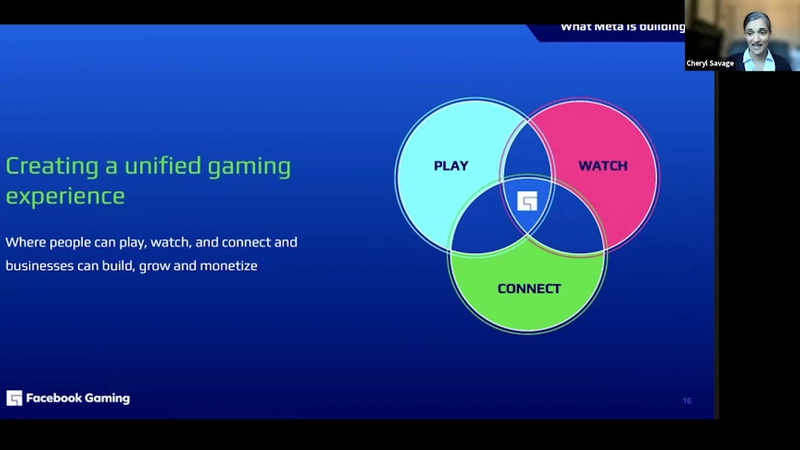
the industry challenges are fueling our intention for the gaming ecosystem across consumers developers and marketers we are more committed to the gaming ecosystem than ever before and here's why we continue to build the world's gaming community with 1 million gaming groups on facebook that have 350 million active users each month we also have 1.29 billion watch hours for live gaming last q3 alone both active users and watch hours have shown strong growth year over year and we see that growth continuing and when we look at that across the globe we know gamers worldwide use meta technologies for gaming related activities from discovering a new game watching a creator stream to simply playing games and it's for this massive audience and for our developers that we want to bring gaming activities closer than ever before this is why we continue to build a
unified experience where people can play watch and connect and where businesses can build grow and monetize we're looking forward to seeing where we can take gaming experiences and the value we can bring to everyone that uses our technologies so we've covered what meta is building now let's move on to the actions you can take to thrive in the future and immediate actions that help enhance performance in the present so to meet people's demands for privacy and adapt to the changing ecosystem games that want to thrive in the next level performance marketing need to center performance around people this will take an innovative approach to marketing and a holistic business strategy built around deepening the relationship between you your games and your players so what does this look like how do you get there well we believe there's a new performance equation made up of five
foundational actions one build your brand for player trust two own the relationship with players three connect first party data across your business four future proof your measurement strategy and five elevate teams and reduce the layers between them so let's dig into this first powering performance is going to rely more on first party data as there's less third party data available with people expressing discomfort sharing personal information earning their trust is imperative this is where building your brand for player trust becomes more important than ever a trustable brand helps people have a deeper connection with you which can fuel stronger engagement second relying on passive data collection through device ids will be less effective going forward games need to rethink how data is sourced in a privacy safe way by owning the relationship with players to create a value exchange for first party data
third with the shift away from passive third-party data collection games will need to strategize how to ingest measure analyze and use first party data to power performance throughout the game life cycle fourth as privacy gets placed first it may be necessary to embrace the tension between measurement models rather than trying to reconcile them into a single source of truth measurement strategies will need to change to capture the full picture of the effectiveness of your marketing and last but certainly not least completing the new performance equation requires a massive rethink across the board this includes how teams are structured to drive marketing now for more information on these steps you need to take to implement these actions above check out our website fb.gigi's backslash marketers please also be sure to check out our game changers video series which focuses on the burning issues for for the gaming industry and features marketing leaders
from companies such as rovio and tane electronic arts voodoo gram games and more so let's start about let's start talking about building your brand for player trust people are more comfortable sharing their personal information with a brand they trust in a survey survey by edelman 60 of the people with high brand trusts say they're comfortable sharing personal information with the brand and importantly they pay attention to the brand's communications additionally branding can nurture strong connections with players this can create high value and loyalty as narrowly targeting to find high value players becomes less reliable in another survey 83 of people say they are loyal to brands they trust and when it comes to building your brand you may need to first ask what makes the brand is it the game the developer behind the game or both how does one stand on its own or complement the other to build your brand think about the player journey and how various touch
points from your visual identity creators authentic voice to the creative format and messaging work together consider your full funnel marketing look at every new and existing touch point as an opportunity to turn potential players into loyal fans and to source first party data you need to own the relationship with players so what do we mean well consider the ways you can encourage players to securely share personal information such as an email address while providing value to their play experience value could come in many forms in a survey of u.s mobile gamers who indicated that they were uncomfortable with sharing personal information 45 percent that they would said that they would be motivated to share if you gave them in-game rewards 35 said 35 said it was if you gave them easier login or account creation they would be more comfortable sharing and 35 said promotions and deals in-game would help their sharing
owning the relationship becomes increasingly important as foundational solutions like the conversion api connect your own marketing data to help optimize ads targeting which will also help run privacy enhancing technologies in the future establishing trust and the value exchange with players for first party data is one step using it in a secure and privacy safe way across the game lifecycle is the goal gaming businesses will need to have connected first party data strategy to effectively collect data process it securely and use the data across marketing platforms and partners to start evaluate what stage you're in whether that's just starting to integrate first party data and resourcing teams or already building out a customer relationship management system no matter the stage you're in consider the types of first party data that you have or will have as not all first party data is equal when it comes to connecting the data back to platforms
and partners to fuel marketing effectiveness by assessing and where necessary rebuilding your measurement strategies today you'll be positioned to make more informed and impactful marketing decisions first evaluate your current measurement strategy to understand the impact from ecosystem changes measurement approaches sit on a spectrum of impact by the evolving ecosystem on one end attribution like mta which heavily rely on user level data is very impacted experiments like conversion lift are moderately impacted and then on the other end modeling like mmm is less impacted after you've evaluated your current strategy and understood the impact from ecosystem changes the next step is to adapt your strategy to anchor in on incrementality with data loss and no single source of truth a mix of measurement methods and metrics used together can of can uncover new opportunities let me give you an
example using mmm can provide the overall guidance on the marketing efficiency and optimal spend by media channels calibrated by lift will make it closer to truth-based measurement attribution is in real time and can continue to be used for such allocation as attribution becomes more challenging combining learnings from attribution with lyft and mmms can fill gaps in data and finally using a test and control approach like lift studies can measure the incremental outcomes driven by your campaign efforts so we've covered foundational changes to deepen player relationships but making it happen is going to require elevating and transforming the organization of your teams so what do i mean by elevating teams well database decision making has never been more important and as companies form their own points of view on how to look at marketing data across different sources business intelligence whether it be from
systems and tools or talent can fuel your teams and on the second part of this action consider how your teams collaborate with each other how do they revolve around the player experience inside and out of your game reduce the layers in between your user acquisition brand monetization even game development teams to help every touch point with players lead to lifetime value organizing around the player experience can help produce a connected strategy and provide the flexibility to adapt to change okay so what about the challenges you face in the here and now well here are a few immediate actions to help drive performance for the weeks and months ahead first diversify your strategies for optimization targeting and creative this can be done by broadening your geos to expand targeted reach sizing your creative for different aspect ratios to allow our system to deliver across available placements and maximize the number of creatives as much
as possible when using automated app ads second invest in quality creative that resonates with your audience experiment highlighting unique features of your game with key motivators for your audience to play at the top of this talk i shared information on the diversity of the global gaming audience create a messaging strategy that resonates with this diverse audience this may mean appealing to a variety of motivators to a broader uh to a broader audience over using the same message that worked with a single audience third adapt measurement strategies review all measurement solutions on meta and off this will really help you ident identify any under reporting allow time before you analyze performance perhaps consider waiting a minimum of 72 hours or the full length of the optimization window selected with the inclusion of view through attribution re-evaluate performance of facebook since there may be a change in reported performance
and finally to prepare yourselves to readily power performance with first party data start owning the relationship with your players evaluate how you source first party data securely and what value you can provide players like in-game rewards ease of login and in-game promotions and deals consider how to integrate first-party data across all aspects of your business from the collection processing and deployment of it for marketing purposes mastering the next level of performance marketing is no small feat changes in the ads ecosystem warrant foundational changes in usual business practices and that isn't going to be a speed run yes we have a lot of work ahead and meta is your partner to navigate through this evolution we're listening we're learning and we're here to build the future of performance marketing with you together we have the power to build new technologies systems and processes that work for games and people thank you for having me
thank you very much cheryl we uh we're running a bit late now so we won't really have time for questions but thank you for sharing all that really great information thank you cheryl bye bye [Music] [Music] you
Summary
The gaming industry is currently navigating a significant inflection point driven by evolving privacy regulations, shifting consumer data expectations, and a changing advertising ecosystem. With nearly 3 billion global players, the gaming audience has become increasingly diverse, necessitating a departure from traditional, third-party data-reliant marketing strategies. As platforms like Apple implement stricter tracking permissions and browsers phase out cookies, marketers face challenges regarding attribution, reporting accuracy, and rising acquisition costs.
To address these industry-wide shifts, Meta is prioritizing the development of privacy-enhancing technologies and backend improvements. Key initiatives include the Conversions API, which facilitates a direct, secure connection between first-party marketing data and Meta’s systems. Furthermore, the company is investing in secure multi-party computation, on-device learning, and data de-identification techniques to ensure performance optimization remains possible while respecting individual privacy. These tools aim to minimize the processing of personal information by aggregating and anonymizing data, providing a long-term foundation for sustainable performance marketing.
For gaming businesses, the path forward requires a transition toward a "next-level" performance equation centered on player trust and first-party data ownership. Recommended strategies include building brand loyalty to encourage voluntary data sharing, implementing value exchanges—such as in-game rewards or simplified logins—to collect first-party data, and diversifying measurement models. By combining attribution data with incrementality testing and marketing mix modeling, companies can better navigate data gaps. Ultimately, success in this new landscape depends on organizational agility, where teams across user acquisition, brand, and development collaborate to prioritize the player experience and long-term lifetime value over short-term, passive data collection.























Comments