1 free read left. Create a free account for unlimited reading + AI research.
Create free accountWhitepaper European Conference on Games Based Learning (ECGBL)
1 free read left. Create a free account for unlimited reading + AI research.
Create free accountWhitepaperEuropean Conference on Games Based Learning (ECGBL)
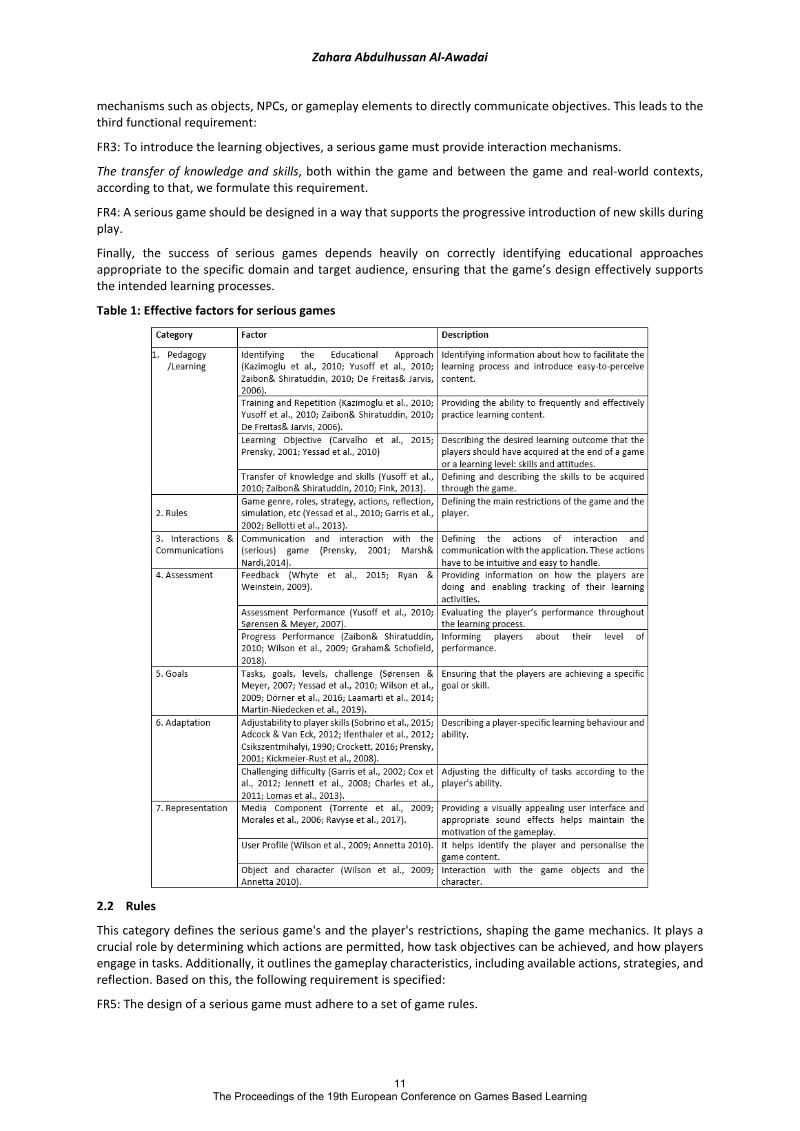
The authors argue that many serious games do not achieve their educational goals. Requirements definition and design are often handled without a structured method.
This paper proposes a participatory methodology for designing serious games, arguing that many such games fail to achieve their educational goals because the requirements definition and design phases are handled without a structured method. The authors begin by framing serious games as a response to a new generation of learners who are digitally fluent and expect active, practical, and engaging learning experiences. They contend that well-designed games can foster critical thinking, creativity, problem-solving, decision-making, and retention, but that poorly specified requirements, especially vague or ambiguous instructions from teachers, leave developers unable to translate pedagogical intent into mechanics, interaction design, and software.
The paper reviews existing development frameworks, including EMERGO, LEGADEE, and methodologies proposed by Barbosa et al., Cano et al., De Lope, and Silva. The authors observe that most of these approaches either omit detail on the design stage, neglect how learning content is integrated, or focus narrowly on specific audiences. Against this backdrop, the proposed methodology has five phases (requirements, design, development, testing, and maintenance), with the article concentrating on the design phase. That phase is structured around three elements: pedagogical elements (learning objectives grounded in Bloom's taxonomy, storytelling, and user definition), game definition (mechanics, scenarios, goals, and player decisions), and screens and databases. The authors stress that these components are interdependent and should be developed iteratively through collaboration among pedagogical experts, game designers, and developers.
The article is a conceptual proposal rather than an empirical study; it presents no survey data, sample, or evaluation of the methodology's effectiveness. Its stated contribution is to make the design stage more concrete and to address the communication gap among academics, game experts, and developers, who often use different vocabularies. The authors argue that unclear requirements are a primary cause of project failure or delay, and that explicit, shared design work is therefore essential to producing serious games that remain both educationally sound and engaging.



European Conference on Games Based Learning (ECGBL) · 2026



European Conference on Games Based Learning (ECGBL) · 2026



European Conference on Games Based Learning (ECGBL) · 2026



European Conference on Games Based Learning (ECGBL) · 2026



European Conference on Games Based Learning (ECGBL) · 2026



European Conference on Games Based Learning (ECGBL) · 2026



European Conference on Games Based Learning (ECGBL) · 2026



European Conference on Games Based Learning (ECGBL) · 2026



European Conference on Games Based Learning (ECGBL) · 2026



European Conference on Games Based Learning (ECGBL) · 2026



European Conference on Games Based Learning (ECGBL) · 2026



European Conference on Games Based Learning (ECGBL) · 2026
European Conference on Games Based Learning (ECGBL) · 2026