Updated Jun 1, 2026 by Sensor Tower
Report · December 10, 2025
Published by Sensor Tower
Predictions for the 26 Six Predictions for 2026 from AI to Gaming Executive Summary | Six Predictions for 2026 Prediction #1 Prediction #2 Prediction #3 Generative AI apps will earn more Vertical video will spur app growth — Gen AI will rival paid advertising for than $¹⁰ Billion in 2026 led by Short Drama driving website traffic Generative AI In-App Pu...
SensorTower 20 $ Predictions for the 26 Digital Economy in 2026 Six Predictions for 2026 from AI to Gaming
Executive Summary | Six Predictions for 2026 Prediction #1 Prediction #2 Prediction #3 Generative AI apps will earn more Vertical video will spur app growth — Gen AI will rival paid advertising for than $¹⁰ Billion in 2026 led by Short Drama driving website traffic Generative AI In-App Purchase Revenue Streaming App Downloads Share of Top US Websites $10B 2023 2024 2025 2026F with More Traffic from Each Source $ B 3.5B More Gen AI than Paid More Paid than Gen AI 8 7 3B B 100% No Significant Paid or Gen AI Traffic $6B 2.5 2B 80% $4B 1.5B 60% $2B 1B B 40% 0.5 20% 0 0 0% 2023 2024 2025 2026F Short Drama OTT Streaming Oct-2024 Jan-2025 Apr-2025 Jul-2025 Oct-2025
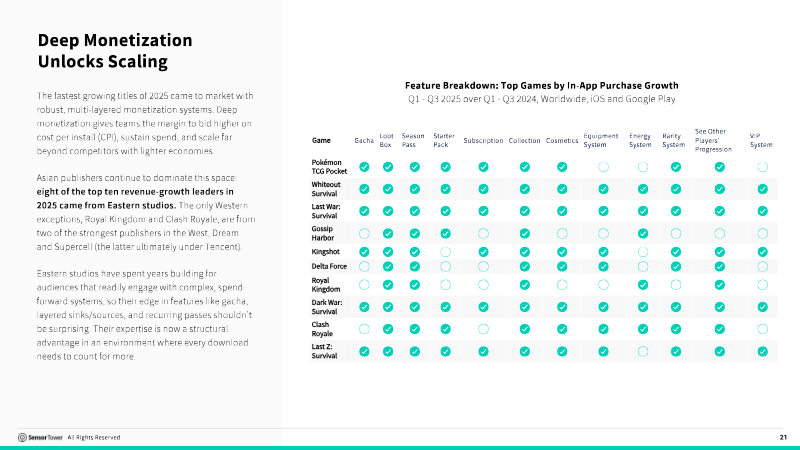
Executive Summary | Six Predictions for 2026 Prediction #4 Prediction #5 Prediction #6 Digital advertisers will shift ad dollars Winning mobile games in 2026 will Shorter, smarter development cycles to image creatives over videos pair ad⁻friendly hooks with deep are returning for video games monetization US Digital Ad Spend by Creative Type Feature Breakdown for Top Growing Games Number of Steam Games Released per Year $20B Game Gacha Loot Currency Season Starter Subscription Collection 20K Box Bundles Pass Pack Video Pokémon $15B +15% YoY TCG 15K Pocket Whiteout $10B Survival 10K Last War: $5B Image Survival 5K Gossip +35% YoY Harbor 0 Kingshot 0 Q 2 2 0 2 4 Delta Q 1 2 0 2 4 Q 2 2 0 2 5 Q 1 2 0 2 5 Q 4 2 0 2 4 Q 3 2 0 2 4 Q 3 2 0 2 5 Force 2018 2019 2020 2021 2022 2023 2024 2025 Royal YTD Kingdom
Sensor Tower | Our Customers Top publishers trust Sensor Tower insights to grow their business Gogc EA DISNEY anlazor PROVIO DOORDASH Walmart ELEVEN Microsoft SEGA SONY fetch Pizza @ Meta Gett ByteDano REWARDS Do &NRA CVS Note: Top publishers by app store revenue | Source: Sensor Tower
Consumers Will Spend WorldwiTop App Genres Projected for 20²6 More than $10 Billion in de, iOS and Google Play (²0²3 - 20²6 Forecast) Generative AI Apps in 2026 Downloads IAP Revenue (USD) Time Spent (Hours) Generative AI was the most discussed topic across the 2023 2024 2025 2026F digital landscape in 2025, spanning mobile, web, and advertising. The genre has earned the buzz: Generative AI apps like ChatGPT and Google Gemini are projected 7.2 Billion to approach 4 billion downloads, $4.8 billion in in-app 15B ...................... Downloads in purchase (IAP) revenue, and 43 billion hours spent in 2026 2025. (+82% YoY) Our 2026 prediction: We project this rapid growth to continue, with both IAP revenue and time spent 10B expected to more than double year-over-year (YoY), setting the stage for a $10B+ market. and a steady flow of tighter, smaller-scope games for 5B players. Dive into the latest mobile apps trends with Sensor Tower's Mobile App Insights Explore PC and Console gaming insights with Source Sensor Sensor Tower's Video Game Insights 0 Note : Tower 0 : iOS and Google Play combined. iOS only for China. Estimates for 2025 are projected Utilities Financial Services Social Media Generative AI Multimedia & Shopping through the rest of the calendar year. 20²6 estimates are forecasted. Apps classified 2018 2019 2020 2021 2022 Design Software 2025 YTD using Sensor Tower's App IQ taxonomy as of December 20²5. Note: 2025 YTD is through December 4, 2025.
By 2026, Generative AI Worldwi Yearly App Genre Ranks by Metric will Be a Top Five Genre de, iOS and Google Play (²0²3 - 20²6 Forecast) Across Key Metrics Downloads IAP Revenue (USD) Time Spent (Hours) As a result of the unprecedented growth, Generative AI 2023 2024 2025 2026F has immediately ranked among the top genres on 1 1 Utilities mobile. By 2026, the genre is projected to see dramatic leaps across all key metrics: 2 Financial Services Downloads: Expected to move from #10 in 2025 to 3 3 Social Media Genre Rank by #4 in 2026, ranking ahead of established categories 4 Generative AI Downloads: Multimedia Design Soft #4 in 2026 like Multimedia & Design Software and Shopping. 5 5 Shopping & ftware ahead of top genres like IAP Revenue: Projected to jump to #3, surpassing 6 Shopping and Movies & Business Productivity Soft TV Shows popular genres such as Dating & Social Discovery. 7 & ftware Time Spent: Expected to climb to #5, outranking 8 8 Movies & TV Shows major consumer categories including Travel & 9 Travel & Tourism Tourism, Shopping, and Financial Services. 1 0 Health & Wellness and a steady flow of tighter, smaller-scope games for 10 11 Lifestyle & Services Generative AI is quickly cementing itself as a 12 Jobs & Education powerhouse, positioning itself among the top five 13 1 3 Antivirus & Security genres on mobile by 2026. 1 4 Dating & Social Discovery
2023 - 2025 (Key Insights and Data) QUONADIS ● Users in Gaming on different platforms CANDISS ● The Attention Economy: Gaming vs. Other Leisure Spending oy ss GANG Ae IED ● Mobile Gaming Marketability ● Downloads and Revenue Concentration in Mobile Gaming ● Mobile Gaming vs Non-Gaming ● Mobile Gaming Growth (Android vs.
Mobile gaming has become the dominant engine of the global video‑game market, now accounting for more than half of total industry revenue and projected to exceed $126 billion in 2025, with an overall forecast of $150 billion for the segment. The surge is driven by unprecedented user engagement—4.2 trillion hours of app usage in 2024—and a rapid shift toward direct‑to‑consumer (D2C) commerce following the April 2025 court order in Epic Games v. Apple, which obliges iOS platforms to permit external web‑shops and allows developers to retain up to 95 % of transaction value. Early adopters report revenue recoveries measured in millions and a 60 % increase in user engagement for high‑volume titles. Regulatory reforms across the EU, United States, Japan, South Korea and China are dismantling traditional app‑store monopolies, mandating alternative storefronts, transparent odds disclosure and the elimination of hidden fees. Despite tighter oversight, the mobile ecosystem remains robust, with the United States generating roughly $52 billion in in‑app‑purchase sales, while emerging markets in Latin America, Southeast Asia and Saudi Arabia expand the geographic footprint. Hybrid monetisation—combining in‑app purchases, advertising and subscriptions—is employed by 72 % of developers and now represents about three‑quarters of mobile revenue; live‑ops‑driven hybrid‑casual titles are delivering a 30 % year‑over
The mobile gaming industry is entering a period of strategic recalibration, projected to reach $126.1 billion in revenue by 2025. This growth is underpinned by a transition toward hybrid monetization models and the integration of AI-powered personalization to combat persistent retention challenges. While global install volume grew by 4% in 2024, the market exhibits a distinct geographic divide; North American and European markets face stagnation, whereas Latin America and the Middle East and North Africa regions demonstrate robust expansion. Success in this evolving landscape requires developers to move beyond traditional acquisition, favoring diversified channels such as Connected TV and localized, player-centric engagement strategies. Data from early 2025 indicates that user tracking remains a pivotal operational hurdle, with global App Tracking Transparency opt-in rates hovering at 37.9%. Although arcade games have seen notable improvements in opt-in performance, the United States remains relatively static at 32%, underscoring the necessity for refined messaging strategies to maintain visibility. Concurrently, the industry is grappling with a complex financial environment characterized by rising costs per install and declining average revenue metrics. These headwinds are forcing a shift in marketing tactics, as developers increasingly rely on a broader array of acquisition partners and data-informed creative experimentation to sustain growth. Ultimately, the path to profitability in 2025 lies in prioritizing long-term player value over short-term acquisition metrics. By leveraging AI-driven optimization and fostering community-building initiatives, developers can mitigate the impact of declining revenue per user. The industry is clearly moving toward a more sophisticated, data-reliant ecosystem where the ability to measure performance across fragmented channels—including mobile and Connected TV—is essential for maintaining a competitive advantage in a maturing global market.
The live streaming industry experienced a period of stabilization and strategic maturation throughout 2024, characterized by a modest 3% year-over-year increase in total hours watched across major platforms. This growth brought the global annual viewership to approximately 35 billion hours, signaling a shift from the volatile surges of previous years toward a more sustainable, long-term trajectory. While Twitch maintained its position as the market leader in terms of total hours watched, its market share faced increasing pressure from YouTube Gaming and Kick, the latter of which saw a 45% increase in viewership as it successfully attracted high-profile creators through non-exclusive contracts and aggressive revenue-sharing models. Geographically, the Asia-Pacific region remains the primary engine for mobile streaming growth, while North American and European markets show a deepening preference for high-production "eventized" content. Non-gaming content, specifically the Just Chatting category, continues to dominate the landscape, accounting for nearly 15% of all platform activity. However, the competitive gaming sector saw a resurgence driven by the massive success of tactical shooters and the expansion of co-streaming rights for major esports tournaments. These community-driven broadcasts often outperformed official channels, representing a fundamental shift in how audiences consume professional competitive play. The integration of artificial intelligence and enhanced monetization tools defined the technological landscape of the year. Creators increasingly utilized AI-driven moderation and clip-generation tools to maximize reach across short-form video platforms like TikTok and Instagram Reels, which now serve as the primary discovery funnel for live broadcasts. Brands have responded by shifting budgets toward long-term creator partnerships rather than one-off sponsorships, seeking to capitalize on the high engagement rates of mid-tier streamers who boast more dedicated, niche communities. As the industry moves into 2025, the convergence of live commerce and interactive broadcasting is expected to become the next major frontier for platform revenue.