1 free read left. Create a free account for unlimited reading + AI research.
Create free account
In Defense of Imagination - When to NOT Tell the Whole Story to Players - Extra Credits
Key insights
7 takeaways- 01Titles like Undertale and Stardew Valley demonstrate that simpler aesthetics can effectively invite player participation and foster stronger personal connections to the game world.
- 02Prioritizing player imagination over exhaustive visual detail offers a potential path to reduce the unsustainable costs associated with the current graphics-focused development arms race.
- 03The modern industry's pursuit of photorealism often replaces active player participation with passive consumption, undermining the potential for deep, lasting immersion.
- 04True immersion is driven by world-building that invites player collaboration rather than high-resolution textures or particle effects.
- 05The Souls series and Bloodborne achieve critical success by utilizing fragmented lore, which forces players to actively construct their own narratives.
- 06Overwatch leverages external media to provide minimal context, successfully sparking fan investment through intentional information gaps.
- 07Minecraft centers its core gameplay loop on player agency, proving that leaving space for the user is a viable strategy for creating memorable experiences.
Ask AI about this video
Transcript
Games used to be an act of imagination, where you'd conjure knights and castles from a simple chessboard or whole worlds from the words of your DM. But for 20 years, perhaps inadvertently, the AAA industry has waged a quiet war against imagination. Now, the industry spends hundreds of millions of dollars a year trying to reduce how much players have to rely on their imaginations to play our games. But in doing so, we risk casting aside one of the most powerful aspects of our medium. This episode is sponsored by Schism, a social political card game whose Kickstarter is live right now. Check out the cool stuff they're doing at the link below. Once again, say hi to Extra Sci-Fi Zone David Weso doing the guest art for this episode. Thanks, David. While writing our content conundrum episode, James had a realization that there was actually another episode he wanted to write, a much larger episode. An episode that talked not just about the practicalities
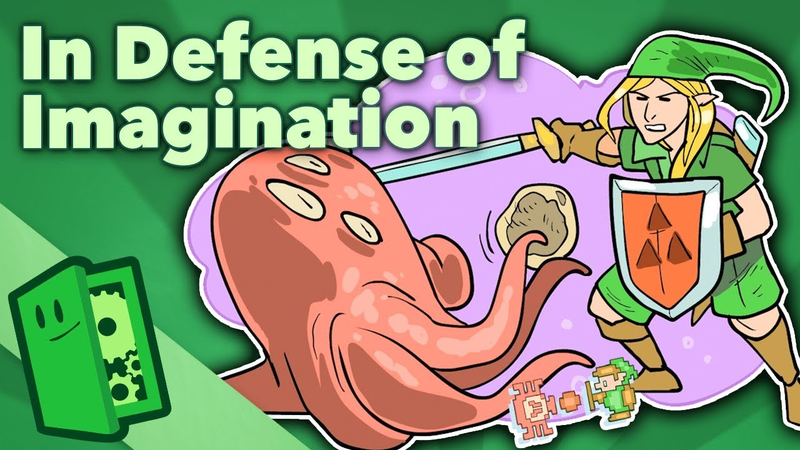
of content cost, but about the mentality that drives the ever-rising cost of content in our industry. The mentality that the less players are required to rely on their imagination, the more people will play our games. Now, I don't think that many people who are pushing this mentality are thinking about themselves in exactly that way. Instead, we usually cover it with FANCY WORDS LIKE FIDELITY or immersion. But our graphics arms race has really been a race to reduce the amount the player has to use their imaginations while playing. Remember back in the day when everything was just 2D scratchy sprites and you couldn't quite be absolutely sure what anything was? Are those rock-shooting octopi in Zelda? I guess that brown puddle is supposed to be an acid slug in Ultima Online. And remember how in almost all of the Final Fantasies, your armor used to be just a simple line of text? How it didn't change your character's appearance at all? Well, that's okay because our imagination can fill in the gaps. That acid slime can be terrifying and getting
animate armor can be truly epic because our minds make them so if we're truly immersed and not just immersed in the messy sense it's often used now. Those things become real to us. Novels have been doing this for centuries making places feel real to us that are no more than words on a page and games can do this just as well. There are many people who will tell you that venturing into the dark and being eaten by a grew is something that they can still picture with horror and those monsters in the first two Silent Hills what were they? It doesn't matter because not really being sure allowed your mind to turn them into whatever interpretation was the most terrifying for you. Now this is not to say that modern graphics are bad or that the latest tech to render things is something we shouldn't use because yeah, we absolutely should be using those things. The advances we've made in these fields are amazing, but we should think carefully about why we're using them. They can be used to spur the imagination or to attempt to render it unnecessary,
but when we do the latter because we don't trust our audience to do the hard work of imagining when we're afraid that not as many people will buy our game if everything isn't spelled out. We're eliminating the single greatest tool we have for creating games human imagination. Our graphics shouldn't be there to help us tune out or make the player do less imaginative work. They should be a jumping off point for a fully realized world of wonders we create internally in our minds. When we first started to throw around the term immersion in games, it meant real immersion. It meant having that moment where the game is so real to you. You forget it's on a screen and that you're in an ordinary chair in an ordinary room in our perfectly ordinary world for that moment. You forget that there's a world outside the game. But over the years this industry has moved the term more and more just to mean how high-res we can make All the time you hear the phrase, "Immersive graphics." But truthfully, it's not the graphics that are immersive. It's the world they help
create. We seem to have lost track of that somewhere along the way. And as we started to decide that truly first-class AAA games had to show every item, render every different type of sword swing, and to make sure that every ability was accompanied by a small host of particle effects, we actually lost touch with what got so many players so completely immersed in our games in the past. The fact that we let their imaginations do half the work. James has sat with publishers and studio heads who don't know why their bland military shooter didn't capture people's imaginations. I mean, after all, it had cutting-edge graphics. But to really stick in one's imagination, you have to let people imagine in the first place. So, let's talk about some recent games that succeed at this. Lower-budget games like Undertale, Stardew Valley, and FTL ask the player to imagine with them and succeed incredibly. But what about AAA games? Ones that utilize a lot of modern graphics potential and aren't afraid to trust their players to imagine outside
the bounds of the game? The first that probably comes to mind for many of you is Bloodborne and the Souls series. Because these games actively ask the player to imagine and fill in the gaps between the lore they find in the world. Rather than holding back visual information, they hold back narrative information. They set up a mysterious world and then give the players a huge amount of clues as to what's going on. But crucially, they don't give the players all of the clues. In the massive amount of lore they pile on, they never actually let the players definitively solve the mystery. Instead, the player must make conjectures and imagine answers to tie together the fragments that they have. And that's part of why these games have become such a phenomenon. Overwatch takes this in a different direction, providing fragments of stories outside the game through videos and comics, and then letting the players fill in the gaps with their imagination. No other multiplayer shooter in my memory has had such a fan base for its world and characters and it's because no other multiplayer shooter has given people just enough to
be invested and then trusted the audience to use their imagination and run with it. Lastly, I can't not mention Minecraft. It's not AAA in terms of production, but it certainly is in terms of sales. The entire gameplay is to imagine and then make what you imagined real. We've all seen what happens when we spend $200 million on a game. We become afraid you won't get it if it's not all laid out for you, but it's high time we as an industry realize that this isn't a benefit to our audience, it's a disservice because when we trust our players to be willing to imagine, we can make more games for less and most importantly, we can create the types of games that you dive into so deeply, you'll remember them forever. Until next time everyone. And speaking of imagining cool stuff, this episode is brought to you by Shasan. We over here at Extra Credits have been really jazzed by the idea of teaching people about democracy through games. First with our Extra Politics board game and now with the Shasan team
over in India who built a game to help people both in their own nation and around the world learn about the democratic process through playing it. And you know what's really awesome? We are writing the fall of the Rowan Republic expansion for their game because what better way to learn about democracy than through its collapse? Or, you know, at least through the collapse of a weird pseudo-democratic system that we still draw on today. You get what I was going. So, if that sounds up your alley, check out their Kickstarter at the link below.
Summary
The modern video game industry has increasingly prioritized high-fidelity graphics and exhaustive visual detail, a trend that inadvertently discourages player imagination. While technological advancements in rendering are valuable, the industry’s pursuit of photorealism often stems from a misguided belief that players require every detail to be explicitly rendered to remain engaged. This approach risks replacing the active, collaborative role of the player’s mind with passive consumption, ultimately undermining the medium's capacity for deep, lasting immersion.
True immersion is not a product of high-resolution textures or particle effects, but rather the result of a world that invites the player to participate in its construction. Historically, games relied on limited visual information, forcing players to interpret abstract sprites and text-based descriptions, which fostered a stronger personal connection to the game world. By contrast, contemporary AAA development often attempts to eliminate these "imagination gaps," leading to bland, over-explained experiences that fail to resonate despite their technical sophistication.
Successful titles across various budget levels demonstrate the power of leaving space for the player. Games like Undertale and Stardew Valley utilize simpler aesthetics to invite player participation, while the Souls series and Bloodborne achieve critical success by providing fragmented lore that requires players to construct their own narratives. Similarly, Overwatch leverages external media to provide just enough context to spark fan investment, and Minecraft centers its entire loop on the player’s creative agency. By trusting audiences to fill in the gaps, developers can create more memorable, impactful experiences while potentially reducing the unsustainable costs associated with the current graphics-focused arms race.



















Comments