1 free read left. Create a free account for unlimited reading + AI research.
Create free accountPresentation Quantic Foundry
1 free read left. Create a free account for unlimited reading + AI research.
Create free accountPresentationQuantic Foundry
The Gamer Motivation Model categorizes gaming preferences into twelve distinct motivations. It links these drivers to game selection and engagement.
Scale. The model uses data from over two million global participants.
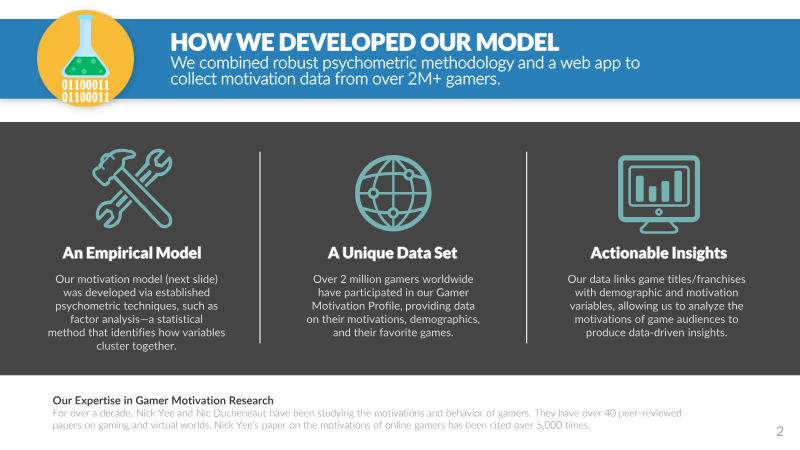
See it on page 2This document outlines Quantic Foundry's Gamer Motivation Model, an empirically derived framework identifying 12 distinct gaming motivations grouped into six pairs, which further cluster into three high-level categories. The model was developed using psychometric techniques, specifically factor analysis, on a dataset of over 2 million gamers worldwide. This extensive dataset links game titles and franchises with demographic and motivational variables, enabling data-driven insights into audience motivations.
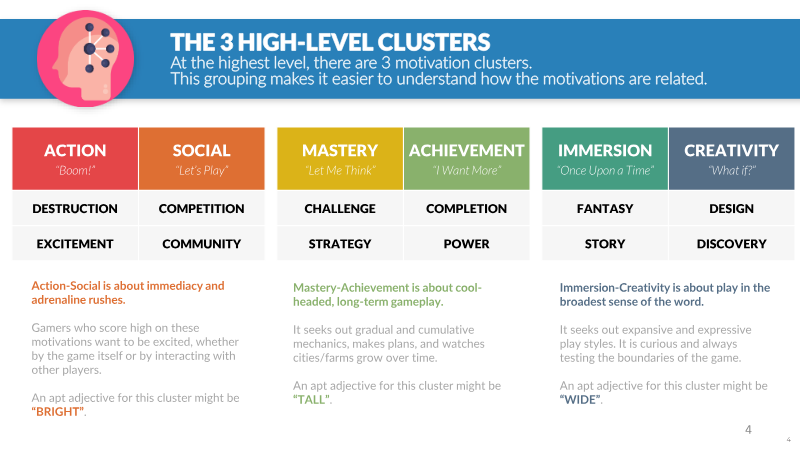
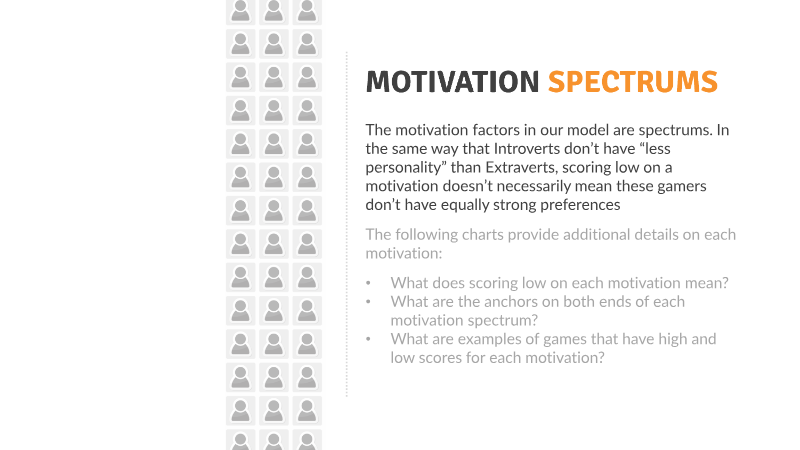
The 12 motivations are Destruction, Competition, Challenge, Completion, Fantasy, Design, Excitement, Community, Strategy, Power, Story, and Discovery. These are organized into three high-level clusters: Action-Social (focused on immediacy and adrenaline), Mastery-Achievement (centered on long-term, cumulative gameplay), and Immersion-Creativity (emphasizing expansive and expressive play). The document details each motivation as a spectrum, explaining what scoring low or high on each means, providing anchors for both ends of the spectrum, and offering examples of games that exemplify high and low scores for each motivation.
For instance, the Action-Social spectrum includes Community (ranging from independence/single-player to teamwork/social interaction), Competition (non-adversarial to high conflict/leaderboards), Excitement (calm/turn-based to thrilling/fast-paced), and Destruction (enduring/cozy to chaotic/mayhem). The Mastery-Achievement spectrum covers Completion (self-driven to task-oriented), Power (flat progression to progression-based), Strategy (spontaneous/reactive to contemplative/planning), and Challenge (easy fun to skill-based). Finally, the Creativity-Immersion spectrum includes Fantasy (abstract/shorthand motifs to deep lore/immersive world), Story (open-ended/concise narrative to scripted drama/elaborate narratives), Discovery (practical/fully-exposed rulesets to curious/exploring unknowns), and Design (curated/fixed avatar to customizable/expressing individuality). The model aims to provide actionable insights by linking these motivations to specific game characteristics and player preferences.
Quantic Foundry · 2026
Quantic Foundry · 2025
Quantic Foundry · 2025
Quantic Foundry · 2025
Quantic Foundry · 2025
Quantic Foundry · 2024
Quantic Foundry · 2023
Quantic Foundry · 2023
Quantic Foundry · 2023
Quantic Foundry · 2021
Quantic Foundry · 2021
Quantic Foundry · 2021
DiGRA · 2026