VideoPocketGamer.biz
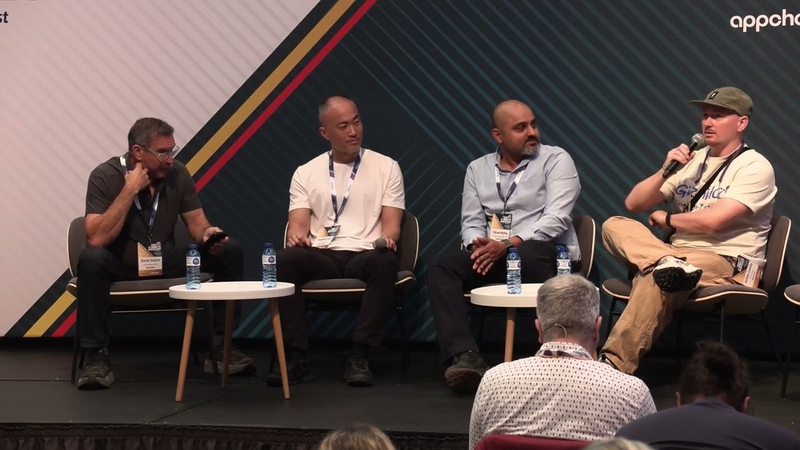
Panel: State Of The Union: The Future Of D2C In Mobile Gaming.
24 Oct 202532 min video
Transcript
[Music] [Music] Heat. Heat. really excited to bring on this great panel which is examining this the the future of direct consumer in mobile gaming. So come up onto the stage guys. I shall remain quiet.
Good morning everybody. Thanks for coming out here so early. Good to see a packed room. Um
I think I think before we start, can we all like do a massive cheer, right?
Yes. One
and then people may hear it
and flood into this room. Let's get a
big woohoo.
Thank you, Adam.
This is why I bring this is why I bring you to these things.
I'm Sam Gaglani, EVPA of global business development at Exola. Uh, and today we're going to talk about uh, DTOC and the future of what's happening in light of all the fun rulings that's been going on. Um, I've got three amazing human beings here. I'm going to start off with Adam. They're going to do intros and then we'll kick right into it. Adam, why don't you go first?
Hi, I'm Adam. I'm the director of product for gaming over at Apps Flyier. Um, we do ads attribution for for mobile mainly, but PC and console too. Hi, I'm Rafa Morgan, VP of marketing and partnership at Crazy Games. Crazy Games is a web gaming platform. Um, and I've been in the industry for like 15 years about it. I was working on the web space. So happy to join here. Thank you.
Good morning. I'm Sarah Thompson. I am BD director at Epic Games Store PC and
mobile, our newly launched mobile store. and I've been in games for 18 years now and have been all over the place on PC, console, and mobile.
Awesome. Well, as you can see, we've got some experts here and we can talk about uh what's been going on lately. So, to recap, uh I think yesterday or the day before, uh Google lost their uh appeal and so now they have to adhere to the guidelines in the United States. uh basically following what Apple is doing uh for iOS meaning you can now present thirdparty uh apps uh payment systems in app you can redirect users um out of that app to a DTOC experience and you can also message in app so quite a big change in the United States um the EU is still kind of uh adhering to a weird scheme where I think you pay like 27% at the end of the day um we're seeing other countries slowly move towards what the US is up to. Um, but it's quite exciting
what's going on. Um, so today what I wanted to talk about in with this panel is what that means for the future of gaming, what that means for developers and publishers as they try to navigate their way through this very confusing landscape. Um, so I guess Adam, I know you had a question that you wanted to ask. I mean, I guess one of the biggest things for me is is probably what most developers are thinking at the moment and certainly most that I've talked to is like what happens when Apple and Google turn around and say, "Right, we're going to drop it to like 15%."
Yeah.
What, you know, what what does that do to this marketplace?
Yeah. So, I I ask that question myself all the time because at Exolo, you know, we benefit greatly from uh what's going on with the current litigation. Um, I'm going to answer first. I'll pass it to you and we can kind of discuss it. But I think what we'll see maybe in a couple
years or maybe a yearish is maybe Apple reducing their commission to 25%. Um, for them to go to 15% that's a huge hit on their EBIDA. I think that would be dramatic shift. Um, if they did do that, this is the question, right? Um, I think the smaller to midsize developers would probably do it. Um, the larger uh enterprise that are seeing significant revenue are still going to take advantage of um the lower margins that companies like Exola and quite frankly our competitors are offering. Um, but there's also other things that are involved here. So, you know, you have to think about alternative payment methods. So, you have to think about um the relationship you've now forged with your consumer or your user that you're not normally getting when you use iOS or play. Um with alternative payment methods, you know, companies like ourselves, we're offering uh ways for people to pay in countries like Brazil or Japan that Apple just quite frankly doesn't offer. Um so, I still think
you're going to see people uh gravitating to third party payment options. um it would really have to go down to 10% for it to be meaningful. Um but I still think even at 10% you'll still have companies wanting to go to direct to consumer experiences mainly because you have
very unlikely as well. 10% is very unlikely as well.
It won't happen. But you got to remember Apple and Google just don't offer relevant payment methods in let's say Brazil, India, parts of Asia where you probably have unbanked users that want to pay for games but they don't have the ability to. Um, so Raf, I know this is kind of an interesting topic for you. Adam, you can you can chime in if you want first. We're sharing microphones so
with with sorry topic with the dropping it dropping the price. Yeah,
I I I think you're exactly right. I mean, I think one of the big areas surrounding this is like the community that you can drive based on pushing
people outside of the game. I think that's a huge benefit in order to be able to really capture cross promotion. If you have multiple games and start to build that whole community in a controlled environment outside of the game, I think that's that's
that's my sole benefit to this to be honest.
Yeah. And I al also feel like at the same time this whole conversation has been pushing the industry towards um you know new developments, new experiences. Um that's what I hear we hear from publishers as well. I mean I work on the web space right which is obviously a different way to to distribute your game. The most direct one where you own the data from the user. Exactly. Where you where you don't um share any revenue if you don't want to you know unless you don't see the real value of it. Um and and I think that's also something that you know we there's like even more when we think about technology and game engines I mean there is I think there's a huge interest from from game engines
as well to improve their the quality of the web builds for instance right being so so the the the the game the publishers and the game developers they are able to provide this experience um directly and quite frankly more and more very very much like what you have as a native experience Right. Um, and I also feel like the industry itself is um, it's a bit I always think it's very um, it's funny how dysfunctional mobile industry can be cuz like right now you have this um, a lot of people working with like playable ads which are HMO 5 game. So they would actually provide a portion of the game already in HM friction and then they download the game and then you push them to make a purchase again back on the web right which is like you know so there's like friction friction friction and the only reason why this happened is just because like there's more money for the time being there that's the only that's the
only reason
so as I'd argue that it's it's down to retention as well. Like I mean it's always been easier to retain a user on mobile than it has on web.
Yeah. But but this retention will impact on the LTV, right? So that's that's kind of so it is money in a way. So and that's I mean not to say the web is perfect there. It has a lot of lots of lots of problems. But I just think it's funny how the cycle goes this day right start on the web goes to native and then goes back to web and then we come back here and complain that they are taking too much and giving nothing. Yeah. It's like, you know, feels a bit toxic, right?
Yeah. I mean, this is a topic that's near and dear to Epic's heart. Um, I mean, certainly we have a very long history of coming into spaces where there's dominant uh storefronts and um and really trying to create tectonic shifts through uh disruptive revshare um offerings for our developers. So, you know, we've been on PC for 7 years, over 7 years now, and
Revshure has always been 8812. Um, a few months ago, we announced a new, um, offering for our developers where any game launched from June this year moving forward. Uh, your first million dollars of revenue, you keep 100% and that's on PC and mobile.
Y,
uh, and then it flips to 8812. So really there's this deep deep belief all the way to the top with Tim Sweeney of like developers deserve to keep as much money as possible and that it is absolutely possible for app stores to be giving more back to developers or allowing them to keep more of their money. Uh and that that has needed to change for several years now. That's that's the belief. Um and it's the bigger picture, right? It's not just, oh, we're going to walk our talk and we're going to actually offer that ourselves as an app store, but there is the desire to hopefully um create that change across the industry.
You know, um rising tide lifts all boats type thing. Um and we've seen that and there's that dedication over many years that um Epic has has shown um and invested in greatly and that and that we are uh again we are fronting that ourselves. Uh so that's that's something that we
we are very aligned with.
First of all, I'd love to thank Epic Games because without Epic Games, none of this would be possible. So big kudos to Tim Sweeney and everyone at the org. Um so that kind of leads into my follow-up question is as we are starting to push into DTOC space, if you're a developer, a publisher, what what do you think are some of the biggest barriers to setting that up? I feel like you guys released something early. Um this web shop thing, right?
Yeah. So, we just a couple of days ago now I think I've lost track of the the days with all the travel, but um very recently in the last week certainly um we just and we just launched our web shop. So, we announced them um earlier
in the summer and really again this is a play in offering more choice and optionality for both developers and gamers. There's obviously lots of folks in the space. I mean
Epic has used Exola for many years. We love Exola as well. We love you
and and we love to play in the realm of like the ecosystem at large with a lot of folks that in some respects are competitors but we also you know have really great relationships with Unity is another great example of that. Um,
and so there really is that again walking the talk of we we want developers to be able to have a lot of different ways to build community to have a relationship with their with their develop with their users. Um, and that there's choice for everyone, right? And that creates really healthy vibrant ecosystems as opposed to one option or two options.
Correct. And so Rafie, talking about optionality, you guys offer a great option as well, right? With Crazy Games.
Yeah. Um, you mean in regards to payments or
and or or payments and also getting your game out outside of iOS and playing?
Yeah, definitely. I mean, we it's it's I also feel like that's something I mean, not just about crazy games, but the the industry as a whole right now. People learn that they cannot put all their eggs in the same basket. So, you're looking for, you know, different um options for you to go about it. And it's really like, you know, it's not just crazy games. I mean, there's like 10 15 different options for you to go about today, right? Even like Telegram, you have Wishhat, you have like Reddit is coming, Discord, there's just so many different options for you to go to go about. And obviously crazy games we try to to make as easy as possible for for the developers to um to find a way to find a community and to you know build
on what they have. And what we hear even like for you know online games that need like a a huge amount of players like we help them populate their servers so the gamer keeps live for quite some time. So it's uh I think that's that's where where we heading as well. And obviously alternative distribution um they they um they provide I would say different audiences right cuz um I do feel like our users for instance they are not um everywhere sure they have a mobile phone but not necessarily they're playing all the games or the same games right so they might be on Roblox they might be you know it's a and this is kind of like where we start seeing a shift um or even like adding this new layer of um of distribution for for publishers and they they're quite happy about And then we start seeing them building like dedicated web teams as well which is also very interesting to hear. Yesterday was um there was there was a talk here which talk about user acquisition they
made um I don't remember the name of the the lady but she made she made this uh this this thinking what if you switch 15% of your way budget to actually alternative dist uh distribution like you have a team that will build up to
the cost are rising right now. Yes, the cost rising and then it was like, oh yeah, that makes a lot of sense, right? Um and and I think that's what we're seeing as well already, you know.
Got it. Adam,
I think one of the biggest struggles I've seen is is the sort of understanding of different geos and how the different geos will regulate different options that you're allowed to do. So I think having different builds of the game as a developer is is you know talking mobile obviously
can be very restrictive and be quite timeconuming in delivery.
Yeah.
So you know having to do a different build for the US compared to Europe those that kind of thing I think makes it makes it more of a challenge and actually understanding what's available in which country I think that you know
there's an educational piece which I think is hugely important right now.
Absolutely. So, I would say, you know, when you when you're looking at optionality, you're looking at different ways that you can distribute your game. Uh UA costs definitely come into uh to play. Um, but there's one other thing I was thinking about, which is now that we've been doing this for 5 years with this direct to consumer experience. The one thing that I keep hearing, and I'm curious to hear your perspective on this, is the companies we're speaking with are saying they've now seen a better relationship with their user than they've ever had before because before it was kind of a black box. Um, so Adam, since you have the microphone, um, from your perspective,
it's like the wooden spoon, isn't it? You're allowed to talk,
swiveling it around. Um, have you do you think that's going to evolve? Um, you know, yes, Apple could or Google could drop their rate, but that relationship
with the user, I still think is of so much value that it still kind of trumps any sort of margin uh any sort of uh lowering of the the platform fees. Um,
I think the the adoption numbers kind of answer that story. Like I've been looking a lot recently
at sort of out of store payments for a lot of the companies on our books. Bear in mind we have like 60% of gaming, you know, with with our SDK and their apps. We get to see a lot of this data. Um, and we get to calculate it across the industry. And so far we've we we've sort of estimated that around 10% and that varies between 10 and 30% through different genres are now using sort of direct to consumer payments. um which that adoption by itself shows that there's a value in doing that and it shows that that's that's you know there's a reason for that and that makes complete sense when you're saying that
part of this is the relationship that you're building with your player base because like we were saying earlier it's not just about hey you can purchase through this link now it's hey you can come to this place you know we're building a community here we're we're crossromoting you we're showing you all of the offers that are available across our entire estate. Need to breathe. And we can, you know, you can you can build that relationship. You have an area exclusively where you can build that relationship.
Yeah.
Um Ralph, I'm going to give it to you because I know for you, we talked about this earlier like this has been like a f your platform has been a fantastic area for driving engagement with the user communities. So, I'd love to hear more about it. Yeah, I think um it's it's a really interesting like um you know um I think there was a especially during covid time I got impression like there a lot of the mobile indepure space they would just try to buy the user as cheap as possible serve as many ad as they could and then the guy would
just go and that's it right if the equation was like you know oneplus 1 and a little bit more you'll be happy about it and and uh and which kind of like obviously just became you know very competitive and impossible to do that. Um, and the way we're seeing right now, um, it's like, so we went from this sort of performance marketing to community marketing and also now learning about how we can actually uh, maintain this community, make them engage, making the produce content on top, make them talk to their friends about it and actually champion the champion the the the game for you, right? Um and and obviously you know it's it's I think it's a open communication and a lot of I would say a lot of uh partners in the past that that uh that we spoke to they didn't really even know how to do that and know so this conversations are actually you know just they're they're picking up right now and they're learning say like okay so marketing is not just about user acquisition and and you know monetization is actually about like understanding your user talking to them
getting a represented like a rep that will you know be spoke speak on their behalf back to the company and champion internally do product changes and all this stuff and obviously you know you want to sell in the end right but you want to sell something that they want to buy too so we this conversation is also very important
Adam we sorry we were talking earlier you about going full circle and it's almost like marketing is going full circle you're almost going back to the days of branding and yeah sorry
we gota we're gonna give Sarah time
yeah I totally agree with that and I I think that um you know how you're uh giving optionality to your gamers around
uh how they're purchasing things or how they're accessing and and all the different paths of distribution. Those that is one piece of a much bigger picture of how are you holistically getting in touch with and building a relationship with your with your gamers, right? And um interestingly, I think over the years, the pattern I've seen is
that not always, but more often than not, it's the indies, right? Indie developers who actually tend to I don't want to say be better at it, but but are really effective because they're they don't have millions of dollars to do that. They So, they have to do it in a very grassroots organic way. And what they tend to have is authenticity, right? It needs to be an authentic conversation and a real care and desire to understand what their user base wants. And people can feel that, right? That's a really, really big difference. And they're listening and they're taking in that feedback
and they're integrating where it makes sense. So, I think that that's part of that bigger relationship. And and one piece of that ability to continue to like uh own that is the optionality around here. Hey, our our super users, they want to be able to to buy more or
be interacting with the game more and therefore DTOC probably makes more sense for them. or you know they want to patronize developers and know that if they buy off Epic Games Store their developers are making more money in that in that way than the usual suspects. So I think that's that's the kind of mentality and then I think where we've had to rewrite playbooks is what are the tools right like how are we actually reaching users because social media is changing constantly um where younger generations are is changing constantly what's relevant to them and what resonates for them and you know us folks who have been in the industry a long time it gets a little harder to understand what younger generations want um so I think it's this constant swirl of disruption and learning and relearning how to do that.
Yeah, I was I was going to say so Epic Games has always been like I I would call them a disruptor, an outlier and that ethos has really I think like you said attracted that that indie spirit
and off offering alternative ways to reach your user. So what what you touched on is exactly what I think is important in this world that we're going through. Um crazy games is for if you talk about indies like most of your uses on your games on your platform are indies, correct?
Yeah, they are. They are. And and it's it's I think it's really interesting to see because so I have two kids. My oldest one is 12. So he's he's exactly on this age where his he loves to play Brawl Star and crazy games and Roblox and so on, right? And I started noticing a pattern toward in the in his friends which is like they always start as some YouTube channel now. And then I I I I I asked them like, "Do you want to be a YouTuber?" And they're like, "No, no, we just want to make the videos so our friends at school watch it, you know."
Yeah. Exactly.
And and then I was like, "Wow." Okay. But there's like an army of them, you know. So it's like really crazy. It's like, "Okay, this is how actually the word of mouth is actually going these days, you know, without any intention to
make something extremely high quality. It's just like, oh, did you see how I, you know, killed that guy or exactly at that moment that happened?" So in these conversations are actually, you know, unfolding. And I think the way we use social media is changing at least changed for me and I learned a lot looking at the younger generations and that's why I think on crazy games is really um it's really exciting to see because we we do have a you know younger this younger generation that's what they started this when I was when I was in school. I also play mini clip armor games and all those websites, right? It's just a natural thing.
So, um I just it's just interesting to see how marketing has changed. Very challenging. I would not know how to place the strategy around.
It's interesting because it's changed, but it hasn't changed. It's kind of just come full circle like you were saying, Adam. Right.
Yeah, completely. I mean, it it's it's a challenge. It's fun. It'd be boring if it was the same thing all the time, wouldn't it?
So, we we got almost five minutes left. I'm going to give the big open-ended question which is D TOC 5 years from now where do you see it and not going to
hold your feet to the fire but love your your opinion love your opinion but I'll start with you five years where will we be
who knows with legislation I like what I what I perceive from the industry right now projecting that five years time I expect that payments will be sort of around 50 60% sent through DTOC.
Y
um I think the you know the the app stores will readjust to all of these changes and put measures in to compensate in some way, shape or form cuz I think they're going to have to now in in in some way.
Um so it will it will kind of
flatten out at some point. Um I I think the the next couple of years are a super time to invest and to be able to sort of jump on this immediately. Um and there's there's certainly money to be made on this imminently like being able
[Music] um but I think longer term it's it will even out. It kind of has to at some point.
Yeah. So Rafie for you because your your platform is mostly you know it is web browser games there's gonna I think this is like the golden age for you guys.
Yeah definitely we're seeing this there's a lot of converging forces going around. Um I do feel like I mean there's if you think about how your desktop works right you also have a I have a a MacBook right I can do whatever I want there. I I don't need to use the app store to download stuff. Why why would it be different? So, but there's there's still like an app store available there for you to use. And I think this is this will be true.
But you are on you guys do have an app on iOS.
Yeah, we do. We do. We the legislation pass our app and like Apple will approve it. So, we we're we're going to grow this. It's going to be a mega app with like 3,000 games and you don't have to download anything and you know, maybe on
it. So,
of course, Sarah, I this is a big question for you guys. Yeah. I So, I think that I think we're going to see this space really thrive. I think we'll see a lot of proliferation in in the space now that, you know, barriers are coming down and allowing for um this area to thrive. And actually this is something that I'm I'm I'm making a statement and I'm really interested to get your take Sam which is like often so my background um I started 18 years ago when Apple first started and I made some of the very first free-to-play games on mobile for the European and um North American markets. And what we would do is we would look at what's happening in Asia.
Yep.
Because Asia tends to be ahead of the game
always.
Yeah. And so it's the same thing with this, right? And yes, there's nuances. Yes, there's particularly unique variables that are playing out in Asia, China,
um, that are going to make that unique. But surely there are signals of how far along they are and how many more years ahead they are and the level of sophistication they are, how that market has matured. So I I'm looking at what has been playing out with alt stores and DTOC in Asia and saying what are the patterns we're seeing? How could this be informing how things will move forward for us in these newer regions for for this?
It's so funny you brought that up. So Asia is always it seems like the forefront or the forerunner. What I've noticed, the trend I've started to see, and I can't get into detail about it because it's confidential, but the trend we're seeing is handheld devices makers are reaching out to big companies and having an alternative store to the other store on Android and pre-installing those stores with amazing games and then offering users incentives
to go to that store versus the Play store. This is a trend I'm starting to see. I've seen it with three companies now, which is three different device makers. Um, and I was like, that's so weird. And it all made sense to me. It's because they are giving them a reason to go there, whether it's through a credit on their phone bill or extra money to spend in that other store. Um, that's been pretty fascinating for me to see. But I also feel like that's an old idea that happened years ago that's being refreshed again, right? It's like it's nothing new. Um kind of like the same way some companies um were giving iPads or devices to social casino players to have them avoid the uh Yeah. Who could that be? Uh to avoid the uh the platform fees. Um and so this is what I' I've been seeing in Asia, right?
Yeah. I So I thank you for breaking that down. And just I know we're almost out of time, but one quick thing that I I
think is really interesting specifically with mobile and this only applies to mobile is you're dealing with such a degree of scale. You're talking about billions of users, right? So even if you're serving a niche of a few million users, that's still very meaningful for a lot of developers if they're able to target an audience based around how um the the marketplace could become more specialized and more um sophisticated.
Absolutely. So we got one minute. Who go?
Yeah. And that's that's why I think like it's again just as a I think in a piece of advice for all developers and publishers there. It's really try to have you know a conversation with all these distribution roots um being epic crazy games or you know and and really try to understand like you know how can you get more value out of it you know because we we all can provide different different sort of um I would say support for your game uh to find your communities so very very important um
and I think that's what it's nice to see that Epic's here on the show crazy games is here and there's a few platforms here that you can just go to this and actually go to talk to them versus like I don't I've never seen somebody from an Apple like in a conference or like to be honest um we are we are at time but if anyone has questions I can't or do we have to go
okay a question or two otherwise we're at time um going once you go yes sir shout Mina territory. So are you talking in terms of distribution or payment options?
Yeah.
Yeah. So Mina I would say is one of the biggest markets growing markets right now. Uh we personally have opened an office in Riad. Um we are heavily invested in the area right now. Um, aside from that, payment options are
really important there because they pay differently than other parts of the world. Um, so for us, it's an important market. Uh, obviously what we're seeing with the Saudi government, EA, Savvy Games, Scopely, Niantic, it is I would say, yeah, EA again, it is a very important part of the world for us. Um, you guys want to touch on that one?
Um, it's something that we're really excited about. It's relatively new for us. Um so we're yeah we're really excited to to be exploring more in there.
Yeah. But I would to wrap it up, it is probably outside of India one of the most important markets where we see growth happening right now. Um but there's also a ton of money there that's heavily pivoting away from oil to gaming. It's no secret, right? EA just got bought. Like that's a big deal. Uh and and went private. Exactly. All right. All right. Thank you. Thanks, guys. Thank you so much. Thanks.
[Music] [Music]
Auto-generated captions from YouTube — names and numbers may be misheard.
Key insights
7 takeaways · ~3 min read- 01Recent legal rulings in the United States, such as the court decision against Google, are forcing app stores to allow third-party payment systems and direct-to-consumer (D2C) redirects, fundamentally shifting the mobile distribution landscape.
- 02Industry experts project that within five years, 50% to 60% of mobile gaming payments will be processed through D2C channels as developers seek to bypass traditional store fees and gain more control over their revenue.
- 03D2C webshops provide essential access to alternative payment methods in emerging markets like Brazil and India, where traditional app store payment options often fail to accommodate unbanked users.
- 04Developers are increasingly diversifying their distribution strategies beyond Apple and Google by utilizing platforms like the Epic Games Store, Crazy Games, Telegram, and Discord to mitigate the risks of relying on a single ecosystem.
- 05The rise of D2C is shifting marketing strategies back toward brand-building and direct community engagement, moving away from the previous model of solely focusing on low-cost user acquisition.
- 06Navigating global D2C expansion remains complex due to fragmented regional regulations, requiring developers to maintain multiple game builds and navigate varying compliance requirements across different territories.
- 07The Middle East, particularly Saudi Arabia, has emerged as a high-growth market for gaming investment, with significant capital pivoting away from oil toward the sector, exemplified by major acquisitions and private equity moves.
Ask AI about this video
Cite this video
Citation
Generating citation…






















Comments