1 free read left. Create a free account for unlimited reading + AI research.
Create free account
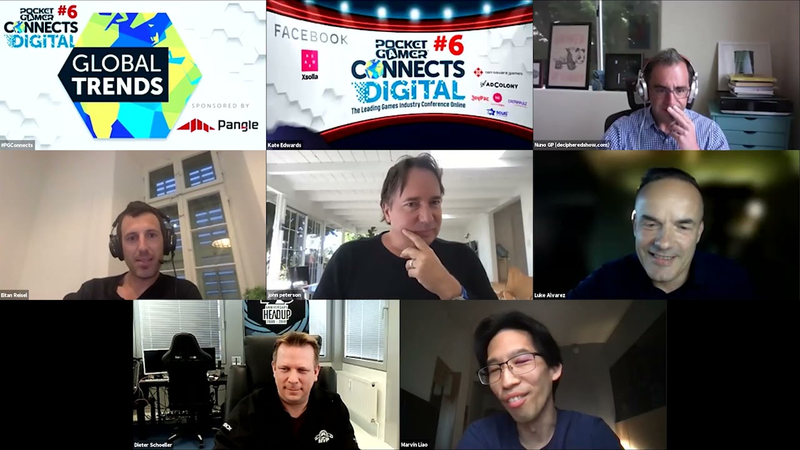
Panel: Are M&As the New Markers of Success?
Key insights
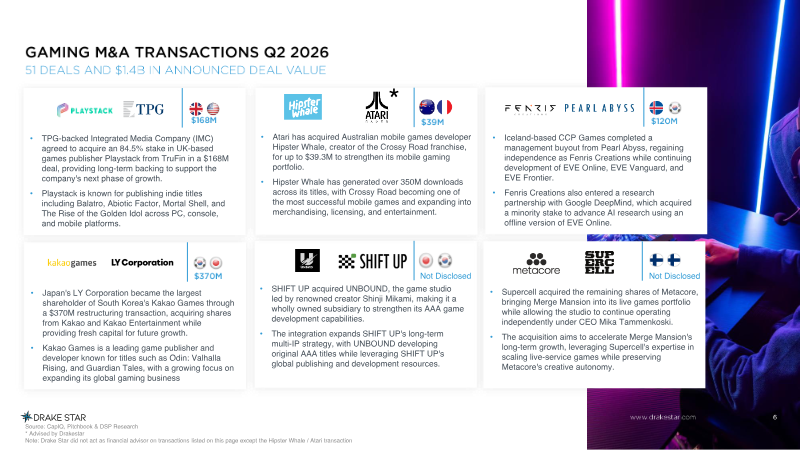
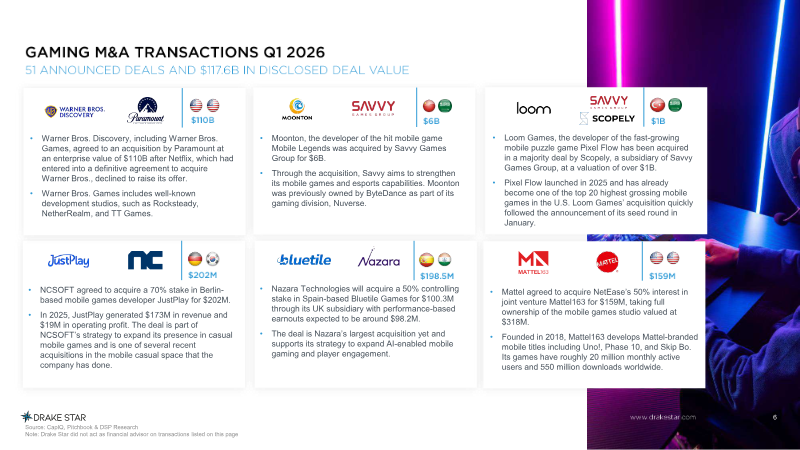
6 takeaways- 01The global gaming industry has reached a $200 billion valuation, driving intense consolidation as a primary mechanism for scaling.
- 02Early-stage studios are increasingly seeking acquisition to overcome the high barriers of global distribution, marketing, and live-operations infrastructure.
- 03Strategic partnerships between established publishers and specialized studios are being driven by non-overlapping growth across platforms rather than technological disruption.
- 04Investment strategies have shifted toward rigorous, data-driven evaluations that prioritize team experience, player retention metrics, and long-term market viability.
- 05The current market environment favors sellers, encouraging founders to proactively network to secure capital for sustainable expansion rather than relying solely on bootstrapping.
- 06Future industry growth will be anchored by the maturation of the creator economy, the expansion of subscription-based business models, and the development of AR/VR technologies.
Ask AI about this video
Transcript
last step in the global trends track we have a panel for you about our mergers and acquisitions the new markers of success and so to lead this panel is luke alvarez from hero capital as the moderator and i will let him go ahead and introduce the rest of the panelists great to be hosting this exciting panel i hope i'll become visible in a moment the video will start um there we go um okay and uh great to be um hosting this panel today uh with this uh auspicious and um distinguished group of colleagues um we're talking i i'll introduce my colleagues and myself and other introduce themselves in a second the topic of this session is global m
a in the games industry and more broadly the investment climate and trends and obviously as a as a as an industry we are privileged to be pretty much the most exciting industry of 2021 and and of the new economy um we closed out 2020 as a pretty much 200 billion dollar sector if you add ad mobile and pc console and ar vr and and and tech components all together probably much bigger if you include in-game advertising and and some of the esports trends um so we're the biggest single media sector we're growing at 20 plus a year we're completely global with three billion players and 2020 in 2021 when much of the global economy has been stalled or frozen was an unprecedented phase of m a intensity
and massive investments and we've seen big m a deals like microsoft and bethesda we've seen massive ipos like roadblocks um we've see and huge and so on and so forth we've seen huge private investment rounds as with epic and we've also seen unprecedented early stage venture investment and we've seen lots and lots and lots of publisher deals so it's a blazing hot exciting place to be around the table you've got a group of specialists representing all the different stakeholders really um we've got john from jam city who represents the publisher corner potential uh publisher deals and or acquirers of studios we've got dieter um whose studio has just been acquired um so he can give you perspective from the posses from that
from that point of view um we've got itan and nuno and myself who are all venture investors investing in early to growth stage video game studios and in some cases tech we're all coming from slightly different geographies um the west coast israel and europe london but all with a global remit and then we've got marvin who's a little bit of all of those things a sort of venture sort of um holding company sort of publisher so uh we hope to have a useful session today we'll discuss a lot of the different pros and cons of different funding routes what it's like being acquired what it's like being an acquirer what venture investors and others look for my background is as a tech entrepreneur and a games entrepreneur i started a small mobile casual game studio in 2001 that we ended up listing on london's a
market we then took it private we had venture and private equity investing and eventually we relisted as a social casino and games technology company on nasdaq in 2016 via a spark so i've made pretty much every mistake it is possible in building a games company and i'm now a venture investor at hero capital um my business partner is ian livingston who's the founder of games workshop and idos and more recently um was a board director at tonic games whom epic just acquired played emmick and is the chairman of sumo plc a big london listed games publisher so we focus on investing at a and b stages so 1 to 10 million tickets in early stage game studios um john why don't you introduce yourself yeah hi everybody excuse me i'm john peterson uh vice president of m a at jam city
uh jam city is based in culver city california uh los angeles essentially we have nine studios um across you know the world if you will and we are 750 plus employees um we're very aggressive on m a uh we love looking for amazing opportunities we've done a number of them throughout the years and excited excited to be here um thank you that's great and nuno a venture investor like in the same bit of geography as john ah so nun gosselshpider i've been in tech now for 25 years uh computer engineer by background product manager then uh growth operator around strategy corporate development business development i've done more m a deals than i can probably recall and then the last side going full buy side with uh venture capital
managing partner and founder of strive capital very much focused on consumer and consumer consumer-like investments companies like draftkings robin hood and others my first ever investment was in a company called symphony that ipo'd in the smaller side of the tokyo stock exchange the mother stock exchange as anish uh i'm a gamer myself and i'm based in the bay area we're about to launch our third fund which effectively will also lead to a new firm and new partnership so very excited about that and the name of the new firm i can't announce yet but it will be a very gaming-like name so it will be a really cool name excellent looking forward to hearing now uh dieter yeah hi i'm dieter been in the games industry 15 to 20 years depending on you count my quake career before that so i've built up a publishing slash development hybrid over the last 12 years on private level with private liability and local bank funds and we've been recently been acquired by the thunderf00t group which is
scandinavia based swedish-based and they basically did a 100 takeover and i'm now in the new role being the ceo of head up on one side but also head of publishing for the whole thunderbolt group and it's super exciting time because thunderful just did their ipo in december so things are moving pretty fast right now um so you can imagine it was a pretty fast acquisition happening but their ceo was a good friend of mine and it was a love marriage in the end that's great and we're going to get dieter to talk about some of the bear traps and things to avoid um and and things to look for in being acquired um later in the session um an italian uh venture investor in israel tell us a bit about what you focus on yeah so no no i have a name already combined with games it's free games i'm the founder and managing partner we're a games focused investment fund we only invest in studios any stage i always say i care about the
content about the team i less care about at what stage and on what platform so we do early stuff and later stuff our most recent investment was uh which we announced was candivore one of the fastest growing game companies out of israel um my background father of four that's probably the most important uh the most important part but i was at google for many years i let google's game team based out of tel aviv and also was part of the product team that built the universal app campaigns angel investor and then uh decided to formalize it into a fund just so i can write larger checks so uh yeah pretty happy and thanks for the opportunity great and marvin um california sitting in kiev yeah yeah i guess i'm the mongrel of the um of the group and so um i i represent game group so game groove is a family office slash holding company so we have several studios and we invest
off the balance sheet but we also i sit on both sides of the table so i do help them with corp dev and corporate strategy and marketing other things like that because my background so a 21-year vet in san francisco and tech and so my previous background you know did startups for a couple years i was the tech executive at yahoo for about a decade leading a lot of their global expansion and most recently was a partner 500 startups so i ran the san francisco office and the core accelerator program and fund three fund four so i left them end of 2019 and um was you know this this opportunity came about so i spent some time here between uh san francisco and kiev among other places so yeah that's my background so mommy i mean since we we're with you why don't why don't we stay with you for for uh for a bit and i mean talk about your two very different ends of the the globe but both with very high um tech skills and so on very different investment ecosystems talk a bit about what is what kind of what you see from the kind of studio
ecosystem and what what what what creators are looking for what is it like being a small studio i think many of the our audience will be early stage studios wondering what kind of routes to take yeah i mean i mean what's interesting is that you know if for anyone who's actually spending time in like the the central eastern european region there's actually quite a lot of like activity in the gaming studio you know sort of like because there's a lot of gamers out here right no surprise and there's a lot of very very proficient technical talent the issue out here just like whether it's sas or whether it's gaming there's just not a lot of investors unlike say for example in the us right southern california or northern california there's actually quite a lot i would say there's a lot more investors and a lot more the the ecosystem is just richer um so for example like when i talk to like gaming studios and things here in in this region one huge issue is actually like understanding like there's good gaming understanding and products whatnot but there's actually not really good this is just my opinion there's not
really great understanding of like distribution like marketing whatnot where that's not the issue in the u.s right like that you know i actually think the us is a little bit more balanced where you have a lot of very very good you know people really understand the gaming industry but people who also really really understand distribution right the marketing aspect and that's that's actually a huge gap and that's one of the reasons why you have a lot of small studios here because they actually cannot grow as a general observation i i mean i think i'd second that and i think uh what we think one of the confounding missions at hero capital is is trying to find great creative teams but maybe don't understand those pieces someone who's made a great gameplay loop kind of wrapping skills as well as money around them that can help them scale um so john i mean you're coming at it from the the publisher and acquirer perspective talk a little bit about what you look for in a studio and also about the current climate where obviously valuations are getting pretty go-go
um certainly in your part of the world and there's probably more competition for assets than there were than there was yeah um we're super excited about a number of opportunities out there i mean we we're looking at probably realistically 30 right now um 10 on a pretty short list but yeah we look for opportunities where and it adds to what we've created i mean we we know casual pretty darn well um so if it's if it's a studio such as um you can games bingo pop that we acquired a couple years back out of toronto that's something that we couldn't do ourselves um but you know with our 30 million mau that cross promote into a to a vertical that we'd never had before that's pretty exciting for us and we have a you know we've built a platform over the years where it's essentially plug and play ua marketing um you know
aibi we're super excited about you know offering that you know to our to our partners um that we find that that don't have the expertise that we can kind of give them um so give them tools that they can access that that uh should accelerate their growth um quite nicely so yeah and so we're we'll either look at studios generally studios that can do things that that we can't do and have something very exciting and we can immediately plug them in and accelerate them um no i think that's i think there's a theme in there that a lot of the logic for a strong creative studio for working with either a publisher and a publisher deal or being straight out acquired by someone like yourself is actually that they do have exactly the gaps that marvin was talking about they got a great gameplay loop but they don't have the ua
funnel or the live ops or peer matching or whatever it is um and it takes time and money to build that um so dieter you've just been acquired um i mean talk about i mean first of all why and the trade-offs and how you thought about that yeah i mean basically um i mean we've been growing quite well over the last years from on a private level but there's a certain level we cannot surpass by private liability i've got three kids so there's just a limit to what i'm willing to give up personally um and we had we had big titles like for example bridge construct with like 80 million players and all that um but i i felt that they i've hit a limit with the team and i would love to have a strong partner who can carry us forward and to unleash the the potential of the guys here and then basically the ceo of the thunderf00t group i've known for over a decade and he's a guy i always wanted to work with so they were building up heavy on development but their publishing site was kind of lacking
and as we've been publishing over 150 games over the last 10 years it was kind of a perfect fit from our both perspective so basically we started talking about that and we came to a scenario and then we they gave us an offer which was quite all right from my perspective for smaller company um and now i'm building up the publishing for the whole group which is super exciting for me so i mean driving 10 more years of a smaller indie company versus building up something sustainable on a larger scale with like a three digit million valuation on the market and so forth is it's going to be a good time good ride looking forward to it so um yep now and either it's good to see because sometimes you we have a couple of examples in our ecosystem of of um creators that sold out and then six months later you know their game was the biggest game of the year and they left you know you know tens or hundreds of millions on the table in terms of how they felt about it afterwards um but there's
the other side of that which is bootstrapping your own small publisher is extraordinarily painful and exhausting and anxious making um and getting a good result and then a real scale multiplier um going forward is is a huge out is a huge win um itam i mean you you focus on studios and and you you talked about investing from kind of very early stage to to growth stage i mean when you're looking at a an early stage studio and it's and he's exactly lacking that kind of scale back end and live ops and all that infrastructure how do you think about that as a venture investor and we struggle with that a lot you know uh for the same reason uh how do you think about that we should share notes so it depends really when at what stage the company is right so if it's really a precede that you know they only have a concept in mind but they don't even have a title we can look
at initial metrics which always something that we would love to see right initial metrics gives you an indication but we'll actually analyze two things one always the team and when i say the team just to double click on that i think the fact that folks worked in these large companies is is creditable and you know we respect that but for me the most important thing is that they at least launch one game to the world doesn't even matter if they failed or succeeded with that title but i think the process of taking something from scratch to something has a lot i mean the second we do a lot of analysis on the category so to understand the potential how much daily revenue we think they can drive after several you know years etc so it's the diversity of the team you know their backgrounds um and of course you know that we believe that the game that they're building in the category that they're building still one has room for new for new games and two um and two there's potential to become a
big you know big title the second thing i'd say if it's more mature we really only care for retention uh our philosophy is that if the numbers make sense we'll be able to monetize you know the long-term retention of course is key and it's hard to ask for that as investors because early days to ask for retention you need a lot of patience and time and and you do need money today the world has become more and more expensive on the marketing and acquisition side of things um but you know but it's something that gives us more confidence and you know then we'll be able also to put larger checks and and pray you know pay higher as well so it really depends on where the team is and what stage they are and what life cycle and what their backgrounds are to really define on our investment strategy that makes sense and nuno i mean you're going to be launching the new fund any minute i mean insofar as you're focusing on
studios what are you looking for and how do you think about the great opportunities yeah i mean we've talked about the tale of two worlds right uh later stage mid-stage scale matters is a tremendous amount i would say the craft of how you tweak your attention engagement in some ways in gaming growth hacking is important but the retention engagement hacking piece as i would call it is even more vital and you can see it actually pretty early on right even if you're running a beta trial or if you've just launched in one market like new zealand or philippines or something else you can see the numbers sort of emerging early on um so the scale piece we sort of take to the side for a second because that will only come much later and who knows and we focus a lot more on the craft side so we focus a lot more on the retention engagement piece and we focus a lot more on whether the team is not only very creative because i think there's a lot of dynamics around the industry of saying in early stage investing it's all about the people and the team and what they're doing
whether they've done before or not but there's a lot of things you can observe for do they have game design experience do they have again retention engagement jobs do they have product management skills that are at scale etc etc and we spent a lot of time on that so we spend a lot of time really analyzing the team at the level of fact-based analysis that i think goes a little bit beyond just we we met for coffee or we met for virtual coffee these days etc the second piece is in early stage investing historically there's been a little bit of what i would call dissing of market analysis in market scanning uh you know obviously everyone does competitive analysis and everyone looks at the market etc but it's almost like oh no no the market doesn't matter as much well the market matters a tremendous amount right and right now we're in the middle of what i would call a perfect storm which has sort of raised all boats to the top but covid the post covert thing we don't really know we don't really know which habits will stick or not i mean pc gaming was sort of meh before covet now pc gaming is hot again right and you
know we've seen a lot of these dynamics right you know advertising at the beginning of covet went down and then it came back up right ecpms went back up again so in some ways i think one of the difficult or most difficult tasks that we have as investors and i think it's true of m a um and and deal makers as well is is this here to stay and how do we take away the fact that there is a covet effect in the current numbers and everyone's being pushed to the top right so in some ways how do we de-risk certain investments and make sure that these things will withstand the test of time going forward so again we spend a lot of time uh with a very fact-based analysis of teams but we also spend a lot of time doing market analysis looking at specific sub uh areas of gaming like you know not just broadly casual in mid core but within mid core where does this fit is there space is this sort of a a red ocean space is this a blue ocean space you know where does it fit so we do actually quite do quite a lot of
market analysis as well that's that's great that's great and i mean i i think a big a big question for for creators and studios is well you know who of these different types of people on this call should i be talking to i should probably talk to dieter because he's got relevant experience and he can tell me tell me some things to do and things to avoid but should i be talking to an acquirer like john or a publisher should i be talking to a kind of emerging consolidator um that like what marvin's maybe building should i be talking to these venture guys you know at the their different stages and and geographies and so on so i mean i turn do you wanna i mean when do you think it's right for a studio to be talking to venture where do you think it's right to be talking to a publisher actually i think it's a great question and i don't know if there's a right or wrong answer here right i think a lot
has to do with the ambition of the founders and where they're looking in terms of taking their company if they want to self-publish if they want to have those capabilities in-house if they're able to raise enough funding or get enough debt to do so um i think it really you know defines if you look on more the casual space i think like at least not the hyper casual but the more casual to mid core we see more and more independent studios that start you know it's easier maybe faster to test and then to see you know where the game is going in terms of opportunity and if you're hitting the right roi numbers then you can probably approach vc's or alternative funding you know and grow if the title itself needs much more capital to build um and that's i think also in specific regions in the world i think publishers are more common and if we take the indie landscape then publisher is super common and it's really i think less relevant for vcs so the outcome you know and the multipliers
we're going to be looking for maybe a conflict with the studio so i really think that you know when we we get endless amount of opportunities and not all of them are suitable but not because they're not funding it's because i don't think the outcome will be aligned and it's still you can build a very valid business without building up you know unicorn next game publishers so it really has to do with the founders sentiment and the team capabilities and really really what category you're building in a game and that's also an important factor to uh to put into that equation i would wholly agree with those things and i and i do think there's a stage thing that often the publisher partnerships not the m a piece makes quite a lot of sense earlier in the cycle and then if things are going well and and you have the ambition and the type of game and team that can fail to something huge then it makes sense to talk to venture and eventually we're going to be interested in talking to you if it's something that can go go very big but the geography's
particular publisher relationships also really matter in particular asia and so on yeah so look i just i just wanted to add i think this is an industry where you should be talking to everyone all the time it's it's one of the few industries where that's actually holds true right we i invest for example a lot on bottom up software as a service you don't need to be talking to everyone all the time and there is a time for you to talk to venture capital versus talking to you know angels versus talking to potential partners and direct channels etc this is an industry where you have gaming founders that do angel checks to new independent studios quite often it's almost like a check of validation so it happens a lot you have discussions very early on with corporate development teams sometimes because of what you're saying because there is publisher relationships that emanate from that as well um talking to venture i think you should do in any case you know maybe not very very soon you know when you're just bootstrapped and you're just coming up with a concept and and doing your your your private betas maybe it doesn't make sense to be
talking to venture but as soon as sort of you're ready to go to market it makes sense also to talk to so i think it's actually an industry where talking to several different sources of funding normally doesn't hurt tremendously and and doing it early on actually doesn't hurt tremendously either i do think capital has become pretty much king in in gaming it is a mainstream industry we always forget about that we always think we're special because we're gamers and we're in the space but it's now so massive um that you do need the capital uh to to scale and so getting funded matters i would say sooner rather than later versus like five years back or something like that right that makes no sense dieter capital is king expect i might hear from you content is king but how do you feel about no i mean there's a reason for our acquisition because capital is king i mean that's so much you can do from from your own private level for me it's weird because i'm sitting between all these chairs i've been looking at publisher pitches all the
time because all the studios came to us i was very active on the indie scene uh and now i'm being part of of a bigger group i'm looking also along along the lines into acquiring studios um so it's super interesting i think the first tip i would give any smaller startup or is basically first check if it's the sellers or buyers market right now uh and right now it's definitely a seller's market so it's a good time um and also decide on on where you want to end up i mean some people are super happy driving indie business it's just a matter of where your vision is because our vision was always okay stay small stay totally independent but that changes over time and um i fully agree with nuno talk to everybody that's a small industry i mean if we take the whole industry in germany it's maybe 13 000 people which is i think less than the smallest delivery service for car uh manufacturing so everybody knows everybody and on a global scale it's not that much different and what i found out by our industries about 99 are nice people who will help
you independent from which level you're on even if you're just starting up um like people like ed freeze will still give you their advice um and be happy to do so so it's a very friendly environment to to gain knowledge and i think that's the most important thing to for startup startups as well just to network i think ed freeze must be one of the best connected people in the industry because that's one of the nicest ways absolutely absolutely he's a rock star yeah marvin i mean you're struggling all these positions i mean you know i'm i'll be honest like i'm relatively new to gaming right i actually come from more of like the media and sort of like the sas background so i've only been gaming i've been looking at the space for the last like three years and really came into it only last year but what that is an observation the thing that's actually super unique and i i completely agree with sort of all the comments have been made in general like it's a very nice industry if you're a gamer gamers want to talk to other gamers in general and they want to be helpful to other gamers um and and one thing i should add just as unique about the gaming industry as an observation
so for example like you know when you see these big changes say from like say mainframes to microcomputers to um you know like to pc to mobile phones there's actually the the incumbents get crushed by the new players right there's always new players arising this actually doesn't happen in gaming right if you think about the arcade game it's pretty much the same continue to grow pc gaming has continued to grow new winners right mobile phone game you know mobile you know sort of players on the mobile game the console all those areas they don't catalyze each other in general right like actually cannibalize other industries and so it is really one of the very few industries where sort of like it's not a winner take all and so that's one of the reasons i think everyone's just so open to sort of helping each other and talking to each other and that's why you should talk to everybody right and i i sit one side i talk to investors because i'm looking to spin out some of my studios and raise money for some of my studios i'm talking to other studios and certain sas related gaming ip and things and um because we're looking to probably invest
off our balance sheet so i do both right and so you just never know you just never know now and i think that observation i mean there's a famous chart that i'm sure we're all familiar with that compares the impact of new technology on the music industry revenues over 50 years since eight track um and you see the you know vinyl and then cd cassette and cds and mp3 and streaming and basically each new you get a peek around cd and then everything craters for a long time and all the new tech and the internet destroys revenues and they're just beginning to pick up with streaming again but from a much lower base whereas obviously you do the same chart for games and you go arcades and console exactly as you were saying and now vr and are on top of mobile and and so on and it's just an ever upward trend so that probably does allow people to be generally friendlier because we're all trying to eat each other's
lunch games it's even more it's even more severe than that luke right sorry to interrupt you but it's more severe than that because for some reason gaming companies seem to come up with innovations that have very little to do with gaming either you know app annie which i'm an investor uh came out of a gaming company slack came out of a gaming company discord came out of a gaming company so it's it's like the most it's interesting because it's actually a truly innovative industry i was like oh but you guys only do games right it's like not really we're changing a bunch of other stuff as well along the way absolutely i mean nvidia can't start as a you know gaming graphics chips and exactly machine learning tech company in the world um so john i mean what are you looking for what what if somebody comes to you what's the perfect story what are you what are you out there you may find some some emails into your inbox after this well i-10 congratulations on candyvore um that's a fantastic opportunity right there um that uh we're excited we're still
excited about that i mean that's amazing um what what they've done in such a short period of time with matchmakers is great so yeah we're looking for companies that are that have something but don't have the expertise on ua don't have the expertise in marketing don't have the capital uh to accelerate um that need our help that you know maybe they've made a game or two in the in the past that haven't been that successful and they have something that's that's showing you know decent kpis initially but um you know we've we've kind of been around the block a few times and you know we've we know what's when stuff happens it's okay and we can help those teams out um and yeah but i think as far as you know what we look with probably not super seasoned uh companies that have been around four or five years and
you know the peaks of the world um that's probably not where we want to the sandbox we want to play in um the companies that are a little bit smaller than that that that really need our expertise and um whether it's ua whether it's marketing whether it's consumer insights um where we can truly uh help them help them grow that's great that's great so look we've got five minutes left um just to repeat um our uh our moderators invites um you can put questions in the q a um or indeed the chat we'll we'll see them either way um but in the last few minutes i mean it'd be great i think if we just went around the table and heard some predictions so what are we feeling big predictions couple of big predictions for the next pick your time period year or decade for the games industry um marvin
that's a that's a tough question i i think you're going to see an acceleration of of m a in general the big get bigger um partly due to several reasons of just sort of like a lot of i think a lot of studios need to be more more sort of building up their portfolios for for either sort of to position themselves for cross sort of like platform um or just sort of like just i just think you're gonna see some consolidation right like i'll give you example like lines you know line studio part of like app loving they just went public um they're saving a lot of money um and they have a customer acquisition machine that works really well that you just need to continue to feed right in the sense of sort of push stuff down the pike so like there's gonna be a lot of that you're gonna see a ton more sort of like ipos and things because of spax for better for worse and so i think it's going to be pretty frenzied for the next two or three years in this space fully agree fully agree and i think that's good and bad for all of us i mean bad on in valuations for the investors on the call
um good for the industry as a whole and good for the general frame rate and cycle speed of everything we're doing i mean our industry is just going faster itan yeah i totally agree and even to build on uh john's last point i think you know the fact that now there are going to be much more game public companies or game related public companies you know and at the end of the day public companies have to show growth year after year working at google's eight years you know and then that's close to my heart quarter after quarter forget about year after year i think we are going to see more and more m a's you know on on larger prices and companies are more mature and i totally agree that we i do think we're going to see also consolidation between the public but as john mentioned i also think we're going to see earlier acquisitions as well of talented teams that came out with titles that are pretty you know early days but you understand the potential of them
and you know if if companies that acquire or don't have the capabilities of doing the billion dollar deals but have the understanding of the potential i think we're going to see earlier stuff still on good returns for the founders and for the investors so i do think the landscape is going to be you know it's going to be a good a good founder ecosystem landscape and that's great because that means that we're going to have more and more um founders come out of more mature companies or folks coming into the industry from other industries or related industries and building game companies and you know and it's i'm happy like look on this call we have three dedicated game funds there are many more and i hear many more coming and and i think it's it's justified it's uh you know the ecosystem is growing and we should make sure that there's capital to support it on the early stages of absolutely absolutely no no for me there's two sort of big uh trends that i uh would anticipate or
at least i have an hypothesis on the short term in the long term the short term i think the next one to two years massive consolidation will continue happening everything that everyone's talking about you know there's so much cash you know public gaming companies are doing so well that they can throw it around try different experiments you know go into corporate venture capital do early stage investing do acqui hires do bigger business acquisitions the big tech companies acquiring pieces of the puzzle and acquiring very strong supportive tools to the industry as well so i think we're going to continue saying that and but i do think there is a bubble i do think there is a public market bubble i think the game of the chairs will stop at some point my best guess it's probably not going to be this year because we're still coming out of kova there's a general optimism with vaccination and all the stuff people are still spending a lot of time at home but you know maybe next year there will be some burst in this bubble and then for me it's the really cool part it's the three five years
five to ten years which is really my cycle your cycle luke and your cycle a ton of investment right and i think we're going to just see tremendous innovation we're going to see innovation in game design that we can't really anticipate today we're going to see innovation in form factors and input and output ar and vr we've been talking about it for a decade now but i think will come of age in the next five to ten years you know that's my big bet and my big disruption and and so and so i think that's going to be the next big disruption it shifts totally the game design piece it shifts totally how we do things there's already some existing players in the market that might actually be brought to the top because of that so for me there's a couple of really big trends in the short and long term that's great john indeed john yeah so uh i i really think that there's an amazing amount of what with the consolidation that's going on out there there's there's incredible teams um sub teams if you will so you have your
founders that are getting all the money not all the money but the majority of it and then you have the teams underneath that might not want to stick around for the urn out and they'll spin out and you're just going to have incredible incredible opportunities um of look at peak for example i mean they got they got two spin-outs right now um that that's i think it's gonna happen um across the globe and it's gonna be amazing opportunities within the next next few years and data i think there's never been a better time to get into games it's basically the best industry right now because you have all these levels of funding and all these possibilities so if i look at for example in germany we now have a 50 million euro fund which basically matches your money invested so you can maybe produce a half of the price um i see so many new forms of of funding methods despite publishers or vc or equity you see publishers spinning off third-party publishing developers
opening like sumo opening their own third publishing third party publishing part and then we have all you guys we have people like kaulu knights and blah blah there's just so much going on and there's so much capital in the market so if you're a smart guy right now it's a very very nice industry to get into um but i do think that experience will will rise to the top so you will have spin-offs for bigger studios a lot of failures in the beginning which is always a shame but it's kind of how the market works and i think call it consolidation will be a big thing moving forward and also i think the market is moving towards subscription which i'm super interested in uh to see where that is going um in terms of will it kill free to play or what exactly will come out of it and china is a black box for me still um because if that turns or opens up at some point who knows it's going to be very different again for the western hemisphere so everything is in motion but it's it's positive motion so i think it's a good time to be in the games i fully agreed fully agree and i think we're in an incredibly privileged position of you know there is
this astounding ecosystem of three billion handsets and pcs and consoles growing every year new emerging markets coming on stream all the time new demographics coming on stream all the time the cloud infrastructure and all of that i mean hero capital is a name check to neil stephenson's snow crash the lead character is called hero and you know we think games are the big next computing platform you know it's going to emerge in these game eco systems that all these different companies that are listing and we're investing in are building it's an amazing time i think we've got at least a decade of mega growth ahead of us and and it's the creator economy if you're making great games there are all these different ways to market so creators come and talk to all the different people here um we've all got different spins on this and different incentives but we're all passionate about the sector
and hopefully that's been a useful session kate i think you're about to tell us we're out of time yes usually when i appear that's generally what it means um but yeah it's great i mean and if i think if anyone has any questions for you they can catch you on discord or they know how to find you guys um so i encourage people to do that so thank you all that was a great panel super insightful thanks everybody thanks for having me all right thanks for having us bye guys
Summary
The global gaming industry is currently undergoing a period of intense consolidation, fueled by a sector valuation reaching $200 billion and consistent annual growth. This surge in merger and acquisition activity serves as a primary mechanism for scaling, as early-stage studios increasingly struggle to navigate the complexities of global distribution, marketing, and live-operations infrastructure. Rather than viewing new technology as a disruptive force that cannibalizes existing revenue, the industry benefits from non-overlapping growth across platforms, which encourages strategic partnerships between established publishers and creative studios possessing specialized technical or genre-specific expertise.
Investment strategies are shifting toward a rigorous, data-driven evaluation of studio potential, with a heavy emphasis on team experience, player retention metrics, and long-term market viability. While bootstrapping remains a viable path for maintaining creative independence, the current market environment heavily favors sellers, prompting founders to engage in proactive networking to secure the capital necessary for sustainable expansion. The decision to pursue acquisition or venture funding is increasingly viewed as a strategic choice dictated by a founder’s long-term vision and the specific scaling requirements of their game category.
Looking ahead, the industry is poised for sustained expansion as capital remains abundant and public gaming companies continue to integrate smaller, agile studios into their ecosystems. Future innovation will likely be anchored by the maturation of the creator economy, the proliferation of subscription-based business models, and the ongoing development of augmented and virtual reality technologies. As these trends converge, the industry is expected to maintain its trajectory of rapid growth, with M&A activity serving as a foundational pillar for both technical advancement and market reach over the coming years.















Comments