1 free read left. Create a free account for unlimited reading + AI research.
Create free account
Organic high-value user acquisition
Key insights
7 takeaways- 01These findings are based on T-SQL analysis of approximately 700,000 games and apps from the Amazon Appstore, supplemented by benchmarks from Newzoo and Kongregate.
- 02Power users constitute less than 0.1% of the total player base but generate a disproportionate share of revenue, frequently spending over $200 per month.
- 03High-value users typically concentrate their spending within only two specific game titles, demonstrating extreme loyalty rather than broad-market engagement.
- 04Standard metrics like Average Revenue Per Paying User (ARPPU) are misleading due to power-law revenue distribution; analytics must be segmented to track power users independently.
- 05Developers should shift monetization strategies away from addictive mechanics toward identity and social status, offering elite items that allow players to signal achievement.
- 06In-app purchase catalogs should be dynamic, as power users show a significantly higher propensity to spend after 30 days of engagement.
- 07To avoid decision paralysis, developers should limit IAP catalogs to a small number of distinct, high-value tiers rather than offering numerous closely spaced price points.
Ask AI about this video
Transcript
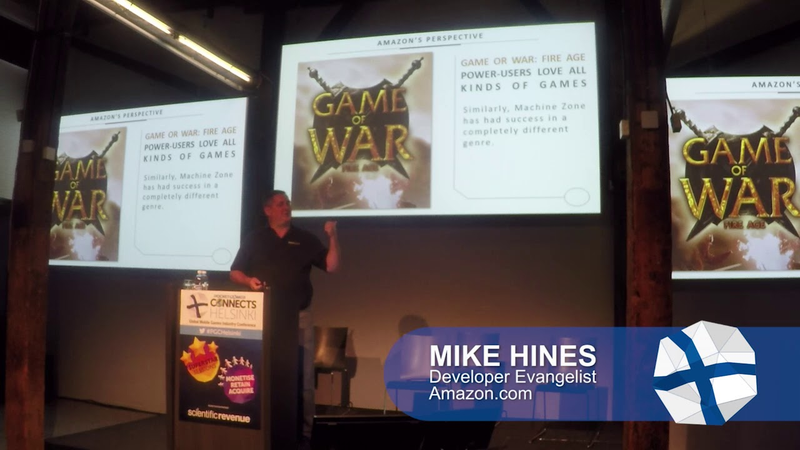
[Music] [Music] thank you guys so the next guy probably doesn't need an instruction cuz he's already kind of opened his mouth a few times and probably as many if not more shows than I do Mike from Amazon is gonna tell us all about optimizing height value how can you high-five your users users that you acquire and retain those customers that will spend an enormous amount of money in your game well thank you very much for coming to listen about that as Oscar said I am my kinds I'm a developer evangelist from Amazon which is a great job I basically have T sequel access into our database of about 700,000 games and apps and I get to go
around the world telling rooms full of developers what is and isn't working for the games in our store today I'm going to tell you about what we found that is working really well to attract and retain high-value users now we do have a fair amount of knowledge about what makes a high-value user and the Amazon Appstore a larger percentage of our customers will spend money on a game than in the other app source and when they do spend money they tend to spend a larger amount of money which means we have a higher average revenue per paying user than the other app stores do and this gives us a lot of insight into how big you spenders actually behave inside our game now power users they're not new they're not unique to gaming industry I mean they've been around for a long time and one of the biggest places that has done research on power users is the casino industry and the casino industry went and gave names to different cohorts
of spenders the most of the people who kind of walk into the casinos and play the slot machines they got called minnows the 50th percentile sort of the median they got called dolphins and then of course everyone's heard the term whales whales is that small percentage of players and a casino or players in our game that actually generate and the large amount of revenue and that's what we're going to talk about are those power users now the numbers are a little bit different but for the most part they shake out to about the same for example new zoo says that about three and a half percent of their us mobile gaming customers will generate 33% of the sales similarly Google says one percent of its us customers generate 14% of monthly sales and my favorite date is from congregate where they say that one tenth of one percent of their US customers will generate over half of all of the
revenue so yes these power users are small but they have a huge impact on the revenue they can drive in your game for the purpose of today's conversation we're gonna say that roughly a power user is roughly that one percent of paying users okay paying users remember paying users are about two to three percent of the users in your game so we're talking 1% of that population so less than 1/10 of 1% of your entire user population is going to be power users now what is Amazon's perspective on power users first of all we want to call them power users not Wales Wales well it's it's pejorative isn't it I mean what do you do with a whale you chase it with a ship you throw a harpoon at it you haul it onboard you skin it for everything it's worth and you throw the pile of bones back in the ocean really is that how we want to treat our best customers no actually it's not how we
want to treat our best customers and when we think about how we want to treat our best customers that also leads into things like well monetization mechanics like Skinner boxes and gotchas so yes you can make a lot of money with Skinner boxes and gotchas but Nicholas Lovell in the book he wrote called the curve actually talks about two distinctly different ways of generating revenue from all of your customers Warren is really kind of a highroad it's generating revenue because people love the experience that they get from your game when they play your game they want more of this experience and they're willingly going in for repeated sessions over a long time and they're spending money to get these things that they enjoy the second technique that Louisville identified was more of an addictive behavior it's sort of I don't really want to go in and spend the money
but I feel compelled to I don't want that next cigarette I'm trying to quit but I feel compelled to smoke and this approach to Skinner boxes and gotchas is what got a gotcha mechanic banned in Japan so think really carefully about how you want to manipulate those economics and those that sense of addiction yeah we know how we've got the psychology we know how to do this but is that really the right thing to do for the long-term health of your business and for the long-term health of your customers so actually a little bit more about what power users look like to Amazon for us we say you have to spend at least $50 a month or more to even qualify in our data set of power users on average however they spend about $200 a month or more they are concentrated in the US UK Japan and Germany and or how do they behave well a majority of these
power users don't spread the money around evenly most of them actually spend their money in just two games so they find a couple games they love and then they take their game spending budget and they spend it decidedly on those two games and that's really important because that's are they a focused loyalty that you can tap into what kind of games do they play well conventional wisdom used to say that you had to have an MMO a massive multi-user online game to generate the kind of experiences that would get that kind of money from players well King changed that when they released candy crush and then the conventional wisdom became you needed an mmm or a really popular casual game in order to make a lot of money but then you know machine zone came out with game before it's not really a casual game it's not really an MMO but they certainly had a lot of power users so I'll tell you what we're gonna base what we're telling you on actual data
that we pull out we'll we'll pull it on data wisdom not conventional wisdom and what we found is that any game genre can have a lot of power users because what power users are gonna do is they're gonna spend money based on what draws them based on what they really care about one of the things that I would like you to care about when thinking about power users is how this affects different aspects of how you work with your game and how you measure your game for example some of the measurements that we use pretty commonly may be incomplete or maybe not work as as well as we think for example I think everyone uses ARPU average revenue per paying user to measure success of their game averages are wonderful okay averages are wonderful when you have a normal shape distribution curve like the number of petals on a daisy or the number of rainy days and Seattle I'm afraid those all work out really well for normal
distributions but when you take a look at the revenue graph of your game I'll betcha it looks a lot more like this power law graph than it does in normal distribution and what do you think that this does for averages well an average here is functionally useless really it doesn't really represent any individual player you've got two distinct cohorts of players here the one on the left this really tiny thin sliver of power users that are generating a ton of revenue for you and then there's everyone else and they need to be measured separately you need to understand how they behave separately and one of the reasons I want you to think about that is because if you're looking at your game and you find that there is a feature in your game that maybe only 2% of your players are using you know heck that'd be a really good candidate for getting rid of in the next version because who wants to support a
feature that only 1% of the players are using right well okay unless it's that one percent on the left then that's a really important feature you don't want to leave behind but how are you going to know unless you actually measure those cohorts differently and measure what they do differently imagine if you can find a set of interactions that all of your power users are engaging in to generate a ton of money but that the rest of your population really isn't catching on to what if you could steer some of the rest of your population into those mechanics or behaviors that really seem to catch people's attention and engage them in a state of flow or engage them in a state where they absolutely love the game and that set of mechanics that you're playing so I want you to measure your power users too differently and when you're taking a look at the things that they engage with and love remember it's all about emotion any game mechanic out there can drive power users
so there's no one game mechanic that is a magic Silver Bullet okay yeah we were looking for that we pulled the data we were hoping to find the magic game mechanic for power users it doesn't exist but actually that's kind of good news for all of us because any of us can actually have a lot of power users in our game what we did find was consistent with all of our power users was that they attached to the game on some Maslow's hierarchy of needs level and that was really important because they identified with something in that game that meant something to them and that's where we got a lot of traction for example what they spend money on says a lot about them as as a consumer I'm from Seattle and you'll see a whole bunch of 2014 American football Super Bowl t-shirts in Seattle and it's not because we don't remember
who won the Super Bowl in 2014 no we remember who won the Super Bowl but we want to show that we're identified with that crowd that we identify with these people and we're willing to spend money so that we can identify with that group of people the same thing works in games and game bill found this out with critique ax the white knights as well as other games where now you can have skins that help you identify with maybe a certain clan or a certain group that help your character stand out be recognized and this is a pretty important emotional attachment particularly when you think about the two kinds of groups that people want to associate with now your regular users probably aren't going to you leverage this mechanic all that much because really you didn't follow the Grateful Dead on tour if you thought Jerry Garcia's hair looked nice no you followed him around because you absolutely loved the band and you loved the group and you liked being associated with the band Grateful Dead similarly
you might want to identify with something that goes big and represents something larger or a small elite of commandos now this is a fascinating story I talked to a game developer who started introducing some very specialized kit that was horrendously expensive $99 for some of this kit but what happened was the super elite squads in his game all bought this expensive kit and now people who wanted to be associated with that squad even if they weren't members of that squad they started buying that kit for $99 because they wanted to be associated with that that's pretty powerful and that ended up working out pretty well for him he ended up going to getting a lot more thousand dollar a week spenders as a result of that one of the next common things that we found is that power users like to be
recognized for the things that they accomplished and do well of my favorite implementations of kind of a leaderboard and achievement doesn't even come from games though it comes from TripAdvisor did you guys know that I'm like the number three fast food restaurant reviewer in my small city of Sammamish and if I just do two more reviews I'm gonna be number one and then I'll be like number what 24 in Seattle and I'll have to do seven more reviews right but here's the deal with TripAdvisor being number one is always a very reasonable amount of effort away and that's cool cuz I love being number one I bet you y'all like being number one - it's a good thing to be recognized for what you're good at think about your game what can you recognize players for in your game that will be really advantageous to them and you like only just one more boss and I'm number one in my particular area or if I
have this particular skill and the number one skill at this particular level or there's got to be a way that you can slice the data in your game to make the step to the next level very real very approachable and that's a wonderful feeling going achieving that and then hitting that mark and then having another reasonable goal set if you tell your player that they're number one hundred and twenty million in the in the game I mean really where's the motivation and being a hundred and twenty millions not really there so think about how you implement that in your game so one of the things that you know better than anybody else does is why people should love your game you know why you love your game right well okay I'm assuming you showed you guys wrote it right so you know what it is in your game that's really that amazingly cool mechanic or that amazingly cool meta game that really gets people engaged promote that find out how to get people
into that and then measure that against the power users that you do have in your game figure out how to promote that mechanic if it's the one that power users are attaching to if power users are attaching to something that you didn't think was really popular in your game figure out what it is and how you can kind of move people into that new mechanic so there are a handful of things that you can do even after your game has been built that you can do to kind of encourage these power users to stick around and encourage more so before your game is released first I want you to foster early engagement getaway for players to actually engage with the game get feedback from the game get on leaderboards and achievements when they're in a state of flow when they're really focused and that thing that they love don't interrupt them with with device messages or with IEP dialogues or with ads that's absolutely the wrong time to interrupt the power user make sure that you can do a good
job of keeping them in the app and get them to come back for multiple sessions and really important they don't want you to overlook having really good server-side accounts because the power users that we looked at are the people who have more than one device they will play your game on more than one form factor and if you have to start over from level one because you switch devices what's the chance that that power you just got to play your game as many times as they want to well pretty low actually so during your game there are a couple things that they can do to engage as well make sure you have ia P items that help them express themselves that really expensive kit that lets them become part of a faction or that skin that lets them be part of something larger make sure that you have a way for them to buy and customize a character like by special abilities or allocate points to generate something that's uniquely theirs that they can be proud of have a way that they can complete collections now be careful about abusing gotchas and loot boxes but
still it doesn't mean that you can't have a collection mechanic is a very viable honest way of making good money in your game besides people love completing collections so give them an opportunity to do that and this is also super important price distribution how many of you were here for Bill's talk not that long ago any of you we're here for Bill's talk okay y'all got a look at Bill slides they're brilliant but one of the things that we're looking at is how we distribute price among our I ap catalog what we found is that most of us do this we have 31% of our catalog at the low price end where we generate 14 percent of our revenue but take a look at the last two price points $49.99 dollars we're only putting 4% of our catalog out there and yet we're getting 20% of our revenue from where we have such a small percentage of our catalog the games that are doing really well monetizing power users have a much better price
distribution than the rest of us do so we should really think about how we leverage that all right after you your game is launched I need you to be able to grow with your power users what does that mean I need you to understand the price sensitivity of your catalog and the study that we did we found that after someone has been playing your game for 30 days power users are gonna be there trust me people will pay 60% more for it in app purchase item than they did on day 0 think about what you're showing your customers after they've been in the game for 30 days is it the same set of IP catalogue items you showed them on day 0 have you been training them that the catalog doesn't change every time they look at it why would a power user come back and look at it again if he knows it's just going to be the same old stuff and if he's willing to spend 60% more well that explains why the top games we looked at
I had 60% more expensive items after 30 days and they did at day 0 your catalog means to grow dynamically with your user base know who's looking at your catalog adjust your catalogue items accordingly and that's where expanding your catalog and keeping it fresh is going to come in when we looked at the data we found that the more items you had in your IP catalog the more average revenue per paying user you were able to make now this doesn't mean showing everything at once it doesn't mean that if you had 1 to 5 items if you just quick show people 15 items you'll make a lot more money what I want you to learn from this data that we pulled is they're still showing only four or five things at any given time to a customer but the depth of their catalog means they can show a different four or five things to customers all right limit your price points while variety is
good for catalog variety is terrible for price points as a matter of fact the more price points you had the less money you made why because what's the difference between a 99-cent sword and a $1.99 cent sword it's really hard for customers to differentiate the value of closely-spaced things and like bill said earlier if you make your customer think they're gonna go play Angry Birds so really fewer price points set farther apart was far more valuable than a whole bunch of price points close together alright and lastly I want you to treat all of your customers really well now what are the takeaways from this first of all the good stuff power users are gonna drive today's revenue and because of what you learn from what their behavior is you can focus your non power users towards those behaviors and drive tomorrow's revenue any user can become a power user and they're driven by what they love please don't try to drive them by compulsion drive them by passion now
there is hard work that goes with this as well you need to plan for them including measuring your power users separately from how you measure everyone else that's really important if you want to get the benefit from understanding how your power users operate I want you to support their emotional choices with your IEP catalog given the things we talked about earlier and I want to make sure that you grow with them and the amount of money that you charge them grows exponentially with their commitment and engagement in your game that way you'll not only help get more power users you'll retain them and make them happier as well guys we've talked about a lot of things these slides will be available online and of course you can always reach out to me I'd love to keep the conversation going as we move forward thank you very much for your time today thank you Mike [Music]
[Music]
Summary
This analysis examines strategies for identifying, acquiring, and retaining high-value users—often referred to as power users—within the mobile gaming industry. Drawing on extensive database insights from the Amazon Appstore, the findings emphasize that while power users represent a tiny fraction of the total player base—typically less than 0.1%—they are responsible for a disproportionate share of total revenue. Unlike casual players, these individuals often spend upwards of $200 per month and exhibit high levels of loyalty, frequently concentrating their spending within only two specific titles.
The core thesis posits that sustainable monetization should be driven by player passion and emotional connection rather than addictive mechanics like Skinner boxes or predatory gacha systems. Power users are motivated by identity, social status, and achievement. Developers can effectively engage this cohort by offering high-end, specialized items that allow players to signal membership in elite groups or display unique accomplishments. Furthermore, the data suggests that standard metrics like Average Revenue Per Paying User (ARPPU) are often misleading due to the power-law distribution of revenue. Developers are encouraged to segment their analytics to measure power users separately, ensuring that features favored by this group are not prematurely removed based on low overall adoption rates.
Methodologically, the insights are derived from T-SQL analysis of approximately 700,000 games and apps, supplemented by industry benchmarks from sources like Newzoo and Kongregate. Key operational recommendations include maintaining dynamic in-app purchase (IAP) catalogs that evolve alongside player tenure, as power users demonstrate a willingness to pay significantly more for items after 30 days of engagement. Additionally, developers should avoid cluttering catalogs with too many closely spaced price points, which can cause decision paralysis, and instead focus on a smaller number of distinct, high-value tiers that reward long-term commitment.














Comments