VideoTwo & a Half Gamers
🧠 MVP UA template: How to set up your Google Ads campaigns for Success by Matej Lancaric
7 Jan 202620 min video
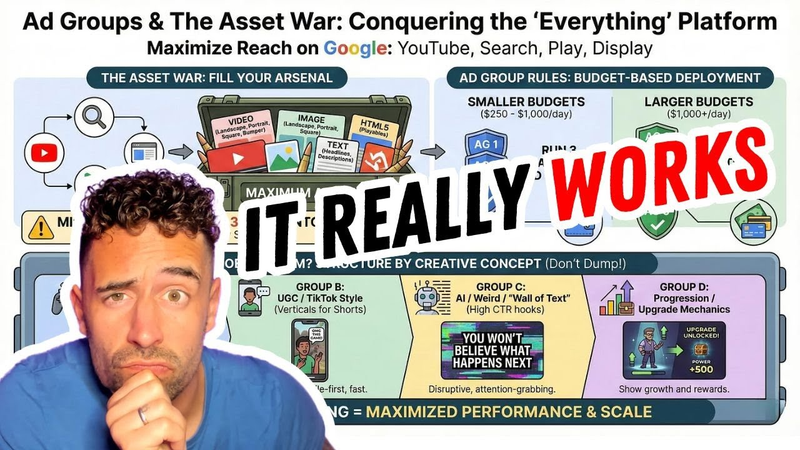
I'm always using audience signals and these are some some kind of case studies that I found u and I have always in one art group at least one one audience
it's 4 a.m. We're rolling the dice. Mate [music] drops knowledge made of golden eyes. Failix with ads making those coins rise. Jack up designs worlds chasing the sky. We're the [music] two and a half gamers. The midnight crew talking UA advers and game design too. Mat Felix Shak bringing the insight. We're rocking those vibes till the early daylight [music] master eyes on the prize. Tracking data through the cyerspace skies. Felix [music] stacks like a wizard in disguise. Jack lift us to the high. Two and a half gamers talking smack. [music] Slow hockey thick. Got your back. Ads are beautiful. They light the way. Click it fast. Don't delay. Uh-huh. Uh-huh. Uh-huh. [music]
Hello everyone. Welcome. This is another solo episode. So, thank you very much for coming. I know we we started doing this a year ago and we keep doing this and we love it and you love it as well and I like to talk about one important topic. I was talking about on the podcast in the the previous episodes and it was connected to the MVP UA template for Google. So basically start well not Google that's what I'm going to talk about today. I was talking about meta. So if you want to go and check it out it's actually pretty valuable. I decided to do it again, but this time for Google. So, I'm going to talk about the Google site and I'm going to walk you through the actual Google campaign setup and then some additional stuff how to set up audiences, what is there like what are the possibilities and everything and I actually have a presentation because looks like you love this and we love it as well. So, let's see. I'm going to share my screen and then we can go directly into this
All right. So, launching Google Ads campaigns. So, we're living in the UA space where running only one two channels is not enough. And I've talked about UA on meta. Now, I'm going to talk about Google Ads and we're definitely going to talk about Apploin. We had an we had actually an episode with Alexi about or Alexis with uh about Applavin but we're going to talk talk about in the future for sure. So anyway, Google ads campaign is actually always in my mix and I use Facebook, Google, Tik Tok and Apploin my top four channels and then we do if we talk about the U diversification the moore lift off unity is still integral as well depends on the game but anyway so I'm going to talk about the tracking measurement conversion windows the actual campaign structure and like how I do
optimizations and then even targeting because of course making the days where Google was Google Adwords and you could run campaigns for keywords, Google Display Network and YouTube and then came to one amazing black box. There's still opportunities on the on the audience side that can help you track what target people tracking and measurement. You this is the bread and butter, honestly. If you don't have the solid tracking setup and measurement, you're You can't run anything and you're going to see different numbers in different dashboards and tools. For UAC, well, Google ads. UAC was before for Google ads, you need to have the Firebase linked because then you can run value based campaigns which is called the ROS or target ROS. Nowadays, you have Max Ras and all the different combinations
of of campaign optimizations. But if you don't have Firebase linked, no bueno. Uh it's not going to work. Also, bidding on Firebase events versus MMP events usually yields bad results because Google, I mean, loves their own products. So you should use Firebase for tracking app events and conversions but also set up the connection to your MMP. So you can actually cross check the numbers within all the dashboards. So you go to Firebase link the Google ads option and then you actually need to go to Google Analytics even and then do the setup there. When you're doing this setup what's most important is the actual events connections and implementation. first open basically you're bidding on that instead of the app installs because guess what like there can be a lot of fraud on Google side but you haven't heard it from me if you do install install based bidding
usually like there's like 70% drop off if you do actually first open it's already kind of action of like opening the the game or app then you always go for like kind of engagement events tutorial completion any type of early progress, which means anything that happens on day one, day two, and it's kind of ident identifying the users or players that are like better quality because they're actually engaging with the game or app. Then add impression absolutely crucial for ads campaigns and then obviously purchases with values. If you don't track or if you don't track values, it means no target ROS or ROS campaigns. And then there is this conversion window kind of debate because by Google by default is 90 days. So you think about it 90 days means and you need Google says you need two or three cycles of the window to actually get better or algorithm to learn which kind
of makes it quite long. If you use 90 days window the best practice usually is 7 to 14 days. I was kind of experiment experimenting with different conversion windows as well and you should do it as well on on your end. But if you think about it like what's happening in the industry now and uploading is pushing for day 28 window. Uh Facebook only has day seven but also like Google has always had this best practice which was 14 days. So you can test 7 days, 14 days, 28 whatever 60 days. different kind of genres can have a different window recommendations and window testing because of kind of how long the LTV improves over time. For hybrid casual 90 days would make any sense for puzzle 60 days could make sense. Although I still think like that's a little bit extreme but again I mean it's up to you. I've had C accounts
where I used the default 90 days and it was performing super well. You just need to think about it in this way. If you're putting a target roas is always tied to the conversion window. So if you're targeting 20% rowas, it's going to be 20% day 90. That's going to limit your spend and then the quality of the users. Test it. When I'm testing this, be careful because if you test it on in one account, it's going to kind of mess up with the campaigns with optimizations and stuff. So, usually I try to have day seven ad account, day 14 at account, and day 28 at account depends on the scale. 14 days by default and then expanding with longer or shorter uh windows. Like I said, shorter window means it's faster feedback loop because if you have 7-day window, you only need to wait two or three cycles. Remember I said it before, two or three cycles, which means 14 to
21 days. If you have 90 days, how long does it take? Quite a lot. But anyway, it's uh the the whale type of kind of games. uh sometimes it's just you need to wait until the cohort major over time. So what kind of campaign should I launch and how should I approach this? The structure you really shouldn't do small campaigns and large number of them. It does doesn't really work like that and usually I'm try to do like free campaigns depends on the I'm going to show it how I'm thinking about it. But even in here on Google, it actually makes sense to do geospecific campaigns. But still needs to be a valid daily budget so you can get enough daily events for the optimization which should be like 10 15 daily new well new net new purchases and what I'm trying to say is
less campaigns higher budgets for more learnings. So this is how I try to look at it. Usually it's again like I said three campaigns. So it's US obviously and then tier one and rest of the world. Tier one depends on your kind of LTV brackets and and values. I'm going for like the the main European ones plus Korea and Japan usually and then rest of the world. So the thing is I mean this is what I start with and it's always doing quite well and after some time I try to try to operate with the the countries and in the tiers. So basically look at the you're looking at the the countries after 7 to 14 days and then uh you're moving the countries back to the rest of the world or just from the rest of the world promoting the the best performing countries to tier one on iOS. Yeah, I'm maximizing the signals with tier one and US into one campaign. It's usually like 250 per day and sticking to cost per action of TCPA which is the the
purchase campaign. And then after like all the shenanigans with iOS measurement are done, then I'm kind of focusing on the the value and the the ROS campaigns on iOS. So just big disclaimer, iOS before the IDFA shenanigans happened, those campaigns were like the best campaigns ever for iOS. Nowadays, it's not the case anymore. No wonder why. And here we're going to I don't want to say technical, but it's like it's interesting thing how to target users. And it's very important to set this up because in this case, I'm not sure if people are using this too often, but it's actually going from broad and targeting everybody on the whole world to just use targeting. And it can be keywords, but it can be also all the competitor games with a bundle. And I'm
going to show it show you how to do it. and demographic filters just to define the audience but also audiences from from Firebase and even if you have your different games it can be very useful and also look alikes for this and it's just pay audience again another layer of targeting because it's it was always about oh well we it's broad you can't do anything else but you can actually and makes a lot of sense because it's something that really perform performs well and I'm always using audience signals and these are some some kind of case studies that I found u and I have always in one ad group at least one one audience signal okay so there's always this kind of saying that you need to start with CPI campaigns and then move to this DCP which is the purchase campaigns then I mean you kind you definitely need data I usually use the purchase or any
engagement event from at the start after I get some data in which which can be two weeks of data if you're getting enough purchases per day or events per day can be even seven days but I just want to kind of I want to say warm up the the account but I don't want to start with target draws right away because like it's just going to be shooting everywhere without any any data. So just get the data in with purchase campaigns or engagement campaigns and then afterwards just go for T- ROS because TAS well target ROS or max ROS now there's the oper there's the option which is just giving it to the algorithms there is no target basically which I don't really like like to do but there's there's the option and if we're talking about the creative side I use usually on on Google side well 30 plus videos 30 plus second 30 second plus videos ideally 60 I mostly do 16 to 9 and 9 to 16 I have a
square format here if I don't add it into the campaign nothing really major happens so fa well for Facebook it's a different story because the the square format is preliminary happening on the on the feed here I mean it happens on the GDN but the Google display network but still 16 to 99 to here mainly for for YouTube. Honestly, I rarely use static images and if you can ask me why, but that's my usual experience. It sucks and it's bringing terrible quality users because showing on the Google display network and honestly, I mean, you have 10 different games, 10 different experiences, but this has been my experience for a long time and multiple times. Anyway, so if you run Google campaigns, there are two schools of thoughts like one is basically running only one ad group and refreshing creatives within this one ad group. I am
the other other guy who is running multiple ad groups at the same time, usually three to five and organizing creatives or ad groups by by creatives. So I have let's say mass battle video. I have 10 different variations. ad group is called mass battles and I put all the mass battles inside this. If I have a new mass battle videos if then I create another ad group which is called mass battles hooks something and then I have a game play then it's another game and another ad group. So how should you think about it kind of free ad groups on the 500 budget. So let's say if I have and if I have thousand per day I can use five ad groups. If I have 5,000 a day I can use 10 ad groups. Most probably what's going to happen is you budgets going to go into free ad groups with high budget but still more ad groups more signals for the campaigns and that's that's my approach but also there is the other one which I mentioned
couple of seconds ago or minutes ago you can refresh creatives within one other if you have all these setup I call this the hamburger strategy because I'm usually doing different things right I'm increasing the budget then I refresh creatives after let's say two or three days then again increase the budget then increase the bit then increase the budget so usually doing different things during the week not everything at once and also keep few days between the between the changes if you do a change every three days it's going to ruin the campaign I know if it doesn't really look great but you know the Google works in this way. You launch a campaign 3 days you can forget about it right away because nothing is going to change that much after 3 days the CPI is going to decrease. You're start to see like
stable performance and then after another three or five days you can start thinking about what to do next because again like if you start making change in the first few days you will get nowhere. That's my observation and it's usually like this. So don't touch it in three first three days then and go for for another 3 days if it looks okay. If it doesn't look okay and they need to act quickly but if it's if it looks decent then don't change that much. Okay. So this is kind of what I was trying to say and now I'm going to show you the Google Google campaign dashboard. Let's just start with audiences that I mention. Let's just pick a random campaign here. We need to go to the ad group and then we go to audiences and I already created an audience here which is a G to 2.5 gamers audience. Let's just remove it from here. Let's add audience.
We can do let's create a new one because it's an audience. Gamers testing audience again. So we can do different different custom segments because I already created the merge games but let's just do we can do my our own data. We can do website visitors app users of different apps that we have not only apps but also purchasers and then we can do combined apps visitors and the purchases for for everything. We can do like a lot of different things in the audience manager but and then again gender different age groups but for our purposes let's do a custom segment which is a new segment same it's not going to be it can be casual games games because I have a casual game and I instead of the interest of purchase in intentions I could obviously do that but I want to use this audience of people who use types of apps because now I can do a like a bundle ID. So, let's say Royal
Kingdom. Okay, here's Royal Kingdom. Then we can do travel down. Yes, we can do Flambe because it's a new game as well. Let's go Harbor and then So, you get it right. So, then we can do gardencapes as well. There you go. So, you can you can kind of put a lot of different a lot of different games here. I would do like 10 and then save it. And then that's that's all we need. So that's safe. Perfect. So how should you think about this? Again, I was talking about three different ad groups. It's basically you can do one broad campaign, one broad ad group, then with gameplay video. Then you do uh casual games ad group with gameplay video. It's casual audience. And then you can do another ad group with payer audience from Firebase. So you can do like three different types
again. Suddenly out of one you have three and you can still using the same creative. So this is how I think about it basically around the audiences and then like the structure of the campaign and then based on the numbers and I adding new competitors different interest because you can then do casual gamers, hardcore gamers, all the different gamers in that in the audience section. So, that's pretty much that's pretty much it, I think. If you have any questions, please let me know. And I guess I see you next time. Cheers. Thank you very much. Join the Slack channel. Bye-bye. Hey,
Auto-generated captions from YouTube — names and numbers may be misheard.
Distilling the key insights…
This analysis outlines a strategic framework for managing Google Ads campaigns for mobile games, emphasizing a structured, data-driven approach to user acquisition. The primary objective is to move beyond basic installation-based bidding toward value-based optimization, leveraging Google’s algorithmic capabilities while maintaining granular control over audience targeting and creative performance.
A mandatory prerequisite for effective Google Ads performance is the integration of Firebase. This connection is essential for tracking high-quality engagement events—such as tutorial completions, ad impressions, and in-app purchases—rather than relying solely on app installs, which are prone to higher fraud rates and lower user quality. By linking Firebase to the Mobile Measurement Partner (MMP), advertisers can cross-verify data across dashboards. Furthermore, the selection of a conversion window is critical; while 90 days is the default, a 7-to-14-day window is often recommended for faster feedback loops, allowing the algorithm to optimize more efficiently based on early-stage player behavior.
Campaign structure should favor consolidation over fragmentation. A recommended approach involves grouping countries into tiers—typically the US, Tier 1 markets, and the Rest of the World—to ensure sufficient daily event volume for machine learning. Within these campaigns, the use of audience signals is a key differentiator. By utilizing custom segments, such as competitor bundle IDs or Firebase-derived purchaser lists, advertisers can refine targeting beyond broad, automated settings.
Creative strategy focuses on high-quality video assets, specifically 16:9 and 9:16 formats for YouTube, while static images are generally discouraged due to poor performance. A recommended organizational strategy involves managing three to five ad groups per campaign, categorized by creative themes or audience types. Finally, the methodology stresses patience: campaigns require a three-day "learning" period before any adjustments are made, followed by incremental changes to budgets or bids to avoid destabilizing the algorithm’s performance.

Two & a Half Gamers · 2026

Two & a Half Gamers · 2026

Two & a Half Gamers · 2026

Two & a Half Gamers · 2026

Two & a Half Gamers · 2026

Two & a Half Gamers · 2026

Two & a Half Gamers · 2026

Two & a Half Gamers · 2026

Two & a Half Gamers · 2026

Two & a Half Gamers · 2026

Two & a Half Gamers · 2026

Two & a Half Gamers · 2026

Deconstructor of Fun · 2026

Two & a Half Gamers · 2026

Two & a Half Gamers · 2026

Two & a Half Gamers · 2026
Two & a Half Gamers · 2026
Two & a Half Gamers · 2026
Deconstructor of Fun · 2026
Two & a Half Gamers · 2025
Two & a Half Gamers · 2025
Two & a Half Gamers · 2025
Two & a Half Gamers · 2025

Two & a Half Gamers · 2025
Comments