1 free read left. Create a free account for unlimited reading + AI research.
Create free accountWhitepaper DiGRA
1 free read left. Create a free account for unlimited reading + AI research.
Create free accountWhitepaperDiGRA
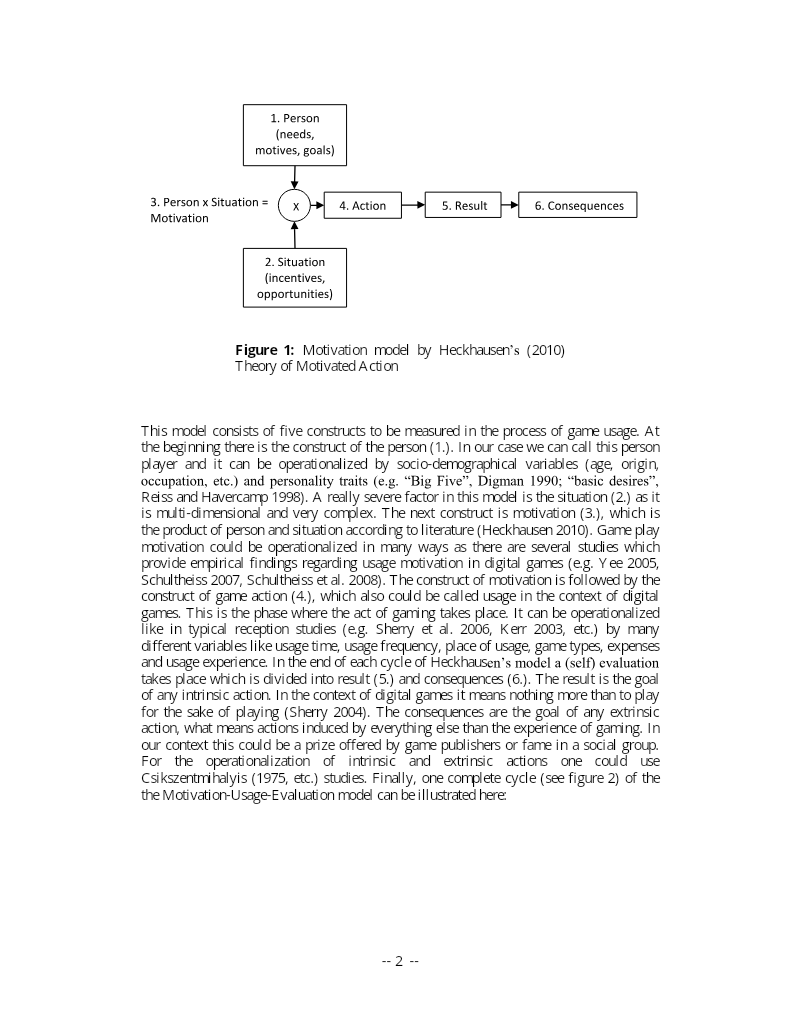
The framework covers the player, the situation, motivation, usage and self-evaluation. It is built on Heckhausen's Theory of Motivated Action.
The paper introduces MUsE (Motivation-Usage-(self)Evaluation), a holistic research framework for reception-based game studies that models a complete cycle of game use. Built on Heckhausen's Theory of Motivated Action, MUsE measures five constructs in sequence: the player (socio-demographics and personality traits), the situation, motivation as the product of person and situation, usage (the act of play), and a self-evaluation split into intrinsic results and extrinsic consequences. The framework is presented as suitable for both cross-sectional and longitudinal designs, with its strongest application in quantitative survey research, while acknowledging that it can also inform experimental and qualitative work, though the interaction effects it emphasizes are harder to assess qualitatively.
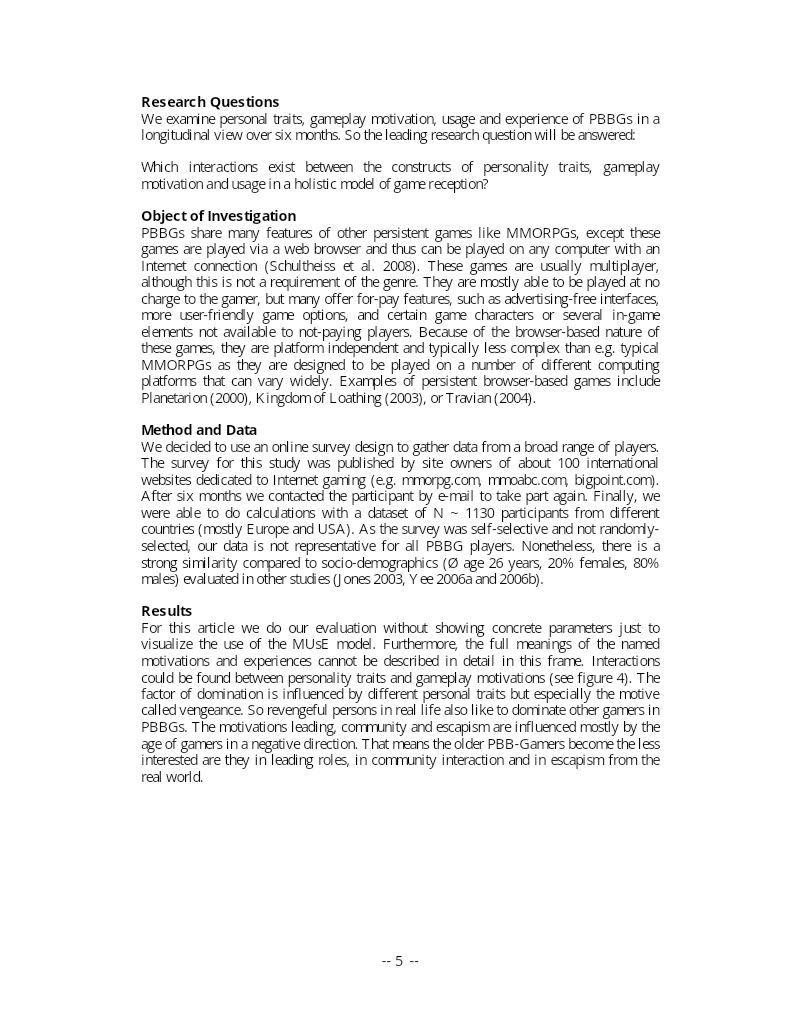
The framework is tested through a prototype study of persistent browser-based games (PBBGs), a genre the author argues has been underrepresented in game studies despite its popularity. Data came from an online survey distributed through about 100 gaming websites, with follow-up contact six months later, yielding roughly 1,130 participants, mostly from Europe and the USA. The sample was self-selected rather than random and therefore not representative, though its demographics (average age 26, roughly 80% male) resemble those in prior studies. The reported results are illustrative rather than precise. Personality traits, notably revenge, were linked to dominance motivation, and older players showed less interest in leading, community, and escapism motives. Transfer and escapism motives were associated with longer play time, and time spent, competition, and entertainment shaped self-evaluation. Evaluations, particularly extrinsic consequences, were found to shape motivation in subsequent play cycles, a finding the author highlights as relevant to developers seeking sustained engagement and spending.
DiGRA · 2020
DiGRA · 2020
DiGRA · 2020
DiGRA · 2020
DiGRA · 2020
DiGRA · 2020
DiGRA · 2020
DiGRA · 2020
DiGRA · 2020
DiGRA · 2020
DiGRA · 2020
DiGRA · 2020
The Game Business · 2026














Comments