1 free read left. Create a free account for unlimited reading + AI research.
Create free accountWhitepaper European Conference on Games Based Learning (ECGBL)
1 free read left. Create a free account for unlimited reading + AI research.
Create free accountWhitepaperEuropean Conference on Games Based Learning (ECGBL)
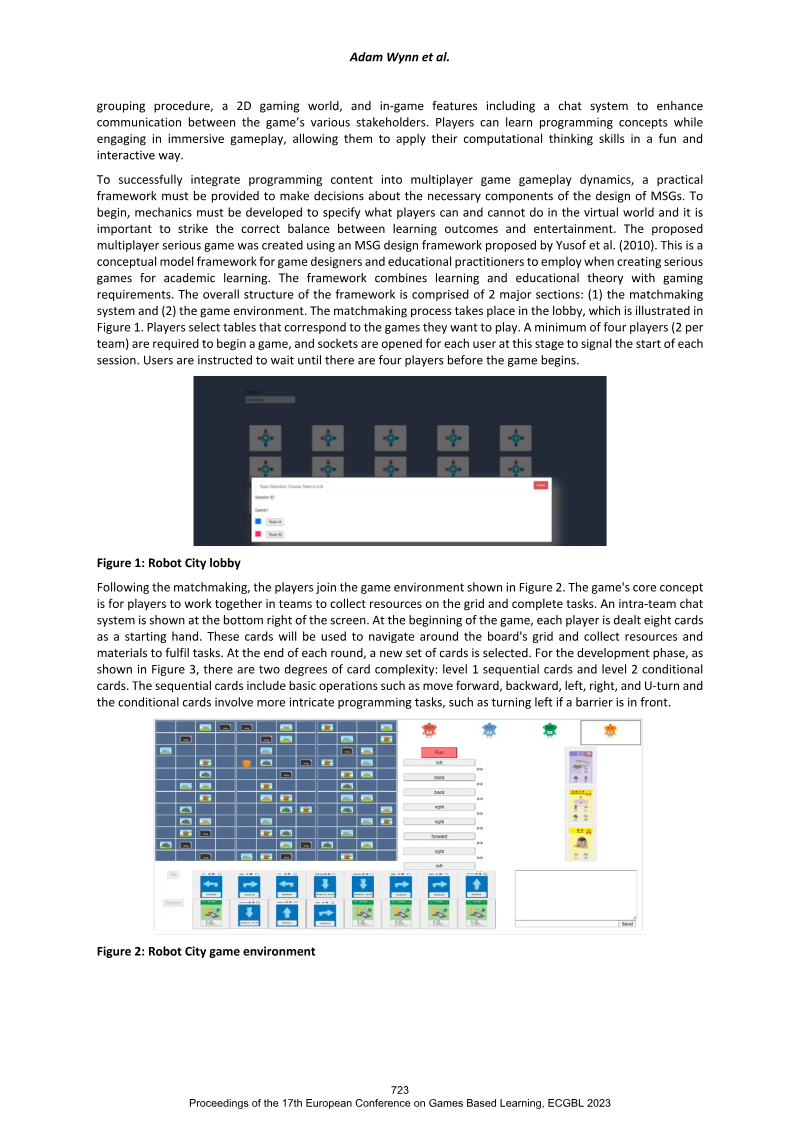
The game adapts Robot City to teach introductory programming and computational thinking to young learners. Teams use card commands on a 2D grid.
This study presents a collaborative multiplayer serious game, an adaptation of the unplugged board game Robot City, designed to teach introductory programming and computational thinking (CT) to young learners. The game uses a card-based structure in which multiple teams of players collect resources, complete construction missions, and apply sequential and conditional logic through card commands on a 2D grid, with built-in chat and card-swap tools to encourage cooperation. The work aims to show how computer-supported collaborative learning and serious games can be combined in a practical framework that balances educational goals with entertainment.
The empirical evaluation was a small preliminary experiment involving 12 students aged 9 to 12, drawn from a French school in Morocco, split into three groups of four. Participants completed a 16-question multiple-choice pre-test and post-test covering sequential logic, conditional logic, and Bebras-style graph routing, with gameplay lasting roughly 40 to 60 minutes between tests. Four of the six teams improved their scores, one remained unchanged, and one declined slightly. Students performed significantly better on sequential and conditional logic than on graph routing (Wilcoxon signed-rank tests, p < .05). Questionnaire results indicated moderate cognitive load (mean 2.67 on a 7-point scale) and a computational thinking literacy mean of 4.11 on a 5-point scale, with the generalization and abstraction dimensions scoring highest.
Qualitative feedback from interviews described the game as immersive and competitive, supporting focus, teamwork, and communication, with teams that had implicit leaders coordinating strategy more effectively. Participants also requested clearer interface cues, more hints, and varied visuals. The authors acknowledge substantial limitations: the sample is very small, the design was not compared against a control condition, and social skills were observed rather than measured. They propose larger studies, additional card levels, storytelling enhancements, and multilingual versions for future research.



European Conference on Games Based Learning (ECGBL) · 2026



European Conference on Games Based Learning (ECGBL) · 2026



European Conference on Games Based Learning (ECGBL) · 2026



European Conference on Games Based Learning (ECGBL) · 2026



European Conference on Games Based Learning (ECGBL) · 2026



European Conference on Games Based Learning (ECGBL) · 2026



European Conference on Games Based Learning (ECGBL) · 2026



European Conference on Games Based Learning (ECGBL) · 2026



European Conference on Games Based Learning (ECGBL) · 2026



European Conference on Games Based Learning (ECGBL) · 2026



European Conference on Games Based Learning (ECGBL) · 2026



European Conference on Games Based Learning (ECGBL) · 2026
European Conference on Games Based Learning (ECGBL) · 2023