1 free read left. Create a free account for unlimited reading + AI research.
Create free accountWhitepaper European Conference on Games Based Learning (ECGBL)
1 free read left. Create a free account for unlimited reading + AI research.
Create free accountWhitepaperEuropean Conference on Games Based Learning (ECGBL)
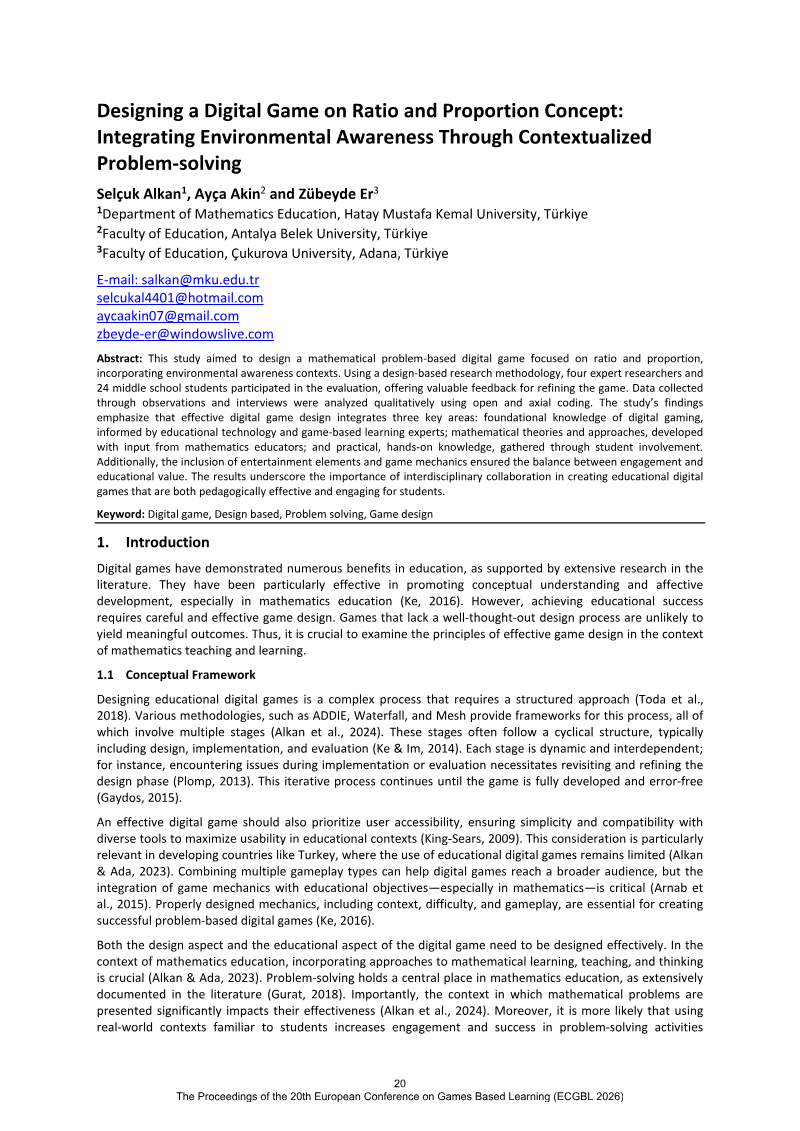
The study examined the digital maths game Seven Spells, played with or without peer tutoring, among fourth-class pupils in an Irish primary school.
A study of the digital maths game "Seven Spells," played with or without peer tutoring, examined whether the game could reduce mathematics anxiety and improve learning among fourth-class pupils in an Irish primary school. The research questions centred on three outcomes: game performance, mathematics errors, and levels of mathematics anxiety. The sample comprised 43 to 55 children across two fourth-class groups, a small, two-class experiment whose limited size constrains how broadly its results can be generalised beyond this setting.
The clearest finding is that average game scores rose significantly for all children, regardless of condition, indicating that the game itself produced measurable gains in performance. Mathematics anxiety, by contrast, decreased significantly only in the group that played without peer tutoring. Across both conditions, no statistically significant differences emerged on game scores, maths errors, or anxiety levels, leading the authors to conclude that peer tutoring was not effective in this context.
Although the peer-tutoring intervention did not achieve statistical significance, a non-significant decline in maths errors was observed, which suggests the game may retain value as a teaching tool. The study's conclusions are therefore cautious: the game shows promise for supporting learning, while the added benefit of peer tutoring for reducing anxiety and improving outcomes remains unproven. The body of references cited in the work situates these questions within research on peer tutoring, digital maths game design, and mathematics anxiety.



European Conference on Games Based Learning (ECGBL) · 2026



European Conference on Games Based Learning (ECGBL) · 2026



European Conference on Games Based Learning (ECGBL) · 2026



European Conference on Games Based Learning (ECGBL) · 2026



European Conference on Games Based Learning (ECGBL) · 2026



European Conference on Games Based Learning (ECGBL) · 2026



European Conference on Games Based Learning (ECGBL) · 2026



European Conference on Games Based Learning (ECGBL) · 2026



European Conference on Games Based Learning (ECGBL) · 2026



European Conference on Games Based Learning (ECGBL) · 2026



European Conference on Games Based Learning (ECGBL) · 2026



European Conference on Games Based Learning (ECGBL) · 2026
European Conference on Games Based Learning (ECGBL) · 2022



European Conference on Games Based Learning (ECGBL) · 2026
European Conference on Games Based Learning (ECGBL) · 2026