Key insights
5 slides
The survey
Women connected to video games across 12 countries were surveyed.
The 2025 report draws on a survey of 3,045 women connected to video games across 12 countries, conducted in Spanish over six weeks in early 2025.
1 / 5
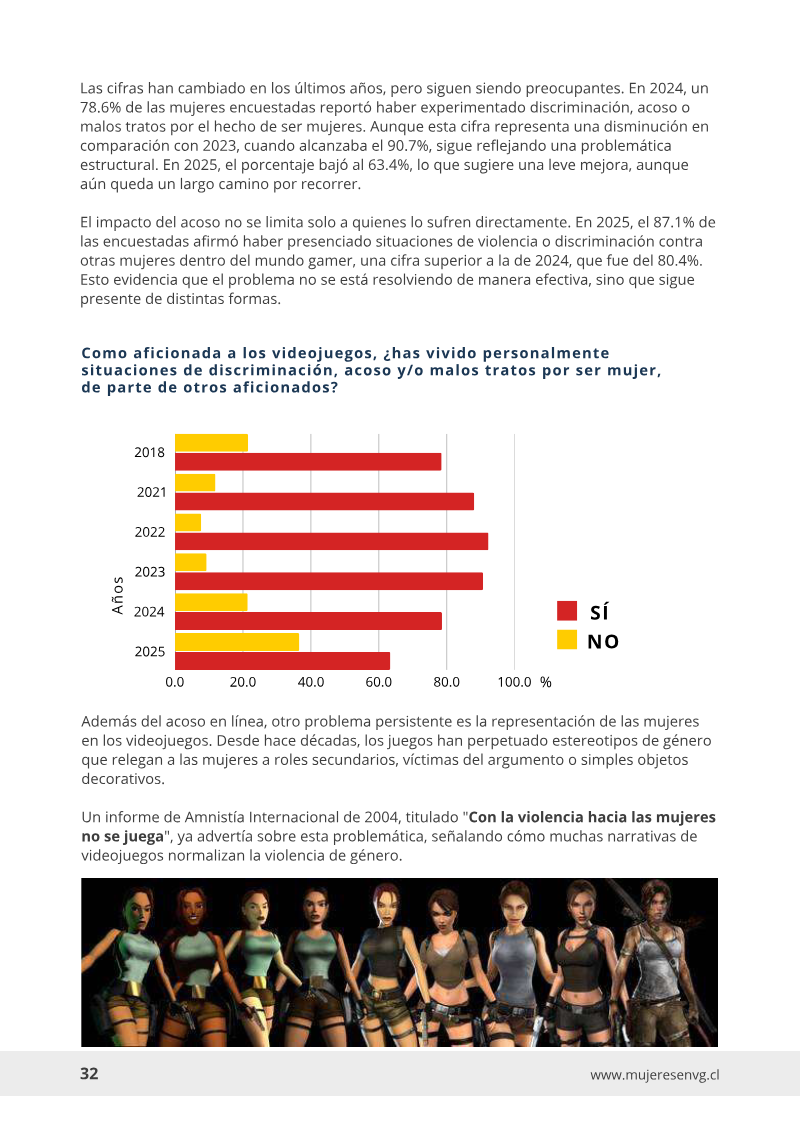
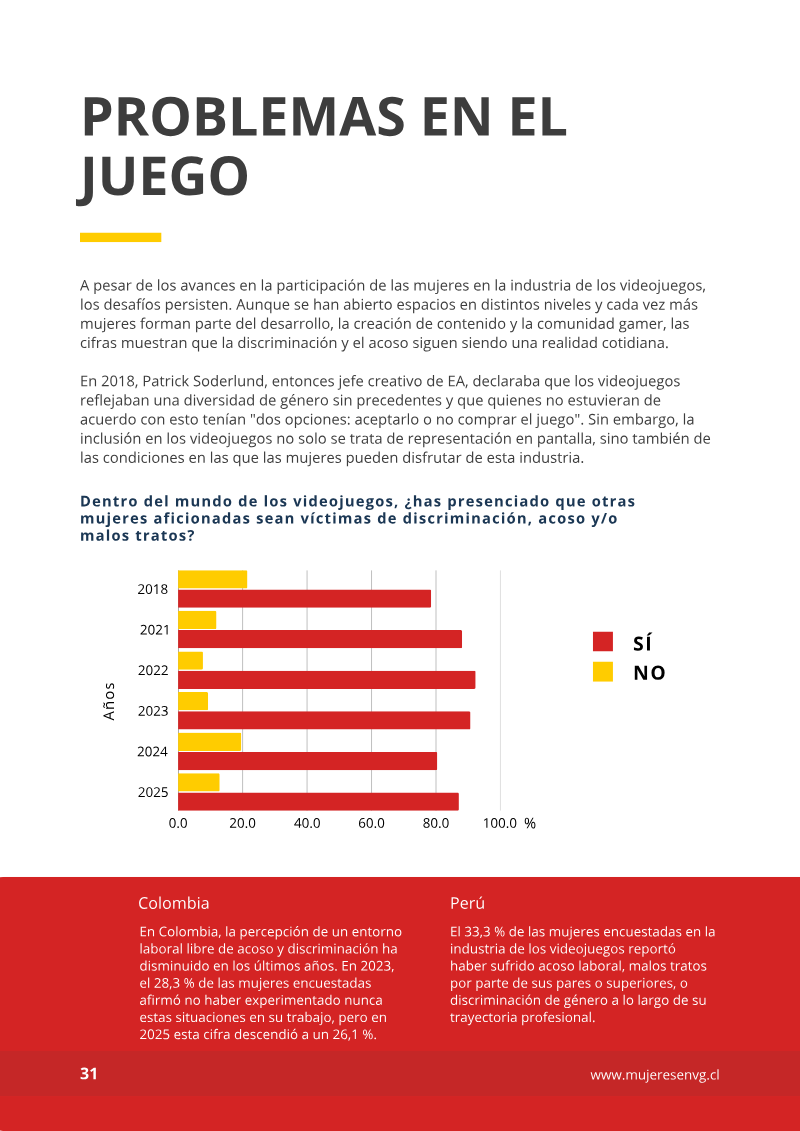
- 01Discrimination against women in Latin America's video game sector fell from 78.6% of respondents in 2024 to 63.4% in 2025, yet 87.1% said they had witnessed violence or discrimination against other women, so the problem persists.See it on page 32
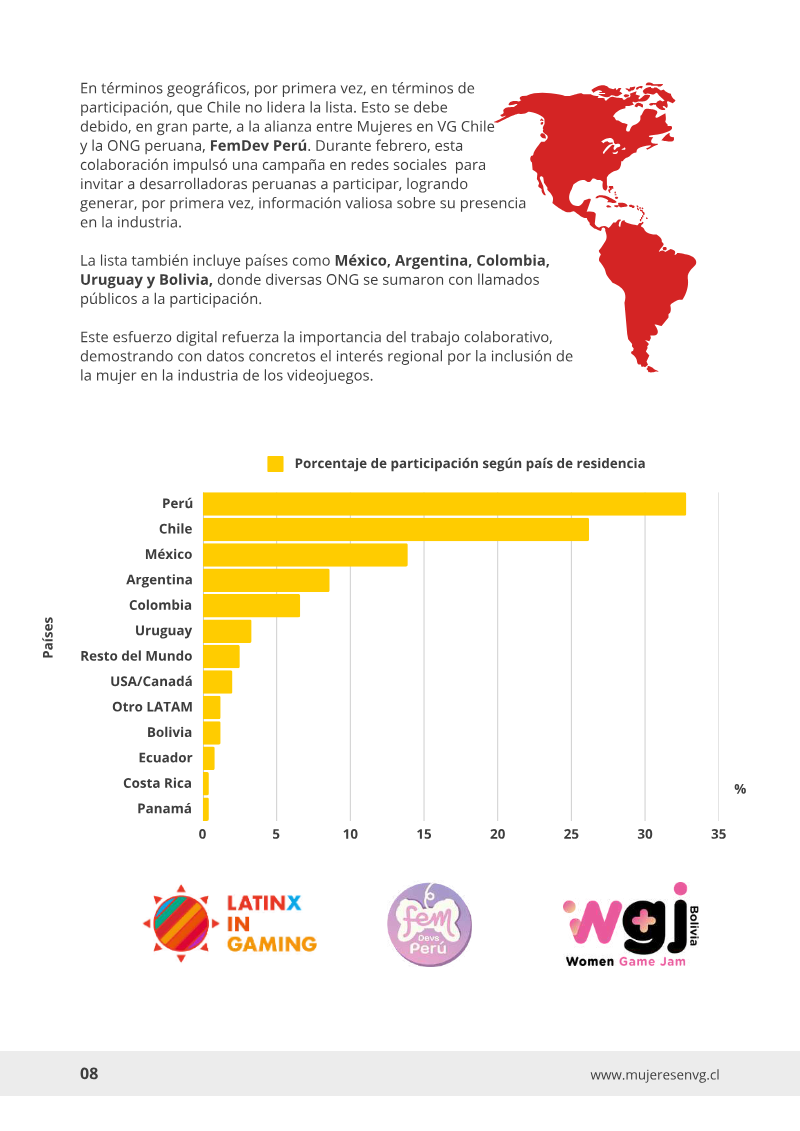
- 02Participation in the 2025 survey of 3,045 women across 12 countries was led by Peru, which overtook Chile for the first time, largely through a collaboration with FemDev Perú.See it on page 8
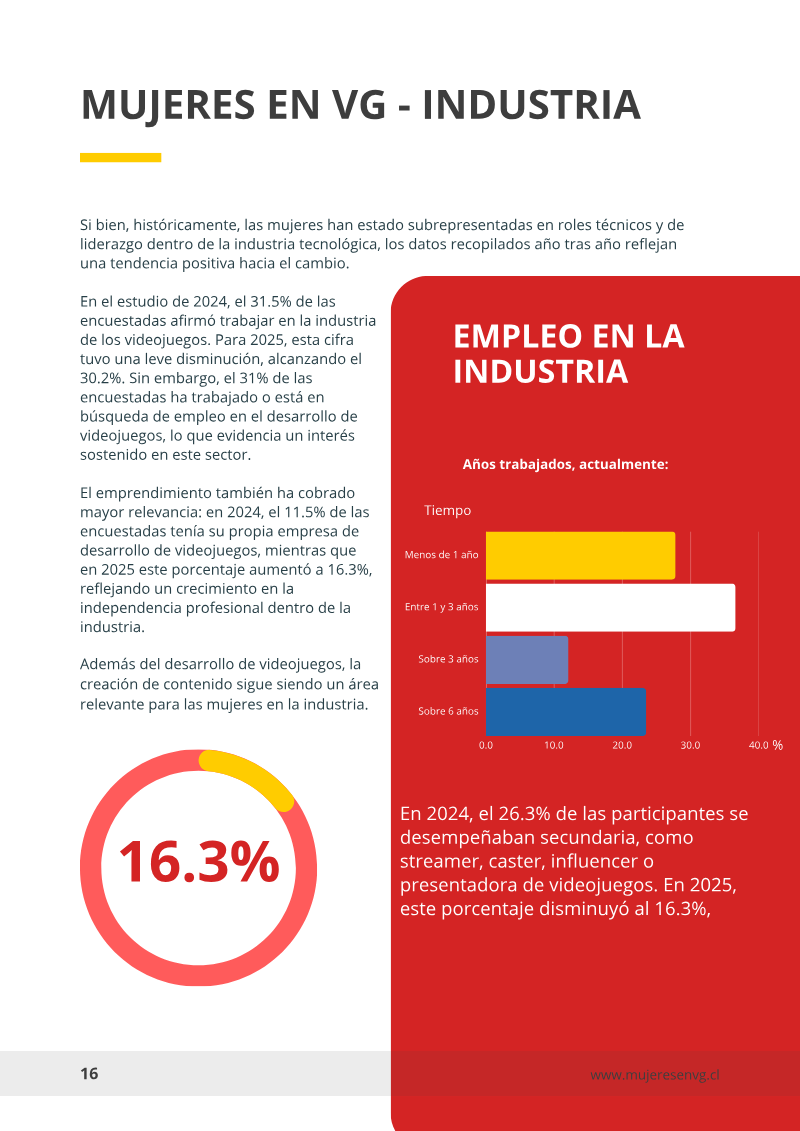
- 03Self-owned studios among respondents grew from 11.5% in 2024 to 16.3% in 2025, while the share working in the video game industry slipped slightly from 31.5% to 30.2%.See it on page 16
- 04In Chile, the share of women reporting no harassment or discrimination rose only from 24.3% to 25.8%, indicating very limited progress there.See it on page 31
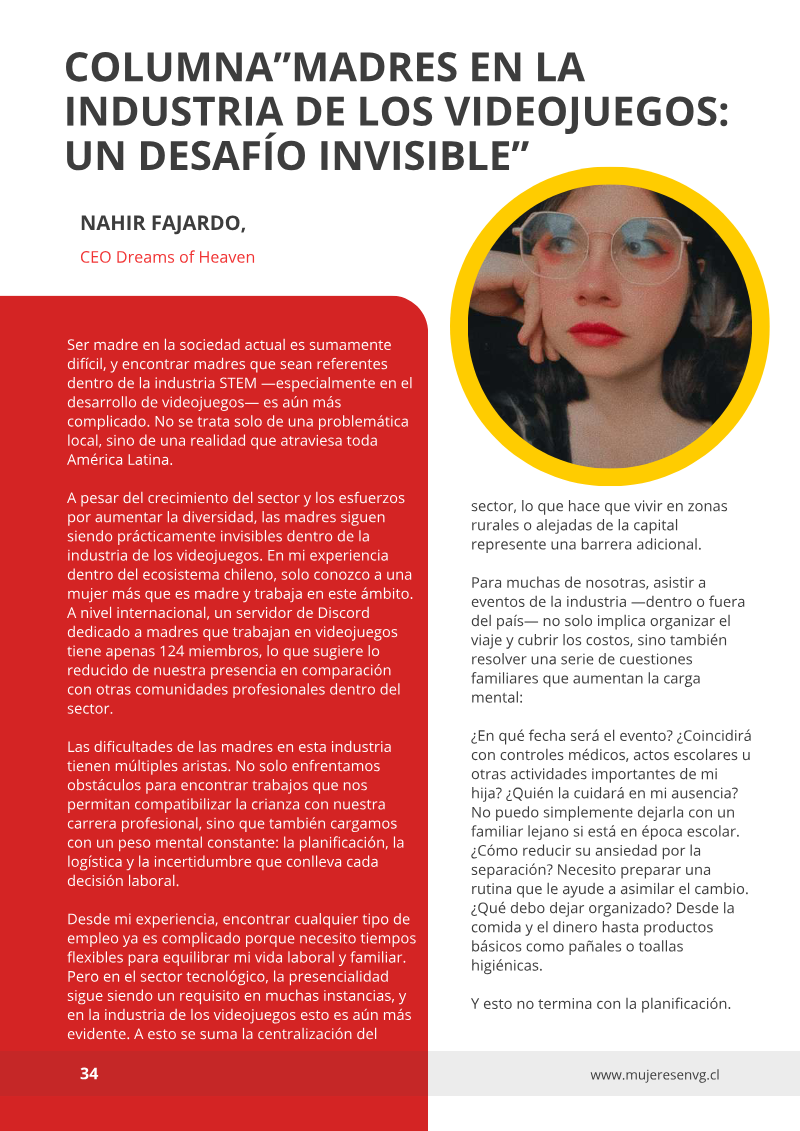
- 05Mothers remain nearly invisible in the Latin American industry, with a working-mothers Discord community of only 124 members, and 24.6% of surveyed professionals report difficulty balancing work and family.See it on page 34
- 06Engagement with gaming is long-standing: 77.7% of respondents played their first video game before age 10, and PC remained the dominant platform at 63.8%.See it on page 13
- 07The report concludes that progress is real but insufficient and argues that structural change, not individual resilience, is needed so women need not choose between gaming careers and motherhood.See it on page 35
Ask AI about this report
Summary
The 2025 Latin America report from Mujeres en VG draws on a survey of 3,045 women connected to video games across 12 countries, conducted in Spanish over six weeks in early 2025. Respondents are predominantly young, mostly aged 25 to 34, and highly educated, with 31% holding a diploma and 42.7% having completed video game-related courses. Peru overtook Chile as the largest source of participation for the first time, largely through a collaboration with FemDev Perú. The findings portray women who see gaming as a source of concentration, frustration tolerance, friendship, and mental health benefits.
Gaming engagement is deep and long-standing: 77.7% of respondents played their first video game before age 10, digital formats rose to 60.6%, and PC remained the dominant platform at 63.8%. Professionally, 30.2% work in the video game industry, a slight decline from 31.5% in 2024, while self-owned studios grew from 11.5% to 16.3%. Game Design and Production/Project Management emerged as the most common roles. The report situates these figures within regional market growth, citing projections of roughly $500 million for Chile's market in 2024 and $200 million for Peru's in 2023.
Participation in the sector remains uneven. Among professionals, 21.1% work freelance and 81.9% report feeling stable in their current positions, while 90.5% would be interested in new job offers. Discrimination has declined, from 78.6% of women reporting it in 2024 to 63.4% in 2025, yet 87.1% of respondents said they had witnessed violence or discrimination against other women, indicating the problem persists. Harassment in online communities remains serious, and in Chile the share of women reporting no harassment or discrimination rose only modestly, from 24.3% to 25.8%.
The report concludes that progress is real but insufficient. Balancing work and family is a challenge for 24.6% of surveyed professionals, and mothers remain nearly invisible in the Latin American industry, a condition underscored by a working-mothers Discord community with only 124 members. The authors argue that structural change, rather than individual resilience, is required before women can pursue gaming careers without being forced to choose between work and motherhood.