1 free read left. Create a free account for unlimited reading + AI research.
Create free account
Maximizing Your Game's Reach - A Quick Primer on Culturalisation PG Connects Digital # 2
Key insights
6 takeaways- 01Culturalization is a proactive strategy that aligns game content, themes, and assets with the specific worldviews, legal regulations, and cultural values of international markets to ensure global resonance.
- 02Unlike localization, which is limited to language translation, culturalization involves surgical design adjustments—such as modifying character armor or replacing incompatible assets—to avoid market bans and public backlash.
- 03Developers should integrate culturalization early in the development cycle to avoid the high costs associated with post-release modifications.
- 04Effective culturalization requires navigating sensitive topics like religious iconography, historical accuracy, and geopolitical boundaries to prevent the inclusion of content that could trigger regulatory or social rejection.
- 05The process functions as a 'fulcrum of compromise' that balances the preservation of a developer's artistic vision with the necessity of achieving commercial success in a globalized industry.
- 06Studios should expand their testing protocols beyond Western markets to include emerging regions like Southeast Asia, the Middle East, and Latin America to gain more diverse and accurate audience insights.
Ask AI about this video
Transcript
next up we've got kate who uh any of you who were watching yesterday's tracks will have seen kate basically doing what i'm doing right now so i would say you're on the other side of the screen but you're basically looking at the same screen but you get what i mean you're here to impart all your wisdom now i'm going to try i'm sure you will we've got a wealth of knowledge in there so i'm really interested in hearing your talking from uh the looks of my document and everything we're advertising you're going to be talking about maximizing your games reach and uh a quick primer on culturalization which is a that's a great topic with a lot of actionable things from it absolutely so let me find why is it not letting me show the right window yay okay now you can see that right
i can see that so i will leave you to it and just quickly i will remind everyone to throw your questions for kate into the q a and i'll be back in a bit and we'll uh see what the audience wants to ask great thank you thank you very much and hi everybody it's great to be here again um this is going to be really quick this topic typically needs at least a good hour of explanation that's why it's called a quick primer on culturalization so let's just hop in here um so basically as many of us know the global game industry revenue is enormous and it continues to grow at a very you know rapid rate um you know the numbers even for this year are already staggering in comparison with with this chart from last year but the point of showing this is is that the growth that typically developers are aiming for you know the when a lot of the developers i work with they make their game for north america or western europe a lot of the quote traditional markets of gaming um but the reality is a lot of the growth around the world is happening in places you don't necessarily expect
and so part of what i try and do with my work as a geographer who's been doing this culturalization work for over 27 years now in the game industry is to help developers understand that with some little tweaking here and there the content you can actually maximize where your game is able to go because there's a lot of markets out there that actually are looking for content or desperate for cut for great content but they may or may not know about your game or they may not know the appeal of it um you know because of the theming or whatever else so so basically my focus is looking at you know how can we expand the content and get it out there as far as possible so we know that localization we're all familiar with localization i think which is to me is mainly language translation that makes up a huge chunk of the industry's revenue but talking about these areas where there's growth that a lot of people are not really looking at is places like nigeria kenya india vietnam with these massive double-digit growth year-over-year
and a lot of game designers don't really think about designing for markets like this they tend to think again like i mentioned more the traditional large gaming markets there's nothing wrong with that but then you're also overlooking a massive amount of emerging markets and other places out there that are looking for content and are ready to play um but it may not but sometimes you have to make some design choices that may need to be made you know to tweak your content um russia is becoming a massive market china of course became the number one gaming market a couple years ago um in mobile games surpassed pc gaming in china um which is hugely significant in that market so we're seeing a lot of shifting going around we know that a lot of game play a lot of this growth that we're seeing is in mobile as well and um so that's another area that's a core focus is that we have to think about um what i'm trying to basically do with the culturalization process is essentially take the game worlds that developers are making and see how are they compatible with the
local world views and so basically i kind of see this like a gene splicing exercise where i'm trying to take the values and the the world and everything else that the game developers created and see is it compatible or not with that local culture with the local laws with the government regulations and all that kind of stuff so i work in the zone of compatibility or incompatibility of content assets so basically i'm looking for things that are going to be either problematic for the game being compatible in that culture or things that are going to actually help the game be more relevant to that specific culture now here's uh an example of the difference between localization culturalization again localization i think most of us are aware of it um you know it's it tends to focus more on language translation than it than anything but here's here's an example for you using a kitkat bar so you can see here two kitkat bars they're essentially the same product the top ones from canada with the english and french rapper and the bottom was from japan with a japanese rapper so same product different labeling
different languages that essentially is the core of localization now with culturalization though it's a completely different concept so in japan what they did with the kitkat bar is they actually culturalize this candy bar in a couple of ways the one thing they did is they they they use the phrase um they kind of riffed on the phrase kitukatsu which is a very positive japanese expression and so kitkat kirikatsu sounds kind of similar so they were very lucky actually that the phrase the japanese phrase was very similar to the product name so they were able to capitalize on that but the other thing they did is they understand that japan tends to be a collector culture that's why games like pokemon go are not a surprise where you know gotta catch em all kind of thing that's very popular in japan so they actually culturalize the candy bar in japan and made different flavors of the candy bar all over the country you can actually see this map where you can collect different uh flavors of kitkat bars
and this phenomenon doesn't exist anywhere else in the world this is the only place where they have culturalized kitkat bar because they happen to just sync up really well with those couple of values that they thought would be really useful and it was you know at this point they've been doing this for over a decade and they have like at this point over 600 different flavors of kitkat bars they've created in japan so that's a great example of how you would culturalize something um now another big difference between culturalization and localization is that typically localization happens later in the product cycle because you have to wait for the text to be complete or complete as possible in order for the content to be ready for localization but with culturalization for example a lot of my work happens at the beginning of the game because i need to understand what is the world they're creating who's in it what kind of characters are there what kind of races or factions or political groups or religious groups or whatever it might be um so i need to understand exactly what this world is and what happens in this
world because when you make when you're involved that early of course i can make early course corrections on the overall concept that will get the game out of trouble or actually help them enhance the game for certain places in the world so it and it's a lot of times it's just tiny surgical tweaks it's not like i'm telling them to change the whole concept it's just little things that i see that i can advise on and basically help them kind of move in the right direction and so culturalization happening early is extremely important um here's a couple of examples of of co reactive and proactive culturalization so reactive culturalization is essentially removing things that are not going to be compatible with the local market so like you may recognize this from fallout 3 it was a two-headed brahmin bull that was incompatible with india because brahman bulls are sacred to the hindu faith and so they could have used this poorly photoshopped two-edited horse of mine as a replacement um because almost any other animal would have been fine for that market but they didn't have time and they just didn't want to take the risk
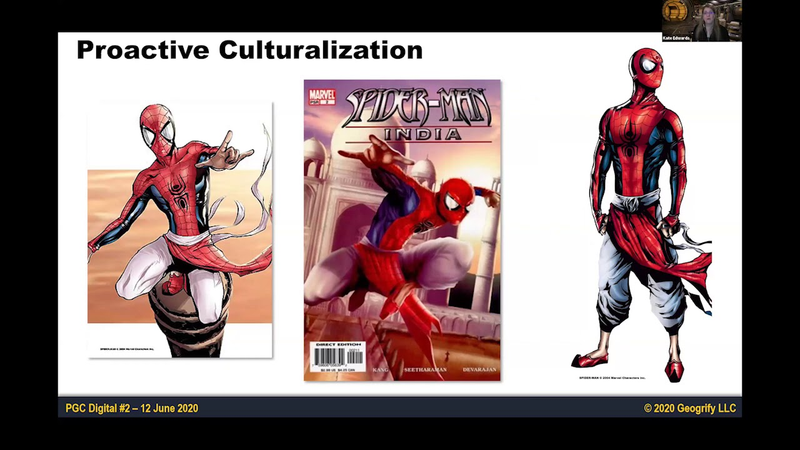
and plus unfortunately at the time they felt that you know doing all this work for india wasn't really worth it which is sad because you know india is one of those massive growing markets so this is an example though we had to take something out or try and change it um but unfortunately because they did not change it this game did not sell in india whereas conversely an example of proactive culturalization in india is when marvel's um partnered with a local uh studio to create this uh this culturalized version of spider-man and the initial reaction was extremely positive a lot of people felt that this was super cool um is really cool that they would take this step and actually culturalize this character for their market however ultimately it didn't do that well because you're dealing with a very famous ip of spider-man who pretty much everyone in the world knows it's peter parker new york city so what the market in this case actually wanted was a localized version of spider-man in the many different languages of india
so um so they had good intentions there and it was a good attempt but ultimately that's not what the market wanted now there's multiple considerations we have to take on and think about when we are doing culturalization work it's not just about looking for whether or not this gesture is sensitive or whatever we have to think about the high level company values and goals for example are you as a company ready to have a game that shows taiwan as an independent country in it even if it's a fictional scenario because that scenario will get you banned in china and it'll be a lot of problems for you and so you have to decide as a company and as a as a creator where am i willing to draw the line on things i will or will not change another thing is the context in which content is generated is very important because every place and every person we're all biased we have to recognize that no matter what we are biased um because of where we grew up where our cultural background and all of that and most of us do a good job of overcoming our bias because we are educated and we are enlightened
but that doesn't always happen in the creative process because in the creative process we're in a state of flow and some of just some of the things that we create sometimes reflect our bias i'm not saying the bias is necessarily negative in a really grievous way it just shows that we may not understand another culture or a particular racial group or whatever it might be um as well as we should in order to represent them in the game the other thing is the business strategy for the vertical so this isn't really relevant for large companies like microsoft and sony where they make other things other than games market strategy for the locale because a lot of companies they may shift their strategy depending on the market because a lot of markets are different you know trying to sell games in china is vastly different from trying to sell games in saudi arabia versus brazil versus the united states um the market strategy for a specific game is also important and then also the changing geopolitical and cultural and ethical factors because the world is very dynamic as we all know the last few months have shown us this
very starkly that the world is dynamic um for example when uh the usk with the game rating agency in germany a couple of years ago decided that nazi symbology is now okay which was kind of a major shift for that ratings agency to to make that decision so now you know this is an example from wolfenstein 2 where you can see on the left that's what most of the world saw but in germany they saw the other versions without the swastika or if you're blizzard you learned very quickly last year about the dangers of geopolitics in china and um in the whole uh cluster fund that happened around their hearthstone tournament they learned very quickly that you have to have a strategy for this kind of stuff and um yeah i'm not even going to go into this this would take me another couple hours to uh debrief on what blizzard did wrong because they made a huge mistake um another thing we have to think about is different themes in our game so like if you have a historical game um history is extremely sensitive in different markets so for example i've
worked on all the age of empires titles in history uh as we as we deal with it in age of empires is somewhat generalized and it's supposed to be for the sake of gameplay well here's a scenario from the original age of empires where we actually had to change history in order to appease the korean government and because the scenario that you see on the top where the japanese invaded the chosen empire back in the middle ages um that the korean ministry of information said that that never happened so we had to make a very uh uh careful decision on our side and at being at microsoft at the time all of those multiple considerations that i mentioned a few minutes ago we had to kind of work through all of that like what does microsoft want to do we want to grow our games business we know korea is very important gaming market we know that real-time strategy games are extremely popular there um you know and so what are we willing to do well this is a case where because there were other precedents that had been set at the company where the decision was made you know
we're basically just going to serve up the local expectation in and so we had to do a special patch which you can see on the bottom which is where the koreans invade japan instead which is definitely not history or historically accurate so um but there's a lot of things in ave empires that are not historically accurate there's tech trees that have different cultures having units that they never had before um so there's a there's quite a bit of fiction in age of empires anyway so we felt that this was kind of we kind of fit that leeway a bit um dealing with faith is also very important both of these games had audiophiles that had uh lyrics or chanting from the islamic quran in them which was highly inappropriate uh to use that in a game um whether or not the game is m rated like the kakuru chojin was which was a game that i worked on or a little big planet which is obviously a much more innocuous fun you know game um so the point being here is that you have to be extremely careful about your source materials you can't just pick like an audio file
and use it because you say wow it sounds cool i think i'll use that if there's lyrics or whatever it else might be you have to do the due diligence to figure out exactly what's the source of this what are the lyrics what language is it what are they saying all of that kind of stuff you have to do that otherwise just you know the the other rule is just don't use music with lyrics just steer clear of that because that's how both of these games got in trouble other things too is it which is a very broad category of dealing with the the perception of being excluded from the experience or included based on your gender your race your nationality your culture all of these things and these issues happen a lot in games um this game that was a mobile game that came out quite a while ago pocket god you can see here they the their portrayal of indigenous people is not very positive it's very antiquated with the bone in the hair the grass skirt and they've got like little sharp teeth so they're kind of like little animals and part of the the issue with this game is that you're actually
your mission on this game is to torture these people you know so that's basically what you do and the the designers of the game said well this is just total fiction it's not a specific culture so don't worry about it but a lot of polynesian groups were upset why were they upset because of this a moai and you could see on their island they put a moai which that makes this a specific exact culture because the moai exists only on one place on earth which is easter island so you could see in later versions of the game they actually changed it to something different and took out that cultural artifact um also things like character design like i worked on games where we had to adapt the female armor in order to be compatible with middle eastern game players and middle eastern you know sensitivities and frankly when i showed this artwork to a lot of people in north america and europe they're like they thought the women the ones on the right looked far better anyway which i happen to agree with um so we have to be mindful of things like this um also geopolitical issues like i alluded to earlier about the whole china
taiwan issue here's a great example where just in the options screen for the game this was ninja gaiden that i worked on um you can see where it says country select and it has roc which is republic of china and it has the taiwan flag this will get you instantly banned in china because this is a very volatile political statement you're calling taiwan the republic of china and you're saying it's a country so in order to fix something like this here's a quick fix if you watch closely so we call it country slash region and then we use the term taiwan because it's used by both sides it's acceptable we take out the taiwan flag because it's redundant information we don't need to use flags to represent language or location and so this works so is in this case is taiwan a country or region that's for the user to perceive it's not for you to assert as a creator and this happens all the time i've done a lot of work with google and a lot of non-game companies where we have to adapt content based on either government regulation or local expectations you can see here's an
example of the northern part of india and jammu and kashmir where in india you must show it as indian territory or else your product will be instantly banned and so you have to get this stuff right so as i'm closing here just a few quick thoughts so we know that distribution in the cloud brings with it a lot of great advantages but it also brings a lot of challenges so like speed we instantly get our content out there and it's being instantly exposed to a broad multicultural audience and in today's world we're dealing along with that audience we're dealing with massive communities on social media and elsewhere where activism is is very high level and so we know we've seen this we've all experienced this we're seeing it right now as i speak you know that that this is a real force of nature that companies have to contend with and creators have to deal with so um basically the point is is that you you need to strive to get it right upon release because once it's out there it's out there and there's no taking it back so you have to do your best to try
and get it right um and also this whole issue that we're dealing with is this battle over mind share this is why when governments are trying to control what their people get to see what gets to influence them and video games are seen as a unfortunately in a lot of places still are seen as a somewhat negative influence on citizens so this is a reason why the great firewall of china exists for example to try and block out certain kinds of content so this is something we need to be mindful of as well but i want to leave you with a very important point because i know a lot of people when they hear a topic like this they're like oh my god this means i need to change my id i need to do this and that i need to basically appease all these governments and people no not necessarily i think you need to exercise your creative vision but you can't expect that vision to align with other cultures so if your desire is to see your game go to as many cultures as possible you're gonna have to think about these issues on some level so basically you have to be extremely conscious of all the creative decisions
you're making during the world building process to know and to think about what will or will not be compatible with these markets to which you wish your game to go and and so basically what we're dealing with is this what i call the fulcrum of compromise where you're striving for artistic freedom and you would love to create the game you want to make without any restrictions which i absolutely encourage people to do but if you have the desire for your game to go global and to be seen all over the place then you have to think about how you would change things deal with reactive and proactive culturalization and these other factors that i mentioned very briefly you know so a lot of a lot of developers are kind of struggling on this this fulcrum between wanting pure artistic freedom and putting out art versus actually wanting to make money and you know pay their bills and so in order to do so culturalization helps kind of on both of those levels you know you want your game to go as many places as possible but you also want to maintain your artistic freedom and it's a struggle every person in the game industry has
and the struggle is real so um but this but culturalization is one of those things that can actually help uh facilitate dealing with this struggle a bit better so um there's a very quick primer i hope that helped so thank you well thank you kate that was fascinating and i don't say that lightly i mean this is literally my jam languages culture the world adaptions everything else like that i'm the person who's got like three different versions of the same game from different countries awesome so yeah now this this was brilliant and i'm actually i'm really glad you mentioned the kitkat stuff at the start as well because uh when i lived in japan i went on a task of traveling around trying all the different versions of fans because they do the same with fanta as well exactly yeah some of my japanese colleagues have admitted to me that they've done kitkat tourism in japan i've got some under my bed actually that were brought back by her by a friend as a gift so yeah um we've got some questions uh well we've got what uh two questions in so i'll
jump straight into them if that's all right with you so yeah jackie says great presentation which i wholeheartedly agree and thank you have you ever had to deal with a crisis by changing a game rapidly and did it work or have you got any examples of companies who have gotten it wrong caused a crisis but dealt with it really well by changing their game quickly yes there's there's uh the answer is yes to both i mean i and i've dealt directly with both i mean i think um yeah i don't think we have enough time to go into all the examples that i could could mention so you're always welcome to follow up with me and i could elaborate but um the answer is yes um there has been some examples where um like the the cockatoo trojan example i showed earlier that's with the early days of xbox that is a great example of how not to handle it um because basically they they had an audio file it was identified as the game was already packaged and literally rolling on trucks to stores it wasn't on the shelves yet
in north america but it was but it was going and so the the problem was identified they fixed it immediately it put in like a non-lyric audio file but then the decision was made and this is where the the breakdown happened is to go ahead and release those tainted units in north america only and me as a geographer i'm like you realize of course that you know there's eight million muslims in the united states or more you know that like places like detroit are 50 muslim we're not a homogeneous society here and so i'm like if you release that in the u.s people are gonna notice and they did notice because three months later the government of saudi arabia contacted microsoft and we had a huge problem and the game was eventually globally recalled because it was receiving so much negative pr in the middle east and i had to go to saudi arabia and do damage control and all that but um but you know the result of that is that they created internal processes that i helped with that actually made sure that other games in the future would not have to go through that and since then they've done a phenomenal job
um there's other companies well like by contrast you know just in the same vein that when little big planet had a similar issue they handled it a lot better but that's because they had the value of hindsight they actually had known about what happened with cockroaches so when they had a similar issue they did not release the game they actually delayed it for three weeks so that they could actually fix the problem they put out a little press release saying you know this is why we're fixing it and they're very open and transparent about why they still got a lot of backlash because people were like how could you be so stupid to use an audio file that has that in there you should have known better but as we know littlebigplanets did come out and it was very successful and has been and so you know so basically that just with that one example of the audiophiles that there was quite a contrast in how it was handled yeah exactly it's like what they say isn't there but i can't remember the phrase properly but a late game is only you know late once but a bad game is bad forever but and i know it's not quite the same but you
know if the error is in there the errors in there whereas you know a delay is a delay absolutely uh doc has asked well he first of all says thanks for the insightful session and says uh we are a studio based in india but we still have to test our prototypes in the us market as publishers want that as india is a growing gaming market do you think we should test games in india will big publishers be open to trying that i my answer is yes i i think so i mean i mean india's growth is is substantial and i can understand completely why they would want the testing to be done in the u.s but honestly i mean the testing needs to be done more than the us i mean we you know easily i mean you know the us is a cluster fund right now anyway speaking as an american but um yeah i mean i i think it's really important to get diverse viewpoints on testing i mean having just testing only in the us for example is is a to me a non-starter um you know you gotta have to
at least to the us you need to at least do you know some a couple of countries in europe and ideally i think in asia you know india is a prime candidate i think india would be a great place to do that testing especially because india you know has it has the english-speaking legacy which i think helps you know so that helps with a certain level of legibility yeah i i completely agree with you as well and especially with what you're saying is especially with how volatile markets are at the moment i mean the uk is obviously volatile as well so only testing in the uk would would not sort of be indicative of uh global values at the moment um so uh one other question we've got is when developers are deciding which areas outside of europe usa china to focus on uh which do you think would be the well they say the top three or which ones would you basically advise to look at outside of the main regional hubs no that's a great question i think part part of my answer is going to say it depends on the type of game that you're making because you know there certainly are preferences in different markets
here and there but generally speaking uh some of the areas that i would be looking out for i would definitely be looking at southeast asia um you know thailand vietnam um you know indonesia singapore that whole region i mean the growth in that area has been pretty substantial so i would take a look at southeast asia uh the middle east often gets overlooked um pretty significantly by a lot of developers but the middle east the game uh game consumption in the middle east has been growing pretty steadily for years now at a at a nice pace so i know a lot of developers tend to shy away from it because they instantly assume that it's going to be a huge headache because of all you know because of you know sharia law and all the other issues i have to deal with but um but it isn't i mean there you can there's tons of great examples of very viable games that sell very well in the middle east and it's a market that is very hungry for content so that's another one i would look at um a couple of other areas latin america of course um you know i think that's that's sort
of a given but also we're seeing you know a lot more interest in um more culturalized culturalized games or more local theming for eastern europe as well yeah you know the balkan region all the way up through you know poland belarus all of that area yeah definitely i know i can agree with that as well um and we see a lot of that with them in terms of the indie developers at the big indie pitch side coming along they're coming from from those sorts of regions as well which is just great to see the spread of diversity in gaming absolutely but yeah um i think that's that's time for this talk but uh yeah thank you so much for uh being a part of this and pulling double duty as well because you were here all all of yesterday running the the same time track and so thank you so much for coming back yeah thank you yeah i'm always happy to support pgc it's it's fun oh thank you so much and yeah fascinating talk i loved every minute of it so thank you all right see you bye
you
Summary
Culturalization serves as a critical strategy for game developers aiming to maximize global reach beyond traditional North American and Western European markets. While localization focuses primarily on language translation, culturalization involves a deeper, often proactive, alignment of a game’s content, themes, and assets with the worldviews, legal regulations, and cultural values of specific international regions. By integrating these considerations early in the development cycle, studios can avoid costly post-release modifications and ensure their products resonate with diverse global audiences.
The process functions as a form of "gene splicing," where developers evaluate the compatibility of their game worlds with local norms. This includes navigating sensitive topics such as religious iconography, historical accuracy, and geopolitical boundaries. For instance, the use of sacred symbols or controversial political designations can lead to market bans or severe public backlash. Proactive culturalization involves making surgical design adjustments—such as altering character armor or replacing culturally incompatible assets—to enhance relevance, while reactive efforts focus on removing problematic content to mitigate risk.
Effective culturalization requires a nuanced understanding of emerging markets, including Southeast Asia, the Middle East, and Latin America, which are experiencing significant growth. Developers are encouraged to move beyond testing prototypes solely in Western markets to gain more diverse insights. Ultimately, the practice represents a "fulcrum of compromise" between maintaining artistic vision and achieving commercial success. By acknowledging inherent biases and conducting thorough due diligence on source materials, creators can navigate the complexities of a globalized industry, ensuring their games are both culturally respectful and broadly accessible.

















Comments