Articlea16z Games
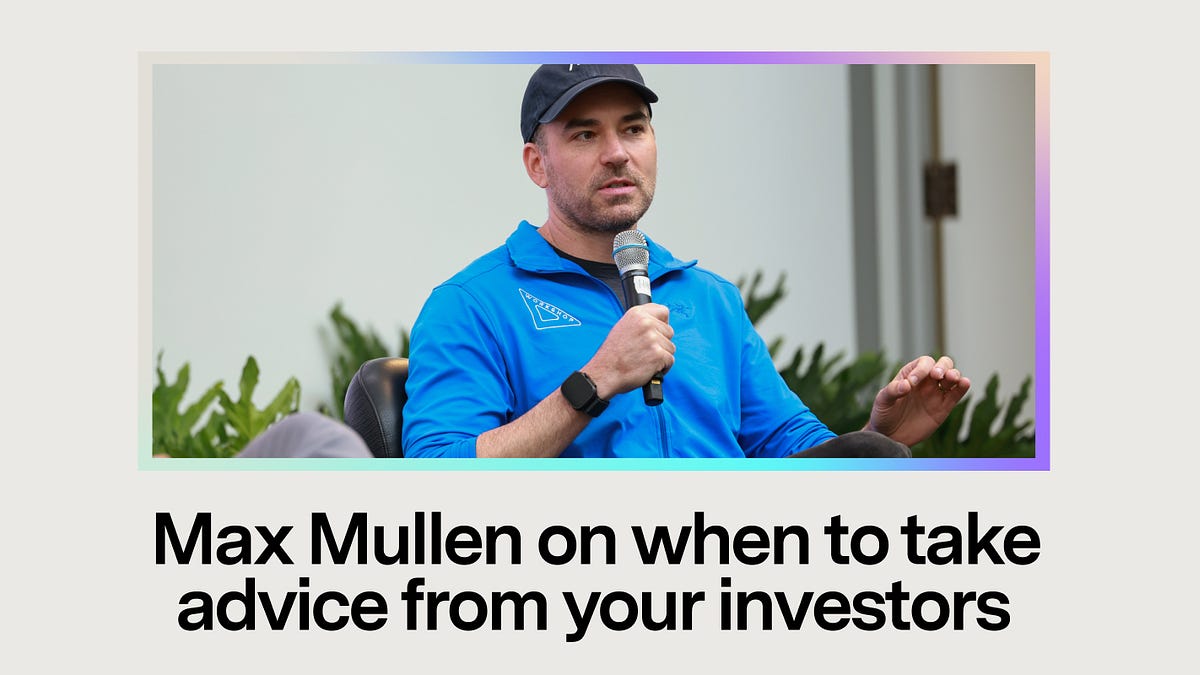
Max Mullen on When to Take Advice From Your Investors
25 Aug 20261 page~12 min full read
Key insights
7 slides
The framework
Investor advice falls into three distinct buckets.
Max Mullen categorizes advice into science, religion, and art. Investors add the most value on science-based questions.
Where investors help
Investors provide the most value on science-based advice.
Science-based advice concerns objective operational or product experiments. Religion and art decisions should not rely on investor input.
The caution
Founders must identify a worthy problem before scaling.
Startups must solve an unmet need that others care enough about to collaborate on. Premature scaling or branding cannot compensate for a lack of genuine market need.
Worthy problem. Startups must prioritize solving a worthy problem before secondary tasks.
The metric
Early-stage companies should align the team around one metric.
Aligning the entire team around a single, clear metric ensures organizational alignment. This can create a high-pressure, 'thrashy' environment.
100%
Instacart’s initial week-over-week growth goal in deliveries
Co-founder unity
Co-founders must keep disagreements strictly behind closed doors.
Co-founders who are not the CEO must subordinate ego to maintain a unified front. Disagreements must be resolved privately to prevent internal instability.
United front. Co-founders must present a united front to the team.
Values and trade-offs
Values without trade-offs are not genuine.
Founders should focus on building differentiated beliefs that include clear trade-offs. Viral social media trends are a distraction from this work.
The takeaway
Protect art, consult on science, and stay focused.
Founders should protect mission and strategy from external interference. They should consult investors on operational experiments and align the team on one metric.
Founder domain. Art-based decisions are the exclusive domain of the founder.
1 / 7
Ask AI about this report










Comments