1 free read left. Create a free account for unlimited reading + AI research.
Create free accountWhitepaper DiGRA
1 free read left. Create a free account for unlimited reading + AI research.
Create free accountWhitepaperDiGRA
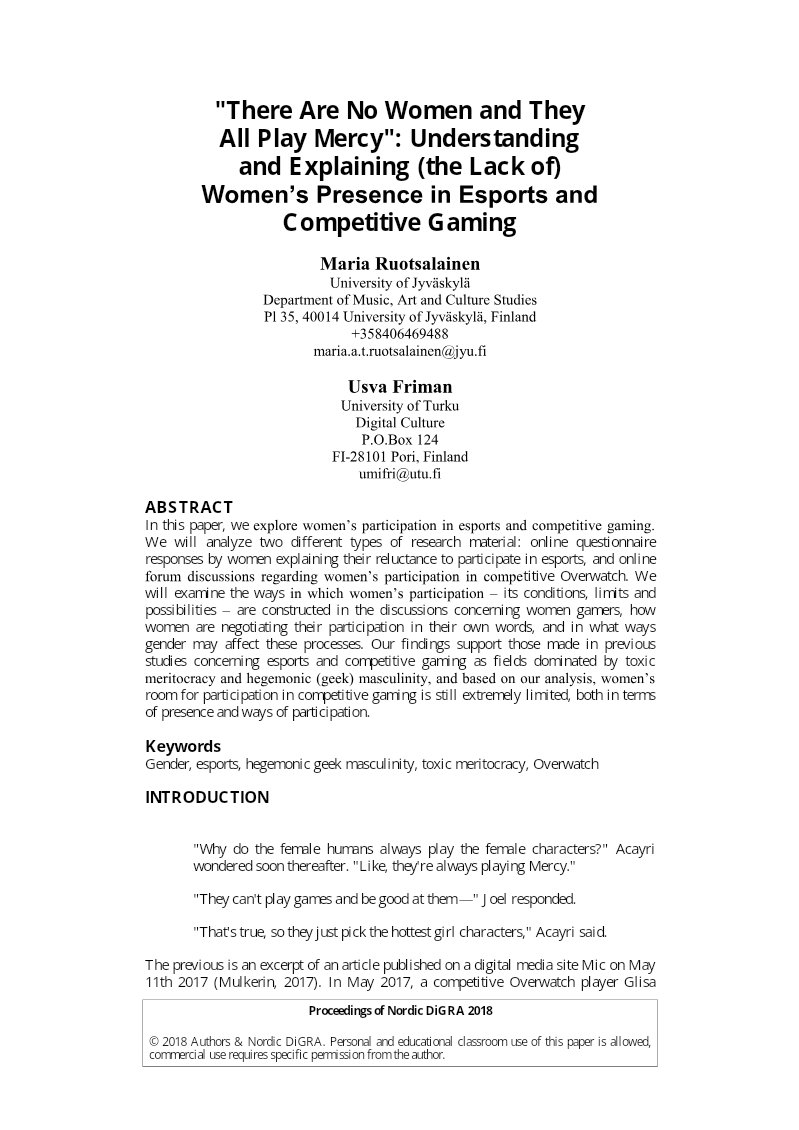
The authors argue that esports' persistent diversity, equity, and inclusion problems cannot be addressed through corrective measures such as women's leagues alone.
This paper, co-authored by Tom Legierse and Maria Ruotsalainen, argues that esports' persistent struggles with diversity, equity, and inclusion cannot be addressed through corrective measures alone, such as women's leagues. Instead, the authors contend that a deeper deconstruction of esports as both practice and representation is needed, with particular attention to how bodies are rendered visible, invisible, or impossible within competitive gaming. They propose applying the framework of transformative justice, which emphasizes accountability to those harmed and changing the conditions that produced injustice rather than relying on punishment, as a lens for rethinking access and participation.
The paper's analysis rests on two case studies. The first draws on ethnographic fieldwork conducted in Berlin between 2024 and 2025, combining participant observation and interviews across semi-professional gaming spaces, a single-game competitive community, and a queer community organizing amateur tournaments. The second examines discursive practices surrounding two women's and marginalized-player esports leagues, Game Changers for Valorant and ESL Impact League for Counter-Strike, analyzing media materials produced between 2022 and 2024 along with infrastructural elements such as prize money, broadcast scheduling, and player salaries.
Through these cases, the authors seek to show how structural conditions shape who can participate, while also capturing the lived experiences through which participants negotiate those conditions. The intended contribution is a framework that accounts for both the best practices already emerging in esports and the ongoing issues that persist alongside them.
Each row is a game or company this document names, each column a document, oldest first. A mark means that document names it. Select a row to see those documents.

DiGRA · 2026

DiGRA · 2026



DiGRA · 2026



DiGRA · 2026



DiGRA · 2026



DiGRA · 2026



DiGRA · 2026



DiGRA · 2026

DiGRA · 2026



DiGRA · 2026



DiGRA · 2026

DiGRA · 2026
DiGRA · 2025