1 free read left. Create a free account for unlimited reading + AI research.
Create free account
Keynote: 2020 so far - How the Mobile Gaming Industry is Changing PG Connects Digital #2
Key insights
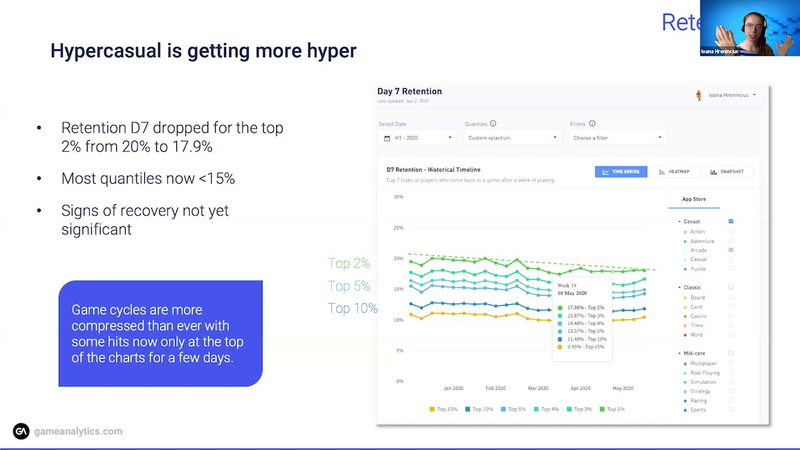
6 takeaways- 01Mobile gaming traffic stabilized at approximately 10% above pre-pandemic levels following a surge in early 2020, though Day 7 retention rates declined, particularly in the hyper-casual genre.
- 02Average session length has become the primary metric for driving lifetime value in ad-monetized models, as the gap in session duration between top-tier games and the broader market continues to widen.
- 03European markets offered more favorable acquisition costs compared to North American markets during the first half of 2020.
- 04The mobile gaming market experienced a decline in Cost Per Install (CPI) across most genres during the first half of 2020, providing a strategic opportunity for user acquisition.
- 05Consumer behavior has shifted toward sampling a wider variety of titles rather than committing to long-term play, necessitating robust LiveOps strategies to maintain engagement.
- 06Non-Asian-focused games faced an estimated 20% performance impact during the first half of 2020 due to shifting market dynamics.
Ask AI about this video
Transcript
for this start of the global trends track sponsored by binstock I'd like to welcome to the virtual stage a regular our events the CEO of game analytics to speak about 2020 so far and how the mobile games industry is changing so please give a virtual round of a wall of applause to Anna Brennan took from from game analytics iona how you doing a yu-er you'll set up Hey I'm gonna I'm gonna duck out into the background and leave it to you if you've got everything you need I would love to say that it's
great to see you all but I can't in any case it's at least great to be able to share this information with you just to put this into context this is extremely extremely fresh the data goes back literally to last week so it's very very new data some of it is from benchmarks flus so in the 2019 we at game analytics really release benchmarks plus it's a benchmarking tool that looks through core metrics in the industry and the top quantiles of games like the top 10% of things versus the top five percent 2% and so on so you can always tell how your game is doing come first or there is in the same genre four core metrics client retention special length IP revenue and most recently some advertising KPIs which we received from our friends from adjust the size of the
data is absolute absolutely massive so we truly believe a triplet represents the industry we've passed two billion monthly players when we launched this it was like 1.25 billion so network has been growing 22 billion monthly sessions a hundred thousand games so it is we feel a relevant data set for for the scale of the industry and these are some of the things that we're going to talk about today industry snapshot so literally what's been happening in the industry how things have been moving up and down what's happening with retention because I know many of you have been launching games and it's um you know retention has had a very clear pattern there's some learnings in session length CPI and of course we're gonna see how you can get these things from benchmarks as well okay so you know the moment you've been waiting for the industry change week on week so we've highlighted so you can see
this starts from like the first full week in January from the 6th of January the 25th of May and the change this highlights the dark line at the top is just overall use unique users that we see and the bars are the change that we have seen compared to the week before so every one of those bars represents changed in that way converts the week before so interestingly I want to highlight some things here when China started locked down as opposed to the other two regions so Europe the u.s. there was a small drop it seems like in China there the job just came the increasing traffic came the following week and I probably this is because of the time everything was new and it was taking time for people to adapt probably people were queuing to buy toilet paper instead of being under phones the first few days but still then there was we saw then a consistent increase in in traffic
and somewhat somewhat of a stabilization towards late February early March however the the big increase in traffic is the moment that Europe went into lockdown so mid March and then shortly after the US also started to go into lockdown if you have all seen some the same analysis we published later this year play time changes actually differently so the change in users seems to follow very clearly the actual moment and whereas the change in how much people were playing seemed to happen a bit earlier so people initially people started to play more with people that were already playing we're playing more and then more people were playing as well which probably explains why even though the growth is very high in March actually the peak and traffic is somewhere like towards end of
March beginning beginning of April that's actually when the peak happens so before kind of the growth starts to become negative of course because by then all this growth all this positive growth was compounded by the end of March and that's one thing this really really kind of peaked massively then things started to normalize a bit however you can probably see that the decrease the orange lines they do not make up for you know how much kind of growth growth there has been so generally traffic is staying higher than it has been before the pandemic it's hard to say what will happen next my assumption is that generally traffic will remain like at an industry level around at least 10% higher or so as more people again still people are not able to do the same activities as before but more people who start playing games continuing to play games people that were maybe not gamers before but yes and
you can also see that kind of please notice this period of April beginning of April to mid-may when the growth is negative because we're gonna be looking at this period in the next slides as well so now we're gonna go into retention and we're gonna see what happened over over this period so we're focusing on retention day seven for this because it's an indicator of kind of the general state of the industry and you can see that kind of that period when when the growth started to be negative so when things when traffic sorry when traffic started to go back to normal there is a drop in retention however there is also an underlying trend and retention of retention day seven going slightly down across the industry and the most affected by this are the best games it's interesting that this growth it's I think this changes it
affects about kind of 10% of the ratio of retention so we're going from about 25% for the top 2% of games to 22.5 so a drop of 2.5 absolute points but the change that you see in your particular studio or in each game will certainly depend on the actual genre of the game so the mechanics of the game some learnings here however we have seen that traffic has grown and people try more games but people also departed those games or they switch through multiple games instead of sticking to only one so we have seen in growth this growth in traffic led to a drop in retention in the following weeks another thing to look at in this graph is that there is quite a big difference between the top games all we're looking at here is top games so we're looking at only above the
top 15% high performers and between the top 15% and the top two percent retention t7 doubles it's it's quite so even when you start your game starts to get good there is an order of magnitude more then you can go to above that and because and I want to look at how this looks across regions as well because we just spoke about kind of the different events and I want to put that into context before we look more specifically at genres we're going to look at regions and platforms and one of the reasons I like this graph is that you can really see Europe behaves so like so conformist sometimes you know like it retention starts off quite high it's a 30 percent at the beginning and then there's a sudden drop and then stable at that level then goes back up it's not really returning to normal yeah it shows some
showing some signs of recovery not fully there but still generally the numbers are good so even during the that kind of bottom period retention is about 26 percent retention they seven so it's quite good in Europe compared to other regions in the u.s. US states introduced lock downs very gradually and they did other different times and we can see that there is kind of a slower drop and then faster recovery and retention is overall a bit a bit lower than retention in in Europe but still quite quite good in general close to close to 30 percent and if we look at platform this also paints kind of an interesting picture iOS users generally appear to be more stable so
they start off at about 25 percent globally which is you know around generally the rate of the industry let's say and it drops by about one full percentage point but generally generally then the numbers are stable whereas Android has kind of a slight a slight continued drop and whereas I always looks like it's slightly recovery entry is not recovering at the same rate it's probably worth right now and supplies to casual games by the way but it's probably worth right now truly looking at them at your games and by platform as well like making the making that differentiation if you look at the edit and retention in aggregate you may not get quite a clear picture of what's happening because by platform you may see different numbers overall retention is lower for Android so whereas for iOS
it's close to 25% so let's say between 23 25% for Android it's under 20% for pretty much all of the year so it's about 15 20 % in general lower than it is for iOS so it's worth it's worth looking at that and the overall facts of this period has has been generally higher something else that we've noticed we track a lot of hyper casual games we work with many of the top hyper casual publishers and we have certainly just anecdotally noticed that the lifecycle of games is getting very very short it it used to be a couple of years ago like two three months and then it came to three weeks and now it's truly like there's only a handful of days like you can see a game at the top four to three days and then there's another one so generally this trend was
had started kind of last year with retention and hyper casual decreasing and it's continued to do so we do look at arcade for this because it's the genre most associated with hyper casual the interesting thing is that for most most quanta so most games now perform below a 15% they seven retention whereas before even earlier this year it was much more normal to consider like above 15% good retention so right now in particular the numbers are slightly lower than what people are used to and again it can be it might be only temporary it might be that all these gamers who started playing are now going back to their regular lives or they shifted for many games so maybe it's not an indication of necessarily a trend that's going to you
know impact this forever but for certain this is not something that you like I said the trap started sometime last year and it's really felt I think I know publishers who were requesting like 20-25 percent they 7 retention and now even for your top 2 percent of games this is below 20 percent and it's only around 17.5 18 percent so definitely these metrics need to be slightly updated to current reality if you are testing a game right now yeah one thing different there's so some some bitter news compared to retention so we're going to look at every session like and whereas total playtime changes in the industry and you know it changes also with the with the new players and what people trying more games average session length is looks pretty rock-solid it hasn't changed that much and what I
want to highlight here in particular is that you know we mentioned that between like the top 15% and top 2% of gaming retention doubles but if we look at average session length between the top 15% and the top 2% of games the difference is like five times so truly it may be that if you want to draw increase the LTV of your players and you your model of motorization is primarily based on ads you can probably get more ads in per session by increasing the session length rather than increasing your retention by a full percentage point if you can probably increase your session length by one two minutes that that could probably make a bigger difference so definitely the difference is much much higher and in average session length in terms of what is good versus what is great
um secondly I want to you know sometimes these numbers for a top session length like what what is in session going adverse Asian one for top games look quite high so I wanted to give you the top ten of the I think this actually this is a top two percent for by genre and in casual in particular and I think for for most people these would be very relevant for core games we see some crazy crazy numbers where it's like hours and hours but for casual games you can clearly see a difference and this is why we use the arcade genre where arcade has the lowest session length and it's about half of everybody else's whereas for all other genres it's between like 45 minutes to an hour let's say what action being kind of the next kind of in between those probably you
know between kind of hyper and casual we see the action genre also something that we see here is the more kind of classic again like puzzle you know the higher retention the higher ASL it has puzzle games always do great and everything so I usually used to make a habit out of telling everybody to build a puzzle game and I want to show you in particular because we looked at arcade I want to show you how this differs across quantile so when we look you know at the top two percent it looks like you know near half near thirty minutes session length then still made I think many of you are probably wondering I like who has that like my game maybe has like four minutes or five minutes or 10 minutes and again this this is from the difference in the quantile so top 15 percent of games have an average session length of six minutes which is what most people identify a snackable hyper casual however top T percent of game is thirty
minutes so it's there is a massive massive difference in what you can get from these games in terms of average session line so so it's probably more even if you know probably like the top two percent argue maybe have some additional features that you may not be willing to add but just going a bit above there can can make a big a big difference and the multiplier really starts when we get like in the top 5% so that's probably what you want to aim to kind of go from the top 15 to the top 10 top 5% okay and looking a bit at what's happening to the acquisition of users like I said our friends and I just have been really great and providing us with this data we have this data for the beginning of this year so it goes to April right now and we're working on updating this I focused
on Europe and North America for the top 10% of games across genres some broad findings in here Europe is cheaper this is perhaps not necessarily a surprise because of course there many countries in Europe and they all vary quite a lot however the difference is significant it's like about half as cheap as traffic and in North America and it's a big market with some good tier 1 tier B + a - economies and it's um it seems like some like arcade for instance you know we're looking at 5 cents which is quite low compared to like 14 cents in North America which is you know something that everybody knows by heart it's like when would the cost for an install for a hyper casual game again core games are more expensive particularly RPGs
role-playing games are the most expensive games gambling some of the most expensive CPI's but generally for casual games with the exception of hyper casual we are looking in the u.s. between 20 cents and let's say between 20 and 35 cents and in Europe we're looking between 5 and I would say adventure is a bit of an outlier because it's it can behave some a bit more like core a core genre depending on the metric but it's generally between five cents and more like ten cents so it's the difference is really really high overall in like what we've seen is that the numbers keep going down one two months so in Europe you can see that January is higher than April in the US again January is hired
maple so CPI's have been going down which is of course very positive for people who are generating the revenue from gaming right now like this is the time to grow your audience really and but also some genres are stable you know genres are generally stable committed players like card casino or PG core gamers they you know that audience for those games where it's always engaged they're still engaged right now and they're still expensive okay so rundown of our key learnings because we've looked at a lot there are some signs of the industry going back to normal there are some signs of you know a traffic after it went down a bit it's now kind of starting a normal organic growth curve again usually June is a peak traffic month I don't expect that this month it will be I don't expect and get
back to April early April levels but certainly traffic seems to be resuming that normal pattern or it kind of goes up in June and then as people go off on all these reduces a bit in the summer and then goes back up in the cold season there is like retention is the fact that retention is decreasing is nothing new it's continuing we do expect it to slightly for this decreased kind of stabilized but it depends we still see it kind of generally trending downwards for Android more than iOS and we see the recovery being faster in the US rather than other regions average session length highly stable it has a good potential as a core metric people always look at it
but it's never treated as oh my god we have to increase such the link retention is much more treated like that and it's probably worth being handled in that way if you're looking for multipliers in terms of five when you liken increasing revenue 30% 40% 50% CPI's are dropping right now dropping almost across the board with the exception of literally two or three genres and Europe has on average higher return higher retention let's say by about 10% the world two percentage points up absolute overall compared to the u.s. North America but has half the cost of the CPI so you can potentially make good margin right now from European players and they also seem to be returning and games at higher levels in the past couple of weeks yes and that's pretty much it there is much
much more in which Forks place that you can actually see these are just some of the highlights in terms of what's been happening in the world literally until last week hopefully you find these useful and I think we're gonna go [Music] absolutely and thank you very much I know that was fantastic we have had some questions that people have dropped into the into the window there I don't know whether you can see them I'll read them out because I'm not sure if everyone can see them but so so we've got the first question we've got here is do you think that the excess of free time during lockdown makes players look at the games in more detail and thus get bored faster so would that explain the jump between games and then the follow-up question is is that an advantage to developers who are not in the top ten Silver Lining Endean so yeah well I guess you know discovery still matters
so being at the top in the top ten is always good more people will see you however yes people may jump more between games but I think it's also happening because people are going through the content much quicker like stuff that with because they have they can have more sessions even if the session length is the same they can probably would have normally taken them like a full week to play they can maybe now play in one day therefore they're likely to either get to a level that is too hard or simply just be like this is not for me and switch so I think there is potential with them switching games faster and then getting to your game yes but your game still has to be discovered but fortunately CPI's are low as well so you can do that more it's interesting yeah about the the different way people consume games perhaps when they're in lockdown I I imagine that a lot of people play games when they're commuting for instance which which would mean shorter pattern play times just by nature of the experience whether they sat at home they can they can play games
and devote more time to it I would have assumed that average session length would go down like would go either up or down if that's the case but it hasn't really so it may be that people have a bit either they're just following the same habits like they're playing the same amount of time in a single session that they were doing during your commute they're just doing like like before they sit down to cook or you know they're just splitting in a multiple session and navigating between apps and so on and taking breaks but actually it's the number of session that's this of sessions that's changed not the individual session so speaking of which I see we've got a question here about an average session length as the ASL is so low in hyper casual do events in games help increase the ASL or interest in the game is there any data showing that LiveOps heavy games are taking better advantage of the average session I can tell you that so I can tell you this anecdotally that generally yes so games that do live ups or more you know casual
with core features those games always always have like this is an adventure is such a type of kind of casual game right we saw like where CPI's are higher social links are higher so yes for sure and like I said hyper casual is notoriously low in LiveOps and you can see that it again has the half the social length of everything else so for sure I think adding content events can help you know double your session length as long as it makes sense with the game design of course great thank you we've got a couple more questions actually so I'll just keep going and please we've got a few minutes everyone so do drop some more questions in as people have been so psy asks what are what are the game cycles for hyper casuals so that is that is a good question so you know obviously there is no right answer to this is the kind of
thing with where you can have a game that has really high metrics but still it goes up and down because everything is so driven by how much you invest in the game again anecdotally what we see is that certainly still I mean let me give you split by answering to so I don't give like a wrong answer good games even in hyper casual can have a lifetime of more than a year however they will not necessarily be top charting in the top 20 for the full year they will have a peak and then they will go slightly down and then don't when as you do what dates that'll go up and down but they'll hover somewhere between like the top 50 and the top 20 in in that range you can still see these games usually six months later where they stay due to a large amount of players that they've accumulated over time and some ongoing some ongoing promotion so if
you're referring to that you can have a game that lasts for six months of 12 months even if it's only you're only been feeling really really good games like the ones that have been super hits are still there twelve months later but in short term again like it's it can be a week now can be two weeks at I haven't seen a game I think really being top-ranking I think for like a month and a half this year really I mean I can't think of one maybe there has been but I can't think of one right now great thank you and I'll tell you what we've got we've got another speaker coming on in a couple of minutes but there's one more question so let's let's do this one and then that could be our last question so an anonymous attendee asks how is the trend of eCPMs for ad monetization across Geo's and ad formats so hopefully in the next one we're gonna
be able to do this is well we're just starting to collect ad revenue in game analytics if anybody does work with us in here we're gonna put out an article on this and we're gonna have her own CCP and benchmarks I cannot wait but generally it's been depends a lot with with the region so for instance Asian eCPMs have been far stronger than North America and Europe that I know of because you know over there kind of things you know the like went down a bit in the beginning and then went back up especially China China since they're doing quite well and North America Europe things have the crease because there's less there's less advertiser competition in the market I've heard anything from like 10% to 50% drops in eCPMs with people who were more brand dependent being more impacted so literally if most of your advertising relies on other but even so if it's
other games like generally I would expect that you would have seen at least like 20% or something like that impact if you're not very Asian focus great thank you we're gonna have to leave it there Iona thank you very much I own a heretic the CEO of game analytics and email on the screen and if also if people want to catch up with you I imagine they can find you in the meet to match meeting system as well right but so you're gonna because I'm gonna give you a round of applause you're gonna have to imagine it coming from everyone else because they're all of it but thank you very much for joining us and that's fantastic and hopefully we'll catch up with you again at a future
Summary
The mobile gaming industry underwent a period of profound transformation during the first half of 2020, driven largely by the onset of global lockdowns. While the sector experienced a substantial surge in traffic that peaked between late March and early April, the long-term engagement landscape shifted significantly. Although overall traffic stabilized at approximately 10% above pre-pandemic levels, Day 7 retention rates declined, particularly within the hyper-casual genre. This trend reflects a broader change in consumer behavior, characterized by users sampling a wider variety of titles rather than committing to long-term play within a single application.
Despite these retention challenges, average session length emerged as a critical and stable metric for driving lifetime value, especially in ad-monetized models. Developers are encouraged to recalibrate performance benchmarks, as the gap in session length between top-tier games and the broader market has widened. This environment favors developers who prioritize robust LiveOps strategies to differentiate their products and satisfy users who are consuming content at an accelerated pace.
Market conditions during this period also provided unique opportunities for growth, notably through a decline in Cost Per Install across most genres. Europe, in particular, offered more favorable acquisition costs compared to North American markets. While non-Asian-focused games faced an estimated 20% performance impact during the first half of the year, the reduced advertising competition and lower acquisition costs created a viable pathway for expansion. By focusing on session length and strategic content updates, developers can effectively navigate the current volatility and capitalize on the shifting dynamics of the global mobile gaming landscape.




















Comments