1 free read left. Create a free account for unlimited reading + AI research.
Create free account
How Wooga sees the mobile games industry evolving in 2016 and beyond
Key insights
6 takeaways- 01The mobile gaming market is characterized by high maturity, intense competition, and significant revenue concentration among top-tier developers, creating substantial barriers to entry for newcomers.
- 02Mid-sized developers should adopt a specialized strategy by focusing on genre leadership, such as casual games, to build deep expertise and offset rising customer acquisition costs.
- 03Internal brand assets are prioritized over external intellectual property because internal franchises better leverage existing player familiarity and allow for the refinement of mobile-first mechanics.
- 04Sequels based on internal franchises are more effective than external IP because they improve marketability and user acquisition efficiency by aligning with established player bases.
- 05Mobile developers must transition from managing individual titles to cultivating a network-wide ecosystem that utilizes cross-promotion and portfolio-wide retargeting to increase aggregate user lifetime value.
- 06Sophisticated analytics are required to track user behavior across multiple titles and manage attribution, enabling developers to move from per-game performance metrics to a holistic network-based valuation.
Ask AI about this video
Transcript
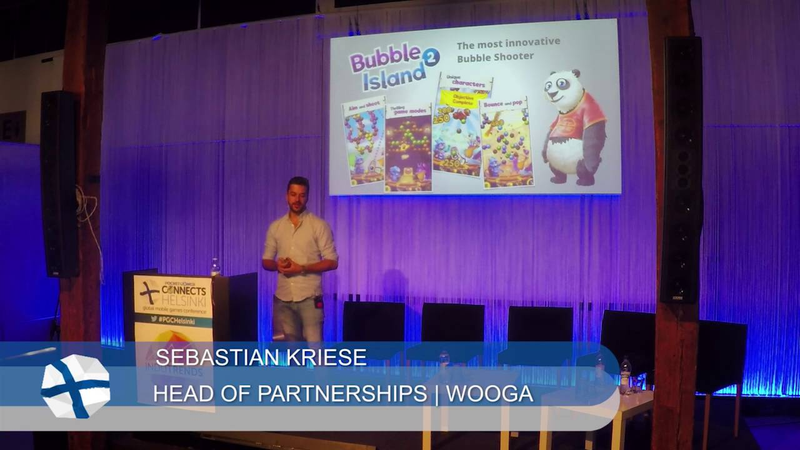
[Music] hello everyone I'm Sebastian I'm responsible for partnerships at Google bougas a mobile game developer based in Berlin 300 people over there and today I'm delighted to share a few thoughts about industry trends how we see the industry evolving especially focusing on the mobile games market and also what that means for our strategy at Google that is probably not coming as a surprise for you there are thousands of new mobile games launching every single day week month I think Pocket Gamer shared an interesting chart on their website about that is how that is developing over time and as you can see there are hundreds and thousands of games out there which
means like we are a really competitive market and also a very mature market if you look at the top grossing charts and the revenue distribution you actually see and that is probably also not a surprise that the top rings are getting the majority of the revenue there the top developers earning millions of millions are highly profitable while it's getting harder and harder for the long tail to actually develop a profitable game also considering that production costs are going up we believe that this will be even more extreme in the future which means like the revenue concentration at the top will become even stronger while it will be much harder for newcomers to enter the market and to be profitable in that space there's still a bunch of midsize game developers in there where we have to see over the next coming months and years how they will develop also we consider Wooga in one of these
mid size categories there and typical category stakes of these midsize developers that on the one hand side they had we still have one hit game that is generating life game revenues it's in life ups it generally generates millions of millions and these mid-sized can use this revenue that is being generated to invest into new options and to invest into new games so how does that translate for vaga and how do we see the market is evolving so when we started in the MOBA games industry it was all really young and early and it's very similar actually to sports in school you have people that are really good at sports so they go out there and every single category they're really good at however if you look into professional sports and into the professional environment there are no multi talents
usually people pick one category and they're extremely good in that category they train a lot they become the leader in that specific category and we believe the same is currently also happening in the mobile games industry and that's why game developers have to focus and that's why we at Google also focusing so instead of chasing random opportunities and having like a random portfolio of different games for us it shift was happening that we also realized over the last couple of months and in the future for us it's developing a portfolio of casual it's becoming the market leader of becoming the best in the category of casual hits so what we want to do is develop a network of casual games we want to develop on the one inside a lawyer player base of people who understand the brand values of Google who understand
the quality of buga games build up genre expertise and bringing the games to the next level of innovation in the casual space we do this because everyone knows lifetime value must be greater than CPI and we think if we become the best in one specific genre our life 10 layers can be higher than the competitors and we can spend more money on the on on the marketing side but anyway we also know CP is the high and marketing costs are raising so we also have to encounter that issue how do we approach the market how do we make sure that we can market our games when the market is so competitive and we have competitors that are able to spend millions and millions in money and I think they were already a couple of talks about this and also a lot of thoughts that we are currently in the year of IPs there a lot of ip-based
games coming out a lot of companies are acquiring IPS you'll also see a lot of movie companies walking around trying to find game developers to work on their IPs and so did we as we were working on a futurama game over the last couple of years that which we released earlier this year but if you look into the approach of developing IP based games you also have to consider that you have ever using IP and every single license has a lot of fans but what is the actual overlap of these fans with for example if you develop a builder game with builder games and how many of these people are playing Mitch three games it's actually not rocket science although sometimes people forget even for our futurama game we try to make some estimation there's a fan base of 30 million fans on Facebook how many of these fans would potentially enjoy image free game how many would enjoy a builder
game how many would maybe not play games at all and it probably also depends on the type of IPs that you're going to use and that you want to leverage in your game so we also took a step back and thought about what about booga I piece all the games that we develop in the past how are they perceived in the market because we know if someone played a game in the past and still knows that brand and license they would probably also enjoy similar games in the future for example we looked into bubble island it was our second game back in the days when Facebook was still really big was being played by more than 95 million people we got on Facebook 9 million likes for that brand and hasn't been touched since 2010 so we did some brand awareness surveys and also recognize that folks on the bubble island and this audience is really a lot of people know that bad and
I really engaged still with Bubba island and there's still a lot of daily active players on Facebook who enjoy the game so we took that chance and actually instead of just looking at external ip's and friends and how to maybe make a movie based game thinking about what if we take our old IPS back and also think about how to develop sequels for existing titles and existing genres and this is how we came up with one of our new games such as being launched in october which is a sequel of bubble island by violent you well chua where we basically took the time and the chances to understand how Bubba shooters work in the jar works but then bringing it to the next level of innovation by changing actually some tiny things in the core mechanic which makes it very interesting and it makes it a lot of more fun also to play on mobile devices so we're really looking forward to how
that is going to work and especially us on the marketing side we already did some early click tests and obviously like marketability test and we've already seen great results compared to other IPS a fee if you go for that approach so again the idea here is to leverage our network to lower CPI costs and to make sure that our lifetime value has become higher because as you all know especially in the casual space lifetime values are generally lower compared to mid qua titles this also means that we changed the way how we approach marketing in general so in the past three for example Ren performance campaigns on a per game level trying to get users for futurama where users for jelly splash use a full pearls peril and also consider it everything just on a per game base now we are changing that it approaches well and looking into
a player who is playing multiple booga games someone trying to understand how we can interact with our players and make them play not only jelly / but also our hidden object game pearls peril and then transferring them potentially also to bubble island shoes this also changed our whole marketing setup we started to do raymore in-game cross-linking for example if you run out of life life in one game instead of selling you selling interstitials in that position we cross promote to other titles and also highlight how many lives you may have on the other booger game we work raymore with retargeting getting players from one game to another game especially when they turned push notifications across games as well if there is an event happening and one of the other games that you're playing we are able to notify your across the portfolio and also give you hints and our existing titles
can use all that data obviously for emails and for social media and the whole goal actually here is to grow grill than Google Network LTV so instead of calculating and predicting the LTV on a per game level our goal here is to go one step further and calculate a booga network lifetime value of a player so we want to understand how much is the singer user not only spending one title but across our portfolio redirecting them but also attributed the revenue to then being able to spend more on the marketing side we do this because we want to build this network of casual games we believe that by becoming the best and one specific category we can compete in this very competitive market not only by building up the strong expertise but also by building up this lawyer player base by
activating our brand playing way more with our Google values to make us more successful and stronger in this market and with that I'd be happy for it to take your questions as well wow thank you very much [Applause] you're sure which is good yeah like that right now but ok to have any questions first question with we guys we're working with a lot of ip's just sitting elephants you have any other credit amount the question their arm in the air two of them with a lady of microphone garrett bubble island yeah very good question so Bob Allen two will
be mobile first only so it will be released simultaneously on iOS and on Google Play we are currently exploring the option and of like reactivating our old facebook user base and bringing it up there as well haven't decided yet so if you would do it it would be in a later step not on launch day we are currently exploring options you know also wake with unity Web Player we're like WebGL export and things like that we're considering seriously like also bringing it over again yeah yeah that's actually one of the biggest projects I've we currently just started so for us right now it's more about you know come at the current step it's
combining the different lt's that one specific user has across the games so we make sure that we identify users across titles and then calculating the lifetime value the whole attribution part is still work in progress and our analytics team is very much focusing on that also making sure that we use the right sources and also understanding when to for example cross promote a new title to your user without cannibalizing existing life than values right so it still work in progress so that's why I can't really share numbers but as one of the biggest projects actually for the upcoming run for our analytics team [Music]
Summary
The mobile gaming industry has reached a state of high maturity and intense competition, characterized by a significant concentration of revenue among top-tier developers. As production costs rise and the market becomes increasingly saturated, newcomers face substantial barriers to entry. Mid-sized developers, such as Wooga, must adapt by transitioning from a portfolio of disparate titles to a specialized strategy that prioritizes genre leadership. By focusing on a specific category—in this case, casual games—developers can build deep expertise, foster brand loyalty, and optimize player lifetime value (LTV) to offset rising customer acquisition costs (CPI).
A core element of this strategic shift involves moving away from reliance on external intellectual property (IP) toward the revitalization of internal brand assets. While external IP can attract initial interest, the lack of overlap between licensed fan bases and specific game genres often limits long-term engagement. Conversely, leveraging established internal franchises allows developers to capitalize on existing brand awareness and player familiarity. This approach facilitates the creation of sequels that refine core mechanics for mobile-first audiences, resulting in higher marketability and more efficient user acquisition.
To maximize profitability, the focus has shifted from managing individual games to cultivating a network-wide ecosystem. By implementing cross-promotion, in-game linking, and portfolio-wide retargeting, developers can transition players between titles, effectively increasing the aggregate LTV of a single user across the entire brand. This methodology requires sophisticated analytics to track user behavior across multiple games and to manage attribution without cannibalizing existing revenue streams. Ultimately, the goal is to move beyond per-game performance metrics toward a holistic network-based valuation, enabling more aggressive and sustainable marketing investments in an increasingly crowded marketplace.
























Comments