1 free read left. Create a free account for unlimited reading + AI research.
Create free account
How to get the most out of your ad strategy
Key insights
6 takeaways- 01Successful monetization requires integrating advertising early in the development lifecycle rather than treating it as an afterthought.
- 02Data-driven optimization through A/B testing and analytics is essential for balancing ad density with in-app purchase strategies to maintain a cohesive user experience.
- 03Publishers are increasingly using real-time behavioral segmentation to tailor ad experiences to specific player types, such as novices versus experts, to protect retention.
- 04The adoption of sophisticated ad mediation tools and dynamic cascades is replacing manual, homegrown solutions to optimize fill rates and CPMs.
- 05Advertising has become a core revenue driver, with many mobile titles now generating between 20% and 60% of their total income from ad placements.
- 06Industry sentiment has shifted significantly, with twice as many publishers now viewing ads as a strategic monetization opportunity rather than a necessary evil.
Ask AI about this video
Transcript
[Music] [Music] I've got quite a lot of slides so I'm gonna flick through them quite quickly I think you're one of the things that we have noticed at Delta D and I we've been going we reminded ourselves we've been going for seven years just to buy which were quite impressed with the Inc games industry is all about perseverance and keeping going and sticking around and over that seven years we have learned a tremendous amount about how to use data and analytics and CRM tools an ad mediation to balance game economies you know it's a constant challenge to balance the experience that you're giving the players with making money and actually over the last seven years I
think we've done it done a good job of figuring out at different dynamics by a couple of years ago we realized that we were missing an important leg of this three-legged stool if you think about engagement and in-app purchase revenues ad strategies seem to be a little bit sort of thought of by less than the other two now actually we saw some of our clients being quite cautious in terms of their ads and it and it felt like it was a necessary evil at that point in time we've done a survey over the last three years to just take a temperature check of the the industry the hundreds of responses from publishers and developers to see what the attitude is to ads as part of the game economy and there's been some really interesting trends in that so we'll share with you a bunch of charts basically that are interesting findings from the survey that we've done but in
the in the first instance let's just talk a bit about the context for for advertising in in games as I say we've been thinking about this for the last two three years and the reason that we got interested in this was that a lot of our clients did seem cautious in terms of their ad strategies they were waiting for 12:20 sessions they were cutting out the spenders and then there were being fairly aggressive in terms of of advertising different types of advertising as well and actually since I browned about 2015 we've seen a dramatic change in that I think part of this is because the industry is maturing I guess the first sort of two three years of our existence the industry was still figuring out free-to-play we're still trying to figure out water good free-to-play mechanics that gonna make
people stick around and ultimately gonna make money analytics went from being bolted on at the end of the development cycle to something that it was it was at the heart of how you develop games three a/b testing and I think that ad strategies ad implementations are moving earlier in that development lifecycle as well and that's giving you an opportunity as developers and publishers to refine your ad strategies to do a/b testing around ads to understand what is the right placement the right density and the right targeting of ads in the game and treat it just like you would engagement and in our purchase so that's been an interesting and quite a dramatic change I think in terms of attitudes to ads whereas now you know it would be unusual to see a big mobile title without ads in it an ads that are actually part of the game mechanic you get rewarded for doing something for consuming the ads and you're really making the ad within the
game part of the experience so that has been pretty dramatic and as I say we've moved from seeing our clients on the delta t and a platform being pretty cautious by dads so actually nice starting to refine their approach using ads as being mechanic using analytics to target the right density to different segments we talked a lot about behavioral segments that Delta DNA is quite often useful to think about how novice players will in tract with Yogi and compared to expert players so things like defining a novice player and segment in session one and then being able to start your ad strategy early in the game there's no reason why you shouldn't do that as long as the ads the implementation of the ads is thoughtful and you're taking this player first approach so over time we've
seen clients of ours achieve 60% plus in terms of their income coming from ads which is phenomenal because you know it's probably fair to say that the average is 20% on ads so of all of the things that you can do in terms of improving the game economy it seems to us through our analysis of economies and and player behaviors the improving your ad strategy is going to make your game Pro profitable and this is that of all of the things you could do the easier lever to pull it's not easy because nothing is easy in building video games but it's easier and there seems to be a lot more revenue that can be generated from our strategies and we'll talk a little bit about how that can be borne fruit Delta being a platform is a
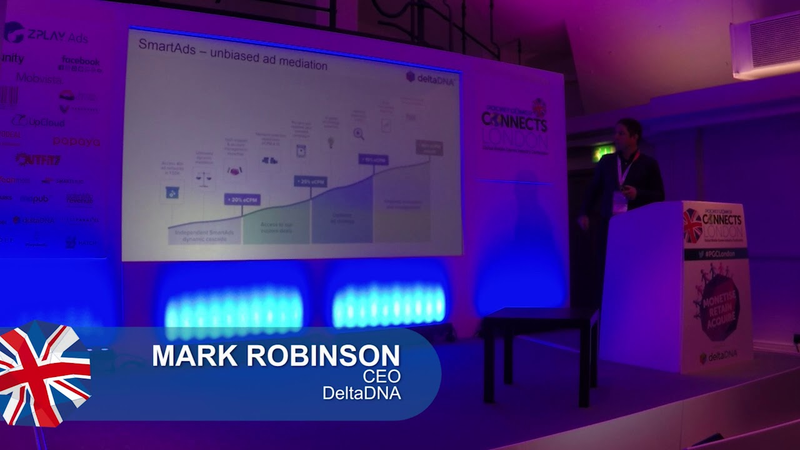
real-time engine data comes out of the game players are segmented in real-time and then you can deploy CRM that can be in-game messaging for offers gifts it can be push notification to reinforce those communications but importantly and this is about managing the whole of the game economy it's a buy ad strategies as well we've got what is called an unbiased ad mediation component to our toolkit called Smart ads unbiased because we're not an ad network we actually exist to shine a light in terms of our network performance and to pick the right ad networks for the particular combination of players and locations and devices but with intelligence I'm taking this player first approach by collecting this data you can then start to think about the player lifecycle so for example on this chart the particular player has declined our carefully crafted in-app purchase offers that's a
shame but we can learn from that so let's stop making offers for the time being and let's do a mixture of ad strategy it doesn't mean that you can't the offers into your course but the point here is that we're not taking this sort of more clunky approach to ad implementation cutting I the spenders and waiting until quite late in the game to serve ads we're not blending ads and in-app purchase and now we're thinking about different segments of players that we're going to implement these ad strategies in the Delta DNA toolkit supports all of that through segmentation tools ad mediation and CRM tools as well so the four components we see are important to delivering strong ad strategies coming looking at this sort of the bottom from from left to right independence Mart has dynamic cascade there's no reason in the world why you shouldn't access six 10 12 20
odd networks to get the best of fill and the best CPM for the impressions that your game serves dynamic cascades through mediation achieve that with technical reassurance there is still issues in terms of black lists and making sure that the technical implementation is smooth and comfortable near the Delta DNA dynamic cascade stack achieves that access to custom deals so buying par is based on impressions the more impressions the better deals you get generally so consolidating traffic with other users of our platform meaning that you can access those good CPM deals even if your game hasn't achieved those new high impressions yet optimizing your ad strategy we do a lot of work in our consulting team looking at games playing games and deciding where our placement is best how to target different segments of players and also how to get the
density right of ads those players what is the right format for them so thinking about this player first approach again and then once you've started to optimize of all of this and this is generally in beta but then continuing and LiveOps is keeping a focus on that part of the economy it's very easy to see your ad revenues tail off after the initial launch you got to keep working at it you got to keep focused on that and keep the the CPM is high so as I said that's just a bit of context we actually as I said before have been running this ad survey across the industry for the last three years we've got hundreds and hundreds of responses to this so we think it's a very good temperature check of where the industry is at and high the attitude to ads has changed over the last few years so what we'll do is a shooter time I'll do it fairly quickly but we'll run through some of the more important
findings here all of this data and information is on our website Delta DNA comm if you want to look at it in more depth the more time later on but here are some of the findings which I think back up some of the stuff that I've just said about developers and publishers being more thoughtful about ads understanding that there's a revenue opportunity here but taking it from a player first approach perhaps that hasn't been done so much in the past so what you can see is that and we we see that this is pretty representative data a very small minority of publishers and developers don't show ads at all some games new ads are not that appropriate maybe towards the hardcore end of the of the spectrum but even even if you look at sort of mid core games 80% are still showing ads casual games it's much stronger it's only seventy
percent seven percent of casual games that don't show ads and you can see you the breakdown there in terms of genre and you know casino social casino is this is the genre the less inclined to show ads sometimes do the blacklisting issues showing other social casinos but certainly there's no reason why that genre couldn't benefit from a less cautious ad approach to ads in general we're talking here about the attitude to ads in terms of cautious versus aggressive as I said before we've seen the industry going back to three years being very cautious about ads we have seen over the three years of the survey a very dramatic shift we're getting the balance right is an important objective and it's not to say
that ads are aggressive night it's just less cautious and better balanced there's no reason why you can't start sending ads in the early sessions as long as you know who you're sending them to and why and what the value exchanges in terms of that you know we have seen casual gamers have a stronger approach to ads and this demonstrates itself in terms of ads in the first session more likely to show ads to paying players so that you're starting to blend that economy and we've we've seen anecdotally that paying players do respond to rewarded video as a way of supplementing their engagement with the game frequency was another aspect to this and what is
the concerns and the worries about ad frequency this kind of split slightly when you look at mid core games versus casual games midco games are still worried about churn and enjoyment and that's fair enough for mid core richer deeper environments you might think that ads are need to be carefully deployed there so that doesn't get in the way of the game it's seen as a real valuable asset to the players and therefore any any concerns by charing are prevented console games much more near the game can be much more integral part of the game mechanics therefore the worries for casual games are much more about Phil and CPM and this is where you can really start to get access to good Phil and CPM through mediation tools next we'll talk about revenue and over the three years of the
survey the percentage of income that comes from ads has dramatically moved from the left-hand side of this chart to the right hand side the distribution has shoved very strongly to the right hand side where now we are seeing you know a decent proportion of games making most of their revenues from ads that we haven't seen until the last last year to where the ad income now is surpassing the in-app purchase income but certainly in that mid-range we're seeing the many publishers forty percent are generating between 20 and 60 percent of ads whereas before the average was below 20 so that does show that in terms of the industry the revenue generated from ads is is not growing strongly and what ad sources are
used this is another area where there's been a dramatic movement quite a lot of people will use exchanges historically people have used their own sort of homegrown cascades and accessed two three four networks but as a developer publisher that's quite hard work does take a lot of setting up in terms of the attack and they're really and as well that the relationships of the ad networks and it does take constant monitoring and supervision because you know in the technical implementation of these things you know it does take does take some work so over the course of the three years we've seen a big growth in terms of mediation solutions and of the obvious benefit for this is access to multiple networks some reassurance and comfort that the technical implementation is going to be smoother in terms of the mediator having wrinkled I all of the
issues and getting access to multiple networks and taking the data across this network so you can be making smart decisions about your your ad strategies and it's the smart decisions it's shining a light on the ad network performance and balancing all of that that is incredibly important to get your ad revenues to where you want them to be so that means the consequent to that shift towards mediation publishers are accessing many more networks than they used to before you there are there are significant numbers of publishers that are accessing at least two to five networks many more than that and with in mediation tools youth in 10 12 20 networks is no problem so that's been another big shift over the last three years people using six-plus networks is
now at 17 percent whereas previously it was 8 percent in the previous year study and this the the last couple of slides here are quite a nice summary of the sentiment towards AD strategies the first couple years of survey the big message was the ads were seen by the industry as a necessary evil and I think the reason for that is the sense of a lack of control concerned about technical implementations worried about it being a reason for churn and over those years I think you know we've moved on as an industry in terms of having a smarter approach to ads a mediation the technical concerns have been I've been wrangled taking a player first approach using analytics to segment players and unbalanced you have strategies incredibly important and I twice as many
publishers believe that ads are an important monetization tool rather than a necessary evil which is a dramatic change in the mindset under and the right one in terms of making sure that your game as a marketplace is doing as much as it possibly can to deliver a great experience but also make money at the same time and so this is the last chart I think we asked for people's sentiment and you can see that 2016 there was a big spike in terms of cautious approach the cautious approach to ad strategies and that has diminished significantly where now people are feeling much more confident that they've got a balanced approach to ads and that's great that's what we want new with tools like Delta DNA people to be able to be confident about their ad strategies within the context of the overall game balancing we know that these are challenging things to do it's
hard to design and run these games profitably but I think with data shining a light on the player experience and making sure that your monetization strategies are appropriate for different types of players that really unlocks European success so conclusions we're still evolving fast I think we're sort of halfway through a 15 year transformation here we're still learning but we've come a long way in the last six seven years I think in terms of using data to figure out what it feels like from the players point of view ads are a natural part of that balancing engagement in-app purchase and ad strategies and making sure that we recognize it as a revenue opportunity and not leaving it to the last minute in the beta testing and the soft launch to jam outs into the game let's think about it in terms of a/b testing strategies and game balancing and through that
route the player first approach managing the whole game economy becomes within reach that really does drive your game success so hope that's been interesting as I say there's lots more content on that on the website dealt the DNA comm but for now thank you for listening [Applause] [Music] [Music]
Summary
The mobile gaming industry has undergone a significant shift in its approach to advertising, moving from viewing ads as a necessary evil to recognizing them as a vital, strategic component of game monetization. This evolution is driven by a more mature understanding of free-to-play mechanics, where developers now integrate advertising early in the development lifecycle rather than treating it as an afterthought. By leveraging data analytics and A/B testing, publishers are increasingly able to balance ad density and placement with player engagement and in-app purchase strategies, creating a more cohesive and profitable user experience.
Data collected over a three-year industry survey reveals a clear trend toward more aggressive yet balanced ad strategies. While historically cautious, publishers are now utilizing sophisticated ad mediation tools to access multiple networks, which optimizes fill rates and CPMs. The industry has seen a notable increase in revenue contribution from ads, with many titles now generating between 20% and 60% of their income from advertising. This transition is supported by a player-first methodology, where developers use real-time behavioral segmentation to tailor ad experiences to different player types, such as novices versus experts, ensuring that monetization efforts do not negatively impact retention.
The current landscape emphasizes the importance of technical infrastructure, such as dynamic cascades and unbiased mediation, to manage ad performance effectively. By moving away from manual, homegrown solutions toward integrated platforms, developers can maintain control over their game economies while maximizing revenue. Ultimately, the industry consensus has shifted: twice as many publishers now categorize ads as an important monetization opportunity rather than a necessary evil. Success in the current market requires continuous optimization and a commitment to treating advertising as a core element of the overall game economy, ensuring that monetization strategies evolve alongside player behavior.

















Comments