1 free read left. Create a free account for unlimited reading + AI research.
Create free account
How mobile games went from Snake to a $50bn industry in 20 years
Key insights
6 takeaways- 01Mobile gaming has grown into a $50 billion global industry, now accounting for over 50% of total gaming end-user revenue and exceeding the combined earnings of the film box office and recorded music industries.
- 02The free-to-play model is the dominant commercial driver, with 22 of the industry's top-performing titles utilizing this monetization strategy.
- 03Modern market success is increasingly dependent on sophisticated user acquisition strategies and navigating rising advertising costs, as new games are released at a rate of one every few seconds.
- 04The industry’s transition from pre-iPhone era limitations to a meritocratic app store ecosystem enabled the rise of 20 mobile gaming 'unicorns' that have each generated over $1 billion in lifetime revenue.
- 05The mobile gaming market has successfully scaled to a global user base of 2.5 billion people.
- 06While hyper-casual gaming currently drives immediate revenue, blockchain technology is considered a long-term catalyst rather than an immediate market disruptor.
Ask AI about this video
Transcript
I put together this piece because it dawned on me that it's actually 20 years since the industry was born and it was born here in this country so I think it's time to to look back and and think a little bit about what's what's happened over those years and over the previous I saw the previous two presentations I walked away feeling really smart and I learned about that monetization and whatnot I guess this is a little bit more of a cultural piece and I look back in history Zhai if you learn something great that wasn't really the intention of mine there's gonna be lots of graphs and figures indeed both because I'm an economist by trade and also because I I want to look smart and numbers numbers make me look smart for journalists Chris I guess you're taking notes there's there's journalists
friendly punchlines this is to make it very simple we give away everything at the beginning and and then you can walk to the next show and and also this is all for the people with severe attention disorders like myself there's also to keep me on track number one we went from snake to fifty billion dollars you know and users are spending less than 20 years and that's much thanks to free-to-play frictionless distribution and universal UI and this year mobile games will represent over 50% of gaming end-user revenues and it's a bigger industry than worldwide recorded music plus box office together now let's see whether these facts are indeed so we're gonna go up walk a little bit back in time and start at the beginning this is where it started 1997 from the hands of software engineer Donnelly Armando Espoo Finland about 10 minutes 15 minutes drive from here
little did we at least did I know what kind of a revolution in video gaming culture and business this would create over the next 20 years so we asked ourselves what the hell happened here twenty years and you know this is worth the pause because this is the first time a video gaming history where we have across all these main platforms we have the same game being number one across all them that's the first time so it is it is a indeed a big milestone in the industry so what happened in between these two in only 20 years and mind you I have only about 15 minutes to tell that story so it's only so much per year well the last few years have been pretty amazing this is worldwide games and user spending it's growing a lot and it's growing predominantly because of mobile this is
what mobile looks like as a piece of of the bigger pie and as you can see this year I haven't I haven't added the 2018 because I want to look backwards at the facts but this year Mobile is gonna be as an individual piece bigger than console and PC together staggering growth over the past few years why why is that so well three main reason 2.5 billion users can be reached with arguably debated lis lo distribution costs I'm getting to a point here but compared to where we were the distribution costs are in fact low today number two universal user interface touch with killer apps being defined ages ago already fragmentation even though some of us think that think that fragmentation is an issue on Android you should have been working in the industry some years ago when fragmentation actually was an issue and number three free the games are free to download and
ninety-five percent the people don't pay in those games so the free value proposition is a huge catalyst for growth so as I also argued if we compare to other forms of media entertainment box office and and the worldwide recorded music that's what that looks like recorded music ain't growing so much neither is the box office whereas mobile games is like a sky and the scale is the same across all all the graphs so it's for easy reading so who would have known a few years ago that this would be the case because it certainly wasn't always so mobile games was perhaps an even harder industry back in the days than it is today at least a different kind of difficult and it did take a few steps to get where we are today so we're gonna jump in this time machine and go backwards in time and look a little bit where we came from so I guess
maybe some of you have heard me talk through this story before and with the punchline being that that there that hockey stick over there hang on there that represents free to play that represents the in-app purchase technical technical innovation on the on the platform and I have all kinds of other finding funny anecdotes on the slide as well this time I won't do that I would just show everything at once those are some of the milestones of the industry there's a lot to be told and there's a lot left out but this time let's talk instead about the unsung heroes of the story let's go back back a bit a bit further and ask ourselves what was it like in the iOS in the pre iOS era of mobile games the first 10 years let's plot that instead we are we're still following end user generated revenues
just because you might follow money usually you get to some sort of facts and and truths for journalists again we're making this a little bit more clickbait the-- you won't believe these four old facts about mobile games first up what you will see is that the left-hand scale those are single digits right so this is not um a huge industry at this point yet so ten years ago 2008 all the mobile games on the planet they summed together to less than the very top video games today can make in one year so that was the size of the industry but let's go to those four interesting facts along the way number one when the industry was very very small some of us literally
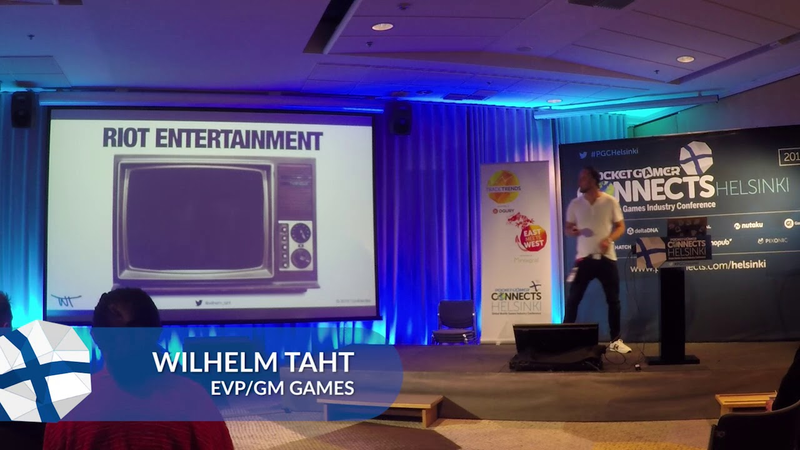
tried to do the impossible we're gonna go straight to right entertainment variety was a finished mobile game startup in the late 90s early 2000 that tried to create create global mobile entertainment when technologies like brew like j2me Java or Symbian were still years away now interestingly these guys also had a higher valuation at their a round than the entire mobile games industry would generate for many many years to come this here is the trailer to the infamous riot on documentary it is available for free on youtube worth checking out six young men from finland and we'd like to have sound six young men from Finland are about to get 20 million dollars to start a revolution a revolution in mobile
entertainment 666 working days later it was all gone I think they left something in the region of three or four million euros also in depth as they as they closed doors so fast forward we were dealing with what today feels like the most mundane bizarre things things were a lot less obvious back then than they are today and for that when you're gonna go to the Nokia ngage QD value proposition I guess a lot of us remember the engage and in here Nokia is promoting the key features and positioning at what really feels today like a totally different time
[Music] so naturally this is but one example but in here the value proposition was that you can change games fairly easily times were radically different when this was the TV ad to drive mobile games adoption right so again Fitbit for further this perhaps is the most important piece and the most important piece that really changed eventually with the App Store's popular games were really bad quality and this was a plague that was gonna keep the industry from growing for quite some time a bit of a mouthful but we're gonna go through it anyways bad games lead to
high churn now picture an environment where there was no free demos really there was just descriptions of games and screenshots on lackluster mobile web portals to download a mobile game you would have to part way with your hard earned cash without knowing much of anything in advance for the of the game and naturally you'd expect to find the very best games in the top ten lists right top ten was usually filled with branded big IP games which tend to sell well in the featuring spots problem was they were often badly designed and developed and badly developed money grabs a ripoff to top it off there weren't any user reviews at this time so what I present here next is the average review scores by the industry
journalists this is where Chris James comes in at the time so this is this is how industry reviewers were rating the top sellers at that time in 2008 the games in Italy were really amazing now interestingly as a result gamers who bought these games they wouldn't come back oftentimes you'd pay for a game you've never actually received the game to begin with but if you did you're pissed off that it was a bad game so just for comparison points I took yesterday the u.s. stopped and grossing average score and and mapped it on a similar scale and this is what that looks like today this is the top ten in the u.s. from a quality standpoint things have changed dramatically because of then the amount of games and the frictionless distribution and just simply the fact that the best games sell
and poor games don't alright the last one we actually came pretty close before the iPhone already there were the right elements but it was they were just cooked with the wrong recipe we were almost there and for that we welcome back Nokia ngage back on the stage we present here the nokia n8 e1n 81 was not only a great name for a phone it was also the first to sport the engage platform and it really did get a lot a lot of things right let's cute a video [Music]
[Music] [Music] [Music] [Music] [Applause] [Applause]
now imagine those were simpler times a smartphone with a 3.5 millimeter headphone jack the truth is nokia got a lot of things right with the n-gage but it was unfortunately plagued by bad execution poor distribution power and fragmentation and a lackluster technology so fast-forward to today this is here this is us guys and also a great mean that we surrett we should resurrect making games is hard and making successful games is even harder given that there's been phenomenally successful mobile games come out of nowhere there is a lot of supply on the market that graph basically tells us that there's a new mobile game every second second minute and that type of market to succeed you got to be really really really good and since there's a lot of good games that can now afford to buy advertising space to promote their
games the price for that advertising space has gone up way up as such I guess the age-old saying to succeed in mobile games you have to do more than just a good game so how much more than well and here is some of the things that you need to be able to succeed in mobile games in fact what a lot of things to think about and in here it's nothing new but I think the most important lesson here is if you don't enjoy the top-grossing games or any of the top grossing games in mobile you probably not want to make one because those games were voted by consumers with consumers money to be the best all right so the final punchline the whole video gaming industry has indeed changed because and thanks to mobile games this is fertile ground for success so one would imagine that there's been quite a lot of success in the space quite a lot of unicorns caught in this space indeed it is so so with
the final piece this is what this looks like video gaming unicorns games that have grossed over a billion in lifetime revenues we look back over those 20 years we look at the whole video gaming industry and the first ten years of mobile there was 18 games on PC / console that dawned and made over over a billion in lifetime there was zero on mobile and three out of those 18 are free-to-play we go move forward o 8 to 18 6 on PC that's interesting that's dropped quite a lot so we asked ourselves what does it then look like on mobile there's 20 on mobile and out of those 26 22 are free to play interestingly 6 of those are from Scandinavia so in terms of the future well that wasn't really the topic and
there's a whole heap of other magicians to talk about that at this conference but in sum I think the future looks bright in our fight to cure boredom of consumers worldwide in some [Applause] a lot happened over those 20 years way more than you can recount in 20 minutes I did my best and this year mobile games is breaking records and in 2019 it's gonna be breaking records again and then we can compare it to perhaps other industries than music and the box office thank you okay anybody have a quick question for Wilhelm ok I'm what what industries are we going to compare it with like the arms business what our business is damn big so as so is the illegal drugs business is also too big
to compare for the time being so so there's your top reference points weapons and drugs but apart from that one quick question I do actually a very good talk always always good always good to have you here this is a trans to track what of the current industry trends hyper casual blockchain PvP what what do you think is gonna drive haven't gonna drive most revenue growth in the next 12 months give me one or two it's finally probably in terms of the existing aspect I would have to say probably have piper casual is continuing to continue grow blockchain will take some time so well some of these other areas I think the to adopt or to create the game that utilizes blockchain it changes a lot of things that you have to think about in the game and and it's more of a catalyst for for for the future rather than a revolution yeah all right
[Music]
Summary
The mobile gaming industry has undergone a transformative evolution over the past two decades, growing from the rudimentary origins of Snake in 1997 to a dominant $50 billion global sector. This growth trajectory has been fueled by the transition to free-to-play models, the implementation of frictionless distribution, and the adoption of universal touch-based user interfaces. Today, mobile gaming represents over 50% of total gaming end-user revenue, surpassing the combined global earnings of the recorded music and film box office industries.
The industry’s early years were characterized by significant technical and commercial hurdles, including device fragmentation, poor game quality, and a lack of transparent user feedback. During the pre-iPhone era, consumers often purchased games without demos or reviews, leading to high churn rates and a market dominated by low-quality branded intellectual property. The shift toward the modern era was marked by the rise of app stores, which enabled a meritocratic ecosystem where high-quality, free-to-play titles could thrive. This shift is evidenced by the rise of gaming "unicorns"—titles generating over $1 billion in lifetime revenue—of which 20 have emerged on mobile platforms since 2008, with 22 of those being free-to-play.
Current market conditions present a highly competitive landscape where a new game is released every few seconds. Success now requires more than just high-quality design; developers must navigate rising advertising costs and sophisticated user acquisition strategies. While emerging trends like hyper-casual gaming continue to drive immediate revenue growth, other technologies like blockchain are viewed as long-term catalysts rather than immediate market disruptors. Ultimately, the industry’s success is defined by its ability to scale to 2.5 billion users, effectively monetizing through free-to-play mechanics while maintaining a high standard of quality that resonates with global consumer demand.




















Comments