International Game Developers’ Association
Association8 documents
Documents
Article
Local Mentee Directory: Berlin
IGDA Berlin launches a local mentee directory to support developers, students, and aspiring professionals across all game‑development disciplines in the city. The initiative invites individuals interested in game design, programming, art, production, QA, marketing, and related fields to sign up for a flexible mentorship program that offers casual one‑on‑one “Mentorship Café” sessions with experienced industry veterans. Participants can choose session times that fit their schedules, ensuring no strict timetable or pressure while still gaining exclusive access to networking opportunities and career guidance.
The program targets Berlin’s status as one of Europe’s most diverse game‑development hubs, aiming to help newcomers find their place within the local community and build professional networks. Sign‑up is facilitated through IGDA Berlin’s online portal, with additional support available via email at [email protected]. The initiative is part of IGDA’s broader effort to nurture talent and foster collaboration within the German gaming sector, complementing other regional IGDA chapters such as those in British Columbia and Vancouver.
Overall, the mentee directory offers a low‑commitment, high‑value platform for career development in Berlin’s vibrant gaming industry, leveraging experienced mentors to guide participants toward growth and integration into the local ecosystem.
- IGDA Berlin has launched a local mentee directory to connect aspiring professionals with industry veterans across all game development disciplines.
- The program features a flexible 'Mentorship Café' model, allowing participants to schedule one-on-one sessions without the pressure of a strict timetable.
- The initiative is open to individuals working in game design, programming, art, production, QA, and marketing.
- The directory aims to integrate newcomers into Berlin’s gaming ecosystem and strengthen professional networking within the region.
- Registration for the mentorship program is facilitated through the official IGDA Berlin online portal, with additional support provided via email.
+1
International Game Developers’ Association
Article
IASIG Audio Education Working Group (EDU-WG)
The Interactive Audio Special Interest Group (IASIG) has established an Education Working Group (EDU‑WG) in June 2026 to foster global collaboration between academic institutions, educators, students, and industry professionals focused on game audio and interactive sound. The initiative aims to connect schools worldwide, share best practices, and strengthen career pathways into the audio sector. Target participants include university and technical school faculty, online curriculum designers, student clubs, industry mentors, and students eager to shape educational trajectories.
Key benefits for students are direct access to industry experts, real‑world career insights, community belonging, leadership development, and a platform for student voices. Teachers gain from a global educator network, curriculum alignment with industry needs, shared professional development resources, visibility for recruitment efforts, research and publication opportunities, and improved student outcomes.
Planned activities comprise monthly virtual meetings, curriculum and resource sharing, conference panels, workshops, mentorship programs, and student pathway initiatives. A free industry Wiki is slated for launch to provide accessible resources. The working group invites IGDA/IASIG members and others worldwide to join via a sign‑up link, participate in Discord announcements, and contribute to building an inclusive, industry‑aligned game audio education community.
- The Interactive Audio Special Interest Group (IASIG) launched the Education Working Group (EDU-WG) in June 2026 to bridge the gap between academic institutions and the interactive audio industry.
- The initiative aims to standardize game audio education by aligning academic curricula with current industry requirements and professional best practices.
- Students participating in the program gain direct access to industry mentorship, career development pathways, and platforms for leadership and community engagement.
- Educators involved in the working group receive access to a global professional network, shared teaching resources, and opportunities for collaborative research and publication.
- Planned operational activities include monthly virtual meetings, industry-led workshops, conference panels, and the development of a free, centralized industry Wiki.
+1
Interactive Audio Special Interest Group
Article
Local Mentor Directory: Berlin
The initiative seeks to expand IGDA Berlin’s mentorship network by inviting experienced game developers across all disciplines—design, programming, art, production, QA, marketing and related fields—to volunteer as mentors. The program emphasizes flexibility: participants can choose when and how to engage, with no mandatory time commitment beyond occasional 1‑to‑1 “Mentorship Café” sessions. The call to action targets Berlin, a leading European game‑development hub noted for its diversity and growing community. By fostering connections among seasoned professionals and emerging talent, the effort aims to strengthen local industry cohesion, support career development, and promote inclusivity. Interested mentors can register through a Google Form linked on the page, while inquiries may be directed to [email protected]. The announcement is part of IGDA’s broader global mentorship framework, which includes similar initiatives in other cities such as Vancouver and Costa Rica. The outreach is supported by IGDA’s existing resources, events, and community channels, underscoring the organization’s commitment to nurturing talent pipelines within the German capital.
- IGDA Berlin is launching a local mentorship initiative to connect experienced game industry professionals with emerging talent across all development disciplines.
- The program operates on a flexible model with no mandatory time commitments, requiring only participation in occasional 1-to-1 'Mentorship Café' sessions.
- The initiative aims to strengthen Berlin’s position as a major European game-development hub by fostering industry cohesion and promoting professional inclusivity.
- Mentors from all sectors, including design, programming, art, production, QA, and marketing, are eligible to volunteer for the program.
- This Berlin-based effort is part of a broader global mentorship framework already established by the IGDA in cities such as Vancouver and Costa Rica.
International Game Developers’ Association
Article
Resources: IGDA
The International Game Developers Association (IGDA) maintains a comprehensive digital resource repository designed to support game industry professionals through advocacy, standardization, and community-driven knowledge sharing. The primary purpose of this archive is to provide members with access to technical specifications, best practice guidelines, and professional development materials that address the evolving needs of the global game development community.
The repository covers a wide range of industry segments, including game audio, legal standards, mental health, accessibility, and environmental sustainability. Key findings and resources within the archive include technical documentation for audio formats, such as the Interactive XMF specification and 3D audio API extensions, as well as operational guidance on game crediting standards, business sustainability, and labor practices like the mitigation of crunch culture. The collection also features specialized content on emerging topics such as blockchain, the metaverse, and climate-conscious game design, reflecting the organization’s commitment to addressing both historical and contemporary industry challenges.
The scope of these resources is global, spanning several decades of industry research and collaborative output from various Special Interest Groups (SIGs). The methodology for these materials relies on expert-led working groups and collaborative research, resulting in a diverse library of articles, webinars, and technical guides. By centralizing these assets, the organization facilitates professional growth and standardized practices across the international development landscape, offering members a structured framework for navigating the legal, ethical, and technical complexities of the modern gaming industry.
- The IGDA maintains a centralized repository of technical specifications and industry standards, including documentation for Interactive XMF and 3D audio API extensions.
- The archive provides operational frameworks for professional game development, specifically addressing labor practices such as the mitigation of crunch culture and standardized game crediting.
- Resources cover a broad spectrum of industry segments including legal standards, mental health, accessibility, and environmental sustainability.
- The repository includes specialized research and guidance on emerging technologies and trends, specifically blockchain, the metaverse, and climate-conscious game design.
- Content is developed through expert-led working groups and collaborative research from various Special Interest Groups (SIGs) spanning several decades of industry output.
International Game Developers’ Association
Report52 pages
Developer Satisfaction Survey 2023 - Summary Report
The 2023 global game development landscape is defined by a period of intense economic contraction and employment volatility, marked by the highest rates of layoffs and terminations recorded since 2014. While the workforce remains predominantly composed of highly educated men in their thirties, there is significant representation from neurodivergent and LGBTQ+ communities. Despite a broad consensus on the importance of workplace diversity, a profound disconnect exists between corporate policy and reality. Two-thirds of developers report that equal opportunity does not exist within the industry, and fewer than half believe that existing equity policies are adequately enforced.
Labor conditions remain a primary concern as "crunch" culture persists, with nearly one-third of developers working over 60 hours per week during peak production cycles. This instability has fueled a growing interest in unionization, particularly through national sectoral unions, as workers seek to address a lack of transparency in crediting and disciplinary procedures. Financial disparities are also widening between full-time employees and precarious workers. While a majority of full-time staff earn over $50,000 annually with access to healthcare and retirement benefits, 66% of freelancers earn below that threshold and lack basic protections such as paid sick leave or vacation time.
The industry’s overall benefit structure is in decline, with health coverage gaps more than doubling over the past year. Self-employed developers and small studio owners face particularly acute financial instability; many frequently forgo their own salaries to cover business overhead, and nearly one-third earn less than $15,000 USD annually. Ultimately, the sector is characterized by a tension between high levels of creative autonomy and a precarious economic environment where frequent layoffs, inadequate enforcement of equity initiatives, and a lack of protections for non-traditional workers undermine long-term sustainability.
- The 2023 game industry experienced its highest rates of layoffs and terminations since 2014, reflecting a period of intense economic contraction and employment volatility.
- Labor conditions remain poor, with nearly one-third of developers working over 60 hours per week during peak production cycles, fueling increased interest in unionization.
- A significant disconnect exists regarding workplace equity, as two-thirds of developers report that equal opportunity is absent and fewer than half believe existing policies are adequately enforced.
- Financial disparities are widening, as 66% of freelancers earn less than $50,000 annually and lack basic protections like paid sick leave, compared to the majority of full-time staff.
- Industry benefit structures are declining, with health coverage gaps for developers more than doubling over the past year.
+1
International Game Developers' AssociationMar 2024
Legal7 pages
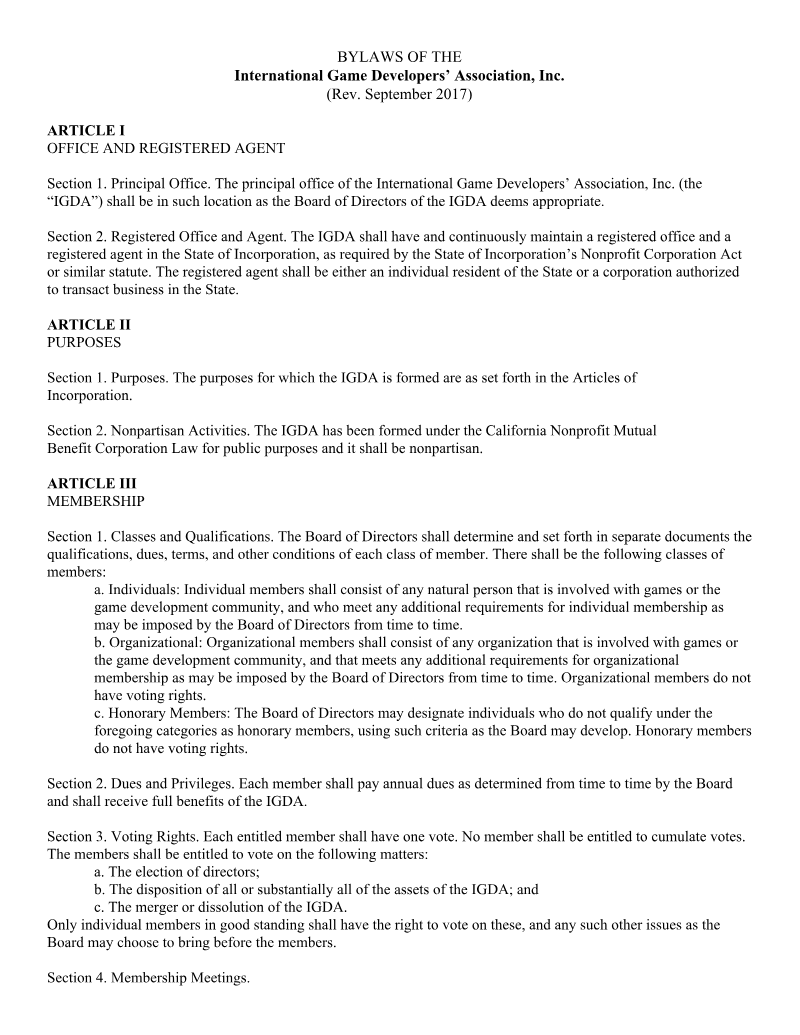
Bylaws of the International Game Developers’ Association, Inc.
The bylaws establish the governance framework for the International Game Developers’ Association, Inc., a California‑based nonprofit dedicated to supporting professionals in the game development industry. The organization’s purpose is defined by its Articles of Incorporation, emphasizing nonpartisanship and public benefit. Membership is categorized into individuals, organizations, and honorary members, with voting rights reserved for individual members in good standing. Annual dues are set by the Board, and membership meetings—annual and special—are governed by detailed notice, quorum, and voting procedures that prioritize electronic participation. The Board of Directors, composed of up to six appointed directors, at least three elected directors, and an optional ex‑officio director, holds ultimate authority over business affairs. Directors serve three‑year terms and must maintain good standing; removal requires a majority vote of members or the Board. Officers—Chair, Vice‑Chair, Secretary, Treasurer—are appointed by the Board and serve one‑year terms, with specific duties outlined for each role. Committees, including an Executive Committee and various task forces, are empowered to advise the Board but cannot amend bylaws or dissolve the organization. An Executive Director serves as chief executive, accountable to the Board and subject to its terms of engagement. Fiscal year aligns with the calendar year, and indemnification provisions protect directors, officers, and employees from liability incurred in good faith. Amendments to the bylaws may be made by a majority vote of members or the Board, ensuring flexibility for evolving governance needs.
- The International Game Developers’ Association, Inc. is a California-based nonprofit governed by a Board of Directors consisting of up to six appointed directors, at least three elected directors, and an optional ex-officio member.
- Voting rights are restricted to individual members in good standing, while the Board of Directors holds ultimate authority over all business affairs and the appointment of officers.
- Directors serve three-year terms, and the four primary officer roles—Chair, Vice-Chair, Secretary, and Treasurer—are appointed by the Board to serve one-year terms.
- The organization utilizes an Executive Director as the chief executive, who remains directly accountable to the Board of Directors.
- Bylaw amendments require a majority vote from either the membership or the Board, providing a mechanism for the organization to adapt its governance structure.
+1
International Game Developers’ AssociationDec 2023
Legal7 pages
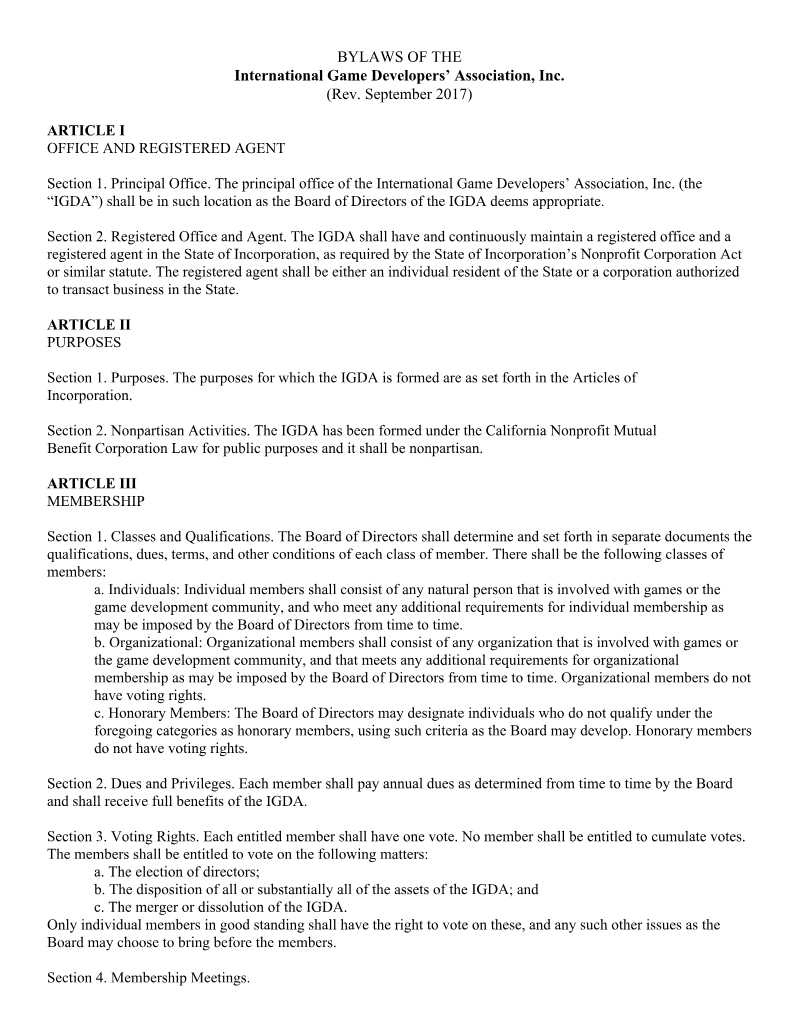
Bylaws of the International Game Developers’ Association
The bylaws establish the International Game Developers’ Association (IGDA) as a California nonprofit mutual benefit corporation with a principal office to be determined by the Board and a registered agent in the state of incorporation. The organization’s purpose is to serve public interests within the game development community while remaining nonpartisan, as outlined in its Articles of Incorporation. Membership is divided into individuals, organizations (non‑voting), and honorary members, with dues set by the Board. Voting rights are limited to individual members in good standing and apply only to elections of directors, asset disposition, mergers, or dissolution. Annual and special meetings are governed by detailed notice, quorum, and voting procedures, including electronic participation.
The Board of Directors may consist of up to six appointed directors, at least three elected directors, and an optional ex‑officio director. Directors serve three‑year terms, must be IGDA members for two consecutive years prior to election, and are subject to removal by member vote or Board action. The Board appoints officers—Chair, Vice‑Chair, Secretary, and Treasurer—with defined terms and responsibilities. Committees, including an Executive Committee, can be formed by the Board to exercise delegated authority.
An Executive Director serves as chief executive officer under Board oversight, with compensation and terms set by the Board. The bylaws specify fiscal year alignment to the calendar year, notice procedures, and indemnification provisions for directors, officers, and employees. Amendments require a majority vote of either the voting members or the Board. The structure supports governance, accountability, and operational flexibility for a global membership engaged in game development.
- The IGDA is structured as a California nonprofit mutual benefit corporation governed by a Board of Directors consisting of at least three elected members, up to six appointed directors, and an optional ex-officio director.
- Voting rights are restricted exclusively to individual members in good standing, covering specific actions such as director elections, mergers, asset disposition, or organizational dissolution.
- Directors serve three-year terms and must maintain continuous IGDA membership for at least two years prior to their election.
- The Board of Directors holds the authority to appoint officers—including the Chair, Vice-Chair, Secretary, and Treasurer—and oversees the Executive Director, who functions as the organization's chief executive officer.
- Membership is categorized into individual, organizational (non-voting), and honorary tiers, with the Board maintaining the authority to set all membership dues.
International Game Developers' AssociationFeb 2019
Article
Interactive Entertainment Organizations File Brief in Support of Video Games’ First Amendment Rights
The International Game Developers Association and several partner organizations submitted an amicus curiae brief to the United States Supreme Court in September 2010 to defend the First Amendment protections afforded to video games. This legal intervention specifically addressed a California law that sought to ban the sale or rental of violent video games to minors and required strict labeling systems. The central thesis of the filing asserts that video games are a sophisticated form of creative expression entitled to the same constitutional safeguards as literature, film, and music. By challenging the state’s attempt to categorize interactive violence as a new class of unprotected speech, the organizations aimed to prevent government overreach into artistic content and parental decision-making.
The brief emphasizes that the video game industry already maintains a robust, voluntary rating system through the ESRB, which effectively informs consumers without necessitating state-mandated restrictions. Industry representatives argued that the California statute was based on flawed social science research that failed to prove a causal link between virtual violence and real-world aggression. Furthermore, the legal challenge highlighted the potential for a "chilling effect" on innovation, suggesting that vague definitions of prohibited content would force developers to self-censor to avoid litigation. This defense focused on the North American market during a pivotal period for digital rights, seeking to establish a permanent legal precedent that recognizes the medium's cultural and expressive value.
Ultimately, the collective action by these entertainment organizations underscores the industry's commitment to self-regulation and constitutional consistency. The filing concluded that the government lacks a compelling interest to restrict speech based on its perceived impact on minors when less restrictive means, such as parental controls and existing rating systems, are already in place. By advocating for the reversal of the lower court's decision, the industry sought to ensure that interactive media remains a protected frontier for storytelling and technological advancement, free from content-based discrimination by legislative bodies.
- In September 2010, the International Game Developers Association and partner organizations filed an amicus curiae brief with the U.S. Supreme Court to defend video games as protected speech under the First Amendment.
- The legal action challenged a California law that attempted to ban the sale or rental of violent video games to minors and mandate state-enforced labeling systems.
- The industry argued that the California statute relied on flawed social science research that failed to establish a causal link between virtual violence and real-world aggression.
- The brief asserted that the existing, voluntary ESRB rating system provides sufficient consumer information, rendering state-mandated restrictions unnecessary and unconstitutional.
- Industry representatives warned that vague legal definitions of prohibited content would create a 'chilling effect,' forcing developers to self-censor and stifling creative innovation.
+1
International Game Developers’ AssociationJan 2010