1 free read left. Create a free account for unlimited reading + AI research.
Create free account
Games monetisation trends in 2016
Key insights
6 takeaways- 01Successful monetization relies on applying behavioral economics, such as hyperbolic discounting and the 'training effect' of early conversions, to align revenue mechanics with player psychology.
- 02The industry is moving toward data-driven optimization, including the use of machine learning for pricing and randomized rewards to drive engagement.
- 03Nearly 50% of developers currently wait until the beta phase to establish pricing tiers, representing a significant missed opportunity for rigorous testing and tracking.
- 04Securing an initial purchase is critical for long-term success, as players who make a 'no-brainer' first purchase exhibit significantly higher retention rates and a greater likelihood of becoming repeat customers.
- 05Monetization must be integrated into the early development cycle rather than treated as a post-launch afterthought to ensure cohesive game economies.
- 06Developers should utilize annuities—delivering virtual goods over time—to effectively segment user bases and cater to long-term players alongside impulse-purchase options.
Ask AI about this video
Transcript
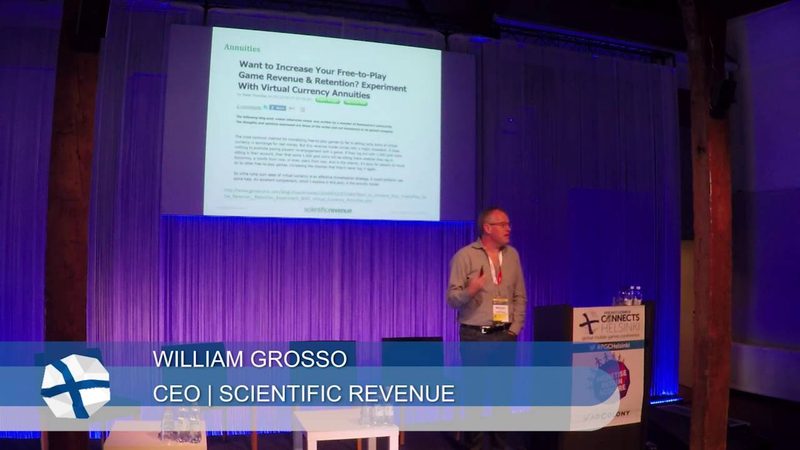
you know I the people of Pocket Gamer asked me to talk about modernization trends and I thought about that a lot and the things we've seen over the past year and the trend is essentially that it's getting more and more complicated and what this slide deck is going to be about is the case for monetization design as a discipline in gaming as opposed to having a director of monetization who kind of parachutes in after the game is done and tries to make it profitable so how do I ask me now the one at the table it doesn't appear to work either unless that does it
perfect okay so first a word about us it's important to establish credentials generally speaking scientific revenue works with large scale games we talked to people who have over a hundred thousand daily active users in their games who already have significant economies and then we use machine learning to make their pricing work better so this is a screenshot of in production this occurring game it's making about 40 percent more per month on a daily basis it varies between sixty and a hundred sixteen and a hundred percent so we do this we probably don't do it for you because we do require a lot of traffic where machine learning guys but it's background so when we do sales calls we're often very surprised people are not tracking their key metrics people are not sure how their monetization funnel works there's a lot of design decisions and I'll go into some of them that people are not making except that you know once you've been in the
business for more than say six months you realize that if you're not making the design decision it's still being made just by somebody else and usually not very thoughtfully so what we've come to realize that there's often an unfulfilled job position called monetization designer and it's someone who looks at the game early very very early and looks at how the pieces and parts fit together so instead of adding things later add in an ad hoc fashion you need to do it early you need to be and you need to have someone own it by the way how many people actually have somebody who does that at their company today okay so let's call that 10% so the prediction the trend is that by this time next year it'll be a 25% so we're often surprised we shouldn't have been we sent this out you can download it from our website we basically surveyed the world and said things like when do you set your in-app purchase prices at
what point in development do you decide typing Pier pricing peers for your IIPs you'll notice that 22% said during design 25% said in alpha you know 46% in beta and some people said after launch and then we said okay well how often do you test it and how many different prices do you use and most people said we don't test it and we've got one price point for everybody slides are available by the way and if you want the slides and Bill at scientific revenue calm so really easy to remember you have to spell out scientific revenue and I apologize for that but it's at least easy to do happy to send the slides out okay so and this was in spite of the fact that most of our respondents used both advertising and IPS in their games so people are using in-app purchases people are using advertising and yet they're not really thinking about it and the interesting thing is so how many people have read design rules for
free-to-play games okay you're gonna raise your hand to everything that's awesome so this is Nick Laval he lives in England he wrote this he wrote the free-to-play toolbox he said the no-brainer first dollar free-to-play design rule number eight this is early early monetization design he's saying you need to convince people that there's a reason to buy so a little bit of thinking about it and the key point one thing which arises from behavioral economics is the fact that making a purchase isn't an isolated event in many cases it's like breaching a dam so that's a really interesting point and it's the key behind the no-brainer for a Staller once you get people to open their wallet buy something they're gonna buy again and again and again repeat purchases really the keystone if you of monetization design and yet how many people know their repeat purchase rate okay so we went from 10% to 5% to 3% the
single most important statistic you're not tracking is if a dude bought once does he buy twice and if the answer's no you've got something broken in you game and if the answer is half the time you're doing pretty well so track it and that's the point of this is the point of the no-brainer first offer is once you get people in the habit of buying or can anyone remember the first time they bought something from Amazon most people when they buy stuff online there's this enormous hesitancy and then you buy something from Amazon and then you go hmm that wasn't so bad I'm gonna buy again and again and again your ecommerce relationships are all long prolonged hesitancies followed by getting into the habit so the rewarded video guys have started talking about it as well when should you use rewarded video so I was at game speed summit in May and everywhere
everybody who provides rewarded video said oh my god don't use it in the don't use it in the coin store as we'll give you 50 coins if you watch a video that's an anti-pattern that's a bad way of using rewarded video instead do this when you get to a point in the game and you fail offer the player a chance to recover but only if they watch a video it's an interesting thing right and yet when you stare at that you say how many people actually do this well most of the games I see say hey you know what you can buy a hundred coins for a buck 99 or you can get twenty five by watching a video so well known best practice and yet often not follow-up another fact people who buy tend to stick around longer people stick line and longer tend to buy more as well it's a nice virtuous cycle there in general in the games we run people who buy retain it about a 2x rate that's
kind of interesting there's a training effect that goes on if you're gonna get a second purchase because you got a first purchase and you have 50% repeat purchase rate and you're gonna get people to stick around longer there's things you can do people who buy buy again so in those three games can I go backwards cool so this is three randomly two randomly chosen games d7 retention of people who bought on day one through three is about 40% and then non purchases is about 20% second game 43 and 16 so essentially the same numbers and second purchase rate of 36% and a second purchase rate of 29% so that's really interesting and that argues that you should really focus on first conversions you should take Nick LaBelle seriously and think about that no-brainer first offer okay here's a really interesting idea how many people have seen an annuity in
a game show you explain what they are first probably so the idea behind an annuity is you buy the thing and then you don't get what you bought right away you get it delivered on a schedule so you're gonna spend $9.99 and you're gonna get 200 coins today and 200 coins tomorrow and 200 coins a day after out for 30 days that's a classic example of an annuity so when you think about that it's really interesting so how many people remember coupons like you clip them out from papers right so coupons are the classic example of you take people who have a lot of time who read newspapers who have scissors handy and are cheap and you get them to come into your store because they cut out the coupon they invest the time and then they go to the store and you give them a different price people who aren't willing to buy the newspaper who aren't willing to cut out the coupon they pay more so you essentially have
two prices one for the thrifty people who cut the coupons and one for the people who don't bother annuities exact same idea you have you sell the same thing next to each other $9.99 by two a thousand gold coins or $9.99 buys you 200 gold coins and then 200 gold coins every day for the next 29 days the second one the annuity is obviously a much greater value you know you wind up with 200 times 30 whatever that is right 6,000 coins for $9.99 the first one you only got a thousand coins for $9.99 there's two key things one you don't care your marginal cost per gold coin is zero and two they tap into entirely different user bases the people who spent $9.99 for a thousand gold coins are doing an impulse purchase the people who spend $9.99 to get the coins for the next 30 days are planning their thinking it out they're being thoughtful they're saying hey I can use those coins next
week once they've accumulated you've increased your retention and you've probably gotten a purchase that you wouldn't have gotten otherwise and that's really interesting so with that in mind how many people have actually seen this being used okay cool about 25% this time it's very common in Chinese games it's very common in Korean games it's not at all common in western games and so we had one of our staff economist write it up and just say here's how to think about annuities and by the way we'll be publishing the annuity design worksheet later this year key point about this is it's just something we think makes the industry healthier okay deli login rewards how many people think daily login rewards are simple good I actually had this conversation with Todd Kelly he's a game designer out of Seattle I mean it's like I was like we're gonna write up daily login rewards because they're complicated and it's like how can they be complicated you
just give people stuff every day what are you talking about bill you're insane ignore that word and the answer is no they really are and this is my favorite example of a daily log and roared so this is a mid core game because this would not work in social casino at all and that's an interesting fact as well and what they do is your daily log in reward is a lottery every day you log in and you get a chance to win something that will help you fight battles but even better every day when you log in you can upgrade the lottery so you can spend money to get whoa you can spend money to get a better bet so every day you log in and you get a randomly assigned chance anybody who's familiar with BF Skinner knows that this is awesome and then every day when you log in and you get that daily bet you can spend some of your money and make the bet a better bet so it's really interesting and it wouldn't work at all in social casino because if you're
logging in to play a slot machine the incremental value of an extra randomize chance is zero the entire game is built around that but if you're playing a mid core or core game that's around PvP combat this is a very effective daily login reward and it increases retention dramatically and it also increases the likelihood of people spending because they threw that in and so as I said we wrote this up as well we tend to put these things out on gamasutra and so on your game has a coin store you sell coins your game has a virtual good store at some point you'll have flash sales at some point you'll have happy hours at some point etc and what winds up happening is you wind up having all these fairly complex things in terms of themselves and they interact with each other and they're all being added to games ad hoc after launch right you're soft launch you launch you realize you
need to do this you'd do some flat sells and nobody stops and says how do my flash selves interact with my daily login rewards how do you know should I roll out an annuity Apple just announced that you should use subscriptions and Reggie talked about it a little bit and you know we have a point of view on subscriptions as well but the key thing is you shouldn't just layer them in without thinking about the whole monetization system so going back to this same slide I just want to point it out right these all interact with each other you can't design them in isolation you can't add them in isolation you can't optimize them in isolation so keep put takeaways you have to have an economy before you can optimize it we're trying to help people figure out how to have an economy there's a lot of design work here the key idea behind free-to-play is that you now control the cash register right
you own the point point-of-sale it's you know everyone yeah I've got a coin store and I sell coins you own the point of sale and that means you need to think about what gets people to buy and that permeates the entire game it's not just the payment wall and this talk you know I talked a little bit about my company in the beginning but we're not really trying to sell you today we're trying to start a conversation we've been trying for a year now so and again billet scientific revenue calm I will cheerfully mail you the slides we've started building a library of this stuff you know so we have a resources page that has a lot of things about how to design coin stores how to design promotions we've got a thing on daily login bonus 'as we've got a thing on annuities we've got a thing on general practices on ia P's feeder apps are small apps that you launch to acquire traffic that you then feed into your other games power up design some
power-ups work some don't some are excellent game play devices but no one would ever buy them what makes a powerup something that people want to buy etc all of these are out there coming up in the fall we're gonna have a design worksheet on how to design annuities we're gonna talk about sticker shock as an actual observable thing in your game we're gonna talk about a lot of things that people have said over the years that are false discounting on weekends is one of the most pernicious ly stupid practices that people follow if you think about it people are more likely to play people have more free time and then you start you know marking down the currency it's not a good idea and I just want to point out that every time we publish something it shows up on our Twitter feed and we announce it on those two mailing lists and try and start email conversations so how many people are actually on the Stanford GSB
mailing list okay you are you're like a hundred percent guy go join it it's run by Fredrik - chomps he's at Zynga it's got about two thousand people all of whom are ferociously interested in game design similarly gaming insiders has an amazingly great mailing list it's called the growth mailing list it overlaps a lot with the Stanford GSB mailing list but these are places where there'll be 20 or so emails in your box every week talking about game design talking about monetization talking about how things fit together and you know every now and then I show up and say and give my two cents as well that's all I had to say today the whole point to summarize you're doing a lot of stuff if it's done in isolation and you don't think about monetization as a system you're leaving a lot of money on the
table and also frustrating your users so monetization design not a profession yet but clearly becoming a profession and all of these things in these slides and more work together to make more effective monetization strategy same conversation from quality time I think my book was released two years ago on games of service 2014 a year before and again I think it's this whole critical idea but it's about design aspects and its intrinsic to the the way that you start yes in the game it can't be done late you know a lot of people like well we're gonna build the game then we'll integrate analytics then we'll hire a guy oh look at the numbers and fix it and it's like no that's not one of it it's also you know obviously you see the background there yeah the stuff that we we've been doing with unity and so on and so forth that lesson that we learn from you know going through that process
of work hang out you know actually that it can can benefit the process of play it's not just about focusing on the way that we're monitors but actually focusing on the experience of the player oh yeah when you add annuities in and when you add daily login rewards you change the experience and it's often they're the better exactly any questions lessons so we're gonna couple more minutes and so we're gonna be know it's business doing that Oh should we try to even get a mic to you because it's a little being recorded be nice to get your voice on there too we have a mic I found your point about annuities particularly interesting my partner I've been talking about that for some time but in the example you gave I was interested in hearing more about how that annuity was set at a daily level is that sad slightly above
what you would expect the user to consume is a set slightly below what the user would consume as it sat at a point where the user sees that and is blown away by the value where where do you kind of see where that daily daily value is set yeah no I so so everyone heard the question who Mike worked cool so I mean that's a great question how much stuff do you give away right and there's sort of different answers so one answer is that it should be punctuated with an item so a weekly item as part of the annuity strategy and or a balloon payment at the end so there there's a whole psychological phenomenon called hyperbolic discounting which implies very strongly that if you give a balloon payment at the end you'll both increase your first purchase rate and you'll increase the repeat purchase rate of the annuity so that's one aspect the other aspect is how much cash should you give
away on a daily basis and there's there's no one answer to that but the general rule of thumb is there's two numbers that you should use the packet the first is what's the minimally useful amount of cash for a good purchase not a great purchase so you look at what you're selling in your storefront and you say these are the commonly purchased items and they cost around this much you know it turns out that 75 gold coins get you about 15% of the storefront or something like that so you peg it to the actual currency cost of your virtual goods and then the other thing you do is you look at your daily spend of a good but not great player so you say okay you know seventy-five gold coins gets me about 15% of the storefront including two of the top five items and by the way my dudes who are playing on a regular basis generally spend about 150 to 200 gold coins and
those two numbers frame the range the right range for an annuity it's got to be useful it's got to get people goods but it shouldn't be so much that it completely swamps a good player you know a good player should have to spend in addition to the annuity so those kind of triangulate it and then the hyperbolic discounting at the end that make sense cool let's have cool any other questions grab room for one more thank you great talk just real quick how do you work with the developer as far as figuring out what to track so for example you want to interject video ads game but you're not quite sure the best
mechanism or place within the game to put it how would you work with a developer on that so so so on that one in fact we don't we're pricing people I was using that as an example of people thinking about it but you know if you go to add colony or iron source or vongole or any of the people who focus primarily on video ads and you say what are best practices they have a set of hints they're just not published yet if I remember correctly from game speed summit the key thing is that when you put it in the payment wall people didn't give people coins people click on it and ignore the video right and it becomes essentially an alt you know it's not delivering value to the end user it's just distracting them from the game and it's also not delivering value to the advertiser what you want to do is you want to tie it to the user experience and so the example that was in the slide
deck of someone is in an endless-runner and they fail and now they have the option of recovering by watching a video is a really good way to do that more generally what we do as a company is when we have conversations with people it depends a little bit so the the path we walk is this we're numbers guys we're data scientists we're machine whatever we're not we're not game design guys we know a lot about how to design monetization systems but there are some companies that are like you're gonna optimize my pricing and I don't want to really what I want to hear it right and we go okay great give us your UI and we'll just feed numbers into it there are other companies that say what's not working here and then we basically will basically take apart their UI and say hey if you're gonna have a happy hour then you need a battlespace notification and this is the sort of thing that works
well and we essentially have a playbook of UI practices we can recommend around that cool thank you very much it's actually mirrored a lot of stuff that I learned when I was in the ads team at Incheon what also from sound was denial of access to that ad at certain time can also be quite interesting so don't always give them the ad to watch to save them because they want you want them to be watching out for that ad anticipating the value absolutely having that fear of missing out and therefore they choose to watch the air and get value from and and generally pay more attention to it so that's actually something we're going to talk about you know we have an editorial calendar and we write these things but one of the really interesting things is the use of randomization so if you if people can you know so suppose you always have a win they have nice topic okay can I finish okay so suppose you always have a Wednesday afternoon sale what happens well people start to plan their lives around that that may or may not be a
good thing you know happy hours drive people to bars right but randomization where it sometimes shows up and sometimes doesn't is often a much more effective call to action because people don't know when it's gonna show up again and people will it will significantly increase your purchase rate so we can talk about that offline definitely want to talk about that of life well that was brilliant thank you so much
Summary
Monetization design is increasingly essential as a formal discipline within the gaming industry, moving away from the common practice of treating revenue generation as an ad-hoc, post-launch afterthought. By integrating monetization strategies early in the development cycle, developers can create cohesive economies that enhance player retention and increase lifetime value. The core thesis is that monetization is not merely a payment wall but a system that must be designed in tandem with gameplay to ensure that various revenue streams—such as in-app purchases, rewarded video, and annuities—interact harmoniously rather than in isolation.
Data indicates that many developers currently lack rigorous testing and tracking protocols, with nearly half of surveyed developers waiting until the beta phase to establish pricing tiers. A critical, often overlooked metric is the repeat purchase rate; establishing a "no-brainer" first offer is vital, as players who make an initial purchase are significantly more likely to become repeat customers and exhibit higher retention rates. Furthermore, behavioral economics suggests that techniques like annuities—where virtual goods are delivered over time—can effectively segment user bases, appealing to thoughtful, long-term players while maintaining impulse-purchase options for others.
The industry is shifting toward more sophisticated, data-driven approaches, such as using machine learning to optimize pricing and employing randomized rewards to drive engagement. Effective monetization requires a deep understanding of player psychology, including concepts like hyperbolic discounting and the "training effect" of early conversions. Ultimately, the most successful games treat the point-of-sale as an integral part of the user experience, ensuring that revenue-generating mechanics provide genuine value to the player rather than serving as mere distractions. By adopting a systematic design approach, developers can avoid common pitfalls, such as ineffective weekend discounting, and build more sustainable, profitable gaming ecosystems.