1 free read left. Create a free account for unlimited reading + AI research.
Create free accountWhitepaper Loading... The Journal of the Canadian Game Studies Association
1 free read left. Create a free account for unlimited reading + AI research.
Create free accountWhitepaperLoading... The Journal of the Canadian Game Studies Association
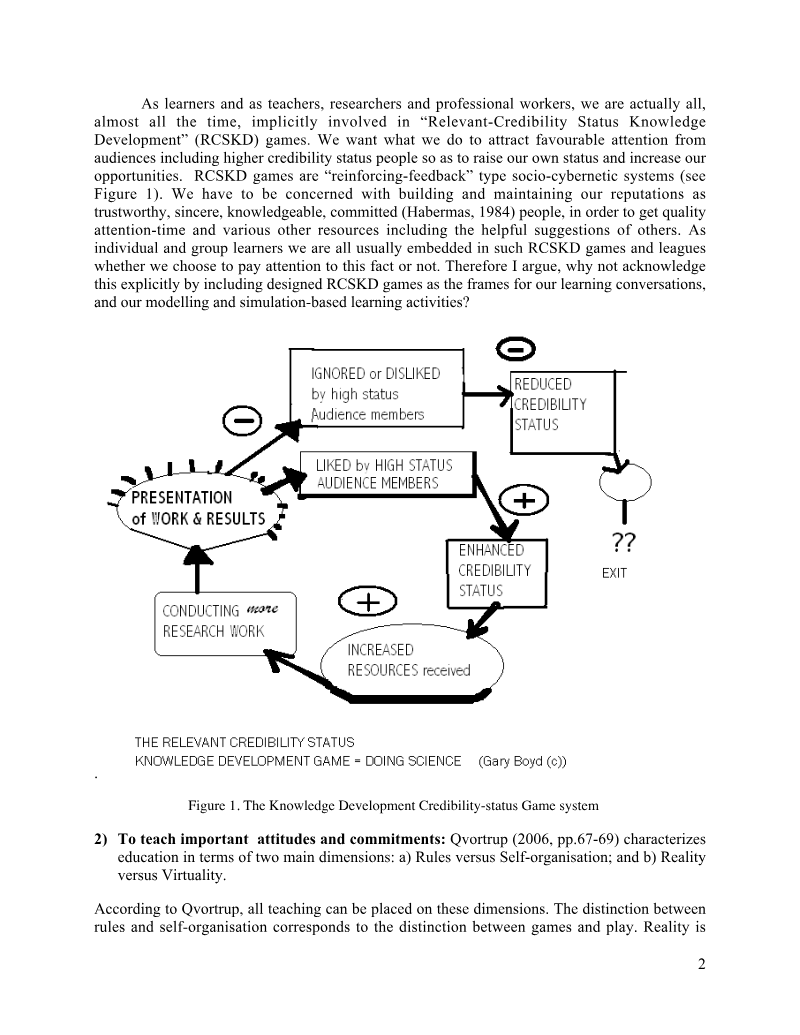
This approach leverages the inherent human tendency to participate in status-seeking and knowledge-development games. It effectively turns the educational process into a recursive, socio-cybernetic system.
Like a competitive sport, where players are motivated by both winning and improving their skills.
The primary purpose of this analysis is to advocate for the integration of multiplayer gaming, dynamic system modeling, and structured learning conversations as a superior framework for educational technology. The thesis posits that by framing complex socio-technical-ecological learning activities as multiplayer games, educators can achieve higher levels of engagement and intuitive understanding. This approach leverages the inherent human tendency to participate in status-seeking, knowledge-development games, effectively turning the educational process into a recursive, socio-cybernetic system.
The findings suggest that effective learning in complex systems requires a synthesis of three conversational types: discussions regarding the necessity of the subject matter, the specific content being explored, and metacognitive regulation. The methodology proposed for developing these systems favors design-based research, which utilizes evolutionary development, rapid prototyping, and formative evaluation over rigid, fully engineered production. This middle-ground approach balances the flexibility of small-team bricolage with the reliability of formalized software engineering.
The scope of this research encompasses the application of educational technology across global, multi-user environments, including mobile platforms and online multiplayer systems. The framework emphasizes the importance of "Relevant-Credibility Status Knowledge Development" (RCSKD) games, where learners build reputations and gain resources through social interaction. By incorporating these elements, the proposed model aims to re-educate learner intuition and provide a forgiving virtual space for testing conjectures. The conclusion asserts that the combination of simulation and reflective discourse within game-framed digital spaces offers the greatest potential for educational leverage and widespread accessibility in modern learning environments.

Loading... The Journal of the Canadian Game Studies Association · 2018

Loading... The Journal of the Canadian Game Studies Association · 2018
Loading... The Journal of the Canadian Game Studies Association · 2017
Loading... The Journal of the Canadian Game Studies Association · 2017
Loading... The Journal of the Canadian Game Studies Association · 2017
Loading... The Journal of the Canadian Game Studies Association · 2017
Loading... The Journal of the Canadian Game Studies Association · 2017
Loading... The Journal of the Canadian Game Studies Association · 2017
Loading... The Journal of the Canadian Game Studies Association · 2017
Loading... The Journal of the Canadian Game Studies Association · 2017
Loading... The Journal of the Canadian Game Studies Association · 2016
Loading... The Journal of the Canadian Game Studies Association · 2016
International Journal of Role-Playing · 2026