1 free read left. Create a free account for unlimited reading + AI research.
Create free account
Game design methodology
Key insights
6 takeaways- 01The framework is a universal tool applicable across mobile and console genres, allowing teams to incorporate player archetypes and reward schedules into a standardized design language.
- 02Game design should be structured around a one-page, visual framework that replaces exhaustive documentation to align cross-functional teams on core mechanics and project vision.
- 03This methodology utilizes Flow Theory, the Laws of Learning, and behavioral psychology to identify the specific 'why' behind game features and mechanics.
- 04The compulsion loop is the framework's foundation, consisting of a clear action, a corresponding reward, and an expansion that drives repeat player engagement.
- 05Designers can deconstruct successful titles like Candy Crush by mapping their loops to analyze how they balance player skill with challenge and integrate monetization barriers.
- 06Using simple whiteboard diagrams during pre-production facilitates rapid iteration and ensures developers, artists, and product managers maintain a shared understanding of the game's purpose.
Ask AI about this video
Transcript
[Music] hello so this should actually be taught be called the mythology for game design and product management so who here is a game designer who is the product manager is there any students great great I like to talk to students so my name is small I've been in the mobile game industry for over 10 years I started at Gameloft as a junior game designer and eventually made modern combat sandstorm which went on to be the most successful for a first-person shooter on mobile and then something happens freemium happened and we all had to adapt and then fully embrace the business model and over the years I've been able of paying tools based on on the game design concept out
there and I want to show that to you today so now I'm a VP of game at magnate I recently was promoted so I want to talk about a tool that my product manager used to better break down the competitors and again design you to communicate the game design early on this is nothing new I'm not gonna break any new game design concept here I'm just using what's already out there and using it in a very practical way so hopefully we'll find the value in that I am highly inspired by Stanley Brenda who introduced the one-page game design black concept at GDC 2009 if you sorry if you haven't had a chance to watch his lecture yet you can access it on the GCC vault it's free last time I checked it was free and he basically came up with that idea by looking at non-gaming document that managed to communicate a lot of information in a single page so since most people in the team won't be reading extensive documentation you want
to have a single go to document that you can use so for example if a new member joined the team you want to explain what the game is about you can use that and also if you want to convince your creative director or the head of the project management to go with your ideas you better come prepare because they probably won't read the extensive documentation that you rolled at least at the early pre-production stage so we want document that show and explain the core mechanic in a very visual way that's kind of what user flow does this can be considered as the one-page game design duct this one is for a match 3 game it's used to describe the core game flow and it's powerful tool to communicate to the developer and in the case of the artists you will be using a UX flow but it's really actually there is no standard format for that if you want to compare game to each other you'll end up with different user flow so you want a way to to be able to compare the game in a
standard format this will be useful for your your dev and your artist but not so much for the game designer so it's good for the what and the how but not so much for the why and why is really important for game designer that's basically the basis of all your decision you want to explain why you're taking decision why your game is acting in a specific way and you also want to understand why your competitors are doing certain things so you can either place a clue the same or iterate on it and and improve it I want a tool that I can use on the fly in a meeting room with a whiteboard but so I'm gonna use simplistic loop but before I talk about how I'm gonna do this I want to talk about fluid theory are you familiar with flow theory okay yeah so flow is the perfect balance of skill and challenges it's when you are the most engaged in in an activity
so it's what developer reference as being wired in or what poker player will call playing a game what most people will refer as being in the zone it is when the time seems to stop while you don't activate so if you for example I'm a huge fan of civilization so I can play civilization for hours the whole night without even realizing what time it is it's because I'm in a flow state and that's where we want our player to be as game designers flow was proposed by me Hallett's and me Holly I'm sorry I completely destroyed that name it's widely it was in different field of psychology it's not a concept that was developed for video games but Genova Chan co-founder of that game company made flower flow journey he wrote his master thesis on this and he basically came up with three ideas in order to put the player in a flow of states in a state of flow so the player has to feel a sense of personal control over the game activity the game must be
intrinsically rewarding and the game must offer the right amount of challenges to match with the player skills this is basically a loop you are in control you get reward and there are new challenges that will make you do the action again in which you are in control so according to him fun is flow if you're in a state where you're the most engaged you're having fun and that's something we want our player to to be him I can't agree with him but there are other theories so for example Roth Costner in his book a theory of fun for game design came up with the idea that fun derives from a stimulation of our brains through learning and all games are based on a pattern that is only fun while we are learning that pattern if you haven't read that book I highly recommend it it takes an hour and a half it's really interesting so if you do some research on learning you quickly find out about the laws of learnings the
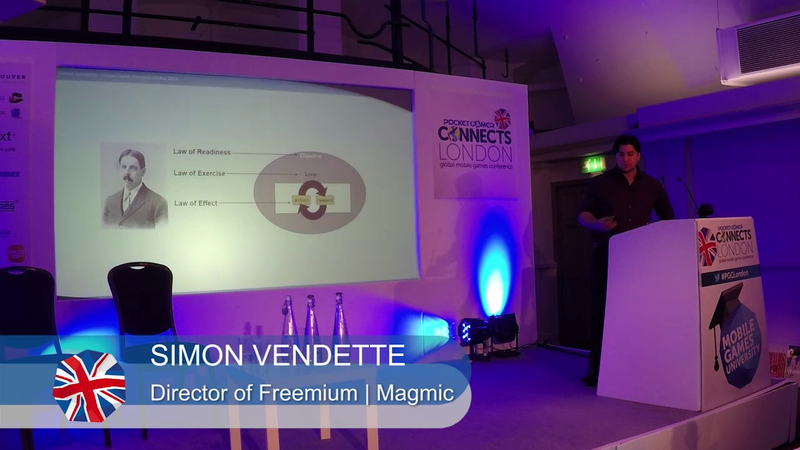
laws of learning were introduced by Edward Thorndike an American psychologist and are still used today in education so it apps to understand our information is acquired process and retain it can be a very powerful tool for game designers so the first law is the lab readiness you near you need a clear objective for example it's that wanna learn Spanish then there is a lot of exercise which state that you have to repeat that if that you have to repeat and do it a lot so I wanna flow in Spanish I'm gonna have to talk Spanish a lot read in Spanish all the time and then a lot of effect states that for every action there must be a report so as I speak more Spanish as I read in Spanish people understand they need it better if I'm you know in a course I'm getting good grades so that's my reward and that is the basis for a bit scanner when he came up with his idea apparent conditioning which is a branch of behavioral psychology by making rats repeat action and experiment with different reward schedule or
punishment schedule he was able to induce different behaviors and that's where the the infamous compulsion loop come from so we have a clear action you get a reward and there's an expansion in order to make you do that action again and again so now with weekend this I'll use this to engage player for a longer period of time and a more intense play session now this is debatable there are some people will tell you that the rats were actually only 20% of the rats were actually doing reactions but that's for another another discussion what is very interesting here is that loop is very similar to the flu loop and actually the more research you do about behaviors you you find out that this is always the same loop there are some studies at MIT about habit loops which is basically the same thing so this is what we're going to use in our in our two today let's take candy crush saga as an example this is the first game and let
me explain how I'm gonna use compulsion loop to deconstruct that game so first the action is to play the level and the reward will be to complete the level the exponential will be that there will be new levels new game mode new narrative and new candies but playing the level in itself is an action so to play the level you have to move the candies you have to this the reward will be to destroy the candies and the expansion will be that there will be new configuration that will make you want to move more candies but then the shrine candies is an indirect action so as you destroy candies you earn points you fill the objectives you there's an effect on the blocker so in that case the liquorice cage will be destroyed and there might be chain reactions so if you destroy candies that will trigger more destruction and so on and the expansion will be that there will be more you will move the candies they will fall and there will be special candies that will spawn so this is basically the core group of candy crush now you can go
further and actually they construct each of the sub interval into sub loops yeah so what's great with that is it's really easy can be drawn in a few minutes in a meeting room with other game designer to try to basically explain what a game is about and you can compare all the games to each other using the same formats but for this presentation let's stick to the core loop candy crush is a freemium game so they are non paying user and paying user of course we want to convert the non paying users but they're both part of the day use and we we need both so in order to keep retention high we need to please both type of players in freemium game designer will weigh in premium in that loop there will be buyers so in order to play the level it cost lives there are a limited number of time or moves and when you complete the
level there are level requirements in order to succeed or fail the level and in the original candy crush when you unlock a new zone sometime you have to get three tickets to access it so what game designer will do is provide keys to overcome those barriers of course you want to provide keys for the paying user that will allow them to overcome those Barrio faster but for the non paying user you still have to give them keys so that they will stay in your game and retention will stay high so in candy crush for example when you play the level you can buy lives can buy special candies or you can buy tickets when you unlock a new zone and the non paying user can share lives or tickets with their friend there are free life regeneration when you after a certain amount of time and there's free special candies and you get back your life when you complete the level so yes it's it's all about monetization social
intervention in freemium that's what matters so we can take that and apply it to the whole model yes sorry I'm using paper the old-school way yeah so that might make we used we call this motivation loops it's basically an aggregate of all the compulsion loop inside a simple model that we can use so we can clearly show the relationship between all the game loops and we can easily compare all the games together using that method till they construct the game in too many minimalistic loops you show the purpose of each game features and you can communicate your vision in a single slide but then you can extend that to two more so if you were using some game design mythologies for example if you're
using mortals for player archetypes I'm sure everyone's familiar with that if you're not you should Google it's very interesting stuff it's basically states that everyone is a mix of those four types of players so every feature in your game will appeal to some of these players type so again we take our motivation loops and we can add an icon next to each feature that will help you understand which feature address to who in your game but then that's not over you can push it further you can use Jesse Schell lenses for example you could use nicole lazzaro for keys to fun and you can basically extend your loop and add all your your reasoning all the why you're making your game this way and it's also very useful when you're analyzing other players game other competitors games and you want to compare them to each other why is candy crush doing something in a certain way I thought about the the compulsion loop there was there was a principle of reward schedule in there
there is a variable reissue scary Ward there is a fixed ratio that's something you can add there so if you do that exercise and you analyze candy crush you'll understand why they're giving reward in a certain way at a certain time and then you can apply that to your game so at mag make the product manager use this to analyze the competitors games and the game designer will use it to layout the first iteration of the early game design can be drawn on a whiteboard you can easily iterate over and over again and it helps validate the game design choices but most importantly it's quick to build its follow a simple format and it shows a lot of information in a single page have any question there's usually another part to this stock but I had to cut it I was not sure I could made it in 20 minutes like five minutes you can
email it the very beginning you can send me an email so by the way this is actually the first time I do this presentation at an event so if you want to send me comments on all to improve it that they appreciated if you use a variety of different types of tables and ways to explore game design yeah are there particular ones that are good for mobile games as opposed to console games or structure that you build is it a source that's described in more universal yeah it actually applies to any type of game when I made the modern combat first-person shooter I use the earlier
version of that but really any game that you're making in the end your player will be doing action you will be rewarding them and you need ways to motivate them to do that action again so if you deconstruct any end design into those three steps it applies to everything to game I never try it but maybe yeah should try it yes I'm very good Breger talk could you possibly expand on one pay talk design document was quite interesting concept and yeah unfortunately much time to go into it I know it CDC talk but could you explain your words how you interpret them a signed document Howie's in any games you've created yeah so basically I found that my take on game design document the game design Bible or the artwork that time is over no one reads a huge documentation and actually not much people in the team actually read the
developer will read certain specific parts of the game design that addressed what they're building but not not much people will read the whole thing so it's really hard to convey what the division of the game is especially at the early stage when you're in pre-production and you want everyone in the team to be on the same page to understand what you're doing so that's how we use it to build our game but also one of the first step in pre-production for especially for project manager is to analyze all the competitors to see what the the segments you're addressing is is about what is the the winning formula if I can say there is no such thing but there is some like there's no recipe for success but there are some certainly ingredients and by doing that exercise you can basically in a meeting room with whiteboards you can draw the motivation loops of all your top competitors and there was some stuff that will just like stand out you you will see that okay this is something that everyone is the Wayne why are you doing it and then you take the time to analyze and you get your answers [Music]
Summary
A practical game design methodology centers on the use of a one-page, visual framework to structure game loops, monetization strategies, and player engagement. By moving away from exhaustive, traditional design documentation, this approach provides a concise, accessible tool for cross-functional teams to align on core mechanics and project vision. The methodology is particularly effective during the pre-production phase, allowing designers and product managers to communicate complex ideas quickly and iterate on designs using simple whiteboard diagrams.
The core of this framework is the compulsion loop, which draws upon Flow Theory, the Laws of Learning, and behavioral psychology. This loop consists of three fundamental components: a clear action, a corresponding reward, and an expansion that encourages the player to repeat the cycle. By deconstructing games into these minimalistic loops, designers can identify the "why" behind specific features and mechanics. This analysis is applied to both internal projects and competitor research, enabling teams to understand the winning formulas of successful titles like Candy Crush by mapping out how they balance player skill with challenge and how they integrate monetization barriers with social or free-to-play incentives.
This methodology is designed to be universal, applicable across various genres and platforms, including mobile and console titles. Beyond the basic loop, the framework can be extended to incorporate player archetypes, psychological lenses, and specific reward schedules, providing a comprehensive view of the game’s design. By standardizing the way games are analyzed and communicated, this approach ensures that all team members—from developers to artists—maintain a shared understanding of the game's purpose, ultimately facilitating more informed decision-making and more effective, player-centric design iterations.

















Comments