1 free read left. Create a free account for unlimited reading + AI research.
Create free account
F2P Design Tips for 2021, Embrace System Deprecation (2 of 4) Ft. Jeff Witt
Key insights
6 takeaways- 01The mobile title Summoners War successfully implemented this strategy by introducing a 'second awakening' system that required new energy and boss-fight materials, bypassing the obsolete resources held by long-term players.
- 02Instead of inflating costs or adding incremental tiers, developers should introduce entirely new currencies or inputs to regain control over the game economy and reset player expectations.
- 03Introducing new inputs allows developers to manage the cost curve more effectively because players lack the historical data to anticipate or hoard resources for these specific requirements.
- 04Developers of long-running free-to-play games should use system deprecation to reset economic balance when veteran players accumulate resource stockpiles that render original progression systems ineffective.
- 05To prevent player frustration, developers must ensure legacy investments retain value by providing conversion stores for obsolete items or by attaching passive bonuses to older, plateaued systems.
- 06System deprecation serves as a tool to create a clean slate, providing developers with greater flexibility for future balancing while keeping both new and veteran players engaged.
Ask AI about this video
Transcript
hey everybody and welcome we are here with jeff witts talking about design tips that you need to know for 2021. if you missed the first tip make sure to go back and catch that but we are here and ready to hear from jeff what is tip number two jeff please take it away so this tip is for game developers who have games that have been out for a while um usually when you design a game a lot of developers will design for you know the first couple months for the first year or two but as games get older um some design decisions made for launch have kind of worn out maybe you're um don't have enough content for players or most players have maxed out that system and it's kind of not used anymore so at this point game developers should think about kind of deprecating that system meaning you know stop
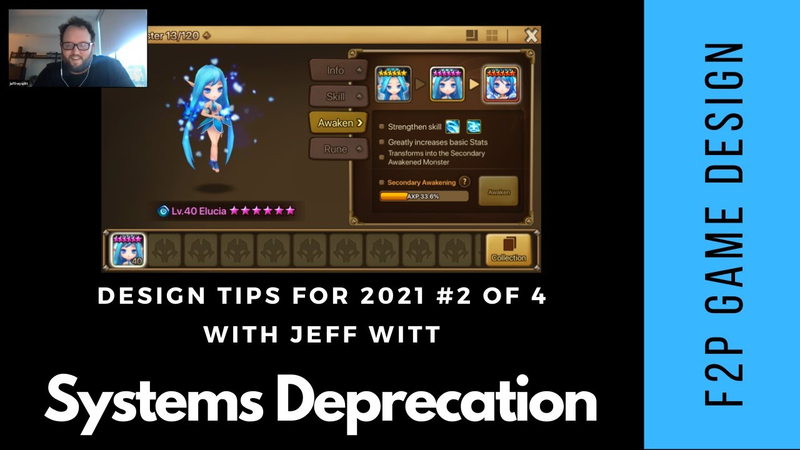
supporting it or add on to it but when you add on to it do it in an entirely new way um a good example of this is in summoner's war one of the main hero progression systems was awakening the hero which you would need special uh magic and elemental items to awaken a hero give it you know a reskin huge stat boost new skills and other stuff but they only allowed you to do it once but recently summoners were introduced a second awakening which does the same thing you know further reskin more stats and stuff but instead of using the same inputs of the first awakening um which uh their elder players probably had tons of by now um they had you earn this special awakened xp that you need to get through specific uh uh
boss fights and you need to use this unique energy system to do those boss fights so uh because of how you know important it was to get the second awakening uh suddenly summoners war has this great new type of energy that they can monetize off of and keep players engaged so they made the choice to sort of stop using the inputs of this old system that was there since launch and instead just ex expand that system by using all new sort of inputs and then that seems to be a more effective way to continue to monetize off of awakening versus they just inflated the cost so sometimes if you feel like most of your players have kind of gone through a system don't just try to add on to it with the same old inputs and designs but think about what changes you could make to the expansion of that system that would make it new fresh and help your kpis and
that that's my second tip for 2021 and jeff in terms of like summoner's war itself like so just the entire kind of notion of an awakening system versus adding on you know when you when the japanese gotcha fusion designers they talk they say they talk about just adding on another star for infinite basically scalability but what do you think the thinking was behind instead of just adding in terms of stars of going to awakening instead of stars and then here going to a second awakening i i think a lot of had to do with just the amount of time between the first awakening and the second so you know if um you just added stars but you know the requirements to get new stars you know uh gradually inflated over time but you didn't give players a long time to sort of hoard those um inputs that you needed yeah i think that's fine but the problem
with the awakening system and summoners war is that that was in you know since launch and players have had you know over half a decade to collect inputs for that and you know if i've been playing the game since 2015 i may have so many inputs that if if they if summoners were just added a second layer of awakening using those same inputs i would just breeze through the second awakening but because it they recognize that a lot of their players probably have a large stockpile of the inputs they decide let's just forget it let's go with this new sort of input system that they have more control over the economy of that system now um so the amount of time does matter and so if if you feel like your players have not yet exhausted a system in your game then you you can continue to sort of expand it over time and and and uh gradually inflate the inputs but um if if the system has been kind of stale for
a couple years and players haven't really interacted with it and you and then you decide to expand it um start from new because that way you're going to have more control over the economy versus trying to sync out all the excess inputs players have gathered over the years right and then what another consideration in terms of not adding a star and going from like star to awakening system b just in terms of the granularity of upgrade does that factor in or as well as the ability to easily change the inputs for like a new system it kind of makes more sense yeah you know instead of like well going from star 7 to star 8 we're going to change the inputs but if you use a different kind of system that that's easier to for players to understand is that a factor what are your thoughts on that i think it could be a combination of things one thing that jumping between systems can do is it could reset expectations for that so like if you know going from you know one star to seven stars yes the cost increased per star but you
can only ramp it up so much before things get crazy or and you know it's hard to change the costs or the the types of inputs from start to star because players expect okay if it takes this input to go from star 1 to star 2 i'd expected the same input to be used for start from star 2 to star 3. but if you go from you know one star to 7 stars and then force the player to do an awakening after that awakening you could change the inputs for stars you know to 14 because you have that awakening to reset expectations i think so going back taking the player back and forth gives you developer um more flexibility in sort of costing out stars 8 to 14 because players won't have as strong an expectation of what those should be because they had that awakening in the middle and maybe another question in terms of system deprecation so are there good
examples of a good way of doing system deprecation and then do you think that for some systems players would kind of revolt or get upset that hey i invested all this stuff into this type of system and now it's gone or something like that or what are your thoughts on that uh you should you know common example is you know in forex games you know certain buildings in your base may have um certain functionality tied to them but at some point the functionality gets exhausted and so you have to ask yourself does it make more sense to have players continue to upgrade that building in many cases probably not um so if you wanted to add new functionality to your base um you could add it to pre existing buildings whose functionality has plateaued the problem is that you know if you have if players haven't been upgrading that building it's hard to get that cost curve right so that you can monetize on
upgrading the building it's easier to introduce another building because with a new building comes a brand new cost curve because players again don't have expectation of how much it should cost to upgrade that new building but with an existing building they do have expectation now to your point that you know with you know new buildings and new costs and stuff that like that players may feel if a former building or a former system is abandoned um they may feel like that um that you know upgrading that you know system or that building was for nothing so if you're a forex game what you might want to do is continue to have building upgrades for a building whose functionality is exhausted but just have it be you know not functionality related put you know attach passive bonuses to it like in a forex game if a building kept giving you like an army uh health buff or attack buff or defense stuff it's still valuable to upgrade that building maybe not as much without the
functionality but you know your your min maxers are going to look for any bonus that you get whether it's through building upgrades or research equipment stuff like that and so you've seen um a fair amount of forex games attach passive bonuses to buildings so that even if the functionality plateaus there's still a reason for players to upgrade those buildings and so if you wanted to do that with a system that you plan to deprecate um i think that's great i think you know if in the case of summoner's war if you know since they're going in totally different direction for the second awakening if they had some sort of store where you know a hundred of this old awakening input could get you you know a um mystic scroll for summoning um that is a good way to you know have players who have tons of those old inputs that are useless now to feel like oh they're not useless i
could still trade them in so i think there's a lot of creative ways you can make sure that systems that are deprecated um the players still feel like they didn't lose out you just may need to think outside the box a little bit all right cool that's all the questions i have jeff thanks so much for tip two and everybody stay tuned next week for tip three thanks jeff [Music] me [Music]
Summary
For developers managing long-running free-to-play games, the strategy of system deprecation is essential for maintaining economic health and player engagement. As games age, initial design decisions often become obsolete because veteran players have accumulated massive stockpiles of resources, rendering existing progression systems ineffective for monetization or challenge. Rather than simply inflating costs or adding incremental tiers to stale systems, developers should consider deprecating old inputs and introducing entirely new systems or currencies to regain control over the game economy.
The mobile title Summoners War serves as a primary case study for this approach. When the game introduced a "second awakening" for heroes, it bypassed the original awakening materials—which long-term players had in abundance—in favor of a new, unique energy system and specific boss-fight requirements. This shift allowed the developers to reset player expectations and create a fresh, monetizable progression path that did not suffer from the economic bloat of the original launch-era systems. By introducing new inputs, developers can effectively manage the cost curve, as players lack the historical data to anticipate or hoard resources for these new requirements.
To mitigate potential player frustration when a system is deprecated, developers must ensure that legacy investments retain some value. Strategies include attaching passive bonuses to older, functionally plateaued systems—common in 4X strategy games—or providing conversion stores where obsolete items can be traded for relevant, high-value rewards. This approach prevents the feeling of wasted effort while allowing the game to evolve. Ultimately, the goal of system deprecation is to provide a clean slate that offers greater flexibility for future balancing and ensures that both new and veteran players remain engaged with the game’s evolving economy.