1 free read left. Create a free account for unlimited reading + AI research.
Create free account
Exploiting timer mechanics as a narrative tool
Key insights
5 takeaways- 01Developers should pivot from using timers as purely economic monetization tools to integrating them as core narrative features that drive world-building and player engagement.
- 02To reduce player friction, designers should align timer constraints with the natural rhythm of short, frequent mobile play sessions rather than using them as arbitrary barriers.
- 03Integrating time-sensitive elements, such as countdowns for moral choices or time-limited events, creates a sense of urgency that makes waiting feel like a deliberate narrative consequence.
- 04Timer mechanics can be transformed into dramatic elements by implementing persistent world states that evolve while the player is offline, creating a sense of a living, breathing environment.
- 05Contextualizing the passage of time within the game's internal logic—such as shifting environmental cycles—turns the device’s clock into an augmented reality tool that grounds the player in the story.
Ask AI about this video
Transcript
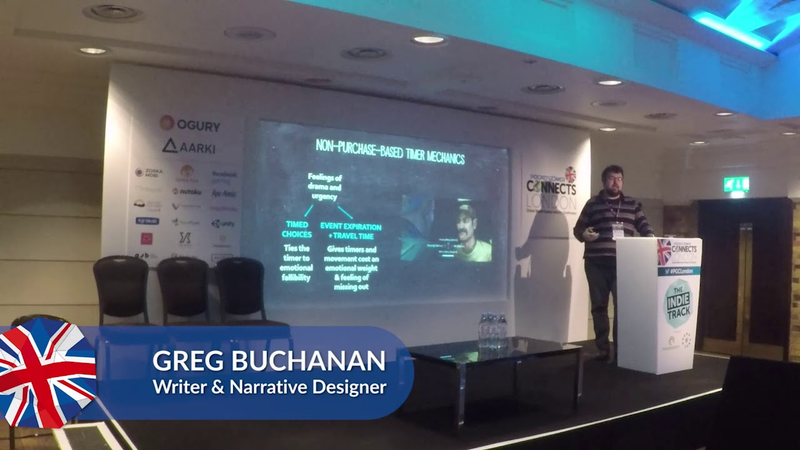
[Music] cool so hello everyone my name is Greg Buchanan as you can see and and today I'm going to be talking about Simon mechanics and narrative in games now this is the case with most conferences like this many of you may probably actually know more about some of these things than me and indeed more about the money side of things and some of these really what I'll be doing and where this talk is kind of aimed is it considering how kind of typical uses of time mechanics goes to work particularly on mobile titles in microtransaction driven titles but also how they work in other titles and how time works in a concept in some games and an S and how we can take lessons from some of those things to at least think about how we can do
some mechanics differently elsewhere so yeah so a little bit about me first I'm games writer narrative designer I've written across indeed triple-a mobile and VR and so on one of the things I'm best known for is the big 30 hour no man's sky story update that changed a lot story in the game added about double the content it was there since release I've worked for chairs worked for THQ Nordic on Equinox steep descent its upcoming game pop your Alexa game called the vortex Rison kind of one of my own titles called a special relationship and a bunch of other drivers different studios that a way for you with a joint list of instance of my background I have an academic background prior to going this games so I did a PhD in identification ethics novel and video games so a lot of it was looking at how characterization worked how we build characters in our different media based upon our playing reading experiences which some films as
well and how causality and sequence and choice and control work as part of this process and yeah I was also written work such as for divinity original sin too and yeah this thing's so I will check my watch occasionally check on the time my CRA's action-oriented time mechanics so just briefly an overview of how I key kinds of timer mechanics working games that would link into my transaction and then we'll be contrasting these with other kinds of timing mechanics so the basic way in which time is often worked games is they force delays and gameplay at intervals so you have to stop playing a white clean or some kind of timer in order to get more gameplay either for the entire game of a particular parts of the game so one way in which this might typically work is tasks take X amount of time to complete so for example it will take an hour to build to the building build another way which it might work is
tasks might cost energy so you a task building the building might take five energy and you'll get one extra energy every hour maybe to a point to a limit for fee for that day or so on entirely which is not entirely dissimilar to the first it's just a different way of conceptualizing it so if the first kind and this is brought pre very familiar to many of you you may encourage the player to spend money to speed up Tiger directly or indirectly so for example you might pay to like half the amount of time it would take to build the building you may if it's like directly a timer mechanic like a actual specific time elapsed things such as in fallout shelter go for example has this in a kind of indirect way and that the egg timers for eggs hatching are based on distance traveled which is equivalent to time whether it requires physical effort as well but you can pay to for example of a super incubator which will half the amount that that distance will take so
one way or the other it relies upon those systems for this second system you may for example spend money to buy energy reserves in advance of their automatic often limited replenishment so you might buy like a bags of energy I'm also on in order to speak like be able to like mash through content very quickly and these co2 systems overlap in various ways and a lot of games have an in-game currency which then sort of serves both functions there is a third kind as well rare but where time durations can not be shortened but where in app purchases will allow the utility of that time to be maximized somehow so for example an echo at seal a you might for example be able to get better or different cats to come to your environment basically got bought with real money but you're still going to wait for those cats to arrive you're not going to suddenly have loads and loads of cats coming up unless they do some update I don't know about but the point would stand about how that would all work Micron's action-oriented tiny mechanics
often seen at best as a necessary evil by players so then we notice we be seen is bad but no one's gonna be like oh my god I get to spend money on shortening a timer again that's not going to be a massively exciting prospect it might be an expected but it's not going to be like a positive great thing which is not amazing it may often be necessary it may even off this talk probably be necessary but it's not necessarily an ideal state of affairs if it could be done other ways you want people to feel happy about choosing to spend time with the get indeed about spending money on that game they want to feel like their experience is worthwhile rather than an annoyance to be mashed past so some good news is that the tiny mechanics are often used in games that do not involve my transactions and so part of the point is talking at those to kind of draw some general lessons about how time works in such games that we could then maybe apply back whether this talk will fully do so or not is an open question but at least interesting ideas hopefully and if we draw lessons from such games and why they make us well in these instances you can better design equivalent mobile
systems bite during inspiration some of my examples are actually from mobile games as well as games other platforms but the point like that for me stands so non purcha Kennex I didn't write some of these on the actual slides but I did in my notebook afterwards to kind of make it clear for myself in a way that poori would have been helpful to be on the slides this first kind of kind of time and mechanic I would call the countdown so the idea where you have a countdown to something occurring or a time little bit of something that could be done within X amount of time that increases pressure upon the player to do something so for example in The Walking Dead screenshot here you have to make a choice and then lost and in telltale games you have to make a choice with some kind of expiration timer on you being able to which is where fertile enough with time choices these will typically force the player to make a gut decision very quickly on the course of action either strategic or moral that they would like to take in a way which may get their gut true history actually because these are quickly but which they may be more likely to regret
and that they didn't necessarily think through the options or will feel like they regret anyway but in a way that's fair in that you don't feel you feel like this is a similar simulation of real life in the way of real life choices and interactions work not somebody external force apply to the game whether time choices in this exact manner are necessary suitable for mobile play sessions and so on is another matter but the point stands about how those work and we'll go into more detail on that later the other kind which is going to overlap with nificantly is where events will expire after a certain amount of time is passed so you have a certain time window in which you can do something in a game otherwise a certain outcome will occur or not occur for you and then you won't be able to do it after that for example if you don't travel tittie within 20 minutes in the game or within a certain amount of moves in a game or whatever a character will die the city will fall something will happen there unless you go there and by going there you've chosen not to do something else and it takes time it's a spend of game time you're doing this is
too often using a narrative sense they are often using kind of not really narrative senses the idea of missing out and is indeed as a very popular game system for some mobile games so time-limited events are often frequently generate a feeling of missing out mobile than you know already used so pokemon grows community days where certain pokemon or shiny pokemon is available in extra abundance on a particular time and you got to do it otherwise you'll miss out often gets players playing all at the same time which induces a feeling of community and community day Hogwarts mystery certain events occurring at certain times where you get certain special items or outfits and so on theme to a particular occasion or indeed Star Trek timelines which will have special gotcha variants of the characters or even narrative content of which helps the game feel like a living universe that you want to keep engaging it again and again but it also makes a feeling that stuff is happening in a chronology so even with low impact narrative games where there isn't a huge narrative by Pokemon go there is still a sense of something happening all the time which
has been particularly accentuated with the quest system that's been introduced or the idea of these big legendary Pokemon Pokemon and a mini developing storyline there anyway so this overlaps or the next sense so this feeling that events on game without player intervention now this is obviously not always true in all cases players are doing stuff it may just be hidden behind the scenes what that is triggering timewise with this basic idea is that time can move on without you in a game and may leave you behind so a very loyal example of this is mystic messenger so a mystic messenger you are sort of a teenage girl chatting to various online men in a kind of chat app over a real signing and if you don't engage in the game at certain times a day you will miss out on conversations that will happen without you and you can then spend in-app purchases to purchase access to those things you missed and go back to miss the Miss content doesn't really matter though I mean whether you do some what
you missed out the content but that was your call you missed out on something that was happening in real time it's part of the fictional world it's part of the conceit of the game in a way that's very appealing or once again feels fair it doesn't feel intrusive and those were the games have this anyone very good by player action but not necessary clearly so so for example in games like this war of mine you basically will have things happening to your base and to your people but in a non kind of clear faction bring it so you might get attacked you might get Rob's various things might that might happen but it's not clear why so feel feeling that the world is in motion introduces a sense of time beyond the economic and all of these points which operate bring it back to at the end as well the item should be in a game that uses time as a microphone to action feature you should if you can play upon time as a feature per se as part of the setting as part of the universe if you can something about it that makes it feel like that is part of the stakes of the game rather than something solely set with your access to
the game it's part of proceedings which is just generally good design other games will have such thing as day or night weather or seasonal cycle where different times a day or different way that will prompt certain kinds of content to appear or not appear Pokemon bumble Eevee could evolve to an Espeon of evolve during the day or an Umbreon if evolved at night different Pokemon may appear more frequently in certain biomes than others in the real world and seasonal events may occur and this is a big MMO steeper seasonal events like Christmas stuff Halloween stuff this embellishes are the x elements in a game to make weights and feel like an opportunity rather than a burden so it makes time fun so anything you can do to make time fun if you're doing having key mechanics especially if your game leveraging time if you make time fun concept this is more likely to linking everything together very nicely finally and this is a bit more off the beaten track in terms of time mechanics manipulation of event chronologies this
is more to society as and less kind of crucial but games where you can actually reverse time or alter the chronology of events somehow so this is a screenshot from life strange very popular PC and console title this thing was ported as well where you can go back into our choices after seeing their effects so you do something you can go back and do something different if you didn't like the outcome souls mistakes in an in-universe story based fashion once again this is fair and the context the game you'll set up to expect the ability to do this unlimited your ability to do it you can only do it in certain circumstances but you you leverage wanting to do something differently rather than waiting to do anything at all is that it's the way that works so some lesson draw from these mechanics which once again slight a bit misleading there because it's just lessons for certain types of mechanics because some of our examples were from mobile anyway so first of all I think some of this is about a sense of fairness so in the first example we play
male or you made a bad result bad choice as a result of a timer it's your fault and that's part of the direct experience but it's part of the game it's not it's not like you've lost the game it's part of the game that you will make mistakes that's part of the experience that's part of what you're there to in giggling and that feeding is meaningful it's not annoyance if designed well it's not about making you anticipate the opportunity to do anything at all it's about wanting to do better in the future and do better in the past if you can some of these things are also about narrative contextualization so if you fail it's part of the story and fits the rules the story it's not imposed by arbitrary obvious external financial forces the world feels real and has weight then free-to-play and once again many of you are probably more exposed to this to me is often not very good at maintaining the magic if the experience loudly it doesn't it it wears what it is on its Eve to a very large degree in a
way that maybe doesn't always happen to all that can be mitigated at least by other elements to help with that also in terms of what this is and what time is and way of conceiving of time as time is kind of one of the ultimate forms of augmented reality in that it's some quiet camera or complex in phone sensors it's a clock it's a real passage of time everyone understands time in terms of why narrative is important to this that's the basis of what narrative is and of what a lot of human thought is chronology making sense of events thinking through thinking through the future thinking through your present self is a big part of being human and it's a thing that games already trying to do even accidentally often in these circumstances but which could be FEMA ties or manipulated and exploited for various purpose so generally words advocating for in a kind of Greg's various random thoughts on this issue is time being presented as a key part of the game experience and those impediment to enjoyment so not like not a time game where you have to wait for an
opportunity but where time is fun or dramatic because that's what because time is already those things in many ways so yeah that's pretty much the end and just some thanks some people who gave me some of the examples in the talk and yet that's my talk on time I think it is I mean there probably are
on the relevance that I just can't think of right now but in terms of the in terms of time and the nature of time especially related to mobile games of free-to-play is mobile play sessions often shorts they're often during the day they're often intimately what these lab mechanics leverage in the first place the fact we'll have short waits for things your extensions of things we'll check in later in the days that's partly why they're not as much of impediment as they might be but I think that the fact that that's the way which are most likely to play those games means that the manipulating for especially narrative purposes could be played around with much more than it is in that that's the bait one of the main ways in which were engaging with those games in the first place we do is we occupy aspects you know prison it is a console might be on the corner so this is my living room we've taken over the TV family but ago spent on their tablets or phones while we're dominating that screen so you know the
last two births or rather sort of experience it will see four to six whereas mobile when attending pause they come back to it and so in some ways I might wrap your you're using that fact that we are dipping in and out to make that make sense [Music] you
Summary
Timer mechanics in mobile gaming are frequently viewed as a necessary evil, primarily serving as tools for monetization and retention by imposing artificial delays on gameplay. These systems typically force players to wait for task completion or energy replenishment, creating friction that developers often monetize by offering shortcuts. However, these constraints are often perceived by players as intrusive, turning the act of waiting into an annoyance rather than an engaging part of the experience.
To improve narrative design, developers should shift from viewing time as a barrier to treating it as a core narrative feature. By drawing inspiration from non-monetized games, designers can integrate time into the game’s internal logic and world-building. Techniques such as countdowns for moral choices, time-limited events that create a sense of urgency, and persistent world states that evolve even when the player is offline can transform time from an economic hurdle into a dramatic element. When time is contextualized within the story—such as in games where missed conversations or shifting environmental cycles feel like natural consequences of the narrative—the player’s engagement becomes more meaningful.
The industry should leverage the inherent nature of mobile play sessions, which are characterized by short, frequent bursts of activity. By aligning timer mechanics with the natural rhythm of these sessions, developers can create a sense of "fairness" where waiting feels like a deliberate part of the experience rather than an arbitrary financial imposition. Ultimately, the goal is to make the passage of time feel like an opportunity for storytelling, utilizing the device’s clock as an augmented reality tool to ground the player in a living, breathing world.


















Comments