1 free read left. Create a free account for unlimited reading + AI research.
Create free accountWhitepaper International Journal of Serious Games
1 free read left. Create a free account for unlimited reading + AI research.
Create free accountWhitepaperInternational Journal of Serious Games
This specialized experimental framework focuses on the progression toward violent extremism. It uses a two-dimensional graphic adventure format to evaluate immersion and psychological flow.
Distilling the key insights…
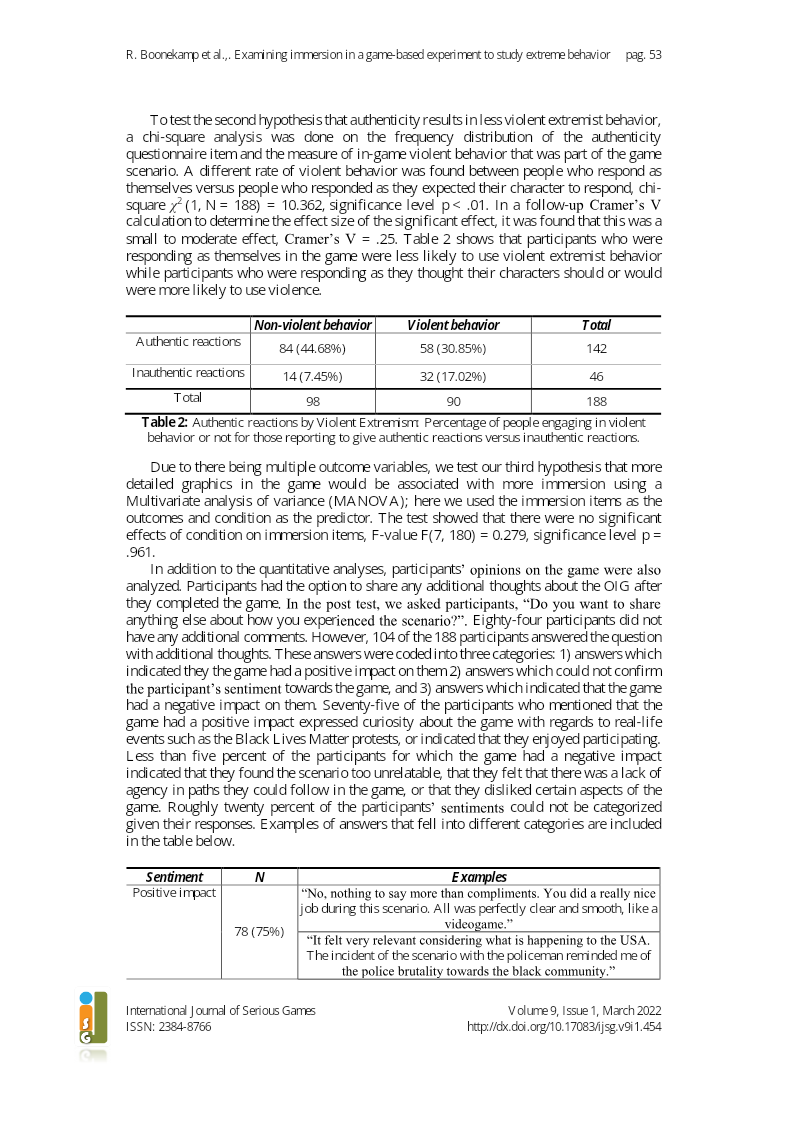
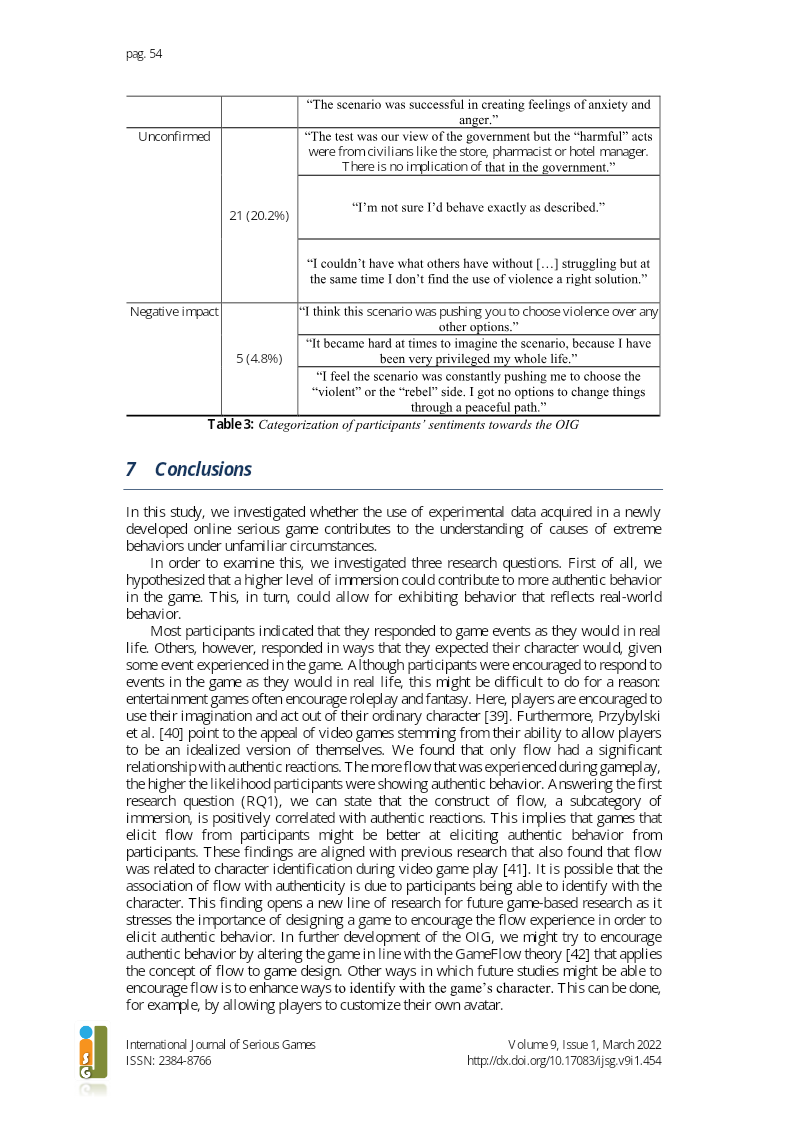
The Opponent Immersion Game serves as a specialized experimental framework designed to analyze human decision-making processes within extreme, unfamiliar scenarios, specifically focusing on the progression toward violent extremism. By utilizing a two-dimensional graphic adventure format, the research evaluates how immersion and psychological flow influence a participant’s propensity for violent behavior. The study, which involved 188 participants, establishes that authentic in-game reactions are a critical indicator of behavior, revealing that individuals who act authentically are significantly less likely to choose violent outcomes compared to those who engage in superficial roleplay.
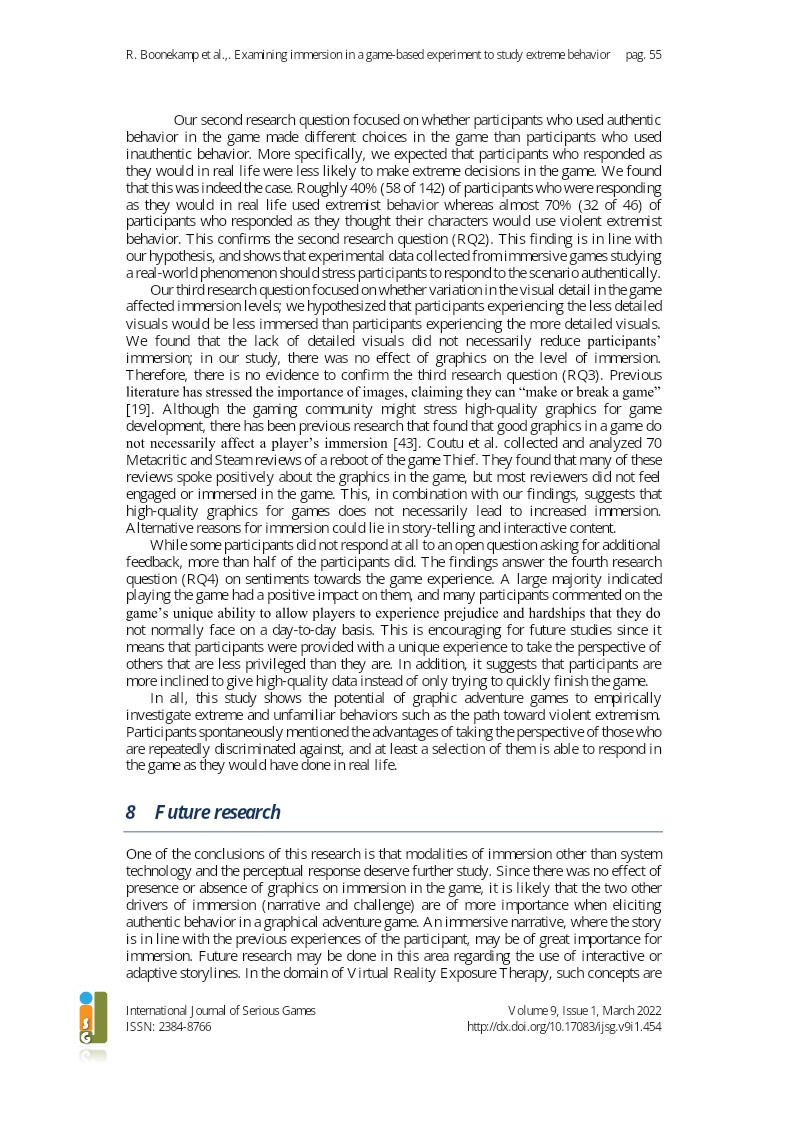
A primary finding of this research is that the state of flow acts as the sole significant predictor of authentic responses. Contrary to common assumptions regarding game design, visual fidelity—ranging from detailed graphics to simple silhouettes—exerts no measurable impact on immersion levels. Instead, the data indicates that narrative depth and interactive mechanics are the primary drivers of user engagement. These elements are sufficient to elicit genuine, real-world behavioral responses, proving that high-quality graphical assets are not a prerequisite for collecting high-quality experimental data in psychological studies.
Ultimately, the research concludes that interactive narrative design is the most effective tool for fostering the engagement necessary to study complex social phenomena. By prioritizing flow over visual complexity, researchers can create virtual environments that reliably mirror human behavior in extreme contexts. This methodology provides a robust academic framework for future investigations into affective outcomes and user engagement, demonstrating that the psychological impact of a game is rooted in its structural design rather than its aesthetic presentation.



International Journal of Serious Games · 2026
International Journal of Serious Games · 2026

International Journal of Serious Games · 2026
International Journal of Serious Games · 2026
International Journal of Serious Games · 2026



International Journal of Serious Games · 2026
International Journal of Serious Games · 2026
International Journal of Serious Games · 2025
International Journal of Serious Games · 2025
International Journal of Serious Games · 2025
Serious Games Society · 2025

International Journal of Serious Games · 2025
Serious Games Society · 2026