1 free read left. Create a free account for unlimited reading + AI research.
Create free accountReport Google Cloud
1 free read left. Create a free account for unlimited reading + AI research.
Create free accountReportGoogle Cloud
Most industry professionals believe generative AI is changing the sector.
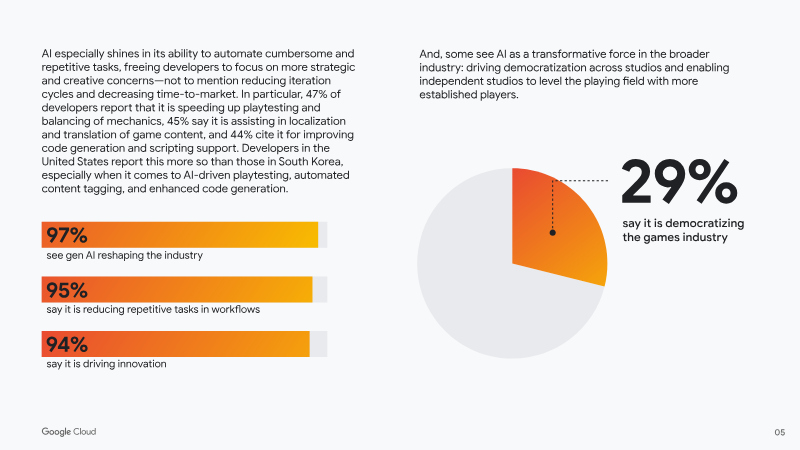
See it on page 18Generative artificial intelligence is fundamentally reshaping the video game industry, serving as a catalyst for innovation, workflow efficiency, and the democratization of game development. A survey of 615 game developers across the United States, South Korea, Finland, Norway, and Sweden, conducted in mid-2025, reveals that 97% of industry professionals believe generative AI is transforming the sector. By automating repetitive tasks such as code generation, localization, and playtesting, the technology allows studios to reduce development cycles and focus on creative iteration.
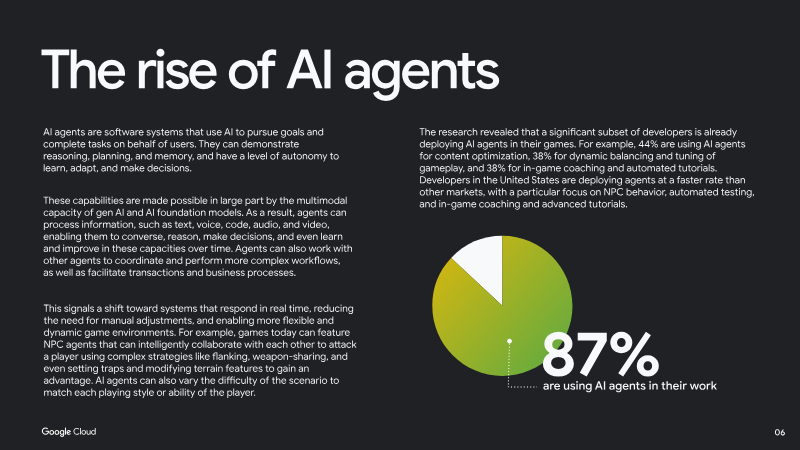
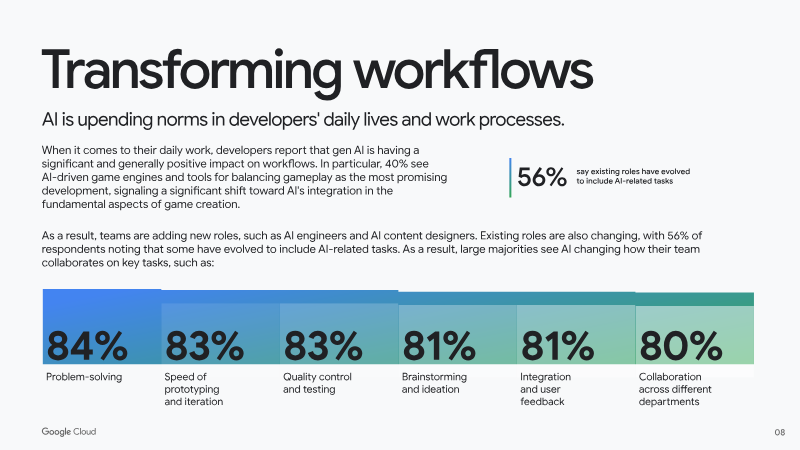
The integration of AI agents represents a significant technological shift, with developers increasingly deploying these systems to manage complex, real-time tasks. These agents are currently utilized for dynamic gameplay balancing, intelligent nonplayer character behavior, and personalized tutorials, which directly address rising player expectations for more immersive and responsive experiences. Approximately 90% of developers have already incorporated AI into their professional workflows, leading to the emergence of new specialized roles and the evolution of existing positions to include AI-driven responsibilities.
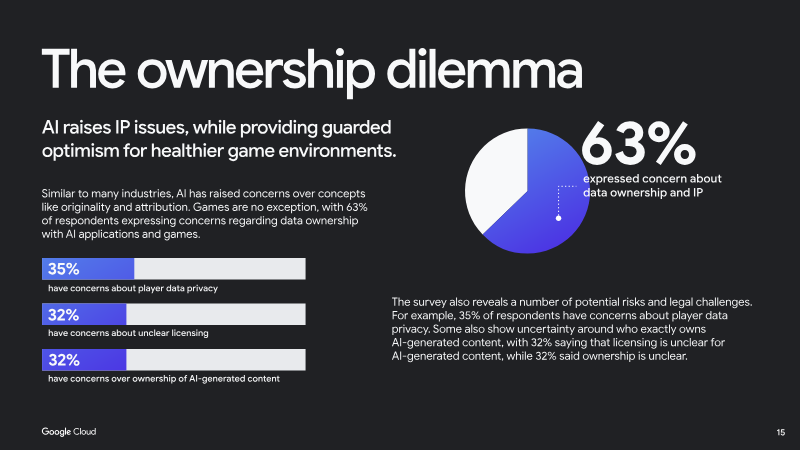
Despite this widespread adoption and optimism, the industry faces notable challenges regarding implementation and governance. Developers cite difficulties in measuring the return on investment for AI tools, alongside concerns regarding data privacy, intellectual property rights, and the ownership of AI-generated content. While 94% of respondents expect AI to lower development costs over the long term, the industry remains cautious, emphasizing the need for staff upskilling, clear success metrics, and small-scale pilot programs. Ultimately, the findings suggest that while AI introduces complex legal and operational hurdles, it is viewed as an essential tool for maintaining competitiveness and fostering a more inclusive, innovative future for interactive entertainment.

Thomas Brush · 2026

PocketGamer.biz · 2026

PocketGamer.biz · 2026

Mobile Dev Memo · 2026

GameMakers · 2026

The Game Business · 2026

Naavik · 2025

Develop:Brighton · 2025
PocketGamer.biz · 2025

Thomas Brush · 2025

Naavik · 2025

Thomas Brush · 2025