Updated Apr 30, 2026 by tinyBuild
Legal
Published by tinyBuild
The Certificate of Amendment for tinyBuild, Inc., filed with the Delaware Secretary of State on June 12, 2025, serves to formally update the company’s corporate governance structure and internal bylaws. The primary objective of this filing is to modernize the company’s administrative framework, specifically regarding board composition, director terms, and legal liability protections, ensuring alignment with current Delaware General Corporation Law. Key structural changes include the implementation of annual terms for all directors, effectively transitioning the board to a unified election cycle following the 2025 annual meeting. The amendment grants the board of directors exclusive authority to fix the number of directors and fill any vacancies or newly created directorships, removing this power from the stockholders. Furthermore, the document clarifies the removal process for directors, requiring a majority vote of stockholders and establishing a formal notification period of twenty-eight days for removals involving cause. The amendment also expands corporate protections by limiting the personal liability of directors and officers for monetary damages resulting from breaches of fiduciary duty, to the maximum extent permitted by law. Additionally, the company has established exclusive forum provisions, designating specific federal and Delaware state courts as the sole venues for resolving complaints arising under the Securities Act of 1933 and the Securities and Exchange Act of 1934. These changes collectively reflect a strategic shift toward centralized board control and enhanced legal insulation for corporate leadership within the Delaware jurisdiction.
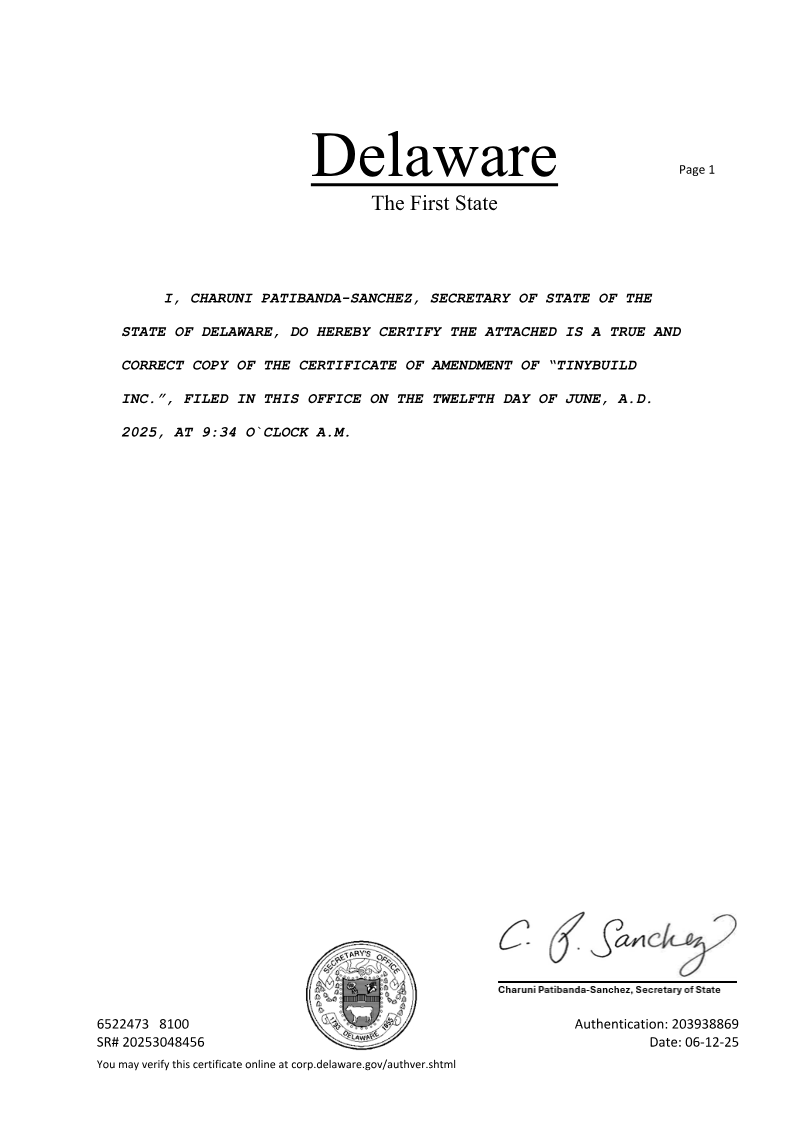
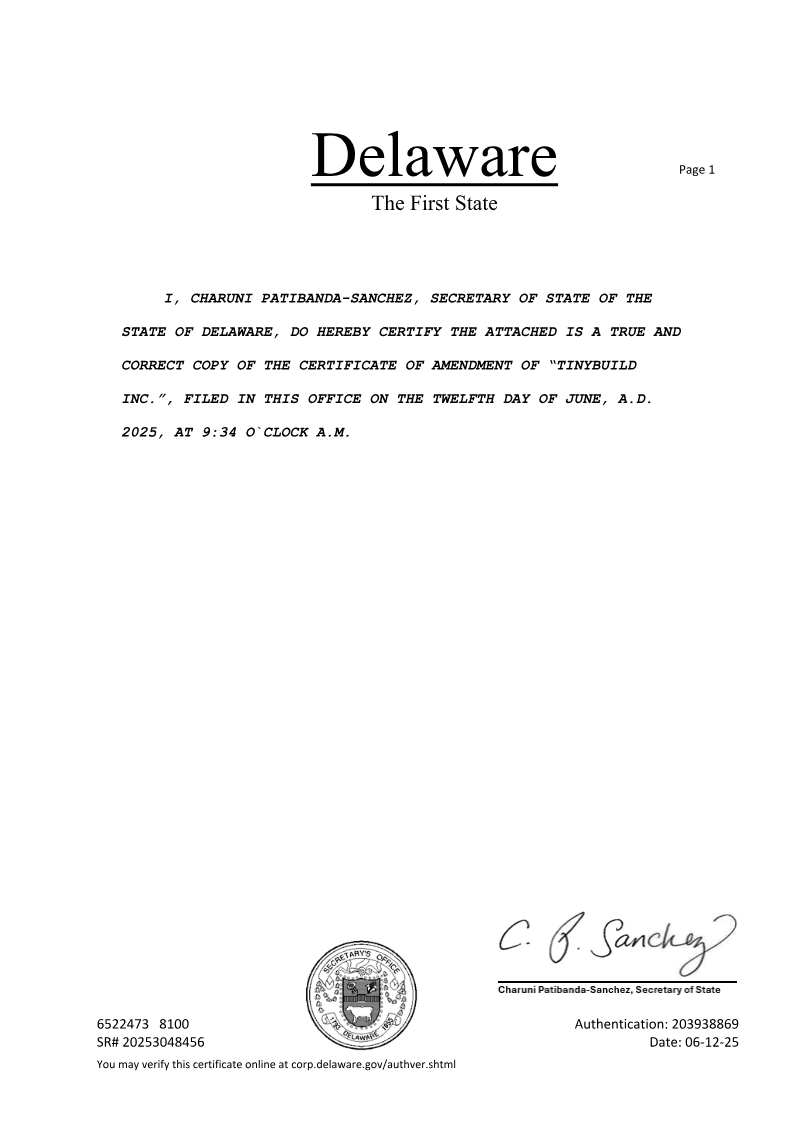
Delaware Page 1 The First State I, CHARUNI PATIBANDA-SANCHEZ, SECRETARY OF STATE OF THE STATE OF DELAWARE, DO HEREBY CERTIFY THE ATTACHED IS A TRUE AND CORRECT COPY OF THE CERTIFICATE OF AMENDMENT OF “TINYBUILD INC.”, FILED IN THIS OFFICE ON THE TWELFTH DAY OF JUNE, A.D. 2025, AT 9:34 O`CLOCK A.M. SECRETA C.β.Sanchz ARY'SOFFICE 6522473 8100 Authentication: 203938869 SR# 20253048456 Date: 06-12-25 You may verify this certificate online at corp.delaware.gov/authver.shtml
Delivered 09:34 AM 06/12/2025 CERTIFICATE OF AMENDMENT OF FILED 09:34 AM 06/12/2025 CERTIFICATE OF INCORPORATION OF SR 20253048456 - File Number 6522473 TINYBUILD, INC. tinyBuild, Inc. (the "Corporation"), a Delaware corporation, does hereby certify that: 1. The certificate of incorporation of the Corporation is hereby amended by deleting Article I thereof in its entirety and inserting the following in lieu thereof: ARTICLE I NAME The name of this corporation is tinyBuild Inc. (the "Corporation")." 2. The certificate of incorporation of the Corporation is hereby amended by deleting Article VI, Section 3 thereof in its entirety and inserting the following in lieu thereof: "3. Number of Directors; Term of Office. The authorized number of Directors on the Board of Directors shall consist of one or more members. The number of Directors shall be fixed solely and exclusively by resolution duly adopted from time to time by the Board of Directors. No reduction of the authorized number of Directors shall have the effect of removing any Director before that Director's term of office expires. Commencing immediately following the effectiveness of the Certificate of Amendment to the Certificate of Incorporation adding this sentence, all of the directors of the Corporation shall hold office for a term that expires at the next annual meeting of stockholders or until their respective successors shall have been elected and qualified or until their earlier death, resignation, or removal.
icate of Incorporation adding this sentence, all of the directors of the Corporation shall hold office for a term that expires at the next annual meeting of stockholders or until their respective successors shall have been elected and qualified or until their earlier death, resignation, or removal. The term of each director serving as of and immediately following the date of the 2025 annual meeting of stockholders shall expire at the 2026 annual meeting of stockholders, notwithstanding that such director may have been elected for a term that extended beyond the 2026 annual meeting of stockholders." 3. The certificate of incorporation of the Corporation is hereby amended by deleting Article VI, Section 4 thereof in its entirety and inserting the following in lieu thereof: "4. Vacancies; Newly Created Directorships. Any and all vacancies and newly created directorships in the Board of Directors, however occurring, including, without limitation, by reason of an increase in the size of the Board of Directors, or the death, resignation, disqualification or removal of a Director, shall be filled solely and exclusively by the affirmative vote of a majority of the remaining Directors then in office, even if less than a quorum of the Board of Directors, or by the sole remaining Director, and not by the stockholders."
th, resignation, disqualification or removal of a Director, shall be filled solely and exclusively by the affirmative vote of a majority of the remaining Directors then in office, even if less than a quorum of the Board of Directors, or by the sole remaining Director, and not by the stockholders." 4. The certificate of incorporation of the Corporation is hereby amended by deleting Article VI, Section 5 thereof in its entirety and inserting the following in lieu thereof:
"5. Removal. Any Director (including persons elected by Directors to fill vacancies or newly created directorships in the Board of Directors) may be removed from office, with or without cause, by the affirmative vote of the holders of a majority of the voting power of the shares of capital stock entitled to vote in the election of directors. At least twenty-eight (28) days prior to any annual or special meeting of stockholders at which it is proposed that any Director be removed from office with cause, written notice of such proposed removal and the alleged grounds thereof shall be sent to the Director whose removal will be considered at the meeting." 5. The certificate of incorporation of the Corporation is hereby amended by deleting Article VII thereof in its entirety and inserting the following in lieu thereof: ARTICLE VII LIMITATION OF LIABILITY To the fullest extent permitted by applicable law, a Director or officer of the Corporation shall not be personally liable to the Corporation or its stockholders for monetary damages for breach of fiduciary duty as a Director or officer of the Corporation. If the DGCL is hereafter amended to authorize corporate action further eliminating or limiting the personal liability of Directors or officers, then the liability of a Director or officer of the Corporation shall be eliminated or limited to the fullest extent permitted by the DGCL, as so amended.
If the DGCL is hereafter amended to authorize corporate action further eliminating or limiting the personal liability of Directors or officers, then the liability of a Director or officer of the Corporation shall be eliminated or limited to the fullest extent permitted by the DGCL, as so amended. Any amendment, repeal or modification of this Article VIl by either of (i) the stockholders of the Corporation or (ii) an amendment to the DGCL, shall not adversely affect any right or protection existing at the time of such amendment, repeal or modification with respect to any acts or omissions occurring before such amendment, repeal or modification of a person serving as a Director or officer at the time of such amendment, repeal or modification." 6. The certificate of incorporation of the Corporation is hereby amended by adding to the end of Article IX thereof the following: "Unless the Corporation consents in writing to the selection of an alternative forum, to the fullest extent permitted by law, (a) the federal district courts of the United States of America shall be the sole and exclusive forum for the resolution of any complaint asserting a cause of action arising under the Securities Act of 1933, as amended, and (b) the Delaware Court of Chancery and the federal district court for the District of Delaware shall be the sole and exclusive fora for the resolution of any derivative claim arising under the Securities and Exchange Act of 1934, as amended." 7.
TinyBuild Inc., a Delaware-incorporated video game publisher, enacted significant structural changes to its corporate governance through a Certificate of Amendment filed on June 12, 2025. This legal filing formalizes a shift in the company’s internal leadership framework, specifically transitioning the Board of Directors toward a declassified structure. Under these new provisions, all directors will serve one-year terms expiring at the subsequent annual meeting of stockholders, effectively ending any previous multi-year staggered terms by the 2026 annual meeting. The amendments further centralize control over board composition within the board itself. The number of directors is now fixed exclusively by board resolution, and any vacancies or newly created positions must be filled by a majority of the remaining directors rather than by stockholders. While stockholders retain the power to remove directors with or without cause via a majority vote, the board maintains the sole authority to appoint replacements. Additionally, the company expanded its liability protections, stipulating that directors and officers are not personally liable for monetary damages resulting from breaches of fiduciary duty to the fullest extent permitted by the Delaware General Corporation Law. Geographically and legally, the scope of these changes establishes Delaware as the primary jurisdiction for corporate disputes. The amendment mandates that federal district courts serve as the exclusive forum for Securities Act of 1933 claims, while the Delaware Court of Chancery or the federal district court for the District of Delaware are designated as the sole venues for derivative claims under the Securities and Exchange Act of 1934. These updates, signed by CFO Gjasone Salati, align the company’s governing documents with modern Delaware corporate standards regarding executive indemnification and jurisdictional exclusivity.
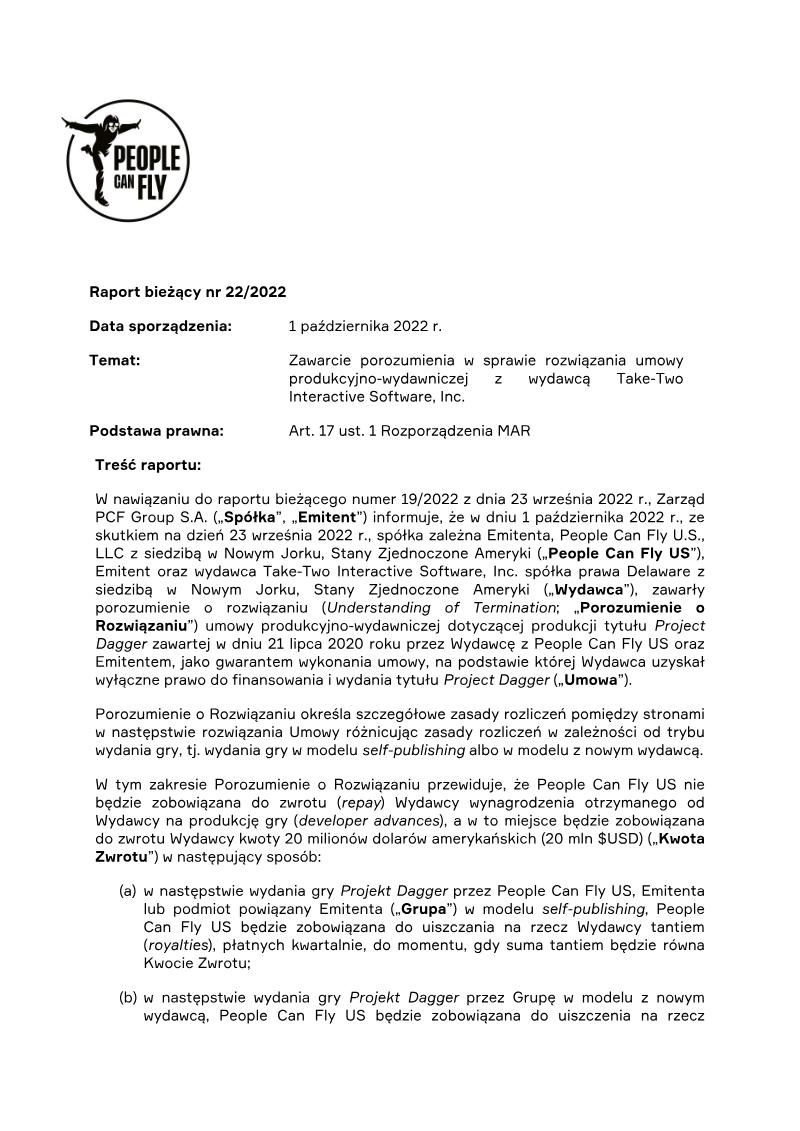
The termination of the production and distribution agreement between PCF Group S.A., its subsidiary People Can Fly U.S., and Take-Two Interactive Software marks a significant shift in the development trajectory of the action RPG codenamed Project Dagger. Effective September 23, 2022, the parties formalized an Understanding of Termination regarding the original July 2020 contract, which had previously granted Take-Two exclusive rights to fund and publish the title. This move transitions the project from a third-party funded model to one where People Can Fly retains full intellectual property rights and control over future commercialization. The financial settlement dictates that People Can Fly is not required to immediately repay the development advances received during the production period. Instead, the developer is obligated to pay Take-Two a fixed sum of $20 million, contingent upon the game’s commercial release. The repayment structure varies based on the chosen distribution path: if the game is self-published, the amount will be paid through quarterly royalties until the $20 million threshold is met; if a new third-party publisher is secured, the sum must be paid in two equal installments within 12 months of the game's launch. Notably, if the project is never commercially released, no repayment is required. By declining to exercise its buyout option for the intellectual property, Take-Two has allowed all rights to revert to People Can Fly. This outcome enables the developer to pursue independent publishing or seek alternative partnerships for the North American-developed title. The agreement reflects a strategic pivot for the Polish-headquartered PCF Group, emphasizing their intent to maintain ownership of their creative assets while managing the financial liabilities associated with high-budget game development.
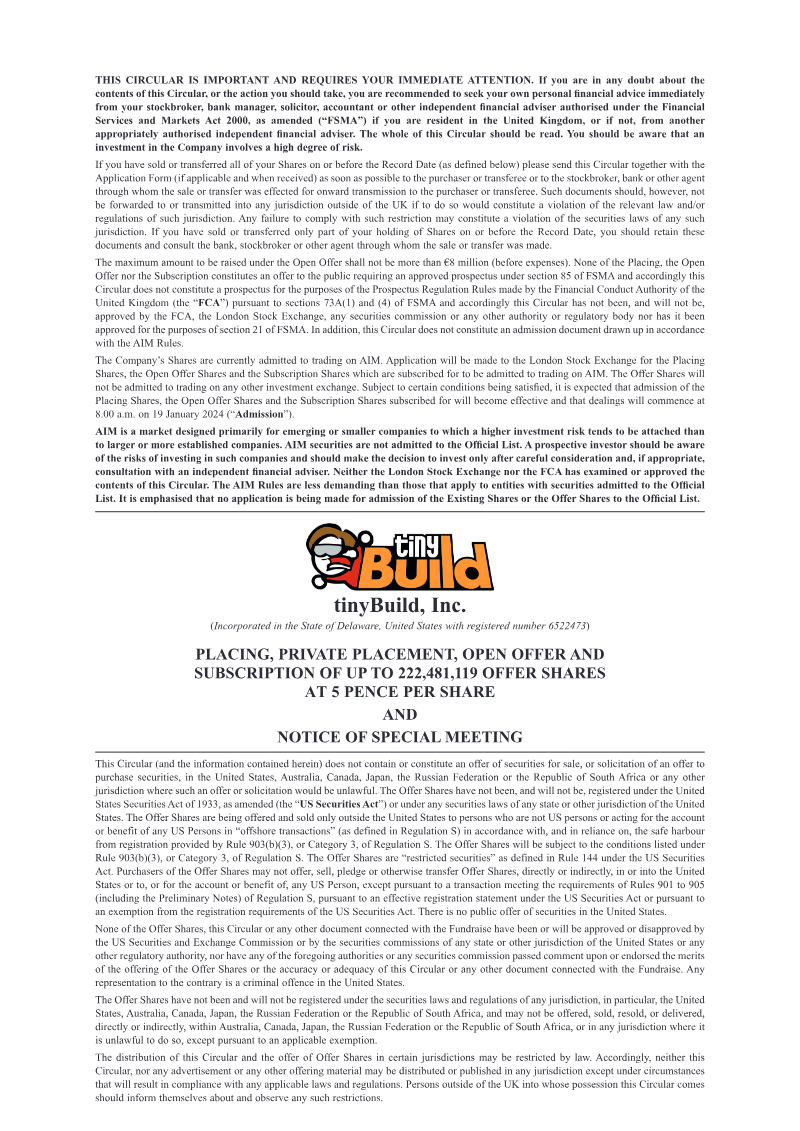
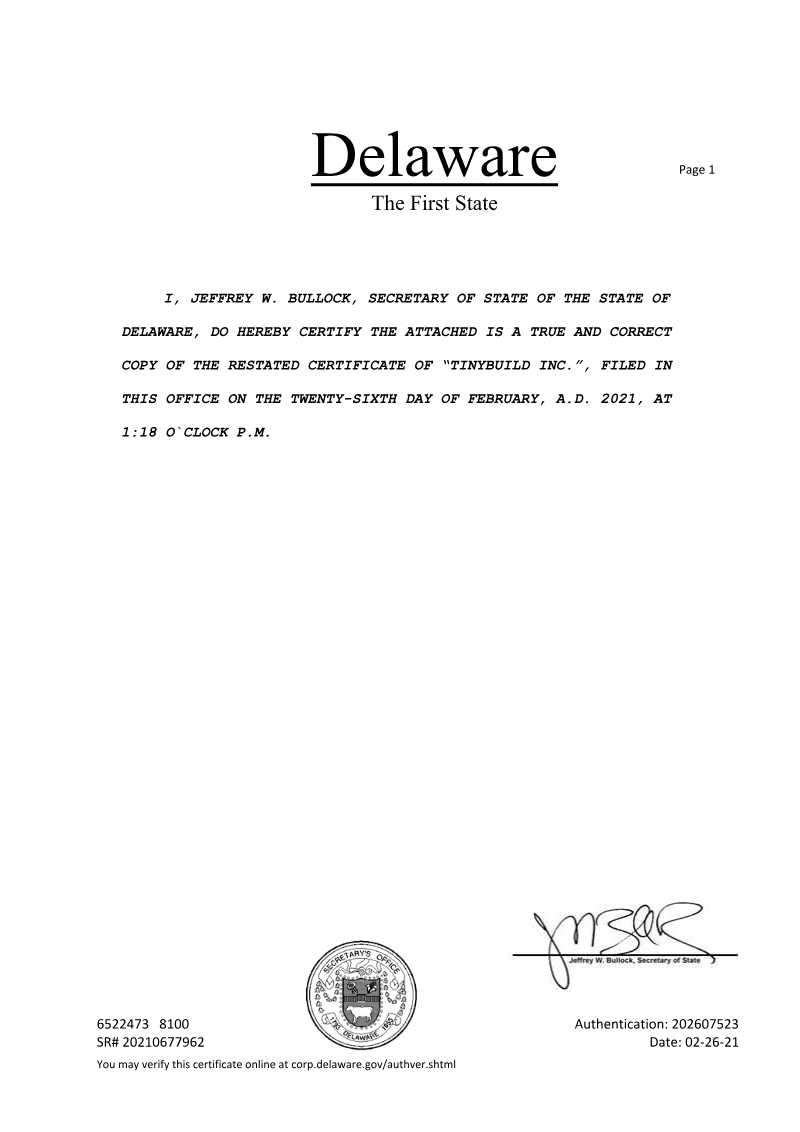
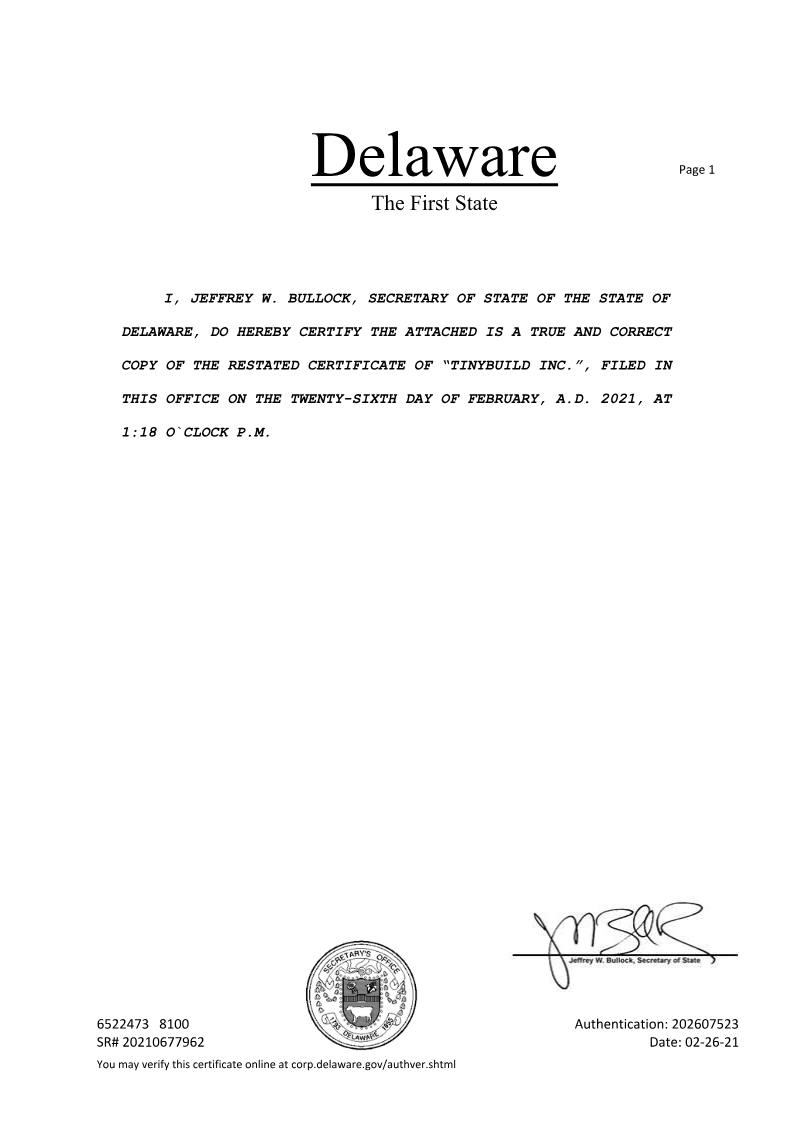
TinyBuild Inc. established a comprehensive corporate governance framework through its 2021 recapitalization and incorporation in Delaware, coinciding with its listing on the London Stock Exchange’s AIM market. The company authorized 800 million shares of common stock following a significant 1:129.826 stock split and the conversion of all preferred shares. This structural foundation prioritizes long-term stability and protection against hostile takeovers by implementing a classified Board of Directors with staggered three-year terms. Directors are shielded by robust indemnification clauses and can only be removed for cause by a supermajority 75% stockholder vote, which is the same high threshold required for any amendments to the corporate bylaws or voluntary delisting from the exchange. The governance model incorporates rigorous transparency and regulatory compliance measures tailored for public listing. Stockholders are legally obligated to disclose beneficial ownership interests starting at a 3% threshold, with subsequent reporting required for every 1% change. Failure to meet these disclosure requirements within 14 days empowers the Board of Directors to impose severe sanctions, including the suspension of voting rights, the withholding of dividends, and the restriction of share transfers. These provisions ensure the company maintains a clear understanding of its ownership structure and can respond effectively to rapid accumulations of voting power. Furthermore, the framework includes strict "Article XII" provisions regarding mandatory offers and control. Any entity acquiring 30% or more of the voting rights triggers specific disclosure rules, while reaching a 50% threshold necessitates a mandatory cash offer to all remaining stockholders at the highest price paid by the acquirer in the previous year. To protect minority interests, the Board maintains broad enforcement powers to penalize non-compliance, including the forced sale of securities. By designating Delaware as the exclusive legal forum while adhering to FCA and AIM standards, the company creates a dual-layered regulatory environment designed to balance director autonomy with stringent shareholder accountability.
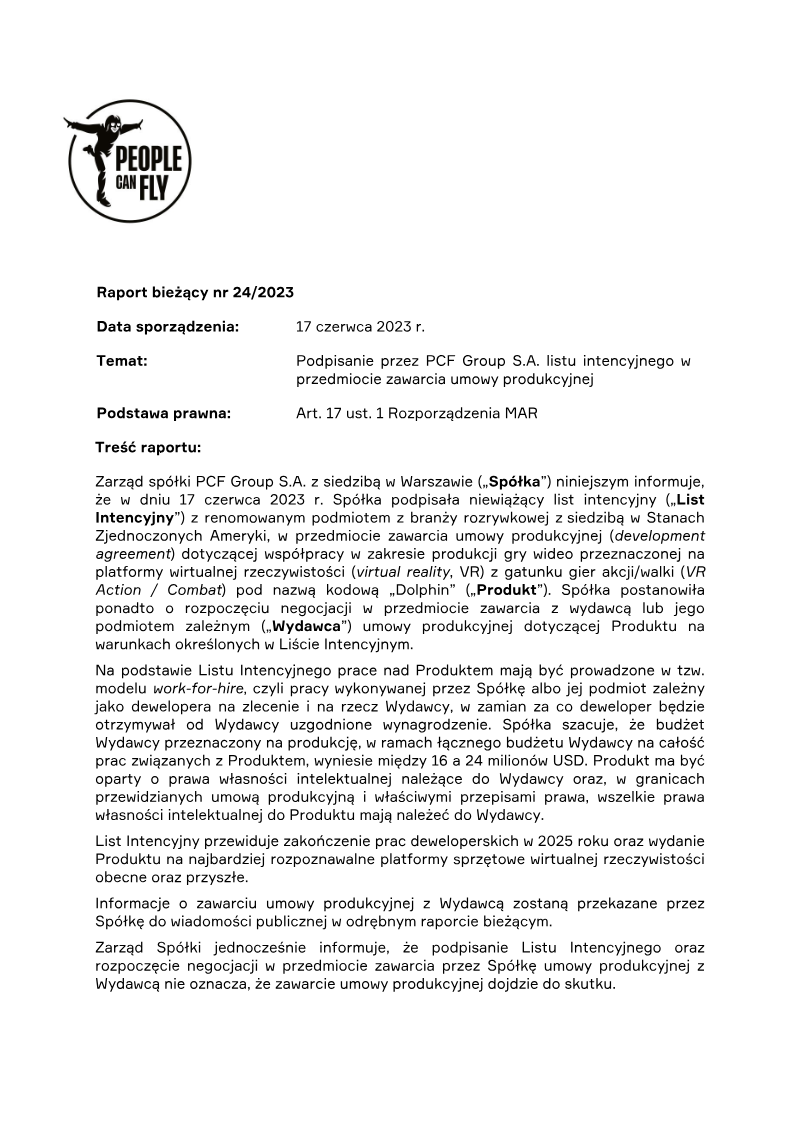
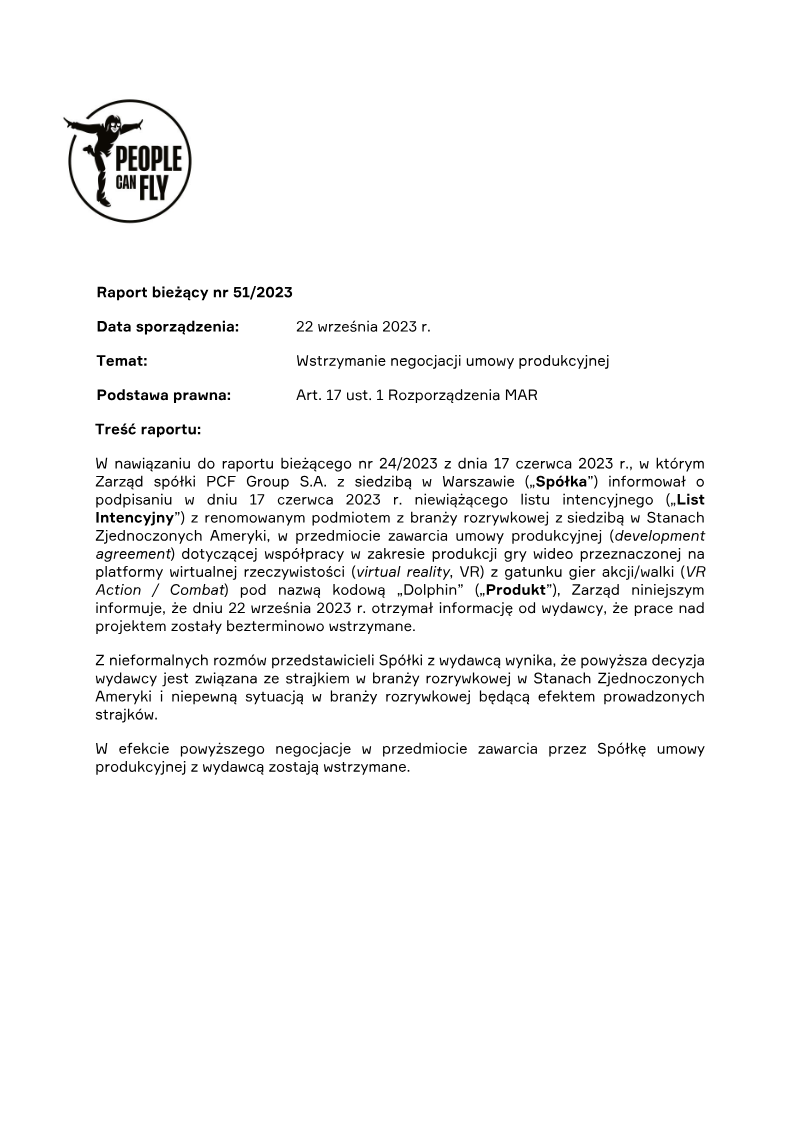
The report informs stakeholders that the production agreement negotiations for the virtual‑reality action/combat game code‑named “Dolphin” have been indefinitely suspended. The PCF Group S.A., headquartered in Warsaw, had previously entered a non‑binding letter of intent with a prominent U.S. entertainment company on 17 June 2023 to develop the game for VR platforms. On 22 September 2023, the publisher notified the company that work on the project would be halted permanently. Informal discussions suggest the decision is linked to ongoing industry strikes in the United States, creating uncertainty within the entertainment sector. Consequently, all negotiations regarding the production agreement have been put on hold. The report covers a single geographic region—Poland and the United States—and focuses exclusively on the video‑game development segment, specifically virtual reality action titles. No survey or statistical methodology is employed; the information is based on direct communication between company representatives and the publisher. The primary conclusion is that external labor disputes have disrupted the partnership, leading to a suspension of contractual negotiations and project development.